[This is cut and pasted from Merkel's and did not 'come over' very well. I tried to edit the result as best as I could, but ran out of time. I'll try to clean it up later today if you would like.]
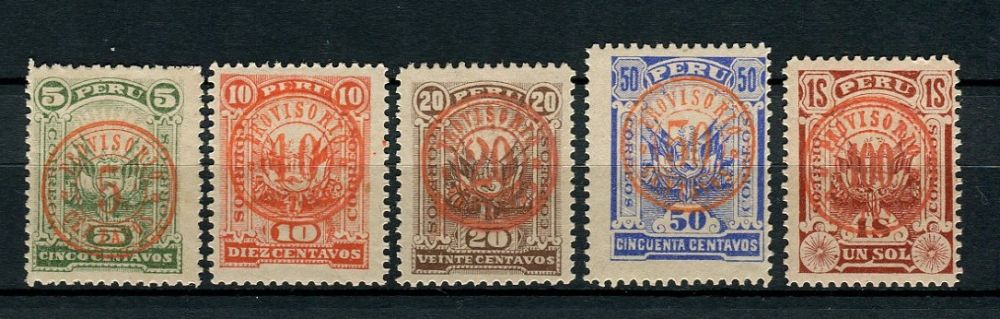
Sometime ago we published a communication from the Peruvian Philatelic Society and the report of a special committee of that organization which had been appointed to investigate the philatelic status of the Peruvian provisionals of 1895.
We supposed that this organization was the only stamp society in that country, or at least, that there was unanimity among the societies on this subject, especially as the report referred to was printed in various important 'papers in the capital and other large cities.
That there is another philatelic society in Peru, and also that there is a difference of opinion there in regard to these provisional stamps the following communication will show. We take pleasure in reprinting it in full, as we have already presented the other side. Our readers may form their own opinion concerning the controverted points. as the two organizations from whom we would naturally expect some reliable information on the subject hold views diametrically opposed to each other. Here is the communication recently received from the executive committee of the Sociedad Philatelica Sud-Americana:
Lima, June 15th, 1896. To the Editor of Merkel's Weekly Stamp News, SI. Lrm's, Ma, U. S. A.
Dear S1r—We desire to offer a few remarks in reply to your recent article (No. 280) about the local provisional stamps issued at Tumbes last year. With your permission we will begin at the end and enter a protest against the concluding words of your article, viz.:
"The decision of the Peruvian Philatelic Society should be accepted as final in the matter, for they, if any one, are in a position to ascertain for us the facts of the case."
Now Mr. Cesar A. Bazo and his friends have the same right as any other group of individuals to form themselves into an association, appoint committees of investigation and publish their reports. But it does not follow that they are infallible nor that philatelists generally should accept as "final" whatever they choose to state. It might be desirable first to make some inquiries about the commerical and social standing of these persons and to ascertain what stock of the stamps in question they and their associates in Piura were able to secure before the "remainders" were ostentatiously delivered to the Lima General Post-Office to be there destroyed. Collectors would then be able to form their own opinion as to whether Messrs. Bazo & Co. are actuated by purely philatelic motives.
Leaving aside these personal considerations we desire specially to state that the Society presided over by Mr. Cesar A. Bazo has no connection with the "Sociedad Filatelica Sud-Americana" whose catalogue of Peruvian stamps is still regarded as the standard work on all issues up to the date of its publication in 1887. With this publication the main object of the Society was accomplished, and the members being too few to carry on an Exchange it was decided to suspend the session; but the Society was never formally dissolved. The undersigned are still its executive ofiicers and whenever we can secure the co operation of a sufficient number of collectors in good standing and respectability the sessions will be resumed.
We have entered into this explanation with the object of making clear to collectors abroad that the Society presided over by Mr. Cesar A. Bazo is by no means the successor of the "Sociedad Filatelica Sud-Americana," and that its utterances do not necessarily represent the opinions of Peruvian stamp col/valor: as distinguished from slam) spew/altars.
Now for the "Tumbes Provisionals." Were the Sociedad Filatelica SudAmericana in active operation it would doubtless have thoroughly sifted this matter and published the result ere this. But the society is in recess-a fact we deplore but cannot remedy-and the individual members who remain have not the leisure and do not care to assume the responsibility of such an investigation themselves. We will therefore take the facts as stated in your article, add a few others that we have knowledge of and draw some conclusion therefrom. I , The report of Mr. Bazo's committee states that the stamps in question were issued in Tumbes by order of the Supreme Political and Military Chief' of the North, dated March 21, 1895, and that they remained in use in the Department of Piura for a period of 40 days. You corroborate this statement by saying that you received during that period mail fully prepaid by' these stamps. Quite so. The promoters of this speculation being intelligent persons, took care to mail packets franked by these stamps to the leading stamp dealers throughout the world, and the Postmasters of Tumbes and Piura being interested would see that they were properly postmarked, etc... etc., while the postal authorities of foreign countries could not take upon themselves to stop such packets without instruction from the Peruvian authorities. But a fact that does not appear in the report of Mr. Bazo's committee alters the complexion of the case, and that is, that no letters franked with llm'e slam/9s were delivered in Lima, and that the issue was immediately repudiated. by the Lima General Post-Office authorities and orders given to stop the sale and seize the remainder of the stamps. Unfortunately the disturbed state of the district prevented these orders being carried out at once. Notice was also given to foreign post offices not to pass the stamps, and although the first letters franked therewith did get through Valparaiso, later ones were charged double postage on delivery.
The question will now be asked-has the "Supreme Political and Military Chief of the North" the right to issue stamps without permission of the Lima postal authorities, or were there special circumstances that would justify his going beyond his ordinary powers? To both these questions we must answer "No." In the first place, Don Augusto Seminario never had the title "Supreme." That title belongs only to the Central Executive of the Goverment or of the Revolution, as the case may be. In the present instance the "Supreme Chief" was Don Nicolas de Pierola, now President of the Republic. The functions of a "Political and Military Chief" (without the Supreme) do_ not usually include the issue of postage stamps, and it is remarkable that an insignificant port like Tumbes, where the mail steamers rarely call, should be selected for this honor instead of the more important towns that were directly under the control of the Central Executive of the Coalition.
A decree is cited for the issue of stamps—but who authorized their printing?
The report is silent on this point. Yet it is evident that stamps must be printed before they can be issued, and it would be natural to suppose that the committee would endeavor to obtain a copy of the decree authorizing the printing as well as that authorizing the issue of the stamps. Why we lay stress on this point will appear further on.
The revolution which had for its object the overthrow of General Caceres culminated in the attack on Lima on 17th March, 1895, four days before Don Augusto Seminario issued the decree under discussion. Let us suppose that these stamps had been printed by authority of the Central Executive of the Coalition, under whose orders Don Augusto Seminario was acting, in the expectation of the civil war being so long prolonged as to render a separate postal issue for the Department under the control of the Coalition necessary or desirable,_as was actually the case in the civil war of 1881-5. Even then we can see no justification [or this issue being made four day: after the war had come praelieally to an end and being in use for forty days afterwards. The Coalitionist' forces attacked Lima at daybreak on Sunday, 17th March, 1895; a truce was arranged on the morning of Tuesday, 19th, and General Caceres capitulated the same evening. As Piura is in telegraphic communication with Lima, news of such importance would be known there immediately and in the rest of the province within a day. Why then such haste to get the stamps into circulation at the very moment when the only reasonable excuse for their issue had disappeared? Were the fishermen and charcoal burners who compose the population of Tumbes so eager to get the stamps that they could not wait the few days necessary to ask and receive instructions from the new Government in Lima? Does it not look as if the promoters of the scheme, knowing that delay would mean the loss of the money invested in the printing of the stamps, rushed around to Don Augusto Seminario and got him to sign a decree authorizing their immediate issue? Don Augusto probably was willing to do his friends a good turn and saw no harm in the substitution of one set of colored labels for another in the post'offices of the province, so the deed was done.
The Piura newspaper which you quote gives the case away when it says:
"It seems that the revolutionists desired to perpetuate the memory, by 'means of elegant stamps printed on good paper, of an event so important to them and their interests."
Thus do the apologists of these stamps themselves confess that they are no more than a commemorative issue, and that not made by a properly constituted government, but by a group of revolutionists (or speculators) in an obscure corner of the country. The stamps issued in September of last year 'by the General Post-Office in Lima, under government authority and with all due precautions and formalities, have been condemned by the S. S. S. S.-'the stamps of the Republic of Cuba, and those of various Chinese towns, are .also blacklisted—where then will these local-provisional-commemoratives come in?
Having thus made what we think is a full and fair statement of the position of these stamps, we leave collectors to judge for themselves whether or not they are worthy of a place in their albums. We have no interest in the matter beyond letting the truth be known, but for those who may wish to 'collect the stamps we will add a few words of advice. A statement has been published showing how many were printed, how many were delivered to the Lima authorities, and the inference is that only the difference, a very small number, went into circulation. These stamps were necessarily printed secretly and there could be no efficient control over the number of impressions taken. Who can guarantee that the figures published are exact and that there were not some extra sheets struck off of each value? Until we have some more reliable information, it would be better not to lay in a stock at fancy prices in the belief that they are going to be very rare.
With apologies for taking up so much of your space, we remain,
Your obedient servants,
A. W. ASCl-IER, President.
WM. C. Dawson, Secretary.
A. B. LEON, Treasurer. |





 Posted 11/30/2015 07:25 am