| Author |
 Replies: 14 / Views: 2,353 Replies: 14 / Views: 2,353 |
|
|
New Member
1 Posts |
|
|
I'm sorting through what's turning out to be a very nice collection I got at auction in a box lot, and I came across this cover. I haven't found much info on a cover like this, though I did find some on Ernest Ackerman, who represented New Jersey's 5th Congressional District from 1919-1931 and is in the American Philotelic Society Hall of Fame. This was mailed just months before his death. What am I looking at here? How uncommon is this? Any suggestions on where to look for more information?  |
|
Send note to Staff
|
| Edited by squirrel - 03/31/2016 06:34 am |
|
|
|
|
Moderator

United States
12330 Posts |
|
|
Pillar Of The Community
Australia
978 Posts |
|
|
Squirrel,
Welcome, but life is much easier if you learn how to post images of what you have.
Load the image to your computer, upload it to photobucket and then copy the file details to your post here.
it is only hard the first time. |
Send note to Staff 
|
| Edited by 64idgaf - 03/31/2016 08:58 am |
|
|
Moderator
United States
12330 Posts |
|
|
64idgaf,
Squirrel had originally posted an image but later edited it, removing the image and modified his post. I am unclear as to why he did that.
Don |
|
Send note to Staff
|
|
|
Valued Member
United States
118 Posts |
|
|
Hopping on an old posting, but I came across a Ernest R Ackerman cover from Colon, Panama April 18, 1931. It is on a House of Representatives envelope and he signed in the right corner like a free frank. There was a strip of 4 Panama 234 added. Would free franking work in another country? Would he do it at the embassy and then they added the stamps? He was the House Representative from NJ from 1919 until October 18, 1931 when he died, so the cover is 6 months to the day before he died. He was an accomplished stamp collector and used that connection to meet King George V of England. Gave his US proof collection to the Library of Congress, who transferred it to the National Philatelic Collection. https://postalmuseum.si.edu/people/...t-a-ackermanFrom the "experts" at wikipedia: He was known for his famous collections of British Guiana and Spain, but he was regarded as an expert in postage stamps and postal history of the United States. His U.S. collection included scarce carrier and local stamps, United States Department stamps, and U.S. essays and proofs. 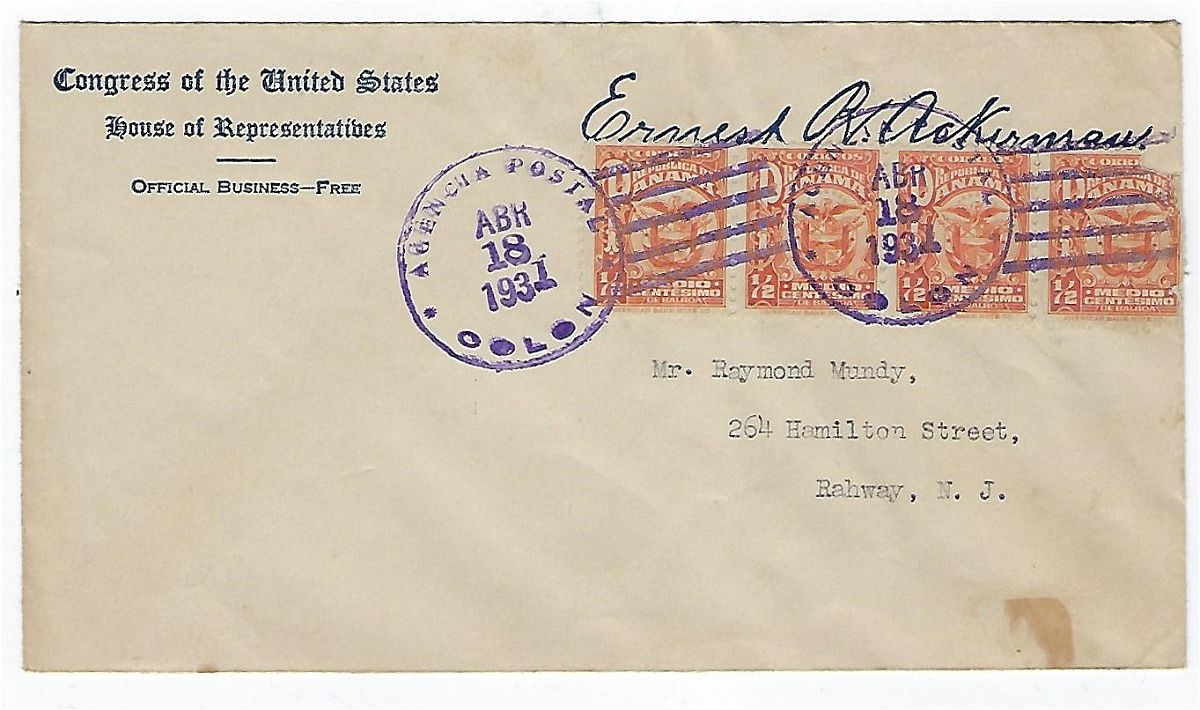 |
|
Send note to Staff
|
|
|
Moderator
United States
12330 Posts |
|
|
The original poster removed the cover image from his post for an unknown reason but this was the cover he posted back in 2016. Since it appears to be relevant (and Easter weekend!), I am resurrecting it now. 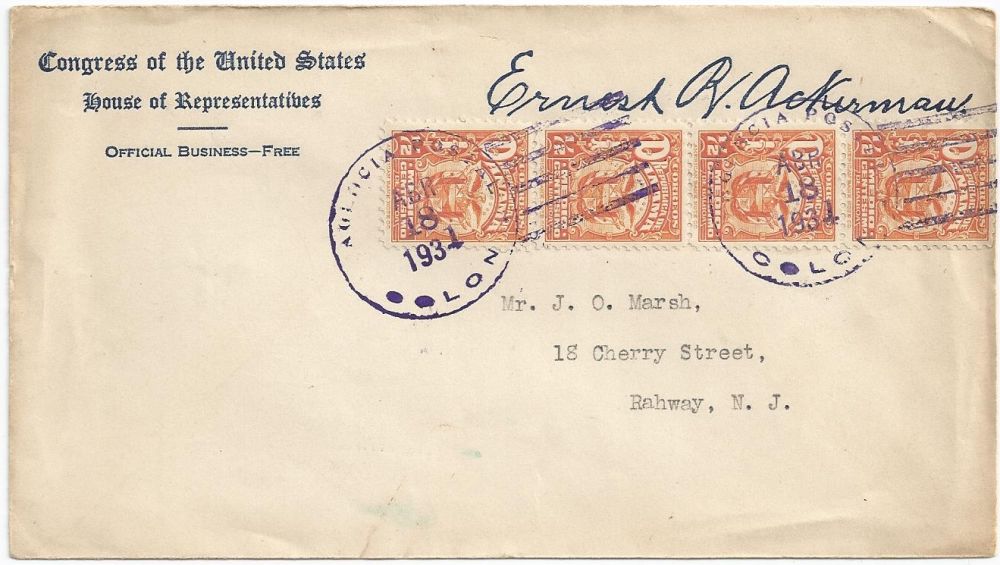 Don |
|
Send note to Staff
|
|
|
Pillar Of The Community
France, Metropolitan
3755 Posts |
|
|
I think the cover is just philatelic and not a free franking cover.
He just sent the letter through normal postal channels.He used a official
Congress envelope and just signed it.
Embassy covers had no stamps.
|
|
Send note to Staff
|
|
|
Pillar Of The Community
6361 Posts |
|
|
Both facsimile "signatures" are preprinted on the envelopes. They are not signed. They are not autographs. The envelope has no free franking power when mailed from a non-US post office, thus the addition of stamps. Leaving his name visible effectively completes the return address information. |
|
Send note to Staff
|
|
|
Valued Member
United States
118 Posts |
|
|
Very good. I was thinking they might have just been letters to stamp collecting friends as souvenirs. Thank you all for sharing. |
|
Send note to Staff
|
|
|
Pillar Of The Community
6361 Posts |
|
|
Lacking the contents, it is hard to determine the intent of the mailings, whether philatelic souvenirs or congressional business.
A non-philatelic franking used by the average citizen would typically use the minimum number of current definitives. These two covers are paid with a multiple of lower denominations, which does smell of collector intent to make something a bit flashier. |
|
Send note to Staff
|
|
|
Rest in Peace
720 Posts |
|
|
Almost 50 years ago I joined the Plattsburgh NY Stamp Club. One of the older members (in his early 80s at the time) told me that he and his father had been good friends with Ackermann and have hosted him at their house in northern NY in the late 1920s. |
|
Send note to Staff
|
|
|
Pillar Of The Community
1213 Posts |
|
|
I think they are definitely purely philatelic. Ackerman, as a sitting Representative, had free frank privilege not only in the US but also in US possessions - this is per the U.S. Official Postal Guide of July 1931, page 19. What this free franking privilege did and still does not include is to use one's free frank for personal or non-official mailings. My guess is that Ackerman was likely in the Canal Zone on what we call a CODEL or a Congressional Delegation to do some fact finding for his work in Congress. As a major league stamp collector it would have been likely that he grabbed up some stamps from the CZ post office and also mailed himself and his friends some letters such as these. I have been on CODELs myself, including one to the CZ, and there are all sorts of personal moments such as this for Representatives and Senators (and often their spouses) who go on them. As for value, since these are common stamps and there is nothing special about the covers (as was said, even the free franks are just pre-printed and are not autographed franks) and they are purely philatelic creations my thought is that these would have only a very minimal cash value.
|
|
Send note to Staff
|
| Edited by Kimo - 04/15/2020 1:43 pm |
|
|
Pillar Of The Community
6361 Posts |
|
|
Kimo,
Panama vs Canal Zone. The use of the Panama stamps hastily led me to think in my previous post that Colon was in Panama, rather than in the Canal Zone at that time, or to check a map. Would it be your interpretation that the envelope was carried fully by its frank and (that even without the frank) the Panama stamps had zero franking power by being used outside their boundary? I may be missing something here. |
|
Send note to Staff
|
|
|
Valued Member
United States
118 Posts |
|
|
Colon was in Panama. It is a Panama cancel as well "Agencia Postal". Colon was excluded from the Canal Zone even though it was partially within the US controlled 5 miles section on each side of the canal. I think the idea that it is personal/philatelic in nature is the answer. He just used his envelopes, but add the stamps since he could not free frank form the Colon post office. Agree no significant value, but interesting due to his stamp collecting status. Picked it up in a lot of covers as I work on an exhibit on the Panama Coat of Arms issue. More from the Canal Zone overprint side, but also addressing the long use in Panama and the multiple overprints of the design by Panama. Panama ordered 1/2 c - 1 balboa of the issue. The Canal Zone did overprints on 1c - 1 balboa, but only issued the 1c & 2c. The Taft agreement ended and the US started using overprinted US stamps. Here are proofs on cards from ABNC that I picked up for the exhibit. 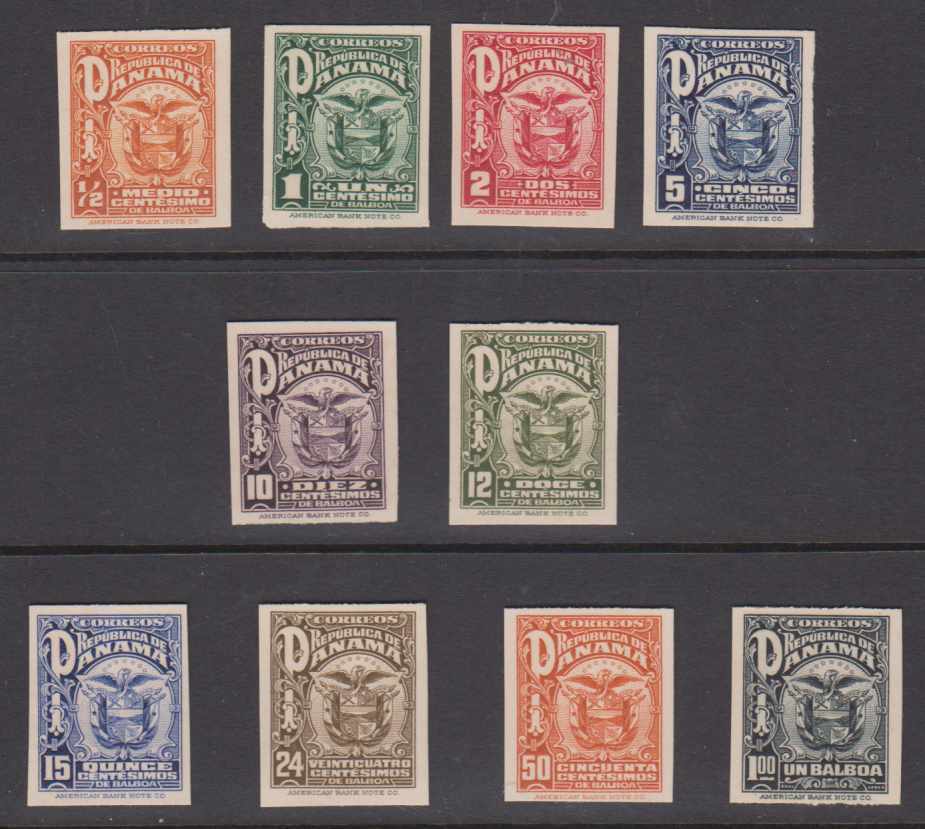 |
|
Send note to Staff
|
|
|
Pillar Of The Community
6361 Posts |
|
|
Thank you NumOnes for that great explanation. My initial gut feeling was correct, that the Panama stamps moved the mail and the facsimile signature meant nothing. (But had it been mailed in the Canal Zone, then the opposite!) |
|
Send note to Staff
|
|
| |
Replies: 14 / Views: 2,353 |
|



 Posted 03/31/2016 05:38 am


