| Author |
 Replies: 17 / Views: 4,362 Replies: 17 / Views: 4,362 |
|
Valued Member
United States
94 Posts |
|
|
|
Could someone explain the tagging differences of the 2720 varieties?
I do not understand what I am reading in the Scott Specialized.
|
|
Send note to Staff
|
|
|
|
|
Pillar Of The Community
United States
4170 Posts |
|
|
The paper has some tagging in it - on all versions
The lithography part of the printing was done first - on all versions
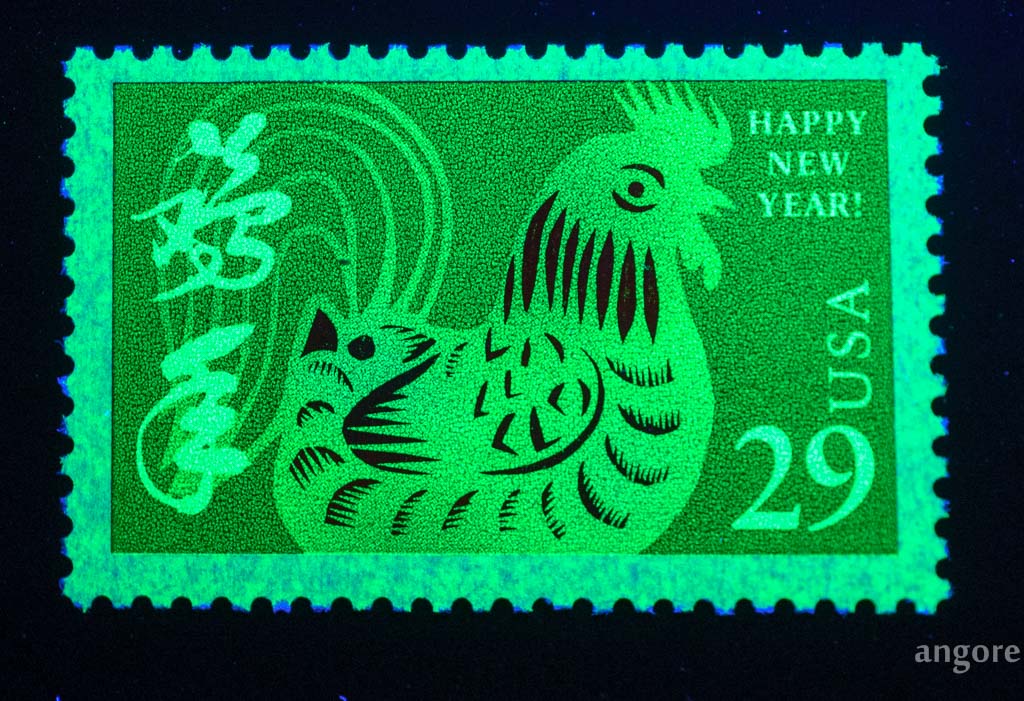
The block tagging is the same size as the red lithography background, but is often shifted slightly and if you look with a magnifier you can usually see a narrow stripe along one of the edges of the design where the tagging extends beyond the edge of the design. - 2720 & 2720a. If you see such a stripe, you do not have 2720b. If you don't see such a stripe it doesn't automatically mean you have 2720b. 2720b is quite scarce.
2720 - before the engraved part of the printing was done, a block of tagging was printed. When viewed under shortwave UV, the engraved part of the printing (the red features on the rooster) looks dark red and very sharp.
2720a - the block of tagging was printed after the engraved part of the printing was done. When viewed under shortwave UV, the engraved part of the printing (the red features on the rooster) looks hazy (less sharp and less dark).
2720b - there is no block tagging. |
Send note to Staff 
|
|
|
Pillar Of The Community
United States
6756 Posts |
|
|
For those who don't have a Scott catalog, US #2720(30Dec1992) is the 29¢ Chinese New Year (Year of the Rooster) stamp.
All 3 varieties are on prephosphored paper. So under filtered short wavelength UV light, the entire stamp will have a mottled greenish glow.
#2720 and #2720a have an additional block tagging. #2720b does NOT have the block tagging. The block tagging is the size of the stamp design, but glows a slightly different tinge of green. Because there is only a modest effort to align the block tagging to the design, you can usually see the block tagging with little difficulty.
The hard part is distinguishing between #2720 (block tagging UNDER ink of engraved design -- feathers) and #2720a (block tagging ON TOP of ink). Unfortunately, it is difficult to describe/identify if you only have one of the block tagging varieties. If you have both side by side, you can see the difference in tagging intensity at the feathers. Some will describe a difference in the "sheen" of the feathers under normal light, but you still run into the problem of needing both varieties to tell which one you have. It's definitely easier to tell the difference under UV only light.
Sorry I don't have a picture of the luminescence to show you. Maybe there is one somewhere on the internet? |
|
Send note to Staff
|
|
|
Pillar Of The Community
United States
6756 Posts |
|
|
Pillar Of The Community
United States
6756 Posts |
|
|
Pillar Of The Community

United States
1498 Posts |
|
|
This probably won't help much, but Scott doesn't mention it. If you have a plate #, you might not need a UV lamp. Most of these can be identified entirely by plate #. The plate numbers are of the form xxxx Ax where x is a digit. The plate # occupies two lines with the first 4 digits immediately above the Ax. In short, if the plate # ends in A2 or A3, the stamp is 2720a. If it ends in A1 or A4, it's 2720. If it ends in A5, it can be either 2720 or, if the entire plate # is 7333-A5, the stamp MAY be 2720b. But most sheets with plate # 7333-A5 will still be 2720. |
|
Send note to Staff
|
|
|
Pillar Of The Community
United States
6756 Posts |
|
|
Thanks JLLebbert! I should dig out my US collection and check out this new info!
I guess I should also get a newer Durland. |
|
Send note to Staff
|
|
|
Valued Member
United States
94 Posts |
|
|
Thanks everyone. When I put them side by side I can see the difference in the feathers.  |
|
Send note to Staff
|
|
|
Pillar Of The Community
United States
6756 Posts |
|
|
 Congrats! And thanks again for starting this thread. I didn't know Scott had started to list these tagging varieties. Thanks again to JLLebbert to pointing out the possible plates associated with each variety. |
|
Send note to Staff
|
|
|
Pillar Of The Community
United States
1498 Posts |
|
|
khj: This is a bit off-topic, but if you are interested in recently added tagging varieties, there are three other issues that come to mind that you may want to check out.
(1) Scott #1618C from 1978 (15-cent Fort McHenry coil). In 2016, the 1618C entry was changed to read "small block tagging". 1618Cl was added as having large block tagging. CV for the latter is slightly higher. I have been unable to find it in mint condition.
(2) Scott #1927 from 1981 (18-cent Alcoholism issue). The primary entry now is specified as having large block tagging. A few years ago, 1927a was added with small block tagging.
(3) Scott #3840-43 from 2004 (37-cent American Choreographers). A very few years ago, Scott added 3843d (block of 4) specified as "block tagging omitted". There's an interesting article in the October 31, 2011 issue of Linn's about this issue. The tagging in the prephosphored paper was not strong enough to be reliably recognized by automated equipment, so additional block tagging was added. CV for the early version before the block tagging was added (3843d) is $55. At the time of the article, it was still thought that the two varieties were equally common. |
|
Send note to Staff
|
|
|
Pillar Of The Community
United States
6756 Posts |
|
|
Thanks, JLLebbert! I haven't messed around with the US tagging in several years. I'll have to look into it again.
I didn't know about the Alchoholism tagging variety! I have about a dozen panes that I never used up for postage. I'll dig those out and check them out.
I don't think I have any of the Choreographers stamps, as I had stopped collecting modern most mint US by then.
Thanks! I might get back into the US tagging game with this thread! |
|
Send note to Staff
|
|
|
Pillar Of The Community
United States
4501 Posts |
|
|
I checked my sample of the Rooster. The vertical feathers look dark and sharp under both SW and LW. I am guessing I have a 2720. I do not see any strip. The yellow is not registered perfectly with the red. The tagging is what I would call slightly grainy.
Al |
|
Send note to Staff
|
|
|
Pillar Of The Community
United States
4501 Posts |
|
|
Here is my 18c Alcoholism stamp (Scott #1927). I believe this would be small block tagging.  Al |
|
Send note to Staff
|
|
|
Pillar Of The Community
United States
4501 Posts |
|
|
Pillar Of The Community
United States
1498 Posts |
|
|
angore: Definitely 1927c (small block tagging). The large block covers just about the whole stamp horizontally .... there are at best small horizontal fringes that are untagged. The untagged vertical area on 1927 is about half that of 1927c.
I also agree with the rooster probably being 2720. It's definitely not 2720a and 2720b seems unlikely even though the registration of the supposed block tagging would seem better than on most 2720. I do seem to see perhaps a hint of the block tagging along the left & top edges. One other thing I've noticed with my 2720 & 2720b is that 2720b seems to appear darker overall under short UV than 2720. I do not know why this should be the case ... or whether it is true of all 2720b. Perhaps the extra block tagging on 3720 makes the stamp glow a bit brighter under UV. |
|
Send note to Staff
|
| Edited by JLLebbert - 04/27/2016 10:48 pm |
|
|
Pillar Of The Community
United States
4170 Posts |
|
|
Quote:
Perhaps the extra block tagging on 3720 makes the stamp glow a bit brighter under UV Yes |
|
Send note to Staff
|
|
|
Replies: 17 / Views: 4,362 |
|




 Posted 04/21/2016 9:20 pm


 k
k