| Author |
 Replies: 65 / Views: 7,661 Replies: 65 / Views: 7,661 |
|
Valued Member
United States
79 Posts |
|
|
|
In general, what type of premium does a readable handstamp cancel on a 1st issue revenue bring?
|
|
Send note to Staff
|
|
|
|
|
Bedrock Of The Community
United States
10864 Posts |
|
|
Handstamp cancels as such are pretty common, and many add little or nothing to the value. Most examples should have relatively little added value. The quality of the strike and the color can make a big difference. Some specialized areas such as medicines and drugs, railroads, steamships, and insurance companies can add anywhere from a $1 to a few hundred dollars depending on the specific cancel involved. Many are seriously overrated by dealers and ebay sellers from a lack of knowledge. |
Send note to Staff 
|
|
|
Pillar Of The Community
United States
6469 Posts |
|
|
I'm going to disagree slightly with Bart. In my experience, as a general rule, any legible (important factor) handstamp canceled 1st issue revenue is going to trade for at least $2-3 at minimum. Not a huge premium, except when you consider that for a stamp that catalogs 50 cents, that's 4x-6x Scott. There are no hard and fast guidelines on pricing cancels other than experience, because there are so many factors to consider. Additionally, opinions will vary greatly as to the desirability, rarity, and value of individual items. Here is the wording I use on my website with respect to defining estimated retail values: Quote:
What Is "Estimated Retail Value"?
Scott catalog values only tell part of the story when it comes to stamps, and this is even more true of revenues than front-of-book material.
There are a myriad of attributes that can positively or negatively affect the value of a revenue item compared to Scott value, in some cases by several orders of magnitude. These include, in no particular order:
Underlying condition of the stamp
Type of cancel (manuscript, handstamp, printed, stencil, cut, etc.)
The color of a cancel
The intricacy of the design of a cancel
The company whose cancel was used
Where the stamp was used
The date the stamp was used
Aesthetics of the cancel, stamp, document, or any combination thereof
The type of document the stamp was used on
Ornateness of a document and its design
Signatories to a document
Lack of Scott Catalog attention (some listings have not been updated in decades and the values are meaningless)
Lack of Scott Catalog listing entirely
Plate varieties. There are many more than Scott lists.
Valuation of mint stamps. Personally, I only consider 1st-3rd issue revenues to be "mint" and thus worthy of a premium if they have original gum, which are VERY scarce. More than 95% of the supposedly mint early revenues sold have no gum, and in fact are used (but uncancelled) stamps that were steamed or soaked from documents. If it doesn't have gum it's not unused. Period.
The estimated retail value value I give is my personal opinion and is specific to the exact item shown. It is based upon similar items I have seen at auction, in person at stamp shows, in catalogs, in other collections, and experience buying and selling both online and with national revenue specialist dealers. My estimate should not be taken as gospel or as an indicator of value for any other item; it is provided for informational purposes only and should not be construed as a buy or sell offer. |
|
Send note to Staff
|
|
| Edited by revenuecollector - 06/27/2016 12:37 pm |
|
|
Bedrock Of The Community
United States
10864 Posts |
|
|
The number of R15c with an ordinary handstamp cancel runs well into the thousands, and most have a real value of $1 each at best, even though dealers like to pretend they are more valuable. The same is true for most of the first issue numbers that catalog under $1. Eric and Richard are specialized dealers so they charge more, and most others can't tell one from another so they treat them all as rarities. |
|
Send note to Staff
|
|
|
Pillar Of The Community

United States
856 Posts |
|
|
Quote:
... and most others can't tell one from another so they treat them all as rarities. So true. What amazes me is that some of these sellers are apparently successful enough that they can continue marketing common hand-stamped revenues at ridiculous prices. I would have thought that by now they would have become discouraged by lack of sales. |
|
Send note to Staff
|
|
|
Pillar Of The Community
United States
6469 Posts |
|
|
In all candor, I do list common stamps with attractive handstamp cancels at prices ranging from $3-10, depending on the company and strike. I sell quite a few at those prices, usually either to other cancel specialists looking for that particular cancel (or on a particular stamp), or to collectors wanting to fill their album spots with handstamp cancels only. Quite a few repeat buyers too. On the other hand, I've seen plenty of what I would consider $2-3 value items priced at $20-50 on ebay due solely to the presence of handstamps, disregarding other factors. What's actually more egregious are the number of so-called "professional" dealers at major shows that mark ANYTHING with a smudged illegible handstamp cancel at well over Scott, usually with a notation of "RARE!". There's one particular dealer who I really like as a person, who has a third party work up his revenue stamps, and that person upon seeing ANY handstamp cancel, immediately prices the stamp between 100% and 2,000% of Scott, even in the presence of severe damage. This dealer's prices are high to begin with (rarely anything below 90% of Scott unless damaged). Rather than risk the amicable relationship we have by pressing the issue, I simply don't purchase as much as I otherwise would. |
|
Send note to Staff
|
|
|
|
Valued Member
United States
344 Posts |
|
|
Hand cancels on revenues are no different than hand cancels on Banknotes. They add $$$ value only in the eyes of a cancel collector. My revenue collection is of representative examples only. I am not interested in stamps where I "overpay" for a revenue. I have paid up to perhaps a 500% premium on Banknote fancies after consideration. |
|
Send note to Staff
|
|
|
Pillar Of The Community
United States
856 Posts |
|
|
Dan, my comment was definitely not referring to you. I will gladly pay $3-$10 for a common first issue revenue with an attractive cancellation. The sellers I'm talking about might have charged 10 times as much. They often do so, as you pointed out, even if the cancel is ugly and illegible. |
|
Send note to Staff
|
|
|
Moderator

United States
12330 Posts |
|
|
Interesting, and timely, discussion. I am working on a new online database for First Issue Insurance cancellations and am debating with myself if I should add a 'rarity' field. I think that a case can be made that a field like this is of value but it also has some drawbacks. I am designing in the field but will not make it visible to others for now. The database also is designed to store census numbers for each type/style cancel. Over time the census might be a better way to understand how common/rare a cancel might be. Having First Issue Insurance cancellations in a public searchable database should provide users with a much faster and easier way to identify their stamps. It will support advanced filtering capabilities; so if a stamp only has a partial cancel they should still be able to quickly identify it. And each record will be illustrated with examples of the cancels as shown here 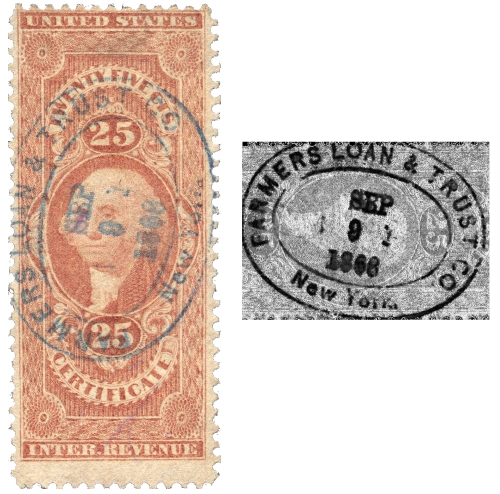 If this proves to be useful expanding it to other type Revenue cancels is possible. Don APS #094826 |
|
Send note to Staff
|
|
|
Pillar Of The Community
United States
6469 Posts |
|
|
A rarity scale for cancels is... well... I don't know how accurate it would be. There are a lot of old-school cancel collectors who do not participate in online activities/collaboration, whose collections would likely never be reflected in the data.
I can (and do) make value estimates based upon what I have paid, seen others pay, and seen items offered for online, at shows, at auctions, etc. But I would not be able to extrapolate those numbers to populations and/or scarcity.
Additionally, it's not only populations that affect value but aesthetics and collector demand. There are certain well-known cancels that will always command high dollars, yet are more common than the prices indicate (Walker & Taylor printed cancels are a good example). In the same way that Columbians and Zeppelins are not actually scarce, it's demand and notoriety that keep the prices propped (IMO artificially) high.
I initially thought of doing a scarcity indicator rather than an estimated retail value on my website, but ultimately decided that the latter would be more useful to other collectors. An uncommon example of a common cancel or stamp can command much higher prices than a scarcer cancel or stamp, due solely to aesthetics. |
|
Send note to Staff
|
|
|
|
Pillar Of The Community
United States
868 Posts |
|
|
I would agree that the clearness of the strike, the centering of the strike, and the aesthetics of the cancellation itself are key factors on value. There is another factor that may add to the demand, the identity of the company and its tie to the companies that later used private die proprietary stamps. This is certainly the case with the playing card manufacturers and importers. But it is also the case with match companies, the sole canning company, and the medicine manufacturers who later used private die stamps. The printed cancels in these four areas provide a terrific introduction to the private die stamps themselves. My personal interest in telling the story of the revenue stamps is greatly enriched with the combination of the cancels and the private die stamps.
Ron Lesher |
|
Send note to Staff
|
|
|
Pillar Of The Community
United States
770 Posts |
|
|
What I like about a scarcity indicator is that it should be a relatively stable number. Thats unless a cache is discovered. I understand any of these numbers would be a ballpark, but it would be up to the individual collector to evaluate condition and strike of the stamp and cancel, then decide how much they want to pay. There are so many variables that go into setting a $ value figure for any stamp. I'm just beginning to recognize the relative values to many of the the M&Ms, but except for a few well-known and popular rev cancels, I have no idea!
|
|
Send note to Staff
|
|
|
Bedrock Of The Community
United States
10864 Posts |
|
|
Part of the problem with scarcity indicators is deciding what constitutes "scarcity". For example, there are tens of thousands of bank cancels out there. Most are in the common CDS or double CDS style. The cancel from a bank of a town of perhaps 100-150 is probably pretty scarce as such, but the number of people who will actually care is also very small because there are thousands of banks just like it all over the country. And presumably most will also have a handstamp cancel. And unless one is compiling a specialized collection of some kind then they would all be considered a "common type". |
|
Send note to Staff
|
|
|
Pillar Of The Community
United States
770 Posts |
|
|
That's true - there may be only a handful of copies of a cancel within a common style. The number of people who care though is irrelevant to it's scarcity. It's very relevant to demand and thus it's value. If there's only a handful of people who care about that cancel, it's value will be low relative to it's scarcity. That's ok.
|
|
Send note to Staff
|
|
|
Pillar Of The Community
United States
770 Posts |
|
|
Maybe scarcity needs to be defined. Is it potential number of cancels stamped? Or is scarcity how hard it is to obtain the cancel today, which takes the market and demand into account? |
|
Send note to Staff
|
|
|
Moderator
United States
12330 Posts |
|
|
And there may be a circular effect…so say a cancel gets listed (or known) as 'rare' or 'very uncommon'. Independent of demand, suddenly we see ebay listings with the stamp at 10X of what the actual value is… If some suckers bite on these listings, does the value then rise? Yikes Don |
|
Send note to Staff
|
|
|
Replies: 65 / Views: 7,661 |
|




 Posted 06/27/2016 08:39 am





