| Author |
 Replies: 76 / Views: 9,905 Replies: 76 / Views: 9,905 |
|
|
|
Pillar Of The Community
United States
2230 Posts |
|
|
For comparison to the two 4800 DPI closeups shown above, here is what I would consider close to a perfect inking on a #11A. The cross-hatch pattern of the inner background oval is easily discernible here. Stampcrow's 6R1L at the top of this thread is similarly well-inked. The 4800 DPI closeup of the experimental orange brown above shows over-inking/ink voids spanning three lines of the cross-hatch in many places.  |
Send note to Staff 
|
|
|
Pillar Of The Community
United States
1947 Posts |
|
|
Classic coins ---you use the word colorized. I am unsure of what this means. Could you explain. |
|
Send note to Staff
|
| Edited by rohumpy - 09/11/2016 06:39 am |
|
|
Pillar Of The Community
United States
2230 Posts |
|
|
rohumpy, By "colorized," I simply mean a specialist identified the color variety. This is a significant, and at the same time, controversial undertaking. Confirmation of the experimental orange brown color for a #11A translates to a 2011 Scott catalog value of $400, versus $15 for a common #11A color. A #10A (orange brown) has a 2011 Scott catalog value of $150 versus $15 for a common #11A color. Controversy occurs when people incorrectly advertise (on ebay, etc.) common #11A as #10A or scarce #11A colors, such as experimental orange brown. I posted an 1851-57 3-Cent imperforate color set in the following post: https://goscf.com/t/48122&whichpage=2#415137 |
|
Send note to Staff
|
| Edited by Classic Coins - 09/13/2016 12:17 am |
|
|
Pillar Of The Community
United States
1947 Posts |
|
|
I have an orange brown, as proved by the date on a cover (plus it looks orange brown). Whether or not it is the experimental orange brown I will have to investigate. |
|
Send note to Staff
|
|
|
Pillar Of The Community
United States
2948 Posts |
|
|
rohumpy, the date could also eliminate the possibility of it being Exp. OB.
If it's prior to Oct (don't recall the exact day)1851, then it's not. |
|
Send note to Staff
|
|
|
Pillar Of The Community
United States
1360 Posts |
|
|
Awhile back, Peter said: "I saw it in the thread title and read plum over your first sentence."
Peter, after admitting that you don't know this issue well, you probably had no idea that you just threw out the rare shade that everyone chases for this issue and that's "plum"! I thought it was really neat the you used that word in the context that you did, when plum is such an important word for 3c 1851 collectors. So thanks for posting!
I couldn't resist and thought I would throw the plum shade into the mix here.
Do any of the 3c 1851 specialists here have a plum, and if so, could you post it?
Thanks, Ray |
|
Send note to Staff
|
|
|
Pillar Of The Community
United States
2948 Posts |
|
|
Good one ray.mac.
To answer, I don't have a plum identified in my collection. The bulk of my collection I've had for less than a year. Plus...I struggle identifying colors.
Member 'Classic Coins' has helped me start a color reference library within my collections. Alas, no Plums or Exp OB's. |
|
Send note to Staff
|
|
|
Pillar Of The Community
United States
2230 Posts |
|
|
Pillar Of The Community
United States
2555 Posts |
|
|
I have at least one plum that I think would get a good certificate. The problem is I don't actually trust anybody with color identification, period. I don't mean this as a slight against classic coins either. The rarest shade is the Pink and I think I may have one of those as well. I have seen one particular pink sell for $3000 with an Amonette signature. It was in my opinion, a pale claret. That is one of the many reasons I have little trust in the anointed or self professed experts.
I will try to find my plum and post it. |
|
Send note to Staff
|
|
|
Pillar Of The Community
United States
2230 Posts |
|
|
I showed the "real" plum above because it has been said that Carroll Chase named the plum stamp color after the inside of he plum, contrary to popular (especially on ebay) belief that it looks like the dark purple of the outside of the fruit. This misconception is what has people thinking that deep clarets are plums, and advertising them as such. Here is my plum #11 that I acquired directly from Dr. Bill Amonette, with the brownish claret and deep claret #11 colors for comparison, followed by Amonette's notes. All three of these stamps were placed on the scanner glass side by side, and scanned together.   |
|
Send note to Staff
|
| Edited by Classic Coins - 09/14/2016 9:37 pm |
|
|
Pillar Of The Community
United States
2555 Posts |
|
|
OK. The left stamp is IMO a solid brownish claret, the middle stamp is my plum expertized by yours truly, the third stamp is what I think most people would call a purplish claret and is likely to be most often confused with a true plum but not a real plum like CC just posted.  |
|
Send note to Staff
|
|
|
Pillar Of The Community
United States
2948 Posts |
|
|
Pillar Of The Community
United States
2948 Posts |
|
|
worst scanner ever. Stamp on left is Brownish Claret, on the right is Deep Claret. 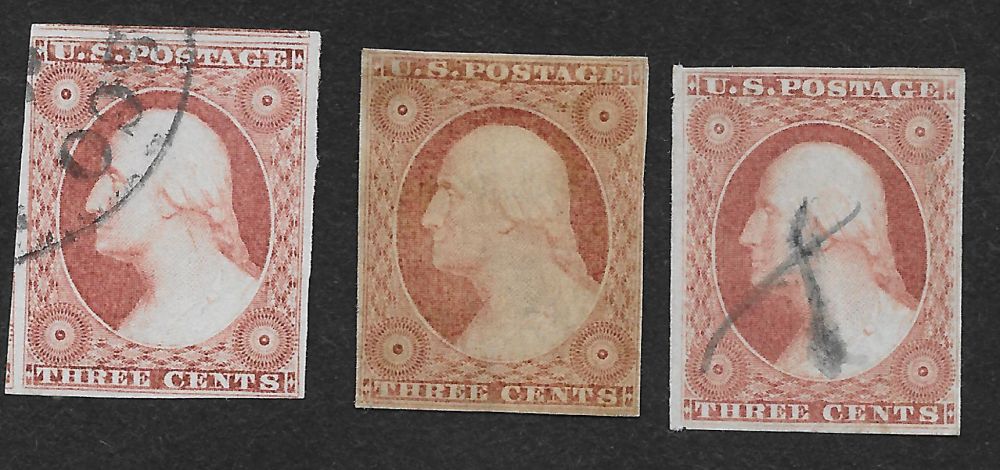 Oops. Brownish Claret is on the right. Deep on left. |
|
Send note to Staff
|
| Edited by stampcrow - 09/14/2016 10:23 pm |
|
|
Pillar Of The Community
United States
2555 Posts |
|
|
I would say it is probably more like a '52 brownish carmine on the left and a '56 brownish carmine on the right. Hard to say from the scan. The left stamp could be an early '52 claret but I don't think so. |
|
Send note to Staff
|
|
|
Pillar Of The Community
United States
2230 Posts |
|
|
Stampcrow, thanks for the Siegel power search. If it makes you feel any better, the Siegel images aren't a good color match with each other. |
|
Send note to Staff
|
|
|
Replies: 76 / Views: 9,905 |
|




 Posted 09/10/2016 10:54 pm


