| Author |
 Replies: 15 / Views: 2,656 Replies: 15 / Views: 2,656 |
|
|
Valued Member
56 Posts |
|
|
|
Users of international catalogs other than Scott, will know that there is more than one way to value a stamp.
Comparing the price for the same stamp in identical year editions of Scott, SG, Michel and Y&T can show massive disparities.
The key reason for this is that catalogs are either published on either:
a) a Reference basis (this gives a relational idea of price against each stamp to which you then apply a large discount to get to the buying price)
OR
b) a Retail basis (effectively the price you should expect to pay a dealer, perhaps with a small discount
The three European catalogs all work on the reference system with large discounts almost expected off the majority of listed prices. Old hands will recall that this was also the Scott model up until 1988/9 when they controversially switched to the retail model.
More than 25 years later, is the consensus that Scott is still representing the retail view...and that most dealers are applying these prices? Or are Scott sliding back to where they were pre-1990 with largish discounts now expected?
Nick
*** Moved by Staff to a more appropriate forum. ***
|
|
Send note to Staff
|
|
|
|
|
Moderator

United States
12330 Posts |
|
|
Who wants to keep buying expensive sets of catalogs to find that their stamps are trending downward in value? What happens to catalog sales when stamp prices are trending upward or downward? Large, older publishers have access to the definitive answer to this question and it no doubt influences their decisions.
Don |
Send note to Staff 
|
|
|
Pillar Of The Community
United Kingdom
8636 Posts |
|
|
It's a little more complex in that both SG and Yvert, unlike others, actually sell stamps themselves, starting at the catalogue level. |
|
Send note to Staff
|
|
|
Bedrock Of The Community
Australia
38679 Posts |
|
|
For mine : Reference Catalog for issues and price. I am a huge fan of the Scott catalog, I defer to Michel and Gibbons (and SCF) for specialisation, but the basic "go to" reference is Scott. Scott is basically my Plimsoll line for all sales and purchases, I work on 25% of Scott for most buys, I am only a mid range collector, so the expensive and spectacular varieties are not in my scope. For more scarcer stock I feel comfortable to go to 50%. I have not enjoyed my collecting more, (as a WW collector) since transferring from SG to Scott. Not everybody's taste, but certainly for me. I don't see how any catalogue can be reliable for accuracy in pricing, when individual tastes and range of disposable incomes vary so much. I have just seen an offer of $12 on a set of 3 SAG cinderellas, that a few years ago were bandied around free. Rather amazing. Seen from a broad perspective, Scott to me for price, is just an indication of the scarcity , or not, of an issue that I may be mounting or purchasing or selling. ebay or auctions, then become the hard facts. |
|
Send note to Staff
|
|
|
Pillar Of The Community
United States
6483 Posts |
|
|
If you're talking in-person show or brick & mortar, then I would say that Scott represents retail pricing. If, on the other hand, you mean online/eBay sales, then likely more a reference catalog.
It also varies by country/area.
At the end of the day, does it matter which model a catalog series is published as? Most knowledgeable collectors will know what the real world pricing is in their country for the material in question, even if there is a wide gamut between Scott, Stanley Gibbons, Michel, Yvert, Facit, Ma, etc.
ALL catalogs, to a certain extent, are part fiction. |
|
Send note to Staff
|
|
|
|
Pillar Of The Community
United States
845 Posts |
|
|
At one point in time the distinction of reference vs retail seemed like it might make sense. I think this originated in the price cuts taken by Scott in the late 80's (?) compared to the other catalogs.
In practice, I find it is irrelevant. All stamp catalogs are reference catalogs and its crazy to think they could possibly reflect pricing at any point in time, given the size of the hobby now, the difference in vendors and the enormous number of stamps and stamp conditions.
I like to have a benchmark reference catalog, I live in the US, so I chose Scott. I compare prices of material against Scott and use rough discounts to Scott (e.g., different percentages) for different situations, collection vs singles, rare classic vs common, good seller vs unknown seller, condition of the material, etc. Each person has to establish their pricing methods through experience and having a benchmark helps ground those methods.
Its easy to forget condition and scarcity of material and think that employing a simple percentage of catalog value is a valid pricing scheme.
In addition to the catalog as a reference, real world prices from completed auctions or current online offerings inform my pricing.
I used other catalogs for reference, and in my collecting areas, in general, Michel prices require a 50% cut to equal Scott. So more of a reference but still the same principles apply when pricing material for sale/purchase. |
|
Send note to Staff
|
|
|
Pillar Of The Community
6366 Posts |
|
|
Of course Scott used to be a retail price catalog. Here is the top portion of the title page from the 1937 edition. Note: "... and giving the price at which most of them may be purchased, used or unused, of the Scott Stamp and Coin Company Ltd." This statement had changed by the 1940 edition. 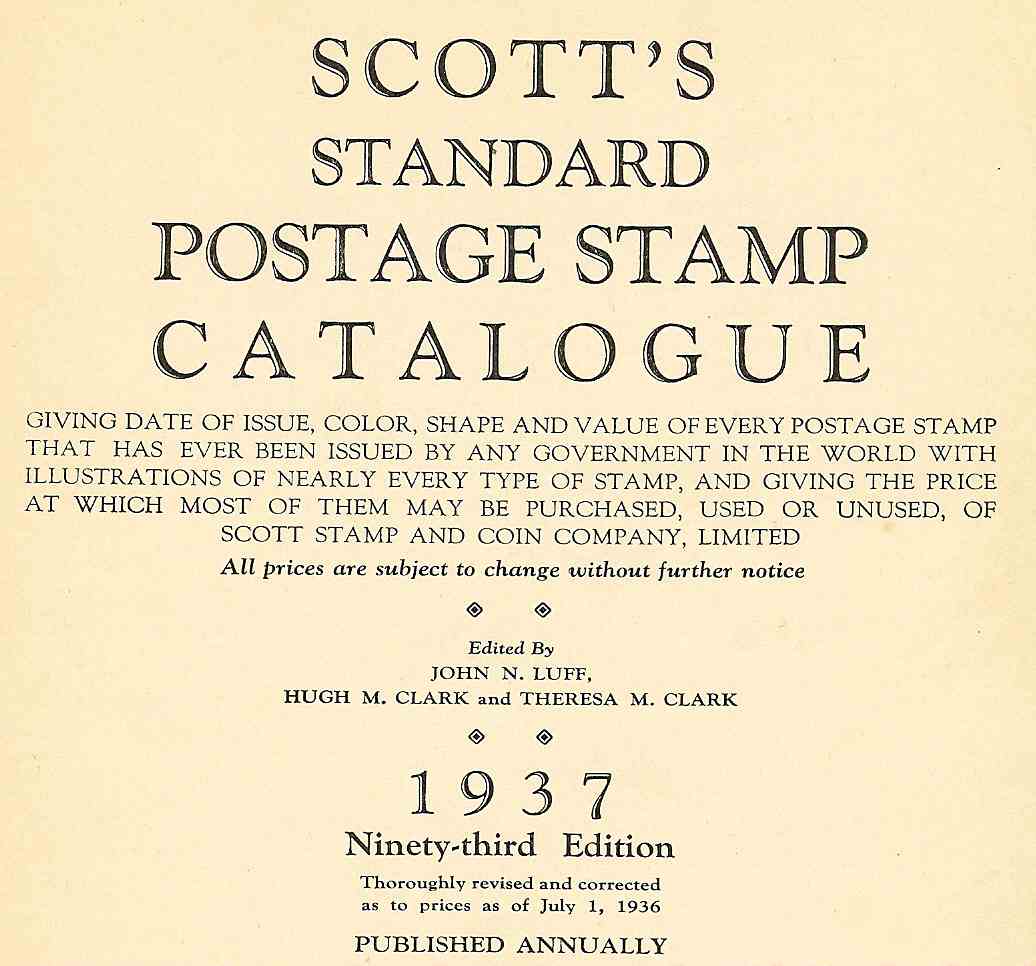 For the irony a few pages later, Scott discounted Scott! 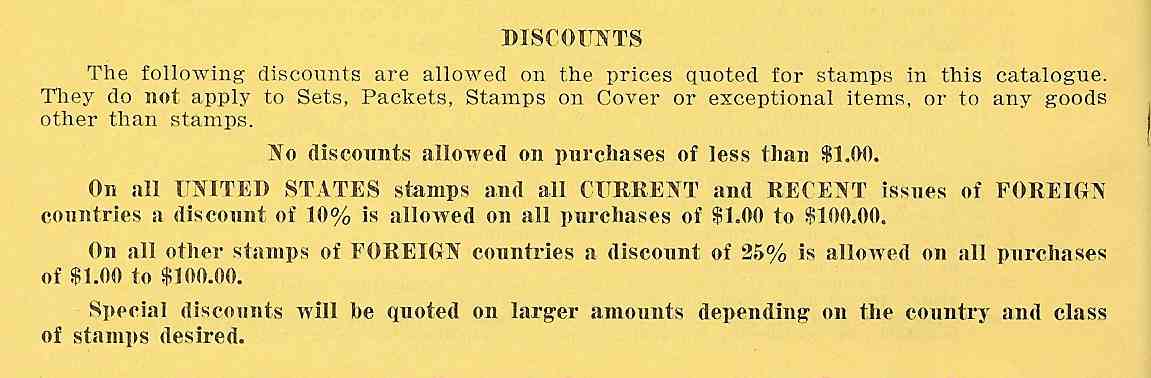 But one must also remember that today Scott provides a value for a grade of fine, which few stamps actually are. A discount is quite appropriate for lesser grade stamps which their "US Specialized by Grade" section addresses fairly well. |
|
Send note to Staff
|
|
|
Pillar Of The Community
United States
6483 Posts |
|
|
Quote:
But one must also remember that today Scott provides a value for a grade of fine, which few stamps actually are. Not F, but VF. "The Scott Catalogue value is a retail value; that is, an amount you could expect to pay for a stamp in the grade of Very Fine with no faults." |
|
Send note to Staff
|
|
| Edited by revenuecollector - 10/24/2016 2:13 pm |
|
|
Pillar Of The Community
6366 Posts |
|
|
Correction accepted, but the point still being that few stamps measure up to the catalog grade. Unfortunately many heirs and beginners think any stamp should be worth "full catalog", without understanding condition considerations. The coin world seems to do a better job of increasing values for increasing grades in their catalogs. Any catalog is only a starting point. |
|
Send note to Staff
|
|
|
Pillar Of The Community
United States
772 Posts |
|
|
The value of catalogs are in their reference value. Valuation is more of a rough guide that can never be really accurate considering the catalogs are only published once a year and the valuations done months before actual publication.
If you want to know the real retail value of a stamp, you have to comparison shop between auctions, dealers and internet sites.
The identity of a stamp, though, is based on its catalog listings in the various catalogs. And that is why catalogs remain an important part of the hobby. There has to be some sort of reference so that buyers and sellers can agree what stamp they are considering to have a transaction. |
|
Send note to Staff
|
APS #173088
|
|
|
Pillar Of The Community
United States
2055 Posts |
|
|
Quote:
The value of catalogs are in their reference value. Valuation is more of a rough guide that can never be really accurate considering the catalogs are only published once a year and the valuations done months before actual publication. In Scott's case, they don't even do a thorough evaluation every year. Major countries might get a thorough review every 3 or 4 years, even less often for some less popular countries. They just keep using the same prices year after year until they do another review. Some stamps, such as rarities sold at auction, still get updated as needed, however. |
|
Send note to Staff
|
|
|
Bedrock Of The Community
Australia
38679 Posts |
|
|
Quote:
The identity of a stamp, though, is based on its catalog listings in the various catalogs. And that is why catalogs remain an important part of the hobby. There has to be some sort of reference so that buyers and sellers can agree what stamp they are considering to have a transaction. I like that, succinct. |
|
Send note to Staff
|
| Edited by rod222 - 10/25/2016 12:58 pm |
|
|
Valued Member
58 Posts |
|
|
I usally only like the album to see the different kind of stamps and because sometimes I dont know how to google the stamp its easier to look in the book |
|
Send note to Staff
|
|
|
Valued Member
56 Posts |
|
|
I'd be interested to get views on Scott pricing as it relates only to bricks and mortar or show dealers. With online ( ebay particularly) and regular auctions, I think we tend to set our own personal limits as to what percentage over Scott we are prepared to pay. A dealer, laying out his stall, has to put a line in the sand as to what discount off Scott he is prepared to make on the bulk of his material. This can be Scott, as published (sometimes with a discount on the whole purchase if the value is reasonable) but often a dealer may offer a standard 10%-30% off the published price. These guys have higher costs than the ebay trader, so need a higher margin. Would be interested to get a feel for what discount your local dealer applies (if any!)... |
|
Send note to Staff
|
|
|
Pillar Of The Community
United States
1874 Posts |
|
|
As a data point, for Champion Stamps in New York City (midtown Manhattan), it's 20% off Scott, provided the stamp is truly VF and in demand.
I'm also aware of a solo dealer in GB stamps, who only sells at shows, whose rule is 40% of Stanley Gibbons or 60% off. That catalog is widely perceived to be inflated, at least in North America.
Beyond that, I don't see any rules. It depends on whether the stamp is cheap or costly, scarce or plentiful (and the former may NOT be reflected in catalog price; some cheap stamps can be maddeningly hard to find), VF or better or lesser. Stamps cataloging over $100 that are hard to find VF or better, with attractive cancels if used and good gum condition if mint, may well go for 10% off catalog, 0% off catalog or a premium.
Chris |
|
Send note to Staff
|
|
|
Valued Member
56 Posts |
|
|
That's a couple of great reference points to start us off Chris.
I agree with you that for certain stamps, pricing is often tailored to suit, depending on scarcity, condition etc. But I tend to find that many dealers with a decent bulk stock (i.e. 10,000's if not 100,000's) will often use a 'standard discount', rather than tailor it to each and every stamp. |
|
Send note to Staff
|
|
| |
Replies: 15 / Views: 2,656 |
|



 Posted 10/23/2016 09:31 am





