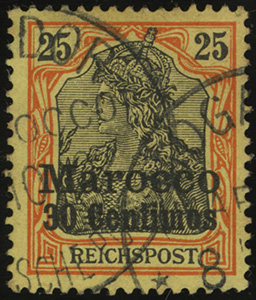
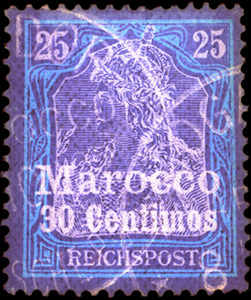
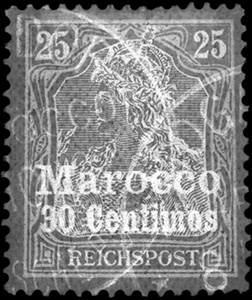
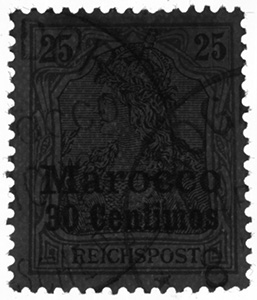
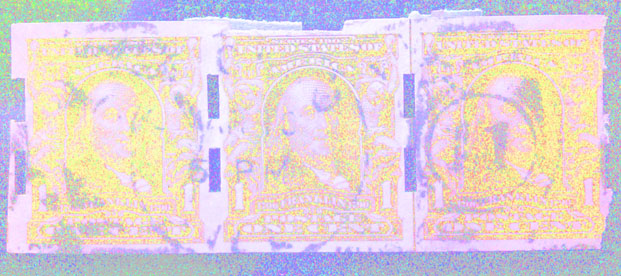
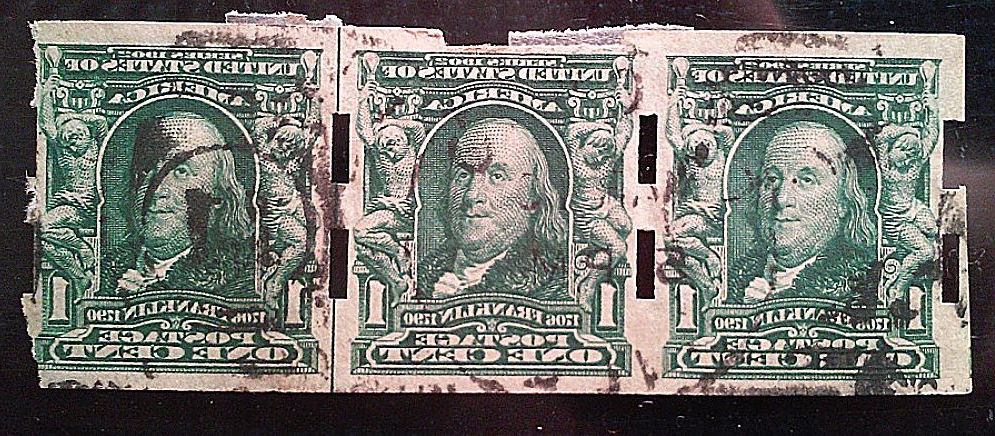
Rick, Greetings:
I hope that y'all have more luck with RetroReveal than I ever did

but, if you don't:
If the stamp is off-cover or readily lifted, I would arrange eyeball-stamp-source, and view the back of the stamp using a very bright light source.
I would also try viewing the face of the stamp under UV light, varying both the angle at which the light strikes the stamp and the angle at which your eye views the stamp.
And, I would also try viewing the face of the stamp thru a digital camera thru an IR-pass VIS-block filter (available from, for example, Hoya) under normal broadband light (eg, a traditional light bulb or, failing that, raw sunlight).
Personally, I don't expect any of these to work worth a twit.
Why?
You would need, by means of a very happy & ridiculously unlikely coincidence:
1) a chemical component in the stamp's ink to be particularly reflective of some conveniently detectable wavelength of light, and
2) the cancellation ink to be largely-non-reflective or particularly transmitting of that same wavelength of light, or for there to be lots of tiny spots where the cancellation ink is MIA.
Good luck with that, to all of us.
Absent those near-magical conditions, the obliterating ink in the cancel is going to, well, obliterate our view of the stamp.
Okay, last desperate measure if you care more about the answer than you do about ever selling the stamp: try scraping the area so as to remove some of the cancellation's ink while leaving most of the stamp's ink in place ... no, that's not impossible, because the stamp ink was deposited before the cancel's ink, so the former might have blocked absorption of the latter.
Cheers,
/s/ ikeyPikey





 Posted 12/01/2016 5:42 pm