The dates on the two parts of this letter give food for thought!
Oliver Cromwell, who ruled England as Lord Protector from 1653-1658, was a great organiser, and his Parliament passed an Act in 1657 which declared :-
"There shall be one General Post Office and one officer styled the Postmaster General of England…and that all other persons were forbidden 'to set up or employ any footposts, horseposts, or packet boats.'
This meant that no one else could carry the mails as a business. It also meant that it was easier to arrange a proper postal service. However, letters were exchanged privately, in particular within the City of London, which at that time was the business and financial centre. This letter is an example, written by Jo.Heath from his office in the Inner Temple, (one of the Inns of Court in London) which is dated 'Last of 10th 1660'. It is addressed to 'Mr. Robert Clayton, a Scrivener Neere the old Exchange House'. There are no postmarks as the Bishop Mark (showing the day and month the letter was posted) was not introduced until 1661, the year after this was written.
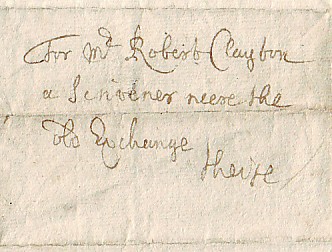
The contents of this letter show that it was privately delivered, and the reply returned to the sender. It is a very early letter concerning banking, and the transfer of money.
"Mr. Clayton,
I have been hitherto irresolute at least, if not improvidently negligent in disposing of my moneys, in yr hands to some better advantage, but within a day or two, when my brother & I are somewhat better (haveing both at present very troublesome colds) I will advise with you, resolve noth. myselfe about it. In the meanetime I pray deliver to bearer fifty pounds sterling, of wch I have present use, for which this shal bee yr discharge from Yr assured friend & servant
Jo. Heath
Inner Temple last of 10th 1660"
Josiah Heath then added the following note
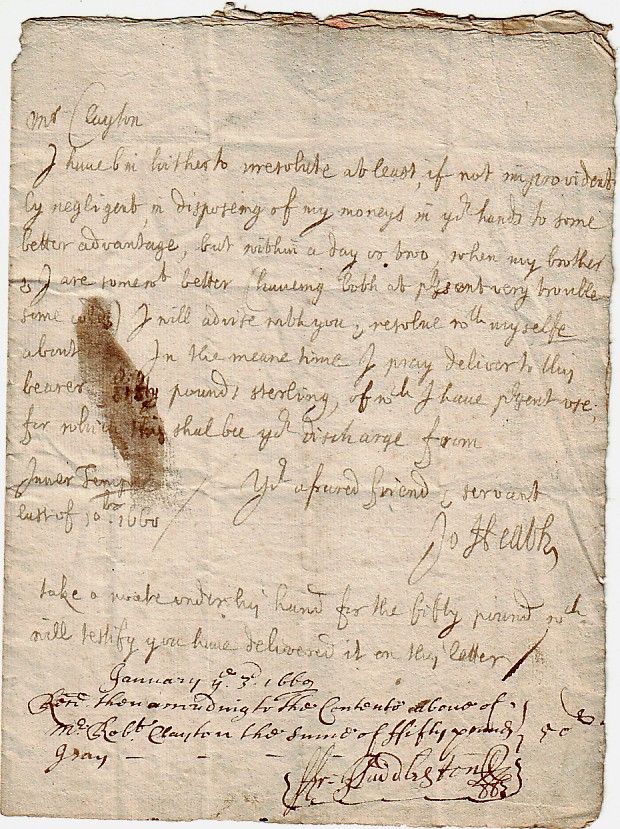
"Take a note under his hand for the fifty pound wch will testify you have delivered it on this letter."
Robert Clayton then added this note as a receipt in his own handwriting.
"January ye 3rd, 1660. Recd. then according to contents above of Mr. Robert. Clayton sum of fifty pounds I say…….(50)....."
This note was signed by the bearer of the note who received the money to be returned to Jo. Heath.
The dates are interesting, as the first part of the letter is dated the last of the 10th 1660, and the follow up is January ye 3rd also 1660, and that is because at this time the Julian calendar was in use, and the year began in March, so December was the 10th month, and 1660 would continue to be the year until the following February. In the case of this letter, the date written as the last of the 10th was in fact the 31st December.
The Gregorian calendar was not introduced in Britain until September 1752, (about 150 years after it was accepted on the Continent). There were riots in the streets in England as the date after the 2nd September was declared to be the 14th and the people thought they had been deprived of 11 days of their lives!
1660 was also important for London and Great Britain as this was the year the Monarchy was restored.
Charles the Second was proclaimed Monarch in May 1660, but his accession was formally backdated to 1649 when his father King Charles I had been tried and executed. After the restoration of the Monarchy in 1660, the new parliament did not recognise any of the laws passed by the Commonwealth or Protectorate parliaments. So in 1660 another Act of Parliament was passed, which confirmed most of the previous legislation, including the establishment of a General Post Office, under the control of one Postmaster General. This is considered to be the origin of the British Post Office as it is known today.
We find these old letters fascinating and if anyone is interested there are over a hundred on our website (non commercial and advert free)
at
-/letters/Previctorian/lettersov.html
to go to the letters
or
-/
for the home page for other stamps Australia, Antarctic, G.B. and much more.
Regards
Ron and Eunice.





 Posted 12/24/2016 06:17 am


