| Author |
 Replies: 18 / Views: 2,778 Replies: 18 / Views: 2,778 |
|
Valued Member
United States
259 Posts |
|
|
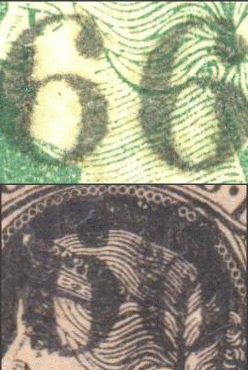
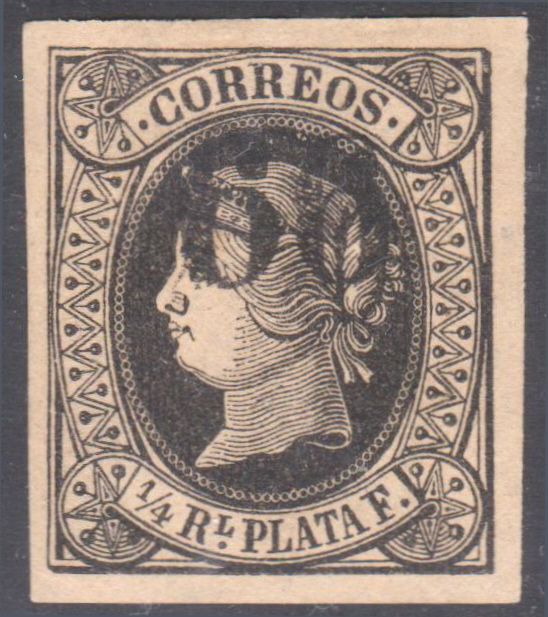
In 1864, Spanish Cuba issued black on buff (Scott 17) and green (Scott 18) 1/2 real stamps. The black stamp with "66" overprint is listed by Scott under No. 22 (it is a common stamp). However, Scott doesn't list a green 1/2 real stamp with the same overprint. Afinsa catalog also doesn't list it. Does anybody know the story behind this overprint?  |
|
Send note to Staff
|
|
|
|
|
Pillar Of The Community
United States
8956 Posts |
|
|
Valued Member
United States
259 Posts |
|
|
As far as I can see, it is an overprint, identical in all respects to the "66" overprint on 1/2-real black on buff stamp (Scott No. 22). |
Send note to Staff 
|
|
|
Pillar Of The Community
United Kingdom
3220 Posts |
|
|
The font does not match that shown in either SG or Scott.
These catalogues both show the sixes as being more closed in shape.
However, I have no idea how much variation there was in the typesetting. |
|
Send note to Staff
|
Nigel |
|
|
Pillar Of The Community
United States
8956 Posts |
|
|
tvoroq, I was asking this because it does not really look like an overprint. It is crooked and the ink looks like regular stamp pad ink. You would not have a scan of Scott 22/
Peter |
|
Send note to Staff
|
|
|
Valued Member
United States
259 Posts |
|
|
It is possible that this is just a cancel. But why would anybody use a second postmark "66"? |
|
Send note to Staff
|
|
|
Pillar Of The Community
United States
8956 Posts |
|
|
Could just be a numeral cancel like the kind that was in use in many countries in the 19th century.
Peter |
|
Send note to Staff
|
|
|
Valued Member
United States
259 Posts |
|
|
I haven't seen any numeral cancellations like this on 19th century Spanish Cuban stamps. Afinsa catalog doesn't show any prostmarks of this kind.
Also, it is very similar to the "66" overprint on the black stamp of the same design, issued in the same year. Please note that this overprint, according to Scott and Afinsa catalogs, was applied by hand in post offices; therefore, at least in some cases, it wouldn't be strictly horizontal or different from postmarks in its color of ink.
So, this stamp still rmains a mystery to me. |
|
Send note to Staff
|
|
|
Pillar Of The Community
United States
8956 Posts |
|
|
Well, you could have made a new or unknown discovery. Maybe you need to contact a Cuban or Spanish stamp club and see if you can get this stamp certified.
Peter |
|
Send note to Staff
|
|
|
Bedrock Of The Community
Australia
38679 Posts |
|
|
Moderator

United States
12330 Posts |
|
|
Rod scaled both "66" to same size for his animation. Perhaps a better comparison is to view both "66" in their actual size; one is nearly 150% larger than the other as shown here... 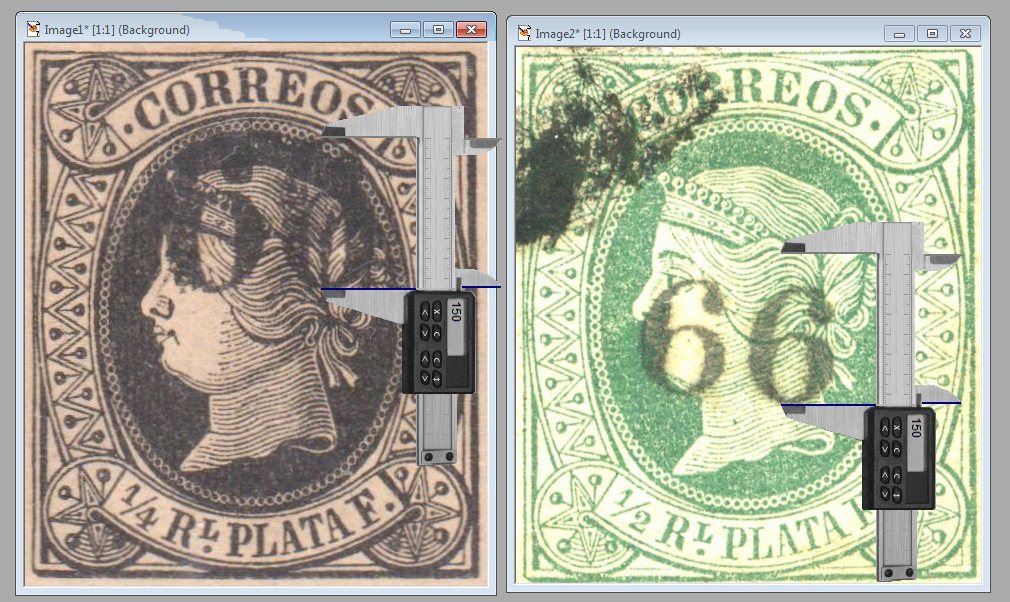 Pretty significant delta between the two sizes. Don |
|
Send note to Staff
|
|
|
Pillar Of The Community
United States
1121 Posts |
|
|
I would agree with others that this is most likely a fake of some sort. Someone trying to take a relatively inexpensive stamp and turn it into something else more expensive, either not realizing it was the wrong stamp to use (the 1/4 green instead of the 1/2 black) or trying to create an unknown variety. Either way, the font is different and not a crisp transfer, and appears to bleed, which means wrong ink as well. Would be considered a "curiosity" in my opinion. Have not seen a "66" cancel like this, and no mention of it in the Edifil catalogs either. |
|
Send note to Staff
|
|
|
Bedrock Of The Community
Australia
38679 Posts |
|
|
Nice work Don, explains it a lot better.
What software uses the Vernier Calipers? Very impressive.
|
|
Send note to Staff
|
| Edited by rod222 - 01/04/2017 10:32 am |
|
|
Moderator
United States
12330 Posts |
|
|
Pillar Of The Community

United States
944 Posts |
|
|
Don, This looks like a neat tool. One thing I could not determine from the description was if this would let me make an accurate measurement of a dimension (e.g., millimeters) of a feature present on a cover when all I have is the image from ebay or an other digital site but no other information? Is this possible? Mike |
|
Send note to Staff
|
| Edited by mml1942 - 01/04/2017 11:44 am |
|
|
Moderator
United States
12330 Posts |
|
|
Hi Mike,
Getting accurate dimensions from an image requires knowing the original resolution (scan or photo). The original image has to be 100% (1:1) scale. So obviously if the person has performed any additional resizing than all bets are off. So ideally you want to be working with images that you control.
There are some ways to manipulate and calculate an unknown image back to a 100% size but it takes some work. For example, if the unknown image has a a stamp in which the dimensions are known (i.e. stamp design size) you can then resize the image back to a 1:1 ratio.
Don |
|
Send note to Staff
|
|
|
Replies: 18 / Views: 2,778 |
|




 Posted 01/03/2017 3:24 pm