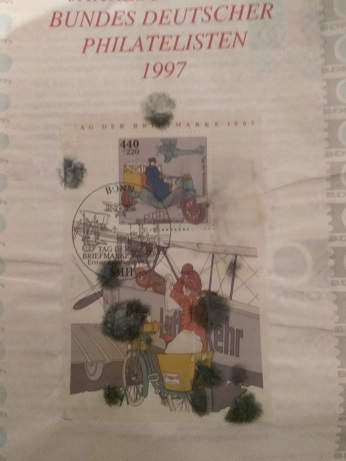
My opinion… If they are rare and/or worth substantial amounts of money than professional preservation is dictated. If they do not fit in this category, then is it worth the risk of introducing this kind of problem into the rest of the collection?
If you do something yourself at a minimum it would be wise to isolate them from your other stamps and pages. Don
I think all stamps should be protected even if its only a plastic sandwich baggie. Tape those puppies up and you have a nice sealed waterproofed container.
They can be easily cleaned but the risk of damage if you have not done it before and you have not got something to experiment with 1st is very dangerous to the stamp or cover etc.
It is a common type of fungus problem when people soak stamps and do not dry them properly before putting them in an album.The fungus is more common in the tropics type of environments as well.
Have removed that type of fungus from the back of stamps with easy and not any disturbance to the print of the stamp.
But again I repeat. If you have never cleaned a stamp with fungus before you will destroy it. It is as simple as that.It is good to experiment with a already damaded stamps 1st.
If they are stamps, I would suggest firstly washing them lightly in cold water with just a drip of washing liquid. Test on 1 stamp and dry and press in a drying sandwich.
As a last resort, use a very mild bleaching agent, dip the stamp for a few seconds, then place/wash in a clear cold water bowl.
Excerpt from the masters.
RESTORATION; HOW FAR? Professor John C West CBE RDP FRPSL.
Unfortunately the removal of micro biological foxing on individual stamps or covers necessitates, for the amateur, the use of bleaching. This involves total immersion. Trying to remove locally, results in dark rings, as the rust colouring tends to spread. These are just as unsightly and unacceptable as the foxing. For stamps the best bleach is Hydrogen Peroxide bought from the Chemist for beauty treatment. The formula H2O2 shows it has a weak binding easily reverting to water H2O and oxygen O. It is this spare oxygen molecule, which does the bleaching. Light itself detaches the oxygen which is why it is stored in a dark glass bottle. It is desirable when bleaching to keep the process in the dark. Hydrogen peroxide can of course be used for full covers by total immersion again covering the dish with dark card to keep out daylight. The snag is that it removes writing ink very quickly and before the foxing. I show some of the results of this.
Disclaimer: While a tremendous amount of effort goes into ensuring the accuracy of the information contained in this site, Stamp Community assumes no liability for errors. Copyright 2005 - 2026 Stamp Community Family - All rights reserved worldwide. Use of any images or content on this website without prior written permission of Stamp Community or the original lender is strictly prohibited. Privacy Policy / Terms of UseAdvertise Here





 Posted 01/23/2017 04:24 am