| Author |
 Replies: 69 / Views: 8,042 Replies: 69 / Views: 8,042 |
|
Pillar Of The Community
Norway
1661 Posts |
|
|
I haven't seen too much on prephilatelic material on the forum, why not get a thread going. 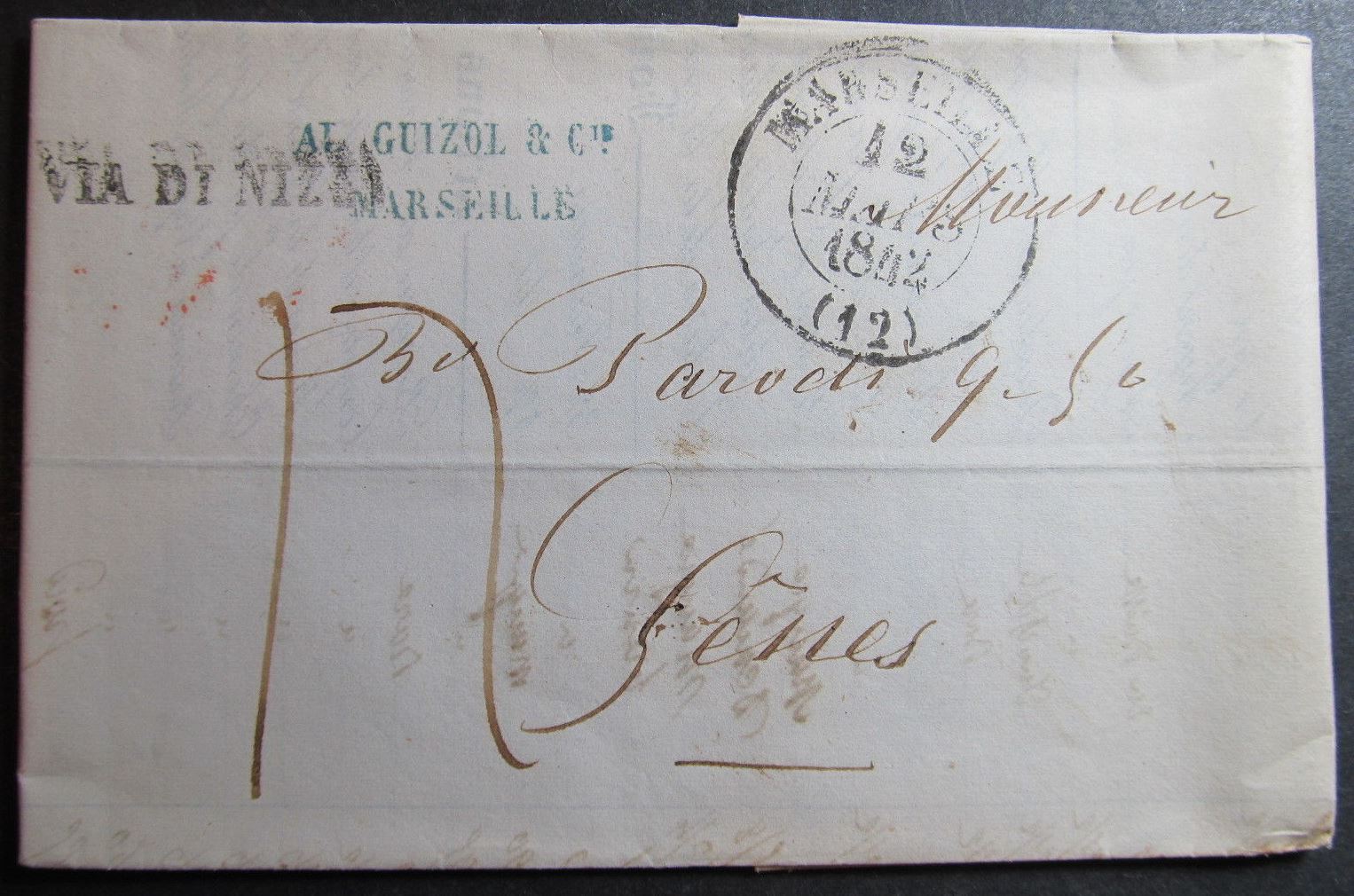 I picked up a few prephilatelic covers the other day. This one was sent from Marseille to Genova in 1842, 7 years before France issued her first postage stamps. I believe the script for postage tax is supposed to be '12' - however I might very well be wrong. Qvestion: I picked this particular letter due to the interesting cachet 'VIA DI NIZZA'. I understand this as a transit marking of some kind - transit via Nice, France? Is 'Nizza' Italian spelling for Nice, indicating the letter was picked up on an Italian steamer in Nice? Or... was Nizza simply the name of a packetboat steamer? Appreciate your help as always  |
|
Send note to Staff
|
|
|
|
|
Pillar Of The Community
Australia
1042 Posts |
|
|
Moderator

United States
12330 Posts |
|
|
Interesting. I have never heard the word 'prephilatelic', I assume that it means stampless?
Don |
Send note to Staff 
|
|
|
Pillar Of The Community
Australia
1042 Posts |
|
|
Hi Don yes prephilatelic means stampless and has been used by folk in GB often also the words pre-stamp & entire. Where USA says Stampless Cover, UK will say pre-stamp letter/wrapper. Others will say prephilatelic letter or wrapper. Entire letter. I'm careful when using the above mentioned terms between a GB letter and a USA stampless folded letter. I find in ebay listings you have to separate these terms to hit the right buyers. |
|
Send note to Staff
|
|
|
Pillar Of The Community
Canada
1449 Posts |
|
|
Don, the "French" use this term on a regular basis. Blaamand, as for the cancellation of post mark of 1842, I believe the (12)means the number of the Department (Departement) in which case this would be from Bouches-du-Rhone....evidently I did not put French accents on Rhone and Departement( ^ and é) since I am using an English keyboard ! http://marcophilie.org/x/x-0105010000-i.htmlRené (with an accent !) edit: There were 86 Departments in 1849- France. Hope you can open the link ! |
|
Send note to Staff
|
| Edited by Renden - 02/14/2017 8:00 pm |
|
|
Pillar Of The Community
Canada
2574 Posts |
|
|
Pillar Of The Community
Norway
1661 Posts |
|
|
Thank you for the response folks! Quote:
I have never heard the word 'prephilatelic', I assume that it means stampless? Thanks for pointing to that confusion in terms. A 'stampless' cover means a cover with no stamp on it.... however not necessarily a cover that was mailed before postage stamps were issued. 'Stampless' is a wider definition. As we all know, covers with no stamps were used for various reasons until semi modern time, like e.g. the stampless covers that was allowed for prisoners of war even after WWII. 'Prephilatelic' obviously indicate mail from the era prior to postage stamps were issued, so its a more precise definition. Personally I would not consider this particular cover (in this thread) a 'stampless' cover, as in 'a stamp is missing'. How could it be a stamp 'less' - missing - if no postage stamps were available at that time in that particular country?  Seems illogical towards the timeline of postal history. Anyway, we can live with that our definitions and vocabulary are different. You say 'Tomato' - I say - well - 'Prephilatelic'  |
|
Send note to Staff
|
|
|
Pillar Of The Community
Norway
1661 Posts |
|
|
Quote:
as for the cancellation of post mark of 1842, I believe the (12)means the number of the Department @René (with an accent !) -  That's correct. It always make me happy when others are referring to the marvelous marcophilie site! Just to avoid confusion, the '12' I was mentioning in the OP was not the '12' in the postmark - but the script/handwriting (or hieroglyph  ) applied by the postal clerk somewhere along the route. |
|
Send note to Staff
|
|
|
Pillar Of The Community
Norway
1661 Posts |
|
|
Quote:
Yes, 'Nizza' is Italian spelling for Nice @timbres667 - Merci So, obviously the letter had transit via Nice, and had an Italian transit mark applied. Why Italian postmark in the French city of Nice? Wikipedia came up with the answer: "Nice continued to be part of France until 1814; but after that date it reverted to the Kingdom of Piedmont-Sardinia. After the Treaty of Turin was signed in 1860 between the Sardinian king and Napoleon III, the County was again and definitively ceded to France as a territorial reward for French assistance in the Second Italian War of Independence...." So, it means at the time this letter had transit in Nice - the city was not French - but temporarily the Italian City of Nizza Isn't history wonderful? |
|
Send note to Staff
|
|
|
Pillar Of The Community
United Kingdom
8627 Posts |
|
|
The French continued to use stampless covers even after 1849 - I've never been clear why. Any advice? |
|
Send note to Staff
|
|
|
Pillar Of The Community
Norway
1661 Posts |
|
|
@GeoffHa - I have seen the same for lots of other countries as well. Yesterday I did some 'shopping', trying to get a few prephil covers from various countries. I saw a lot of items from countries like Germany, France, Italy, Canada, Scandinavian countries etc - with true 'stampless' covers, in the sense that the letteers were passed without stamps long after stamps were issued in the country. I do not know why. Maybe the practice in the early days was that the sender could choose to send stampless if he wanted, so the receiver would have to pay?
(edit - in other words: the practice that had been common until introduction of postage stamps, was continued for some years. As we know, until the introduction of postage stamps, the normal method had traditionally been that the receiver would pay, not the sender ) |
|
Send note to Staff
|
| Edited by Blaamand - 02/14/2017 4:58 pm |
|
|
Pillar Of The Community
Norway
1661 Posts |
|
|
....and then 'Postage dues' came around, which made it more expensive to pay for tax due for the receiver than by 'pre-payed' postage stamps for the sender |
|
Send note to Staff
|
|
|
Pillar Of The Community
France, Metropolitan
3755 Posts |
|
|
Hi Blaamand, Well prephilatelic covers is a very very complicated domain.Without knowing the fundamentals of the postal history and diverse scales relative to every country one will be lost.I think the way to begin is looking at your cover.You said the tax is 12.You are right.The question is why? Two things; weight & distance.You can simply weigh the letter and see how many grams it weighs.I'll bet it must be around 10 grams.That means the tarif must fall into the tarif scale at that time(1842). That means +10gr. = 12d at+500km.The d = 1 decime.So the rate is 12d. Now for the distance.Marseille and Genoa are by the old road over 530km apart.So looking down the weight scale and distance scale it fit's right in.Via di Nizza in Italian means simply via Nice.Don't forget Nice was Italian until 1856. Below link to get into it.....  http://www.asso-philatelique-montpe...-de-1828.pdf http://www.asso-philatelique-montpe...-de-1828.pdf |
|
Send note to Staff
|
|
|
Pillar Of The Community
United States
922 Posts |
|
|
Perf12 - is there an on-line source for rates during the French occupation of Italy under Napoleon? I collect the postmarks for the Departement de Rome (116) but don't understand the rates. 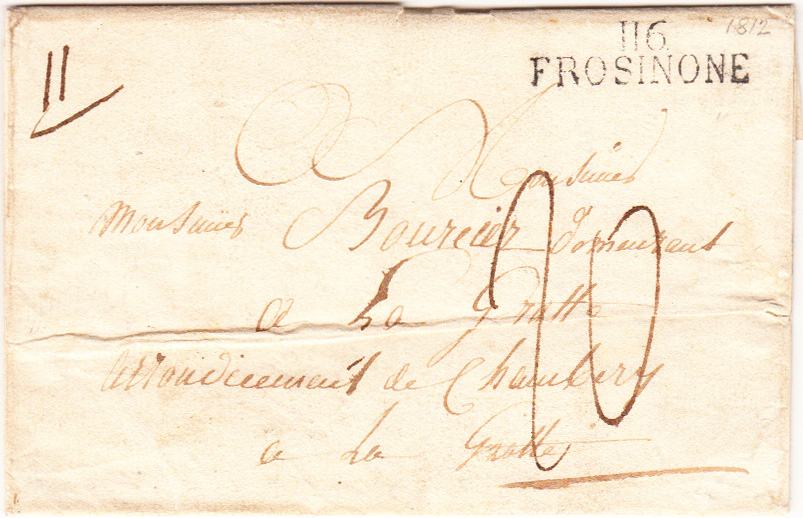 |
|
Send note to Staff
|
|
|
Pillar Of The Community
Norway
1661 Posts |
|
|
perf12 -  - Brilliant info. Thank you for verifying the suspected '12'. 'VIA DI NIZZA' = via Nice, that is concluded. But - do this transit mark indicate anything whether the carriage of mail shifted from land to sea - or opposite? I have a few covers with 'VIA MARE' cachet - in exactly the same style/font as this one - so I was thinking the two marks were both related to maritime post in some way...? I am keeping in mind that all the three cities (Marseille - Nice - Genoa) were major shipping ports at the time, so carriage by sea would probably have been both quicker and faster than by land. "Don't forget Nice was Italian until 1856" - Ha ha, I actually had forgot when I made the OP this morning - but still had this fact of history somewhere in a very quiet corner of my brain. And later the thought emerged to the somewhat more conscious part of my brain - which made me verify this with wikipedia! (ref post above) European 19th-century history is full of these changes to borders - and it makes postal history even more interesting.  |
|
Send note to Staff
|
|
|
Pillar Of The Community
Norway
1661 Posts |
|
|
Replies: 69 / Views: 8,042 |
|




 Posted 02/14/2017 2:17 pm


