| Author |
 Replies: 9 / Views: 1,717 Replies: 9 / Views: 1,717 |
|
|
New Member
4 Posts |
|
|
I found this letter posted to Australia from New Jersey - the "G" struck me first, then I saw "for US addresses only" Is it usual for these to come overseas? Also, what is the colourful "A3314" on the left stamp bottom end? 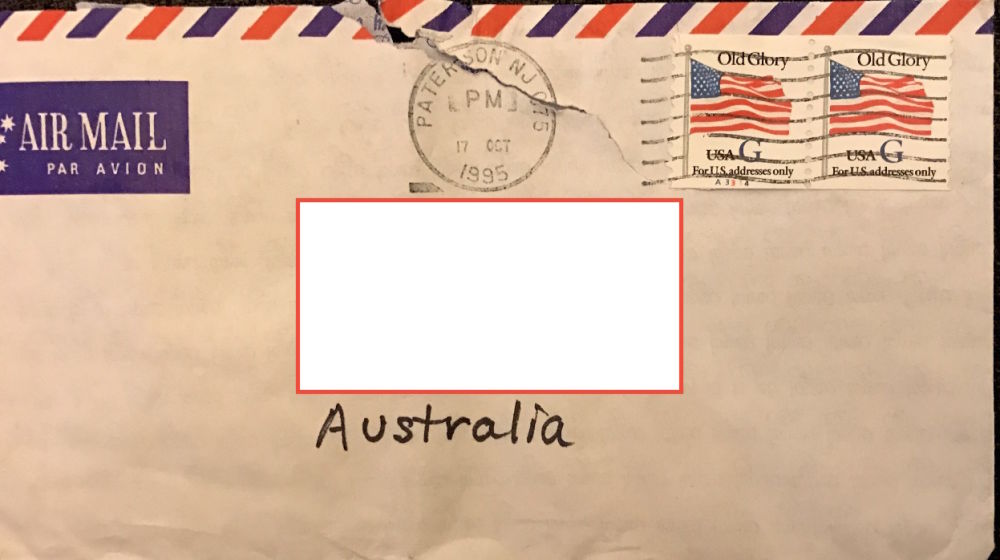 |
|
Send note to Staff
|
|
|
|
|
Pillar Of The Community

United States
1498 Posts |
|
|
The letter "G" is indicative of a postal rate change which affected several postal classes. The letters A thru H were used over a period of years with the G rate taking effect in 1994. The postal service would print the rate change stamps in advance, not knowing for certain what the eventual denominations would be. That way, when the new rates went into effect, stamps could be made available very quickly. There were three G rates that could be identified by the color of the stamp as well as by the verbiage used on the stamp. The first class rate stamp is the one you picture, with background color of white and "For US addresses only". The postcard rate stamp was yellow with the words "Postcard Rate". The stamp intended for bulk mail use was blue with the words "First-Class Presort". Eventually the introduction of "FOREVER" stamps made the issuance of rate change stamps unnecessary.
I do not recall the international rate at the time these stamps were produced, but it would not be unusual for first-class rate stamps to be used for such. Clearly extra postage would be required, hence the presence of two first-class stamps (64-cents). While I'm not certain, I think airmail stamps were primarily the choice for most international mail at this time. The airmail rate in 1994 was 50-cents ... I do not know whether that would have been sufficient for this letter. Maybe someone else will chime in with more detailed info on this.
The A3314 you refer to is called a plate number. Each letter & number in the plate number is printed in a different color ink. The number of characters in the plate number supposedly indicates the number of different inks used in producing the stamp. These particular stamps are coil stamps that are produced in rolls of 100, 3000 or 10000 stamps. Plate numbers appear periodically throughout the roll with a fixed frequency, usually somewhere in the range of every 27 thru 32 stamps. The large rolls are usually used for small denomination or bulk mail stamps while the 100-stamp rolls are used for first-class & postcard rate stamps. There are collectors who collect these plate numbers, usually in strips of 5 with the plate number on the central stamp. When the issue contains multiple designs, plate number strips (called PNCs) can consist of more than 5 stamps. Usually the length of a PNC is 2n+1 where n is the number of different designs in the issue. A PNC containing 3,5 or 7 stamps is usually referred to as a PNC3, PNC5 or PNC7 (similarly for other strip lengths).
Added: Missed one of the G rates ... a green background with "Nonprofit Presort" was used for non-profit bulk mail. The actual unstated denominations for the various rates were as follows": green 5-cents, yellow 20-cents, blue 25-cents, white 32-cents.
|
Send note to Staff 
|
| Edited by JLLebbert - 02/27/2017 05:48 am |
|
|
Pillar Of The Community
United States
572 Posts |
|
|
My understanding was that the 'For US addresses only' was because Postal Union rules required postage with a monetary amount and not just a letter. |
|
Send note to Staff
|
|
|
Pillar Of The Community
United States
6756 Posts |
|
|
That is correct. At the time the G stamp was issued, it did not meet UPU rules for international use. Rules have changed since then, hence the modern "forever" international rate stamps. |
|
Send note to Staff
|
|
|
Pillar Of The Community
United States
8956 Posts |
|
|
JLLebbert, your post is great but for one small thing. Plate number strips are supposed to be abbreviated PS, or Plate Strip. As in PS5, PS11 etc.
Peter |
|
Send note to Staff
|
|
|
Pillar Of The Community
United States
6756 Posts |
|
|
Most plate number coil collectors/dealers that I know of in the US use the abbreviation PNC, PNC3, PNC5... as posted by JLLebbert. That is also the abbreviation used by the Plate Number Coil Collectors Club (PNC3.org).
I've seen the PSx abbreviation more often in non-US areas. But it does get used here in the US, sometimes even for the oversized plate blocks, so that is good of Peter to point out.
Usually when I see PSx for plate number coil strips, I don't assume the plate number is in the middle stamp. That's the context when I first saw that abbreviation many years ago.
It seemed to me that the PSx abbreviation lost popularity among collectors after USPS went away from the Cottrel Press and joint lines no longer appeared near the plate numbers. Just my observation, maybe not accurate or maybe just a coincidence? |
|
Send note to Staff
|
| Edited by khj - 02/27/2017 09:51 am |
|
|
Pillar Of The Community
United States
8956 Posts |
|
|
Khj, PNC3 uses the abbreviation PS. The abbreviation PNC, which could be used for plate number coils with or without plate numbers is mainly used by ebay sellers. If you check the PNC3 publications, starting with the popular values list they all use the abbreviation PS for Plate Strip. Peter |
|
Send note to Staff
|
|
|
Pillar Of The Community
United States
1498 Posts |
|
|
Peter: While I had seen PS used for plate number coils, I was not aware that this was the preferred terminology. Thanks for the info. Out of curiosity, I looked up the A3314 plate number in Durland ... unsurprisingly, it is one of the more common numbers. What I wasn't prepared for was the value of A4435. It was the only PS5 worth more than $12 ... but $230? That came as a bit of a shock. While I don't collect plate number coils, I do find them interesting, especially the transportation coils of the 80s & early 90s. Were I fledgling collector today, I think I would likely choose these to collect. I also noticed that there were 36 different PNCs (or should it be PSes) for this issue. Is there any method or intent behind the selection of plate numbers? I know that I can't discern any meaning in any of the individual numbers that I've seen.
Added: Thanks also to those who pointed out that the UPU rules of the day were what gave rise to the "For US addresses only". This actually would seem to make the OPs question about whether the use of the G stamps for international mail was common more pertinent than I had initially realized. I would guess that the telling point is "when" the stamps were actually used. The postmark reads 1995. The only rate change stamps that used the UPU required nomenclature were the F (1990) and G (1994). The E (1988) and H (1998) did not have the "For US addresses only". This would imply to me that the rules changed sometime between 1994 & 1998, perhaps making the use of the G rate stamps "legal" in 1995. Just a surmise on my part though. |
|
Send note to Staff
|
| Edited by JLLebbert - 02/27/2017 2:20 pm |
|
|
Pillar Of The Community
United States
8956 Posts |
|
|
John, I collect only the Transportation Coils, and I have some 30 albums full of them.
But to answer your question on the plate numbers. On the Cottrell issues an most of the later Transportation issues the plate numbers were simple. Just using 1, 2, 3 etc. The actual plate number was much longer, like 4022-8 for the 9.3 cent Mail Wagon plate 8 for instance. Only the computer check number was printed on these.
After other printers took over the printing of the coils ( and regular stamps ) things slowly changed.
In the case of your example, the A3314, the stamp was printed using 4 plates. The first run of this stamp was marked A1111. When a plate was replaced the number changed to the next number. On the A3314 stamp the blue plate was changed twice, the red one twice, the next one stayed the same throughout and the black plate was changed three times. So no, the plate numbers are not arbitrary.
On later stamps the only plate numbers used are 1's by Post Office rule.
As far as values go, check on the Flag over Porch issue. There are a whole collection of different ones here, some of which are priced over $1000.00 for a used copy!
And by the way, as far as the terminology goes, a PSx always has the numbered stamp in the middle. If it has a number anywhere else it should be called a strip of x!
Peter |
|
Send note to Staff
|
| Edited by Petert4522 - 02/27/2017 3:27 pm |
|
|
Pillar Of The Community
United States
6756 Posts |
|
|
Thanks for the info on the PS terminology Peter. I only have the older Plate Number and the older Coil Line newsletters, which used the PS terminology. I don't have the newer newsletters, so good to see they are still using that terminology. All this time I thought the collector world was phasing away from that and migrating toward the PNCx terminology. |
|
Send note to Staff
|
|
| |
Replies: 9 / Views: 1,717 |
|



 Posted 02/27/2017 05:02 am


