| Author |
 Replies: 57 / Views: 7,403 Replies: 57 / Views: 7,403 |
|
Valued Member
United States
286 Posts |
|
|
|
|
Moderator

United States
4788 Posts |
|
|
Valued Member
United States
364 Posts |
|
|
Pillar Of The Community
United States
1565 Posts |
|
|
I did a quick skim of it. Does appear to contain a lot of useful ;information. But, a question....... does membership in a philatelic library count as a specialty society membership; or a club membership; or was not factored into the study & research? |
Send note to Staff 
|
|
|
Valued Member
United States
286 Posts |
|
|
A library would be considered a speciality society. The definition of club was kept to strictly a traditional local club. |
|
Send note to Staff
|
|
|
Pillar Of The Community
793 Posts |
|
|
I've read through the report; a lot of good and interesting stuff in there and need to go over it more closely again. One small note that may not be directly APS-related - one of the "threats" noted in the beginning was "Discontent with dealers" but I didn't see much in the report about that. Did I completely miss something or are there are conclusions to be drawn "between the lines"? Or is there additional data that was not included in this summary report? |
|
Send note to Staff
|
|
|
Valued Member
United States
286 Posts |
|
|
There were some open-ended questions, which were not reported individually in the report, but I understand comments about some dealers coupled with the importance dealers play in other survey responses are the reason he drew that conclusion. |
|
Send note to Staff
|
|
|
Pillar Of The Community
United States
4505 Posts |
|
|
I have long been a fan of internet provided education. If you offer people services, they have a reasob to stay a member or become a member.
Now, I am not a fan of StampStore as the sole method to offer selling services. I would prefer to see an auction style and approval system. If you cannot trust an APS member, then what does that say? |
|
Send note to Staff
|
Al |
|
|
Moderator
United States
12330 Posts |
|
|
Towards the end of the report, there is a section the covers the 'Employment Status' and is divided into 'Advanced' 'Intermediate' and 'Beginner' collector groups as shown below… 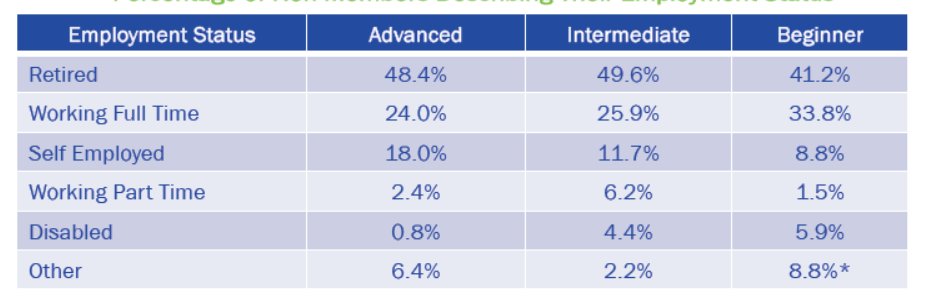 I cannot understand why there would be such an incredible delta for 'Disabled' between these groups. The number of disabled individuals statistically should be approximately the same as long as the sample size was enough. Can anyone explain why there would be such a large discrepancy of disabled people between 'Advanced' and the other two collector groups? Scott, it appears that services such as the APRL and the APS web site are delivering significant perceived value. Can you help us understand better by supplying some cost/benefit analysis in the context of these survey results? In other words, compared to its investment in the new APRL and its perceived value vs. the investment in the APS website perceived value? Don |
|
Send note to Staff
|
|
|
Valued Member
United States
286 Posts |
|
|
The sample size for advanced collectors is largely and presumably older than the other classifications. The number is really, to me, an indicator, of participation.
My interpretation of the website for members is that it is something they rely on as a member. If you you look at non-member use, the numbers are completely flipped which means that a member sees the web as necessary to participating in the APS. That's different than it being valuable.
As for the library, it ranks as one of the most well-known services, my concern with the numbers is the number of members who do not classify themselves as advanced who use it. The way that should read is that members are very aware of the library, but we have not successfully translated the value or need to them individually. |
|
Send note to Staff
|
|
|
Pillar Of The Community
United States
663 Posts |
|
|
The most important observation I take from the survey is an urgency to reach out to youth - 8-13.
Just about all other age groups are "maintainers", but their roots start as kids in the age in which curiosity, adventure and wonder are at the front and stamp collecting feeds off of that.
APS need to apply more "resources" to reaching out to the youth for they are the future of APS.
|
|
Send note to Staff
|
|
|
Moderator
United States
12330 Posts |
|
|
Quote:
advanced collectors is largely and presumably older than the other classifications... Hi Scott, I agree which is why, if anything, the number of disabled folks should be larger than the other groups. I am still baffled by this unusual finding (but doubt it is significant to the overall survey report). Can you tell us how much was spent on the new APRL facility and how much has been spent on the APS website to date? I think it is important to understand the cost/benefit of these two important resources. Thanks Don |
|
Send note to Staff
|
|
|
Valued Member
United States
286 Posts |
|
|
Older or retired individuals would be less likely to identify as disabled then someone who still perceived themselves as being a part of the workforce, but unable to participate. To me, it still speaks to who exactly participated, not necessarily reinforcing the statistical validity.
The library was a $3.5 million construction project - $2.6 million on the last phase completed in 2016.
I don't have the cost of what is spent on the website to date at my fingertips. I'm not sure I really understand the question you are asking since some people talk about the website as the public side and others strictly the backend. A website, either end, is an underlying business requirement today - that does not make it the best it can be and that is why I have focused on revising the front end and ultimately, we will need to focus on the backend. |
|
Send note to Staff
|
|
|
Pillar Of The Community
United States
4505 Posts |
|
|
I think disabled does not fit the category as employment status. I would expect disabled is a subset of other groups. We People are disabled (not fully able). |
|
Send note to Staff
|
Al |
|
|
Valued Member
United States
286 Posts |
|
|
Quote:
The most important observation I take from the survey is an urgency to reach out to youth - 8-13.
Just about all other age groups are "maintainers", but their roots start as kids in the age in which curiosity, adventure and wonder are at the front and stamp collecting feeds off of that.
APS need to apply more "resources" to reaching out to the youth for they are the future of APS. We have three youth-oriented programs serving thousands of youth each year. As a membership tool, there is a 30 lag on recruitment from mid-teens to member for a small percentage of those people. Here is a more troubling statistic that is not covered in the survey in new member recruitment: In 2000, our largest segment of new members was 50-59, just less than one-third. Under 50, 37 percent. In 2016, our largest segment of new members, 60-69 at 31 percent, 70-79 followed closely. Under 50, 12.5 percent. As a membership organization, we need to address the substantially lower number of under 50 (particularly 30-50) collectors joining the APS. |
|
Send note to Staff
|
|
|
Pillar Of The Community
United States
4174 Posts |
|
|
Quote:
The most important observation I take from the survey is an urgency to reach out to youth - 8-13. We can not put all our eggs into reaching the 8-13 crowd, because if we don't continue to attract the 30-50 and 50-60 crowd, there will be no hobby for today's youth to return to when they are older. |
|
Send note to Staff
|
|
|
Replies: 57 / Views: 7,403 |
|



 Posted 03/14/2017 1:01 pm


