First and foremost I apologize for what will likely be a lengthy post.
Quick background: I've spent my life, until recently, in journalism, working as a reporter, editor, and eventually publisher of daily and weekly newspapers and spending some time in PR and digital marketing. I am now, at 47, embarking on my second career as a teacher. I started collecting at around 8 or 9, was active through my teens and fell away when I joined the US Coast Guard. I picked it back up about 20 years ago, when my post-USCG career stabilized. I consider myself an advancedish collector.
One of the challenges of the hobby, in my view, is we keep viewing it through an increasingly archaic and limiting lens. For many people, stamp collecting is clubs, stamp shows, and buying from Linn's classifieds.
Is this how people ranging from youth to even into their 40s approach anything anymore?
My first question then, is always,
what is a stamp collector? Then of course, what is an advanced collector.
About 2 years ago, I was working with a fairly severely autistic child and he wanted to show me his stamp collection. He fired up the iPad and showed me scan after scan. That was his collection. His mom said he'd buy the stamps, scan them, then toss them.
Is he a collector? Most of us would say yes, but I have been told by some no.
Related. How do we connect with kids. I think we do it by time. Everybody wants to turn to social media and youtube. This is where we need to have the information the kids want but what makes the impression, even today, is
time.
The Lord blessed me with three girls. And a wife. And two female cats. The fish was probably a girl before it decided the pressure was too much and flung itself from the tank. Blessed.
All 3 girls have at least some interest in stamp collecting. It varies but what's important isn't the collecting. Rather it is that I take their collections seriously and invest time in them. One is rather serious. At the Nashville stamp show this weekend, she bought an $11 set and started talking about creating an exhibit. That seems pretty serious for an 8-year old.
Here she is debating on whether to spend half her stamp money on one set:
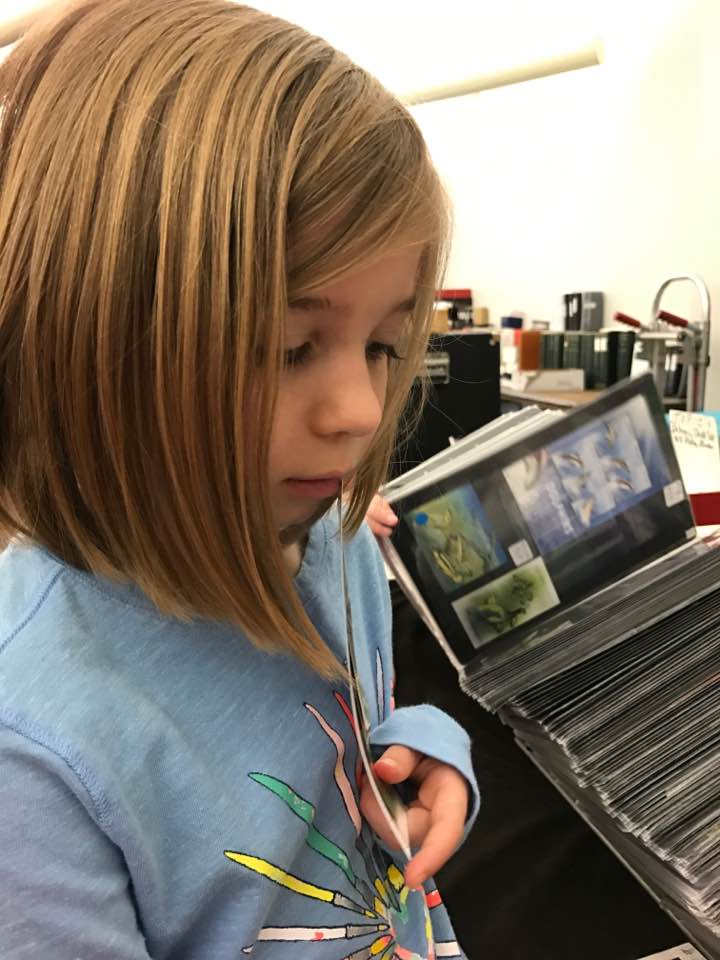
It's about time.
Now this year, something odd happened. I didn't renew a number of memberships including APS. Here's the thing - that failure to renew, and I have various reasons, has no bearing on whether or not I'm a stamp collector. I'm more active than I've ever been.
Quote:
For me, the big takeaway is that the APS should be focusing on catching the 30-50 year old collector. As others have said, youth is important, but we need to bridge that gap from the kids to the old heads.
Seems logical, but long-term membership growth is a sales funnel not unlike an advertising or even a subscription sales model. You have to have something to turn into the 30-50 year-old collector, who can then turn into the 50-65 year-old collector.
Quote:
If the APS is composed of mostly advanced collectors, maybe a way to increase membership would be to turn those beginners and intermediate collectors into advanced collectors.
Exactly. Build that funnel and move collectors along the funnel. That will grow the
organization, but not necessarily the hobby, though it should stand to reason that if you grow the largest organization, the hobby will follow.

One caveat. I still don't buy that the hobby is actually shrinking. When I was last a newspaper publisher, our paid print circulation had fallen off considerably but our readership, via means not traditionally a part of journalism, was much larger than ever.
Has the hobby actually become smaller, or has the way people approach the hobby, buy stamps, store stamps, etc., changed in such a disruptive manner that we can't accurately track who is and is not a stamp collector? And if we could, how many would fail to meet our current definition of what exactly is a stamp collector?





 Posted 03/23/2017 10:26 pm


