|
This page may contain links that result in small commissions to keep this free site up and running.

Welcome Guest! Registering and/or logging in will remove the anchor (bottom) ads. It's Free!
To participate in the forum you must log in or register.
| Author |
 Replies: 154 / Views: 50,869 Replies: 154 / Views: 50,869 |
|
|
|
Rest in Peace
United States
1189 Posts |
|
|
John, thanks for sharing that neat cover. Karl wasn't just a collector, he designed cachets for the series as well. Here's an example of a Karl Scheufler cacheted cover. It's listed in Planty-Mellone as 747-50: 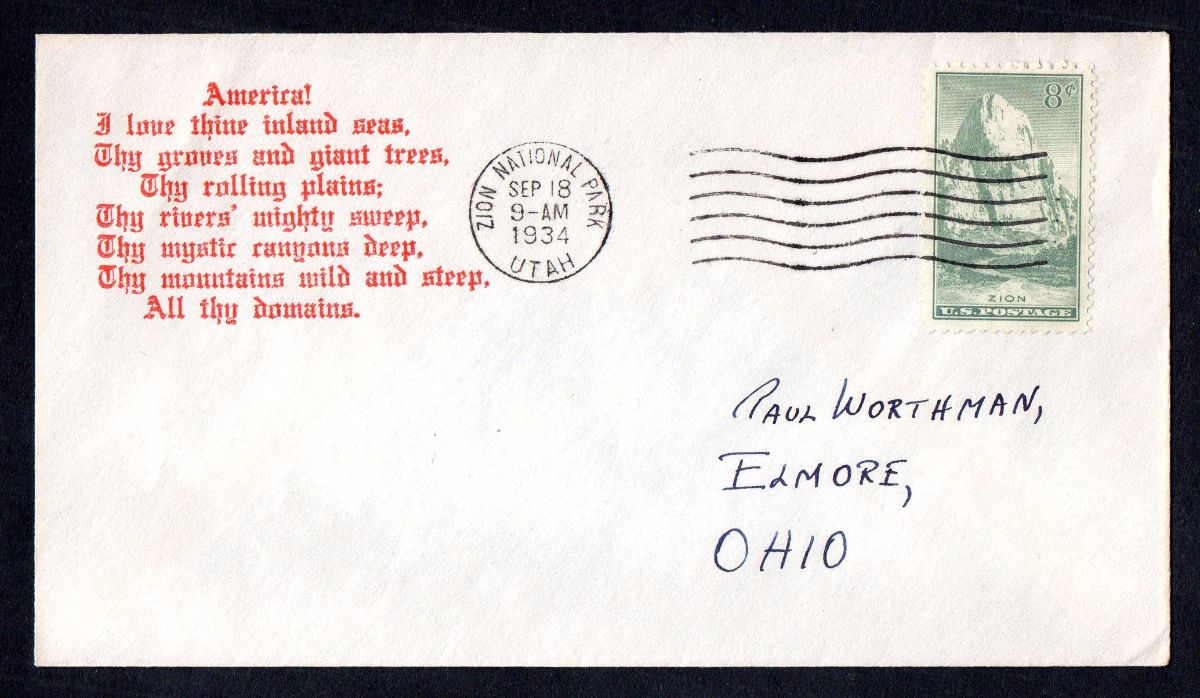 |
Send note to Staff 
|
|
|
Rest in Peace
United States
1189 Posts |
|
|
Scott 770The next issue to be discussed will be Scott 770, the Farley Reprint of the 1934 APS Convention Souvenir Sheet featuring the same design as Scott 742, Mount Ranier, in panes of six each. The design of the Farley Reprint remains the same as the previous issue (Scott 750). As with the other Farley Reprint souvenir sheets, the only distinguishing characteristic is the presence of larger margins than would be possible on singles of the original souvenir sheet or to collect them in pairs or blocks with gutters between. An example, showing the smallest margins safe to identify this as Scott 770 is shown below. Note that the left margin is slightly larger as the original souvenir sheets, Scott 750, were trimmed quite closely to the external lettering around the sheets. 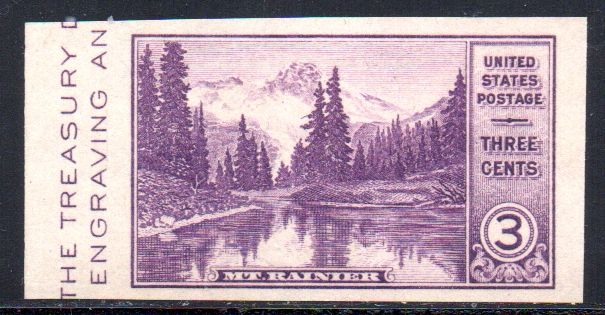 Collectors wishing to complete their Scott National and other albums will need to collect the issue in pairs, both a horizontal pair with a vertical gutter and a vertical pair with a horizontal gutter between. These are shown below. 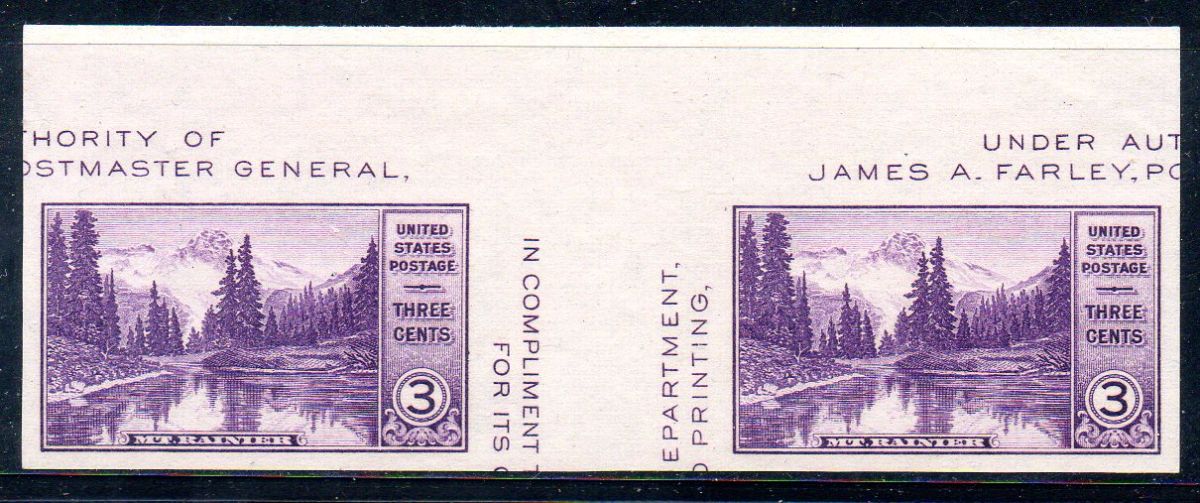 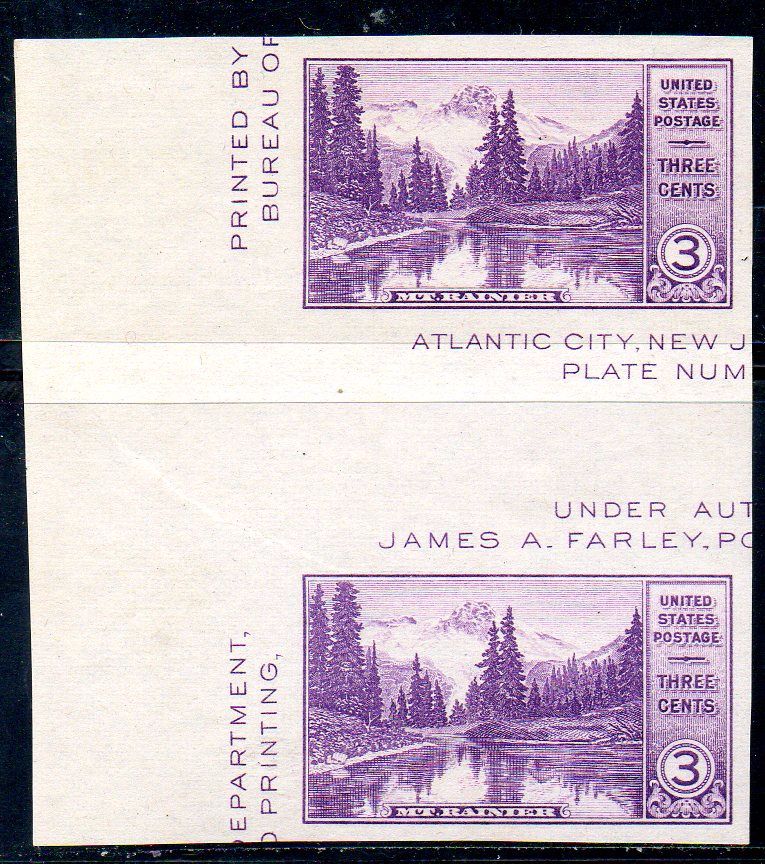 Another important position piece would be the cross gutter blocks of four. Scott 770 was issued in sheets of twenty souvenir panes per sheet. This configuration gives the possibility of eight cross gutter blocks of four. An example of this is shown below: 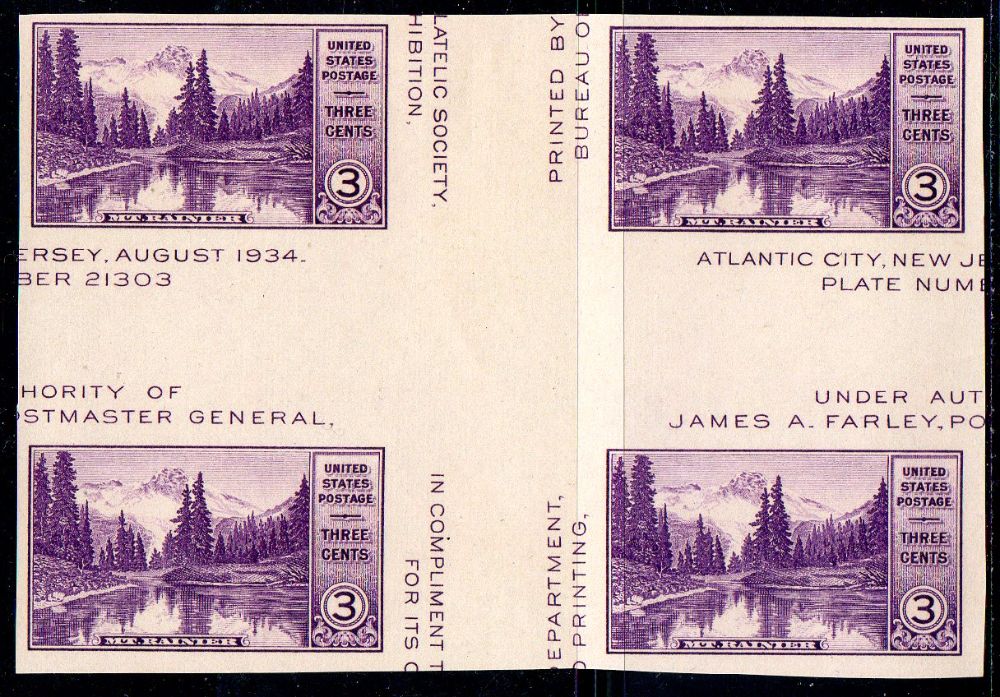 Another possibility is to collect pairs of souvenir sheets, either vertically or horizontally. Examples of these are shown next: 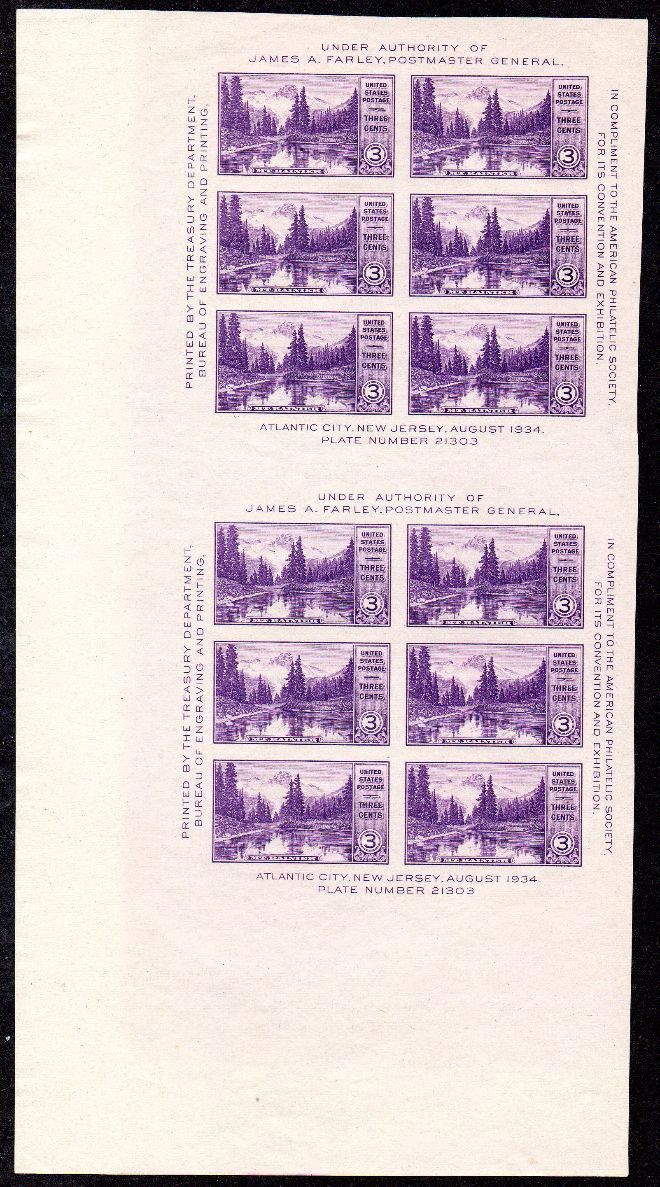 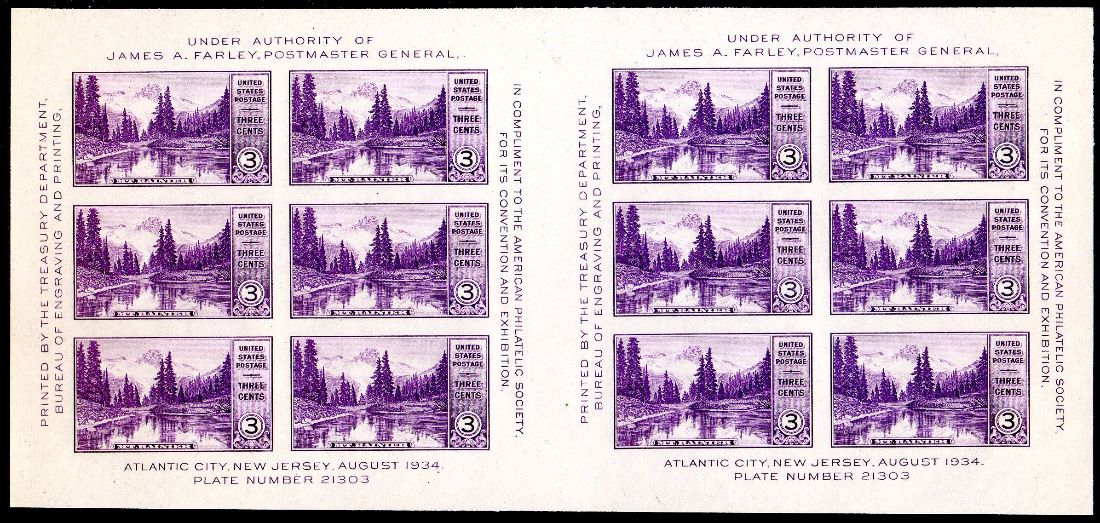 The final position piece shows an entire souvenir sheet with parts of eight sheets surrounding it as well. This is my favorite way of showing these sheets. 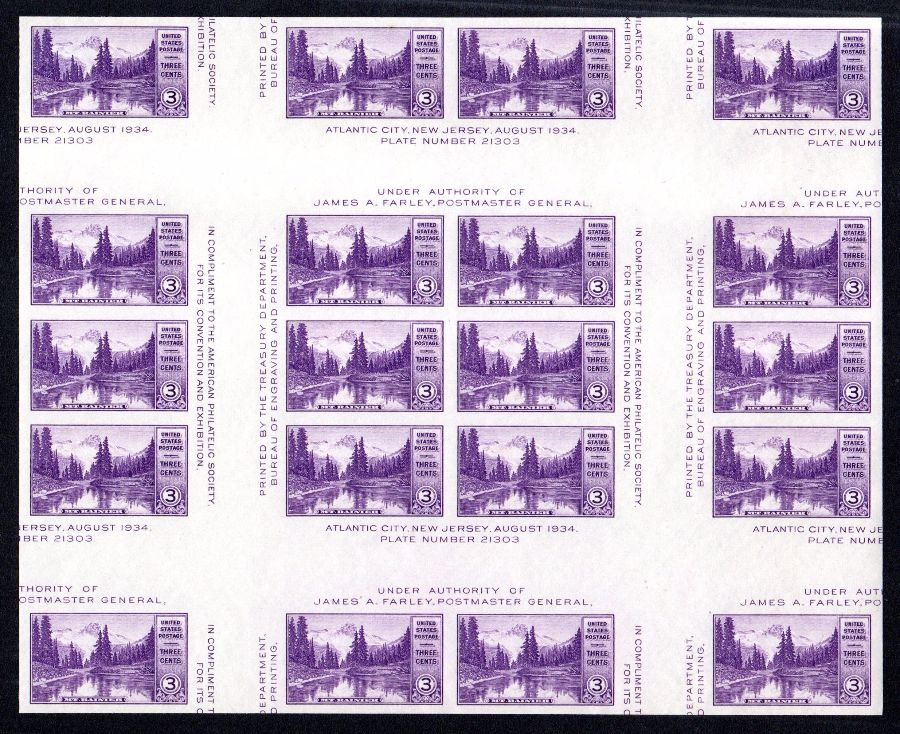 While I'm sure there are some postally used examples that exist, I have yet to find any. This, along with the other souvenir sheets, would have been both a time consuming venture and one which would have provided a company with storage problems. Any existing non-philatelic covers would likely have arisen from a collector paying a bill rather than originating with a company. This brings us to the First Day Covers. The first two covers are both Harry Ioor cachets, in purple, the issued color of the stamp. These are both Planty-Mellone 770-2. Two reasons for showing both covers: First, there is a shade difference which is quite noticeable in the cachets on the covers. The second is that an example of both the vertical line pair with horizontal gutter is shown as is the horizontal pair with vertical gutter. Here are the Harry Ioor cacheted covers: 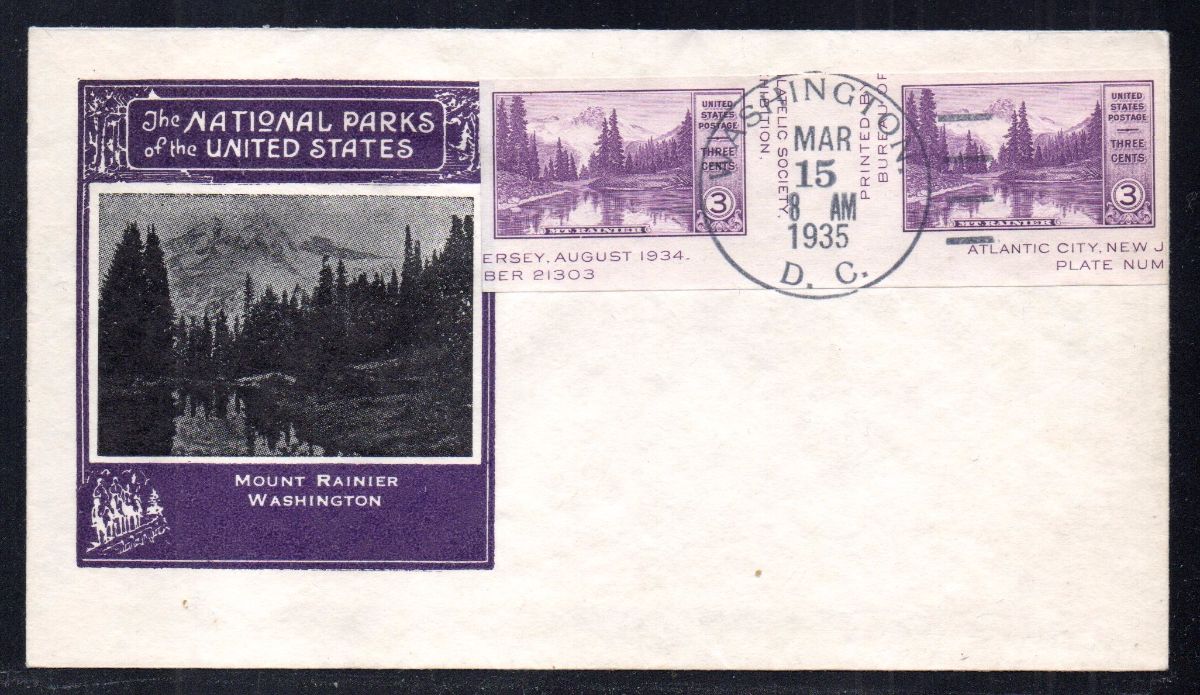 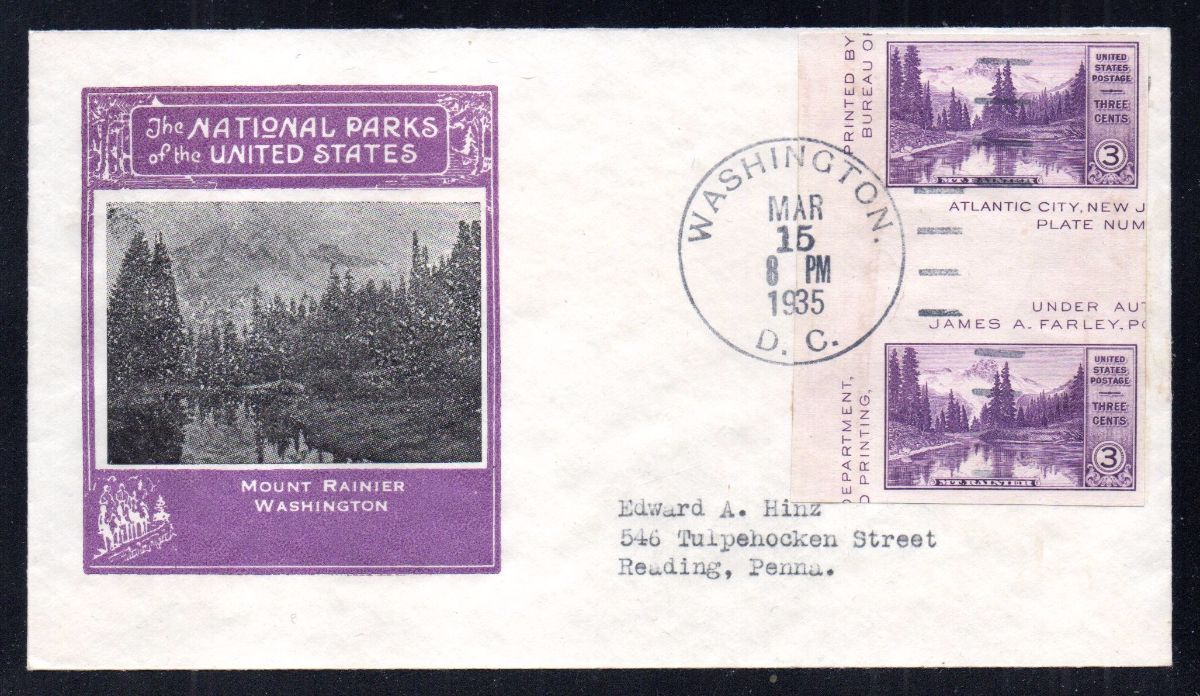 As I've done with previous issues in this series, I'll compare a couple of covers with another which copies major elements of the cachet. The original cachet, shown on this next cover, was produced by Ralph Dyer. This is Planty-Mellone 770-8. 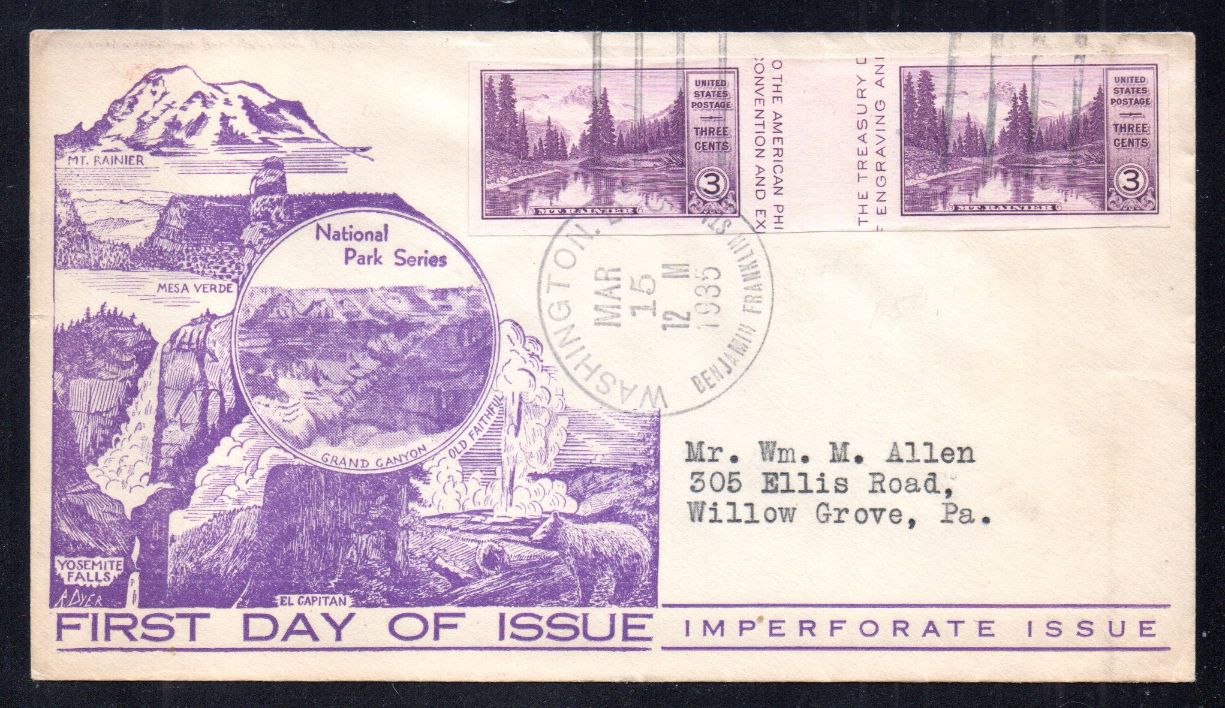 The next cover, which has some elements similar to the Ralph Dyer cachet, is still more individual than some shown for other issues. This is the 1st Ron Hubbard cachet and was used in colors matching the stamps for the Farley Reprints. This is Planty-Mellone 770-16. 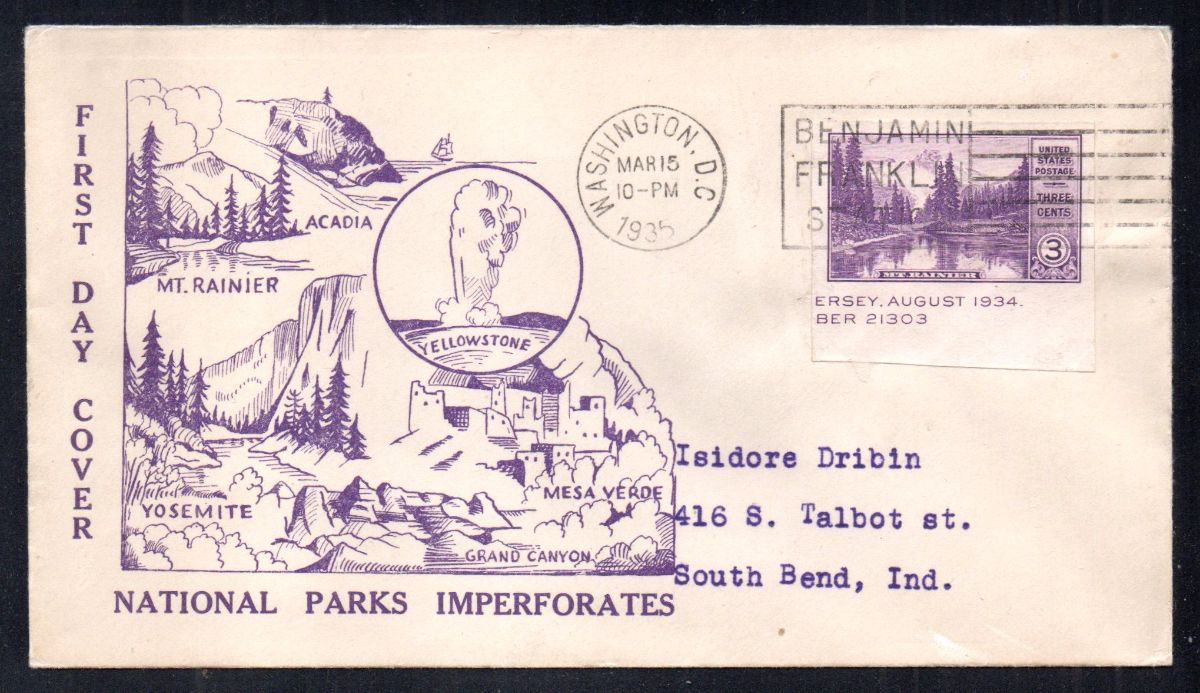 Some generic cachets were used, including the next cachet from an unknown cachet maker. This cachet depicts an open stamp album and is seen on several different issues, as a generic cachet, during the 1930s. This is Planty-Mellone 770-15. 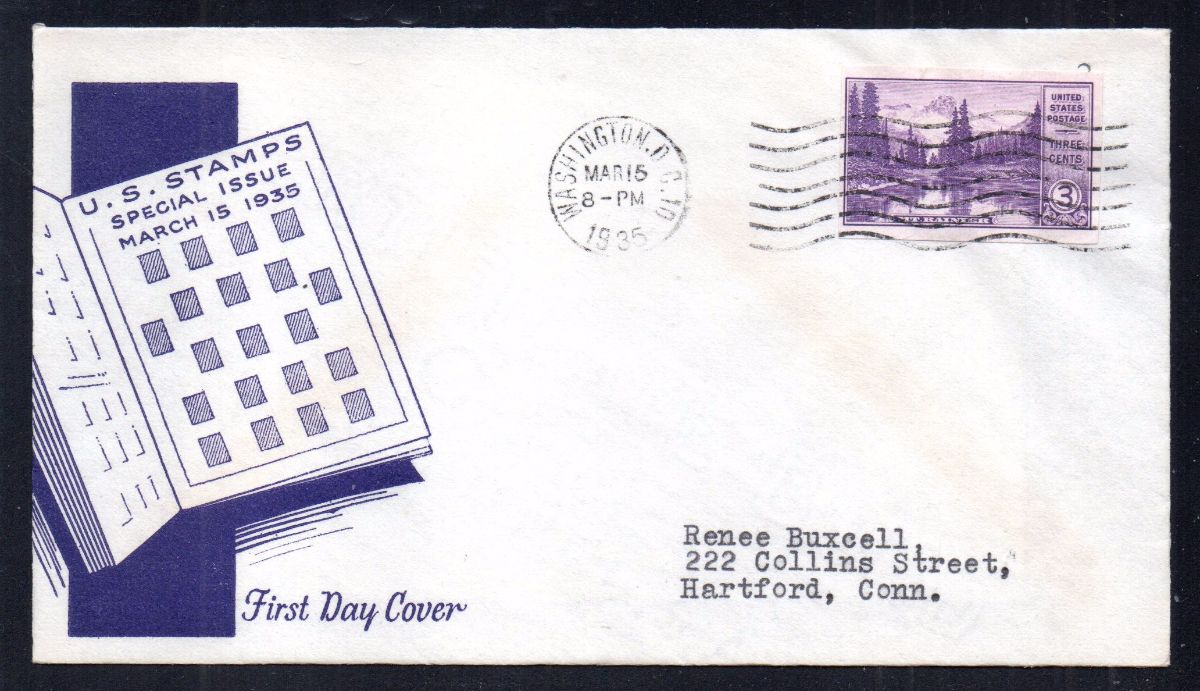 The next FDC is one which is also a generic cover, but one which is not seen often. This the Reliable cachet, done in blue and black. It features a bottom right pair of Scott 770. This would pay the airmail rate at the time. It is Planty-Mellone 770-21. 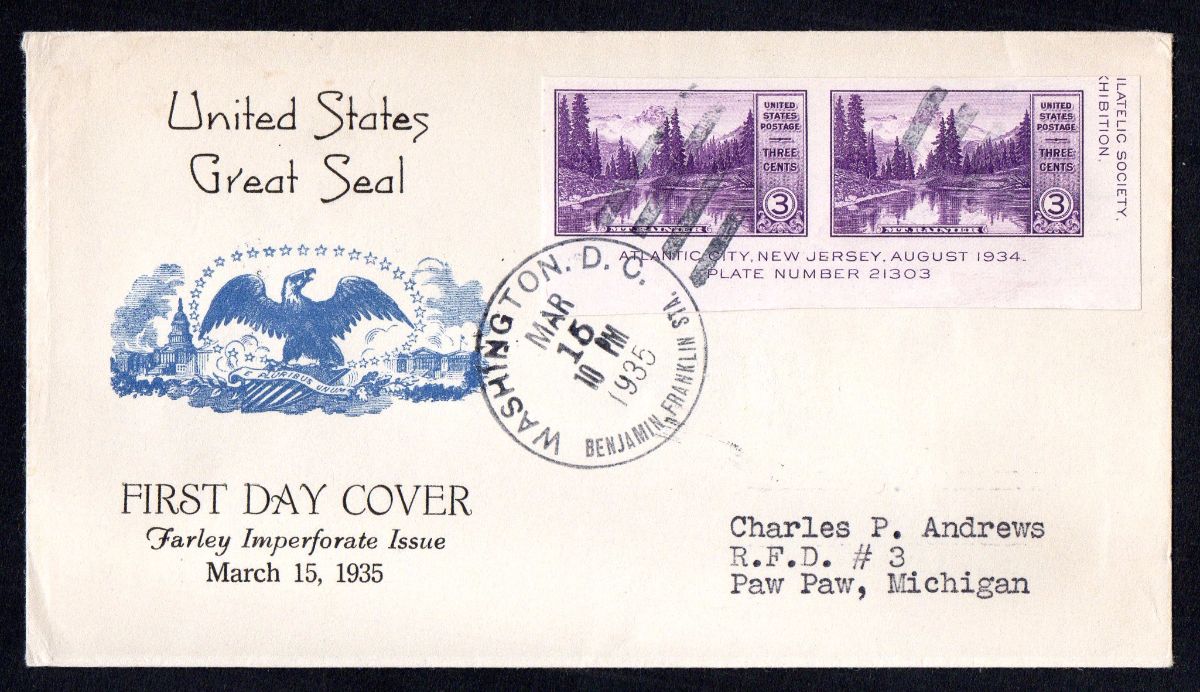 One of my favorite cachets of this period are those created by Clara H. Fawcett. This cachet is shown on the next cover. It is Planty-Mellone 770-26. 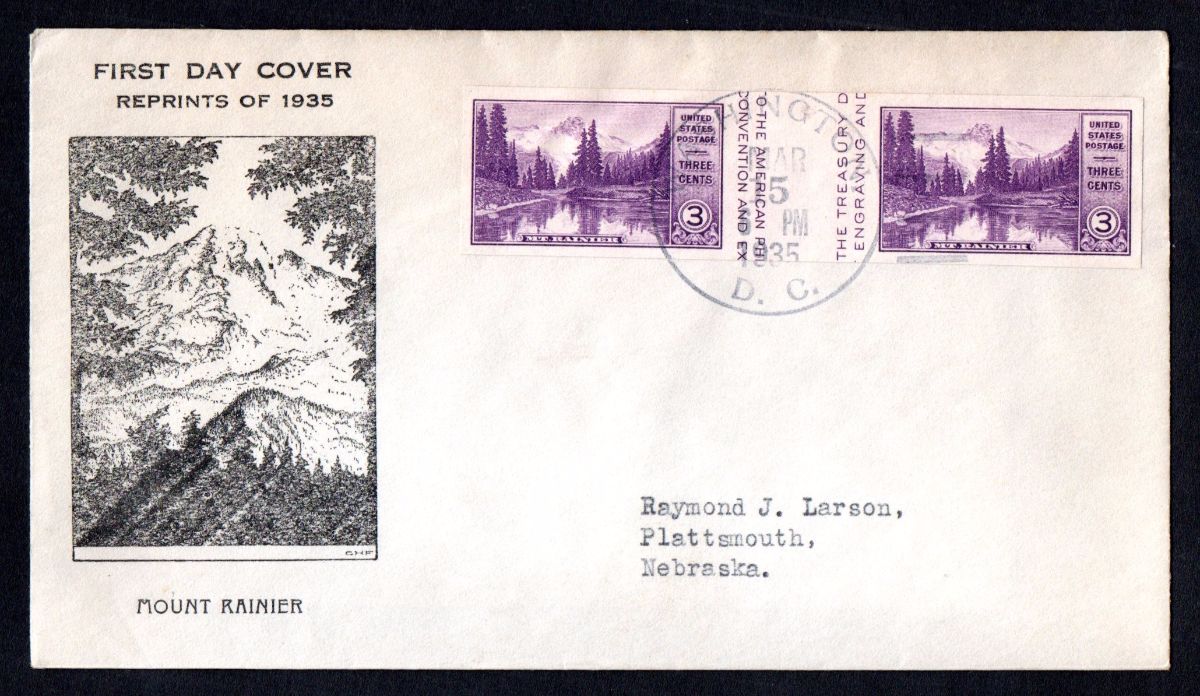 The final cover selected is another of those whose maker's name has faded into the mists of history. This appears to be a generic type cover, feature the U.S. Capitol building at left. It is Planty-Mellone 770-45. It features a horizontal pair with vertical gutter between. Perhaps the reason we don't know who created might be that they didn't want us to know, given the rather poignant cachet wording. 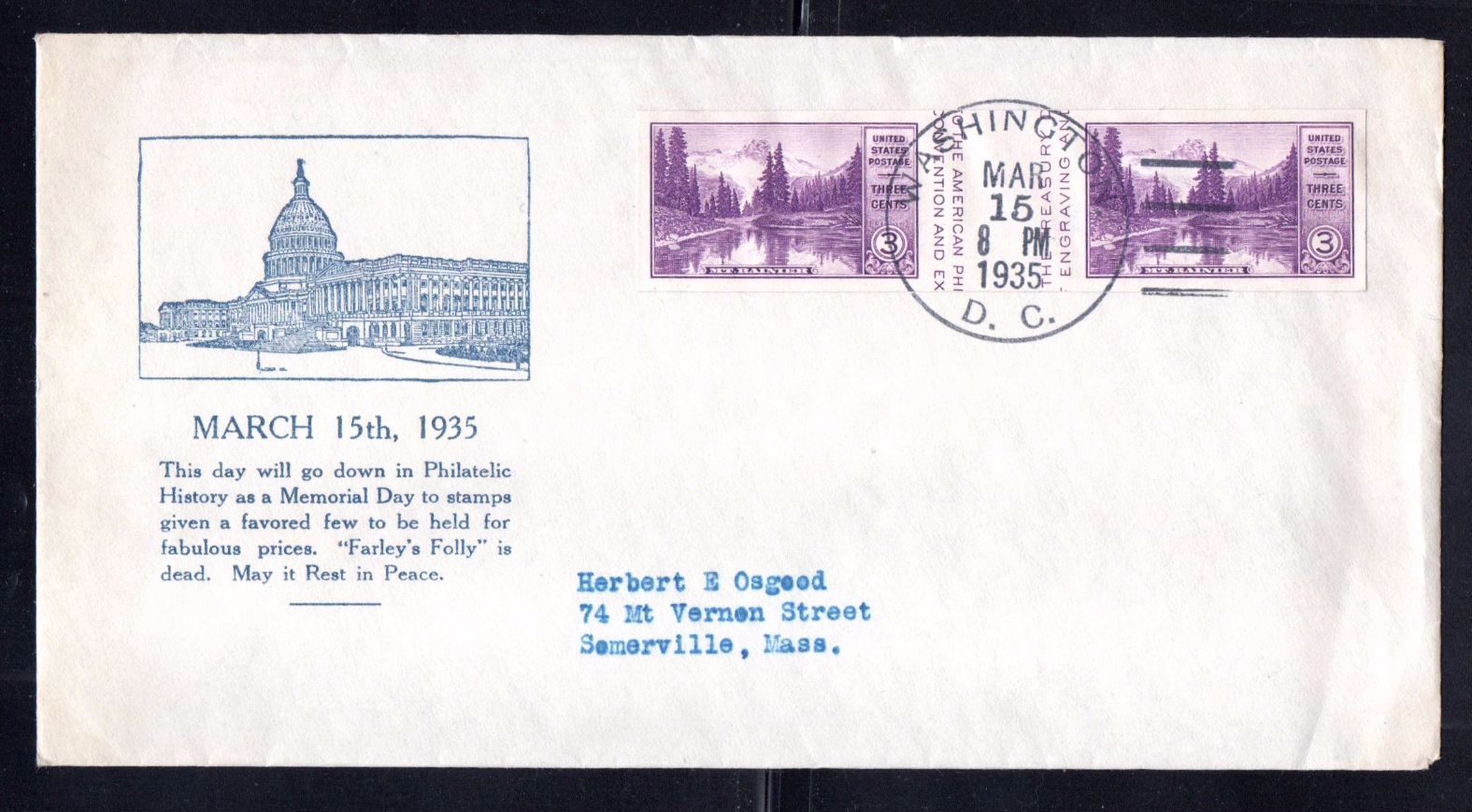 This concludes the discussion of Scott 770. The next thread will discuss Scott 771, the Farley Reprint of Scott CE1. After that will be one more post to this thread to tie everything together and present some combination covers. As always, I look forward to seeing what anyone has to share relating to this thread. Comments and questions are always welcome. |
|
Send note to Staff
|
| Edited by Stampman2002 - 11/04/2017 1:14 pm |
|
|
Pillar Of The Community

United States
5468 Posts |
|
|
Rest in Peace
United States
1189 Posts |
|
|
Scott 771The final issue in the Farley Reprint series was the imperforate version of Scott CE1, the airmail special delivery stamp. This stamp was designed to be an all-inclusive stamp, covering the cost of airmail and special delivery. Changing rate structures, particularly air mail rates, were not conducive to continuing such a combination in a single stamp for the future. These was only one other stamp in this category ever created, Scott CE2. The stamp was issued in sheets of 200, the same as the National Parks series of stamps. Unlike the other stamps in the Farley Reprints, this stamp represented a considerable cash outlay for a sheet - $32.00. Few people were either willing or able to do this at the time. This is the reason why the position pieces for this issue are the most expensive in the series. An example of a single is shown below: 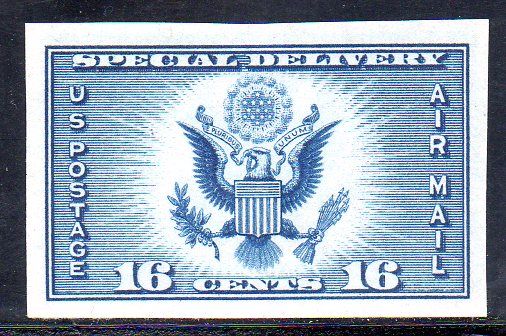 The position pieces most collectors are familiar with, and which most albums will have a space for, are the pairs with horizontal lines and vertical lines. Examples of these are shown below: 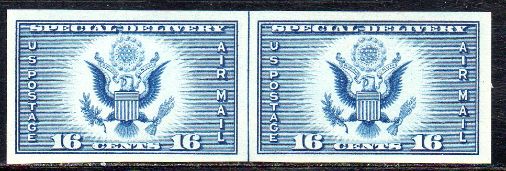 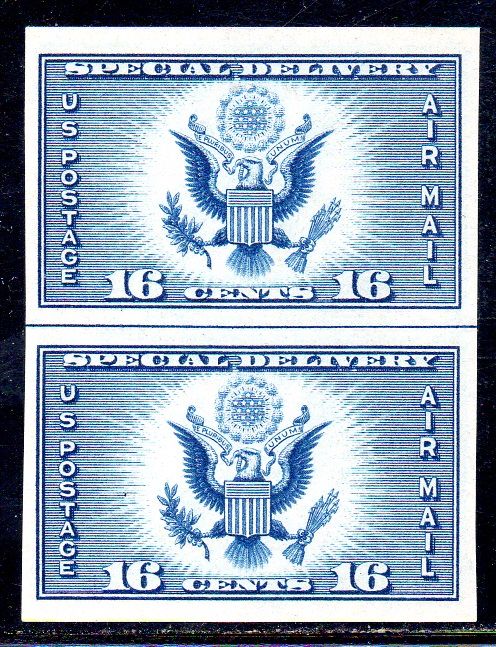 Some collectors prefer to collect these positions in blocks. The block of four with a horizontal line and the block of four with a vertical line are shown next: 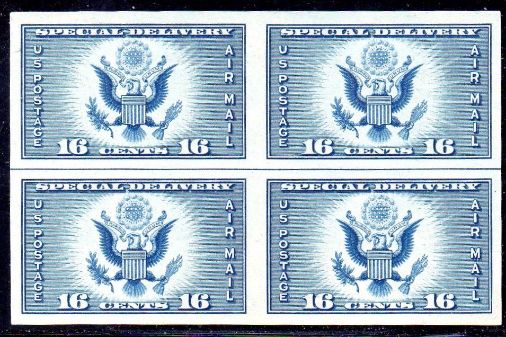 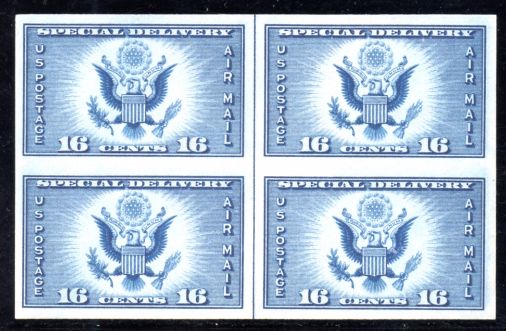 As with other 200 impression sheet stamps, the key position piece is the centerline block. There is only one per sheet. The normal size is considered a block of four. This is shown below: 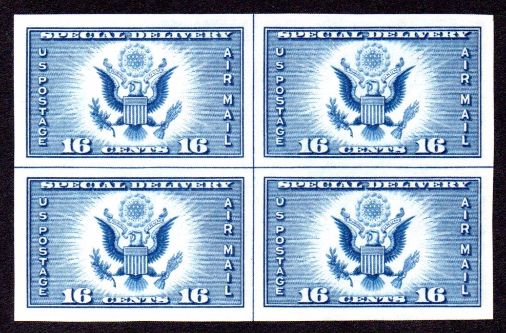 As everyone know by now, I like larger blocks. A centerline block of sixteen is shown below: 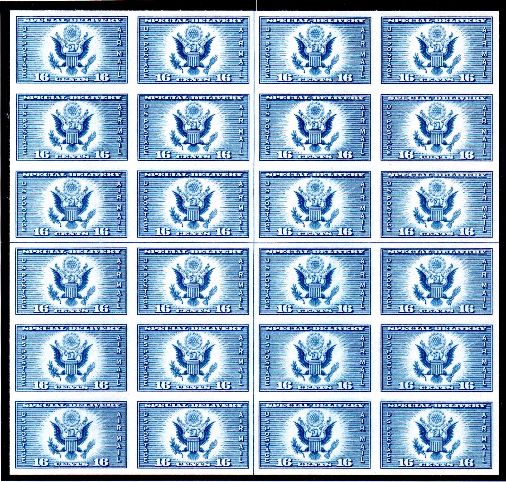 The next position pieces are the arrow blocks. These are guidelines meant to be used by the operators cutting the sheets into panes. These arrows are found in the margins of the sheets at the top, right, bottom and left. They are shown below: 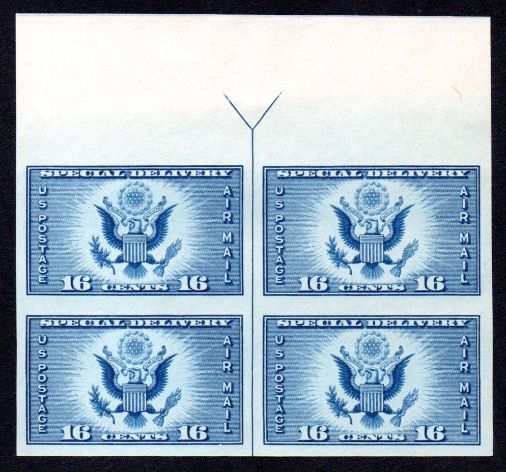 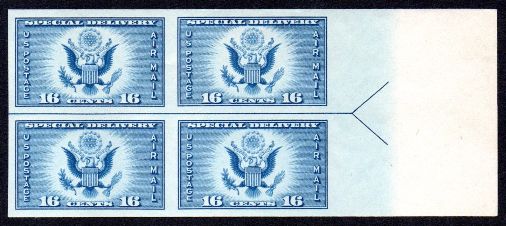 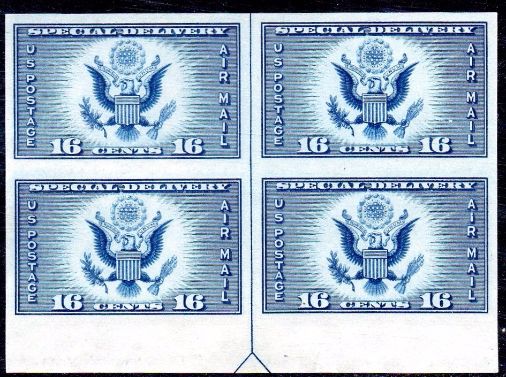 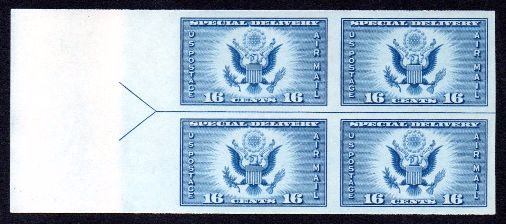 The last position pieces are the plate blocks. As with most of the other issues in the Farley Reprint series, there were four plates used in printing these stamps. A complete set of plate blocks for plate 21313 is shown below: 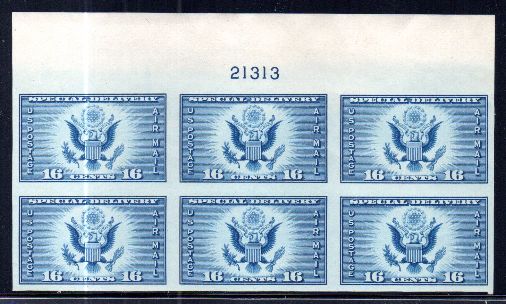 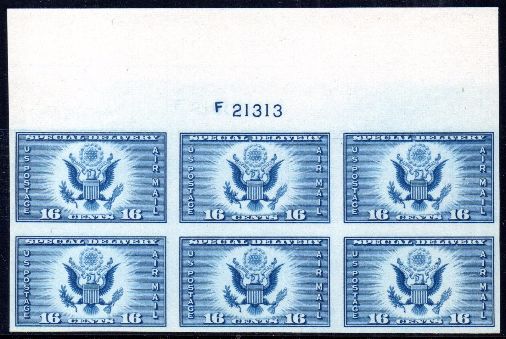 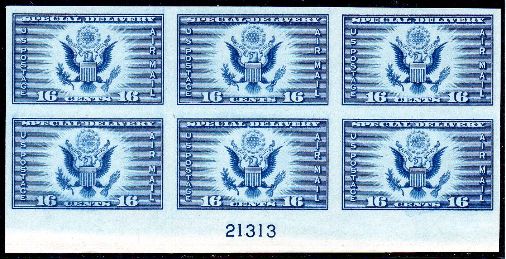 Following the format I've used throughout the thread, the next items discussed will be a selection of First Day Covers. The first cover selected was created by Grimsland and is printed on an airmail envelope with the lozenges around the border of the envelope. Besides the cachet at right, it is printed with the "AIR MAIL" indicator underneath the stamps. Note the purple rubber hand stamp which indicates that special delivery was also used and that the Washington D.C. post office, where the cover was cancelled, collected that fee as the first office of delivery. This cover features a horizontal pair and is listed in Planty-Mellone as 771-1. 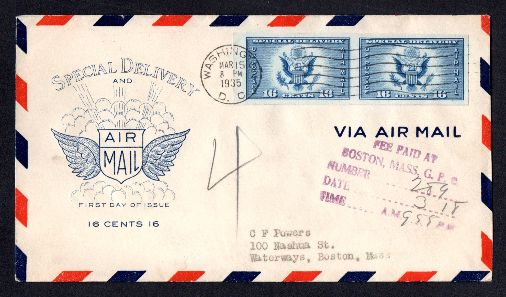 The next cover was created by Harry Ioor and is a general purpose cachet. This has the added distinction of the being the cover pictured in Volume VII, page 71 of the Planty-Mellone catalog. It is Planty-Mellone 771-2GP. 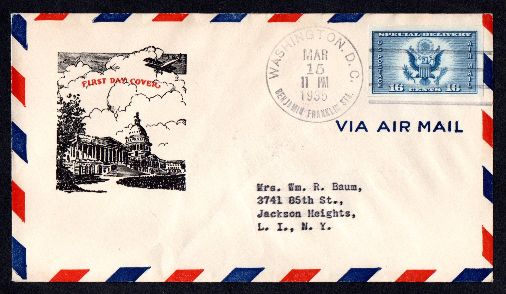 The next cover was created by C.S. Anderson and is a dramatic departure from the usual black image and text cachets he is known for. This is listed in Planty-Mellone as 771-3. 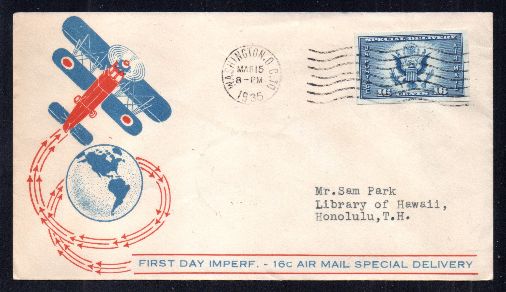 The fourth selection for this issue comes from Ed Kee. This features a vertical pair of Scott 771. It is listed as Planty-Mellone 771-9. 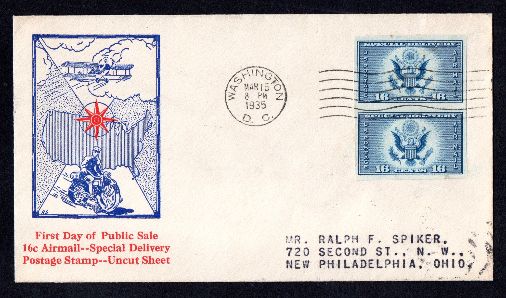 The fifth cover selected was the first design by D. and Homer Roy. A different handstamp, in purple, declares that the special delivery fee has been claimed by the office of the first address, which is again Washington D.C. This is Planty-Mellone 771-16. 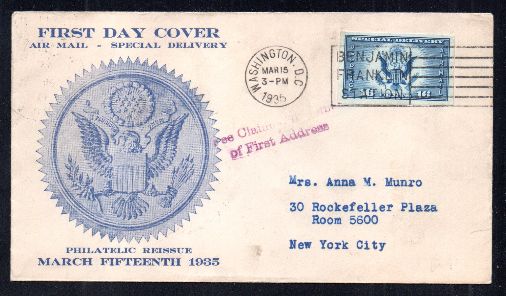 The final First Day Cover was chosen because it represents a commercial interest rather than a cachet. Granted, the McCaddon Company dealt in stamps and first day covers, but rather than create a cachet, the company used its normal corner card and added a pointing hand to the stamps. This is listed in Planty-Mellone as 771-GP1. 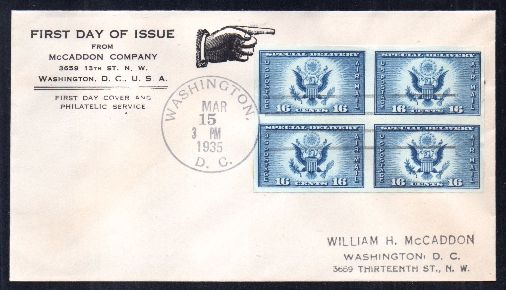 With this issue, and with some of the other issues in the imperforate series, there are stamps known which were privately perforated. Every once in a while, someone mentions having found a National Parks stamp or the Airmail Special Delivery stamp with a perforation which doesn't match the issued stamp's perforation 11. These privately perforated stamps are perforate 14. I was able to obtain the examples which follow from the award winning exhibit by Hideo Yakota. Given that all of the stamps on cover known with the perforate 14 private perforations are from one source, the philatelic dealer Y. Souren, it is a very good probability he was the one who privately perforated the stamps. The first item shown is a single, shown below. 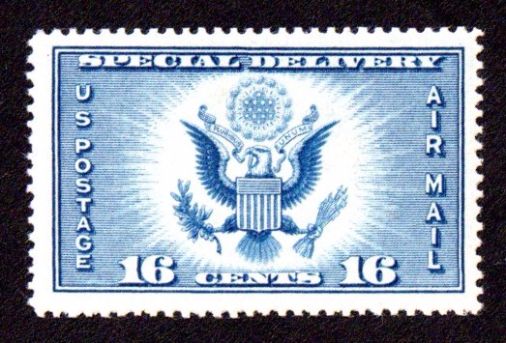 I also have a left margin block of four with the perforate 14 private perforations. This is shown below: 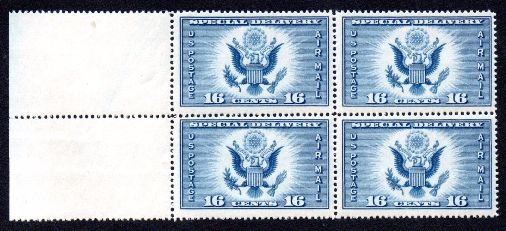 The final item is a use on cover. It includes Scott 720, the 1932 Washington regular issue three cent stamp; Scott 642, the 1926 rotary ten cent stamp; and Scott 794, the five cent stamp from the Army-Navy series. According to Yakota's exhibit information, this is one of three known surviving covers using the privately perforated Scott 771. It is shown below, front and back. 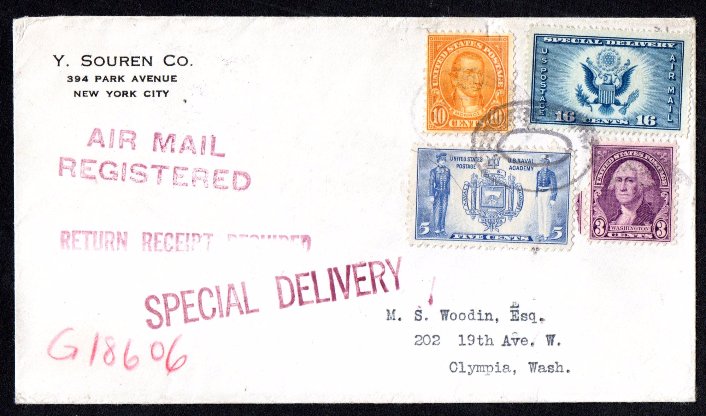 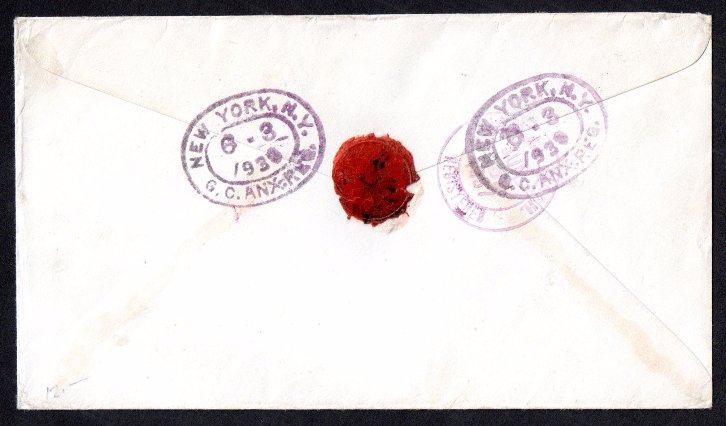 This concludes the discussion of Scott 771. I will have one more post to this thread to present some combination covers, update recent additions and provide a summary. As always, comments and questions are welcome and encouraged. If you have any material which compliments the thread, please share it with everyone. I'd love to see it! |
|
Send note to Staff
|
| Edited by Stampman2002 - 11/11/2017 6:51 pm |
|
|
Valued Member
77 Posts |
|
|
I didn't realize that the private perforation existed on the 771. I have been accumulating commercial CE1 covers over the years. The "Y Soren" corner card seemed familiar to me for some reason. I'll have to see if I have one of those!
Your comment about the high cost of a full sheet of 200 is noteworthy. Is there any estimate for how many of those survive?
Thanks for the wonderful thread! |
|
Send note to Staff
|
|
|
Rest in Peace
United States
1189 Posts |
|
|
While there is no census of surviving sheets, according to Hugh M. Southgate, reporting in the September 1935 Bureau Issues Specialist (Vol VI, No. 5 - Whole issue 67), in an article entitled Presentation Sheets, there were only 5,734 originally sold by the USPOD. I would be very surprised if there are more than 10% of those still remaining intact, given the collector desire for position pieces and plate blocks. That may be a very high estimate, in fact. |
|
Send note to Staff
|
| Edited by Stampman2002 - 11/12/2017 07:01 am |
|
|
Valued Member
77 Posts |
|
|
Thanks Stampman2002. Given the cost of the sheets and the economy in 1935 that is a HUGE number to me! But it is consistent with the production numbers for 771 I found elsewhere on the internet.
Since these special printings were created strictly for collectors, I find it amazing that the production run for CE1 was only 7x the number of the 771 special printing. There must have been a lot more stamp collectors in 1935 relative to the general population and they must have hoarded 771 and CE1 as evidenced by how easily these stamps are obtained today!
|
|
Send note to Staff
|
|
|
Rest in Peace
United States
1189 Posts |
|
|
Wrapping It UpTo begin with, let me share the promised multiples on cover. I've had the fortune to add another full set of the original National Parks on a cover. This one was prepared by the father of the person it is addressed to. I obtained this from his son, who told me how his grandfather was the first mailmain in St. Paul, Nebraska and that he was an avid stamp collector. Nice story to go with the cover. 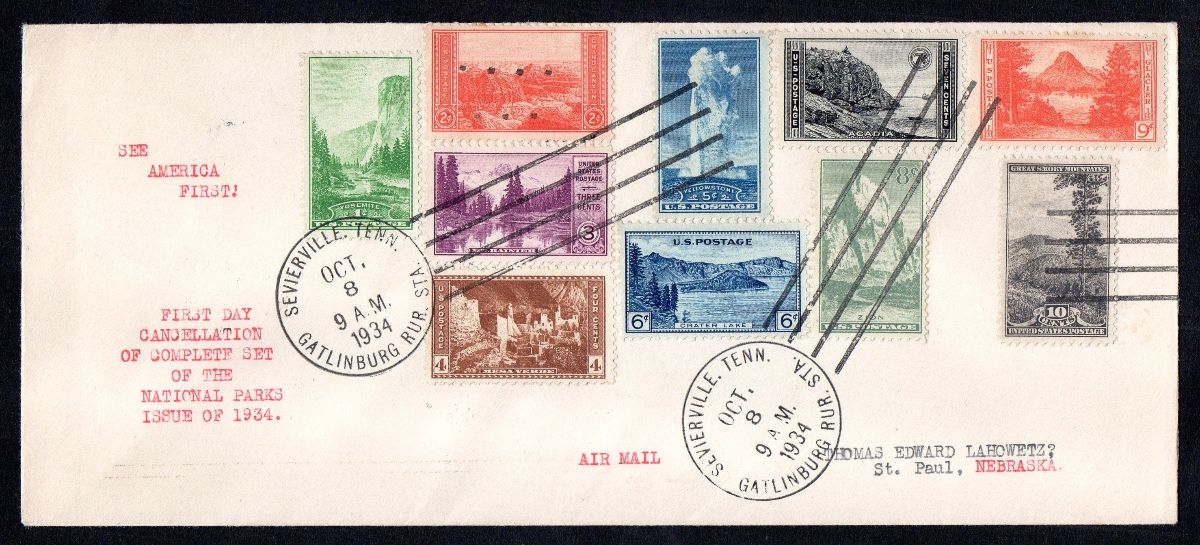 The next group of covers use the Farley Reprints. The first one has all ten issues of the National Parks, in singles, and is an unlisted First Day Cover in Planty-Mellone. The next cover shows all the pairs from everything except the National Parks on one cover. 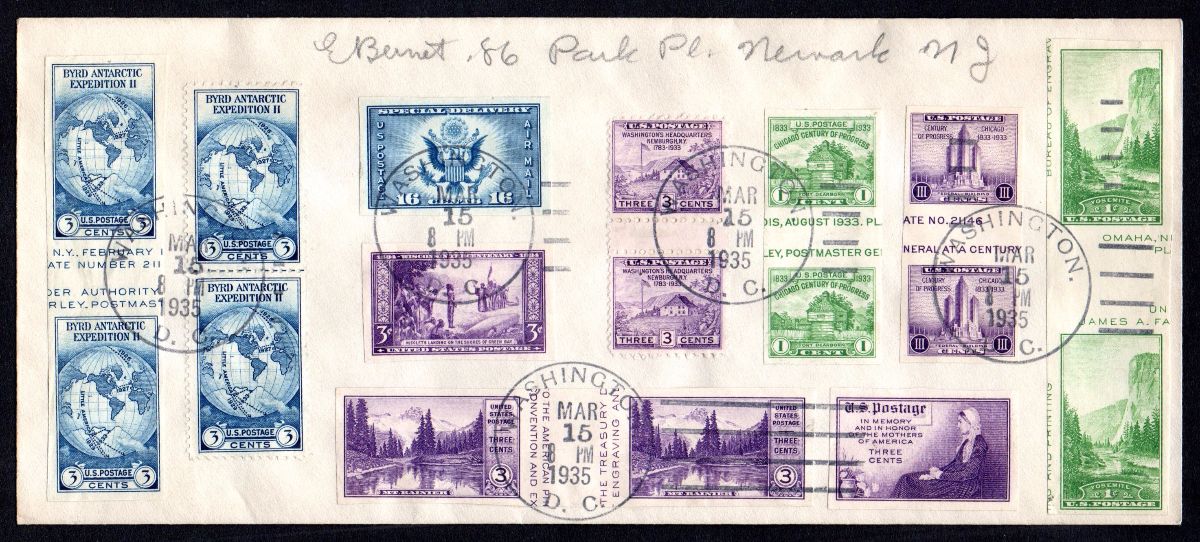 The final cover was created by W. M. Mooney, the Postmaster of the Washington D.C. post office, which was tasked with taking care of the entire Farley Reprint series. This cover has pairs of all the stamps except the souvenir sheets (766-770). It also is unlisted in Planty-Mellone. 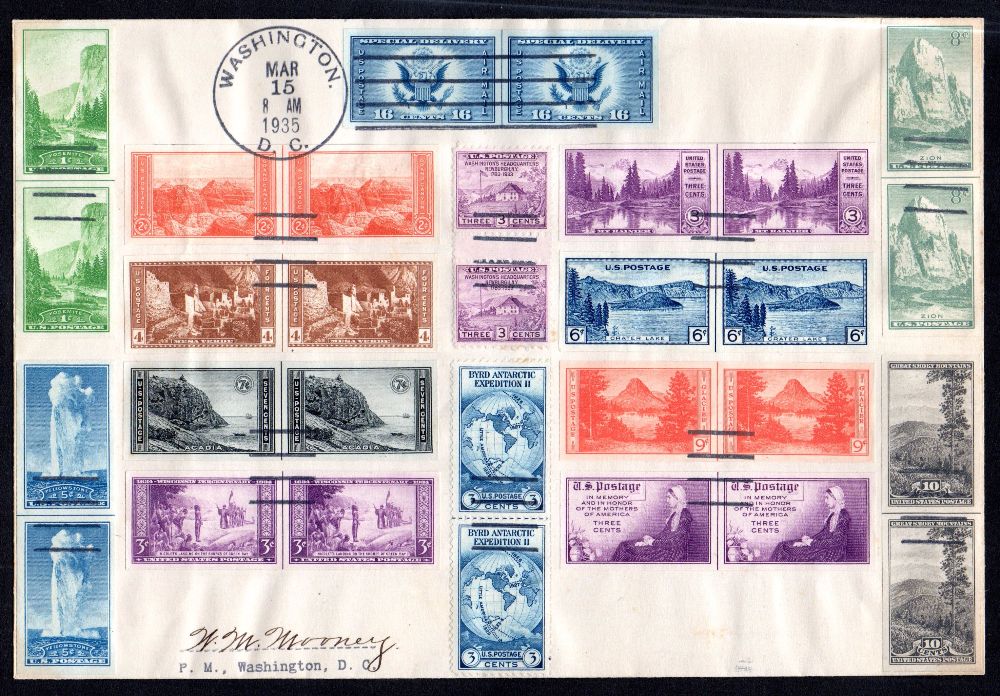 Summation SummationThe era of the National Parks series, and those issues which preceded them under the direction of Postmaster General Farley, was a period which gave the PMG a sharp learning curve vis-a-vis philatelists and what they viewed as proper and acceptable. I've mentioned before that PMG Farley was a career politician and never a stamp collector, let alone a philatelist. He didn't understand the ramifications of taking stamps which were not finished, i.e. imperforate, when that type of stamp would not be available for purchase by collectors. Even years later he still was genuinely puzzled about the whole "Farley's Follies" thing. Scott catalog editors do a pretty good job most of the time. They have a lot to look at every year, what with the constantly changing market prices and new issues. But I have to say I believe they missed the mark completely with the note they added this year before the 1934 National Parks issues. The statement that the imperforates which exist because of PMG Farley's gifts to certain "friends" in high places was a corrupt practice is untrue and skews the story greatly. No one who is doing something corrupt does it with the press taking pictures. Farley followed the policies of the time, purchasing every stamp he received. No one in the Post Office Department, the Inspector General's Office or the Bureau of Engraving and Printing had any problem with what he did. Point in fact is that Farley would give all the stamps he retained personally from this to the Smithsonian Museum of his own free will, without pressure from outside sources. Part of the problem also stemmed from the philatelists' view of what was considered collectible for a "proper" stamp collection as the time. Most of the philatelic press in the mid-1930's scoffed at the idea that the imperforate stamps would even be considered anything other than printer's waste. Things such as proofs and essays were not considered appropriate material at the time either. Times have changed, as have collector preferences. Most collectors today look at everything to do with the production of stamps as something which helps tell the story behind the stamps themselves. Essays, proofs and varieties are eagerly sought out as is borne out by the prices collectors are willing to pay for this rare material. This earlier mentality still colors how catalog editors look at it, though. If the philatelists of the time didn't think it should be listed - and that was adamantly stated - then why should it be listed now? It should be listed because it exists, it is part of the story of why the Farley Reprints exist and it shows the cause and effect relationship between the events and the stamps which resulted from them. They should be listed because the information is still relatively fresh, even those this is 83 years in the past. The further removed from the event, the more is lost. For example, I've been researching the provenance of the FDR imperforate sheets. I know they were sold in the 1946 H.R. Harmer sale of his collection as a single lot, garnering a $1,000 price for the National Parks sheets alone. I know that Stanley Gibbons at some point, I believe in the 1950's broke the sheets up, placing a Stanley Gibbons rubber stamp on the back of each, along with the plate position of the stamp and "FDR". However, I cannot find anyone who can definitively point to this having been done; it's a known event, but no one left can "tell the story" now or provide hard evidence. Stanley Gibbons of New York has been gone since the 1970's, the people who were involved have long since departed this existence and it is likely to have become lost in the mists of time. This is one of the reasons why I took the time and effort to create this post, why I've been writing the series of articles appearing in the United States Specialist and why I truly believe that both the photographic essays and 1934 imperforate National Parks issues should be catalog listed. After careful consideration, I would propose the following listing additions. 740 - 749 - normal production stamps 740A-749A - full imperforate sheets. These would include the Farley owned sheets and those belonging to Third Assistant PMG Eilenberger. 737C, 739C and 740B-749B - the FDR imperforates sold through Stanley Gibbons. 740C-749C - the gummed imperforates certified from the Harold Ickes collection which came from the signed arrow blocks prior to certification. All of the above are genuine examples, known to philatelists and a definite part of the story. The other material which has not been listed but deserves recognition are the photographic essays, such as the ones from the collection of the Director, Bureau of Engraving and Printing, Alvin W. Hall, and the ones issued by the USPOD, which are about twice the size as those from the BEP files. The argument that these are not "legitimate" because they did not cross a sales counter at the post office is disingenuous. There are many items in the catalogs which don't meet this criteria, but still merit listing. I still believe that someday, these will find their way into the catalogues and, in doing so, help keep the story of these stamps complete and alive for future generations. At the end of the day, however much we cherish the stamps in our collections, we are only the caretakers for future philatelists. I thank everyone who has stuck with this thread and added to the discussion. As always, your comments and questions are welcomed. |
|
Send note to Staff
|
| Edited by Stampman2002 - 11/13/2017 7:35 pm |
|
|
Pillar Of The Community
6357 Posts |
|
|
Rest in Peace
United States
1189 Posts |
|
|
Valued Member
United States
238 Posts |
|
|
Excellent series of posts! I finally have all of the center line blocks of the National Parks issues; working on the Mother's Day, Wisconsin Tercentennary and the Air Mail Special Delivery issues next. |
|
Send note to Staff
|
|
|
Rest in Peace
United States
1189 Posts |
|
|
I would ask everyone's help, if you would please.
I mentioned the scarcity of the Scot 742 plate number 21332 in this thread. There are conflicting accounts about it. The one I have in hand is from an award winning exhibit which states they are rare and most were destroyed. The numbers shown by the Bureau Issues Association of the time show many more.
What I would ask is that everyone check their collections and see if you have any of Scott 742, plate number 21332. If you do, please let me know and, if possible, send a scan of the plate block along with your response.
You help in this matter is greatly appreciated. |
|
Send note to Staff
|
|
|
Valued Member
United States
44 Posts |
|
|
Fantastic series. The 1934 Parks have always been a favorite and were probably the one issue that drew me into collecting. The modern update on the Farleys is of note, if only to remark at how much of a stink that would raise if it happened today. But in the 1930 things were different, and while the entire Farley affair is somewhat regretful from the standpoint of ethics, its outcome created an enduring legacy for collectors. |
|
Send note to Staff
|
|
|
Rest in Peace
United States
1189 Posts |
|
|
Unhinged, Thanks for the kind words about the thread. It's been a great series to study and I'm still finding new things. For example, this cover came up on ebay a few weeks ago and I snagged it quickly. It was described as Scott 742 with rouletted perfs???? and that was it for the description. What it is in reality is Scott 758 with rouletted perforations, done after the Farley Reprints were finished. Many dealers sold discounted postage lots of the leftovers from cutting out the position pieces (corner blocks of four, plate blocks, arrow blocks and centerline blocks.) There was a market for those pieces, but not enough to sell off the singles which remained. Hence, the discount postage. Several issues are known with perf 15 or perf 14 perforations added to facilitate separating the stamps. Now, it's also known with rouletting. Here's the cover: 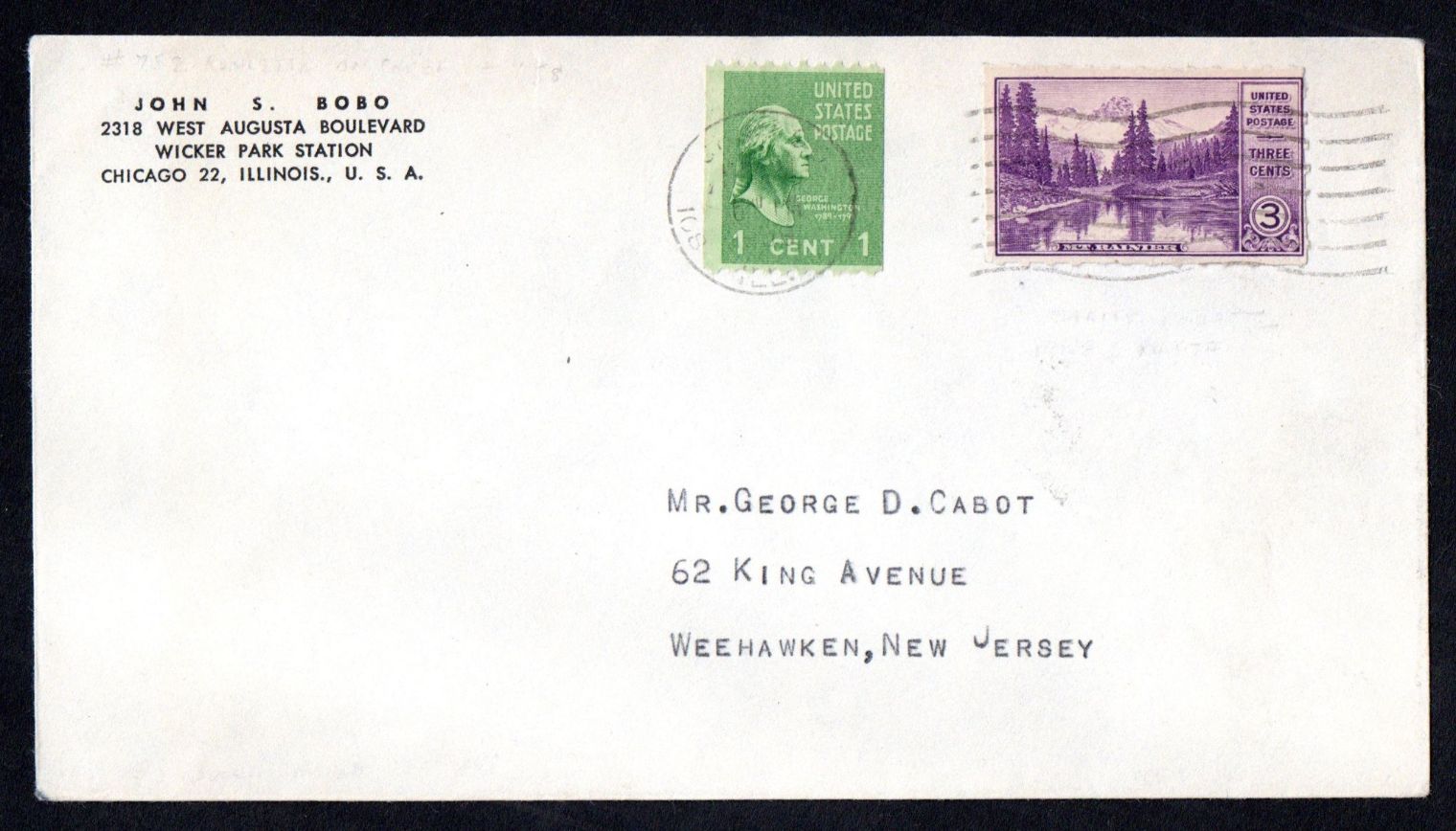 Here's the blowup of the stamp: 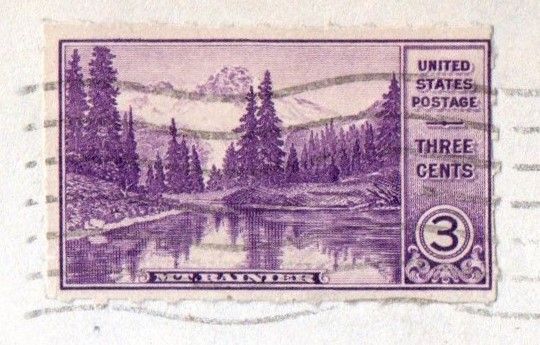 |
|
Send note to Staff
|
|
|
Pillar Of The Community
United States
1868 Posts |
|
|
This thread has been magnificent, as has been the series of articles in The United States Specialist of the USSS. However, I do not believe either of them fully resolves the question of whether Farley acted properly in ordering the 1934 (non-reprint) imperforate, ungummed sheets, paying for them and retaining them for himself and children or giving them away. Four pages back, this thread states: Quote:
Were the stamps illegally obtained? Absolutely not. PMG Farley paid the USPOD the cost of the face value of the stamps before he distributed them to his exclusive list of "friends." ... and this question is addressed in some detail, as "the Elephant in the Room," in The United States Specialist of September 2018. That article is extremely valuable in its level of detail in recounting the facts. However, in seeking to rehabilitate Farley's reputation and "bury the hatchet," I believe it glosses over a key fact: that the imperforate, ungummed sheets that Farley took from the BEP, and which led to the ongoing controversy about him, were not a product commercially available to the public from the USPS. Only perforated, gummed, finished stamps were. Thus, when contemporary writers say that Farley obtaining these sheets was not illegal because "he paid for the stamps," they were wrong. More accurately, Farley paid the nominal face value of impressions printed on interim work product of the government. The amount he paid was arbitrary and bore no relationship to the true market value of a never-issued, interim product. Fish and Millard, particularly, do not appear to have recognized that Farley took inchoate government property, rather than purchasing commercial government product via a privileged channel. In my view, his purchase cannot have been legal, and instead Farley made the serious error of improperly taking government property. Had the USPOD been selling imperforate, ungummed stamps at that time, it would have been completely different. But they were not. Consequently, in the Specialist article, the illustrations of FIG. 4 to FIG. 7 and the text relating to them are irrelevant, because they do not show Farley taking unissued, incomplete BEP product. The fact that Farley sometimes signed imperforate sheets on the press that later were held in government archives, or perforated, gummed and sold, or the fact that he presented newly finished (gummed, perforated) sheets to officials or citizens, namely the same product that anyone could buy at the POD, is not analogous to his taking of incomplete, non-offered government product and giving it to himself, his children or favored friends. The article correctly notes that the root emotion of the ensuing controversy was stamp collectors feeling angst over "not having something someone else had." Thus, the article indicates awareness that the sheets Farley took were not regular USPOD product. However, it does not address that fact in evaluating whether Farley's act was legal. Until scholars stop avoiding this issue and admit that Farley did not pay for a regular product and was not entitled to take government property, even with payment, it will not be possible to "bury the hatchet"—-even if Farley was entirely uninformed about the philatelic market and unaware that he was doing something wrong, which I accept from the evidence in the article. |
|
Send note to Staff
|
| Edited by cjpalermo1964 - 10/08/2018 3:11 pm |
|
|
Replies: 154 / Views: 50,869 |
|
|
To participate in the forum you must log in or register. | |
 New South Wales Numeral Cancels Value Question: Full Sheet, Austria Scott # 840A-H, Issued 5'24'1969. Who Was The Upper Keswick, N.b. Postmaster In 1941 Big Blue Album - How Far Along Is Everyone? Pushing 330,000 All Different Worldwide Stamps In One Collection . History And Usage Of Usir "silver Tax" Stamps What Did You Do Philatelically: Today Or Recently? Indypex 2026, September 18, 19, And 20, 2026 Cover Calendar For Month And Day -Pics Show Me Your Sports Stamps! Fruits Anyone? Food On Stamps! Chile Casa De Moneda De Chile Philatelic Souvenir Cards Of The 50's And 60's Postmarks.day By Day Minkus Supreme Global Albums (The Big Red Thread) Wanted: On-Cover Solo Uses Of United States 14¢ American Indian Stamp Extinction Of Non-Spray Cancels, Minneapolis Lacks The Year Germany Michel #110 Color Computers, Electronic Devices, Software, Information Technology, And Internet On Stamps Portuguese 1910 Overprinted "republica" Forgeries Show Your US 1851-57 Imperforate Stamps Coffee, Tea, And Other Hot Brews! The Stamps Of Indo-China. 1851-57 12c Washington Thematic Group On Freemasonry New South Wales Numeral Cancels Value Question: Full Sheet, Austria Scott # 840A-H, Issued 5'24'1969. Who Was The Upper Keswick, N.b. Postmaster In 1941 Big Blue Album - How Far Along Is Everyone? Pushing 330,000 All Different Worldwide Stamps In One Collection . History And Usage Of Usir "silver Tax" Stamps What Did You Do Philatelically: Today Or Recently? Indypex 2026, September 18, 19, And 20, 2026 Cover Calendar For Month And Day -Pics Show Me Your Sports Stamps! Fruits Anyone? Food On Stamps! Chile Casa De Moneda De Chile Philatelic Souvenir Cards Of The 50's And 60's Postmarks.day By Day Minkus Supreme Global Albums (The Big Red Thread) Wanted: On-Cover Solo Uses Of United States 14¢ American Indian Stamp Extinction Of Non-Spray Cancels, Minneapolis Lacks The Year Germany Michel #110 Color Computers, Electronic Devices, Software, Information Technology, And Internet On Stamps Portuguese 1910 Overprinted "republica" Forgeries Show Your US 1851-57 Imperforate Stamps Coffee, Tea, And Other Hot Brews! The Stamps Of Indo-China. 1851-57 12c Washington Thematic Group On Freemasonry
Disclaimer: While a tremendous amount of effort goes into ensuring the accuracy of the information contained in this site, Stamp Community assumes no liability for errors. Copyright 2005 - 2026 Stamp Community Family - All rights reserved worldwide. Use of any images or content on this website without prior written permission of Stamp Community or the original lender is strictly prohibited.
Privacy Policy / Terms of Use Advertise Here |
| Stamp Community Forum |
© 2007 - 2026 Stamp Community Forums |
| It took 0.24 seconds to lick this stamp. |
 |
|
|
|


 Posted 10/29/2017 9:42 pm