| Author |
 Replies: 538 / Views: 49,718 Replies: 538 / Views: 49,718 |
|
|
|
Bedrock Of The Community
Australia
38679 Posts |
|
|
Rob. Quote:
Hi Rod
A capital "I' (lower case "i"), looks exactly like the lower case "l" (upper case "L").
Most likely your caps lock is/was on.
Rob Thanks for addressing my problem, a real curly one  I'll try again........ iiiiiiii Well, seems to have been solved, my keyboard is over 10 years old, maybe a key was stuck somewhere. |
Send note to Staff 
|
| Edited by rod222 - 08/26/2017 10:31 pm |
|
|
Bedrock Of The Community
Australia
38679 Posts |
|
|
Rob.
With regards to Partime's ACSC 20. 6d Pale Ultra.
How does one identify a "dry print" ?
|
|
Send note to Staff
|
|
|
Pillar Of The Community
Australia
1692 Posts |
|
|
Quote:
Thanks for addressing my problem, a real curly one
I'll try again........ iiiiiiii
Well, seems to have been solved, my keyboard is over 10 years old, maybe a key was stuck somewhere. Hi Rod A very common problem with a very old keyboard. Rob |
|
Send note to Staff
|
|
|
Pillar Of The Community
Australia
1692 Posts |
|
|
Quote:
I also just happen to have an ACSC 403c Booklet pane of 6, though I haven't checked it for Helcon Paper or Ink. Was there an easy method to tell which is which? Hi Steve Use a UV light on the back of the stamp in the dark, if it glows it is helecon, if it does not it is on normal paper, the latter is rare, in the recent ACSC it is catalogued at $1,000 (actual minimal selling price is AU$850), they are not easy to come by. Rob |
|
Send note to Staff
|
| Edited by Rob041256 - 08/27/2017 04:51 am |
|
|
Pillar Of The Community
Australia
1692 Posts |
|
|
Quote:
Just one of the many errors in the ACSC Roos. This one was corrected in the latest version to BW27,28,29(4)o. I usually recommend the Banwell and Parsons 9d Roos for anyone who is serious about the 9d (my area of specialisation). Hi Frank Always looking for books, I will purchase one very soon, I have seen a copy selling for $30 from Michael Eastick & Associates in Victoria, and to anyone outside of Australia $27.27; approx. US$19.91 (GST free). Rob |
|
Send note to Staff
|
|
|
Pillar Of The Community
Australia
1692 Posts |
|
|
Quote:
Rob.
With regards to Partime's ACSC 20. 6d Pale Ultra.
How does one identify a "dry print" ?
Hi Rod The dry ink shows the printed lines somewhat thinner, resulting in a greater area of white on the stamp, the stamp appears to be 'under inked'. This could have come about if the printer had not let the rollers in the ink reservoir run long enough (there is also a heater in the reservoir and the rollers help distribute the ink to an even viscosity before printing is started). If the ink is too thick not enough ink will get onto the plates, hence less ink on the paper and this gives a different appearance to the stamp. If the rollers had been running longer in the reservoir you would have had the ink at a more uniform temperature/viscosity, hence it would have been thinner and printed a normal stamp. The following block of 4 ½d Wallaroos is a very scarce example of progressive dry inking over 4 stamps. The top right stamp is normal, top left showing first stage progression and bottom right showing second stage progression and the stamp on the bottom left is the end result of dry inking. The roos can be used as an example for KGV stamps as well.  If the stamp shows less ink than its normal counterpart it is likely caused by dry inking (this variety is more prominent with George V stamps, less so with George VI stamps). Unused stamps are easy to identify for dried ink varieties. Used stamps that may have been worn from friction (rubbing) when wet may show a false appearance of dry sinking, if you think you have a used one upload it. Rob |
|
Send note to Staff
|
| Edited by Rob041256 - 08/27/2017 10:34 am |
|
|
Pillar Of The Community
Australia
1692 Posts |
|
|
The (ACSC 251ca) vertical booklet pane of 18 is quite interesting, it must be a conundrum fitting that into an album.
Rob |
|
Send note to Staff
|
|
|
Bedrock Of The Community
Australia
38679 Posts |
|
|
Quote:
The dry ink shows the printed lines somewhat thinner, resulting in a greater area of white on the stamp, the stamp appears to be 'under inked'. This could have come about if the printer had not let the rollers in the ink reservoir run long enough (there is also a heater in the reservoir and the rollers help distribute the ink to an even viscosity before printing is started). Rob. Many thanks for taking the time for an extended answer. Tops. |
|
Send note to Staff
|
|
|
Pillar Of The Community
Australia
1692 Posts |
|
|
Quote:
Many thanks for taking the time for an extended answer. Tops. Don't mention it Rod, glad to be of assistance. Rob |
|
Send note to Staff
|
|
|
Moderator

United States
5109 Posts |
|
|
Moderator
United States
5109 Posts |
|
|
Rob, sorry, but I finally got back to your comment: Quote:
Use a UV light on the back of the stamp in the dark, if it glows it is helecon, if it does not it is on normal paper, I have a copy of ACSC 400c, the green 5d booklet, and I have the subject copy of ACSC 403c, the red 5d booklet. When I compare the backs, and put them side-by-side under the UV light, I don't see any glowing from either - they both react the same. When I view a copy of 402bc, the 5d red, join line pair, I see a red-speckled effect on the back of the entire length of 4 stamps. The front glows vividly, the same as the front of the 403c subject. Am I seeing Helecon in any of these items? |
|
Send note to Staff
|
|
|
Pillar Of The Community
Australia
1692 Posts |
|
|
Quote:
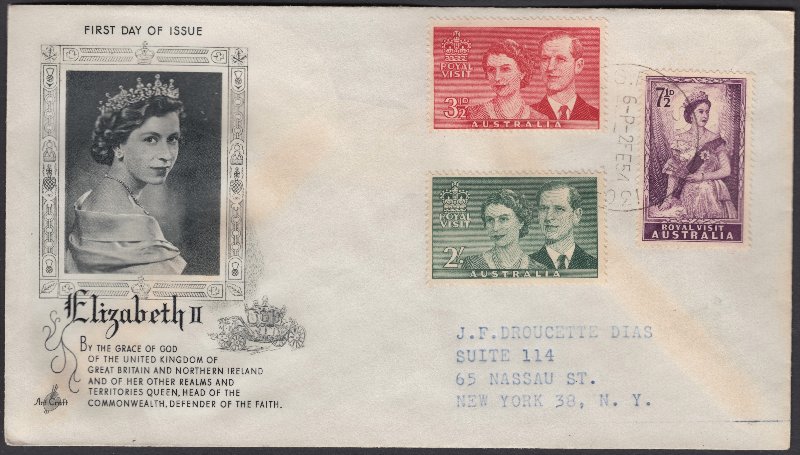
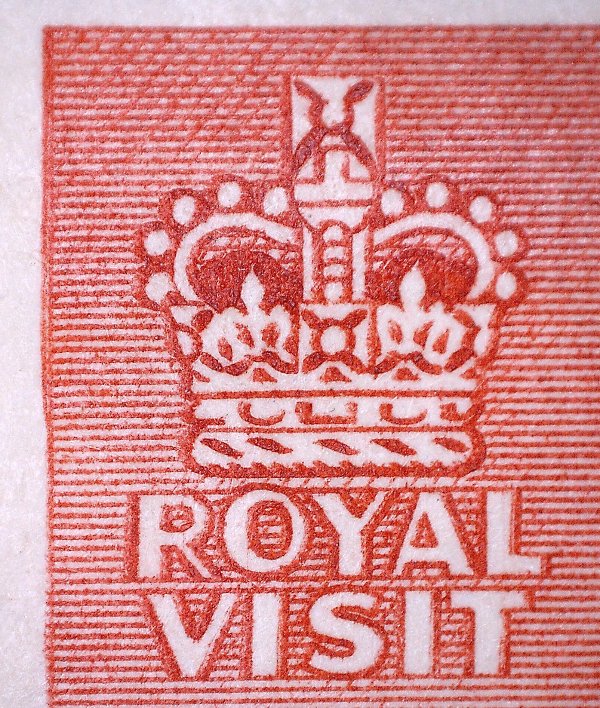
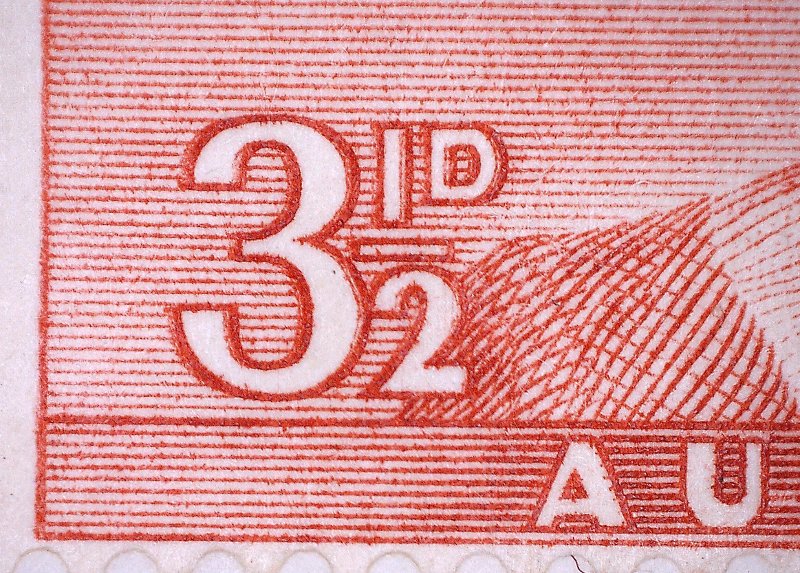
I picked up a First Day cover of QEII visit to Australia, 1954. This is listed as ACSC 310y with a minimal value. Upon closer inspection, the 3 1/2d stamp is 308j, the Re-entry to "Royal Visit", "3 1/2d", etc. I especially like the odd upper left lines. I don't know the value on a FDC, but probably more than a normal version. This was found in the dollar box. Hi Steve The FDC is worth about $10 according to the ACSC. The 308j variety is seen on the Duke of Edingburgh's forehead; you mean 308i. Unfortunately you do not have the re-entry to the "Royal Visit and 3½d. I checked your stamp's enlarged area to my own and they are the same. A 308i is being sold by a specialist mint uinhinged for AU$45.00 Rob |
|
Send note to Staff
|
|
|
Moderator
United States
5109 Posts |
|
|
Quote:
The 308j variety is seen on the Duke of Edingburgh's forehead; you mean 308i. ACSC must be changing their numbering system over the years. I am using a book from 1996, so that could explain it. |
|
Send note to Staff
|
|
|
Pillar Of The Community
Australia
1692 Posts |
|
|
Quote:
ACSC must be changing their numbering system over the years. I am using a book from 1996, so that could explain it. That's quite an old book, although catalogue prices change over the years, old information updated and new discoveries and info added, the catalogue numbers should remain the same, and if a new discovery is found of an already catalogued stamp, they should had a prefix with the original catalogue number as seen often. The Stanley Gibbons Australian catalogue messed up their cataloguing numbers, many times you will notice that there is a gap between numbers caused by the editors assuming there will be additions to the series of stamps and nothing comes to fruition, so a gap in numbers occurs. In my online catalogues, one can recognise the gaps in the SG catalogue numbers. As the ACSC only goes to 2001, years following 2001 are in SG numbers. Rob |
|
Send note to Staff
|
| Edited by Rob041256 - 09/03/2017 4:34 pm |
|
|
Bedrock Of The Community
Australia
38679 Posts |
|
|
Quote:
That's quite an old book, although catalogue prices change over the years, old information updated and new discoveries and info added, the catalogue numbers should remain the same, Rob. That's not our experience, Brusden White can change catalogue numbers as new flaws become known. BW seems to have a new edition every 4 years or so. I'll check next time my colleague visits. |
|
Send note to Staff
|
|
|
Replies: 538 / Views: 49,718 |
|




 Posted 08/26/2017 10:29 pm