| Author |
 Replies: 25 / Views: 7,319 Replies: 25 / Views: 7,319 |
|
|
|
Moderator
1589 Posts |
|
|
The passenger lists are online, but only for passengers disembarking in the US, via Ancestry.Com. So, I was able to get the passenger lists for flights from England to the U.S., but not for flights from the U.S. to England. That's why I could document Juan Trippe's return on July 4, but not his departure on Crotty "N-1" (which is FAM 18-10). I don't know if the passenger lists for flights out of the U.S. are on microfiche or not. Ancestry.com's interest in just the passengers arriving in the U.S., not those departing, is understandable. |
Send note to Staff 
|
|
|
Pillar Of The Community
1213 Posts |
|
|
One would need to put some qualifiers on the description of "first transatlantic passenger service". Perhaps something like "first regular flying boat transatlantic paying passenger service"? For example, starting in 1928 DELAG began flying paying passengers on regular transatlantic zeppelin flights to North and South America that became more regular through the 1930s. For example, the Hindenberg made 36 scheduled transatlantic flights charging passengers $400 per ticket in 1936 alone. Or, in 1919 the R-34 carried paying passengers but that was not a regular service and it was by a dirigible rather than a flying boat. Or 1930/1 there had been a single (non-regular) non paying passenger flying boat flight from Europe to South America and then North America by the Do X. |
|
Send note to Staff
|
|
|
Moderator
1589 Posts |
|
|
You are correct, Kimo. I think I've seen these distinguished as the "first Pam Am transatlantic passenger flights," which would distinguish them from the earlier "lighter than air" transatlantic passenger flights.
Basil |
|
Send note to Staff
|
|
|
Valued Member
77 Posts |
|
|
Basil, Fantastic research on your part fitting the pieces together! No problem with the scans, I am happy to help.   |
|
Send note to Staff
|
|
|
Valued Member
77 Posts |
|
|
After reviewing some of the information on the internet, I agree with the distinction between passengers and paying-passengers. It appears that there was some stiff competition and bragging rights amongst the elites for seats on the first paying-passenger flights, so the published dates of those flights are well documented in the contemporary news.
|
|
Send note to Staff
|
|
|
Moderator
1589 Posts |
|
|
Thanks a bunch. But you know what is odd about the N-3 data? It shows no passengers! This is the flight that is routinely credited with being the "first [Pan Am] passenger fight on the Northern route" from NY to Southhampton. So just when I think I've cleared up all questions about the Crotty data, here's a new one.  But I'm confident I have the backstory on my cover now, and that's the main thing. Thanks for all the help. When I get around to writing this all up for my exhibit (could be a few months) I'll post the result here. Basil |
|
Send note to Staff
|
|
|
Valued Member
Canada
6 Posts |
|
|
Holy Cow! Now I understand why I've had so much trouble figuring out the history of this cover, although, it seems to offer definitive data about the "first passenger flight" across the North Atlantic, at least by a fixed-wing aircraft carrying paid passengers:  As you can see, the cover was postmarked in London on June 30, and the New York City receiver is dated July 1. (I manipulated the color and contrast of the London CDS in order to make the date clearly visible.) The note on the front of the cover indicates that it is to be carried on Yankee Clipper. And the enclosure, a personal letter, makes it abundantly clear that the flight is the second flight carrying mail westward to the U.S. The writer apologizes for missing the first airmail flight. She writes, "Sorry I missed the 1st Air Mail when the Clipper went before, but this is the 2nd & represents the service started in 1939." Bob |
|
Send note to Staff
|
|
|
Valued Member
United States
46 Posts |
|
|
Valued Member
Canada
6 Posts |
|
|
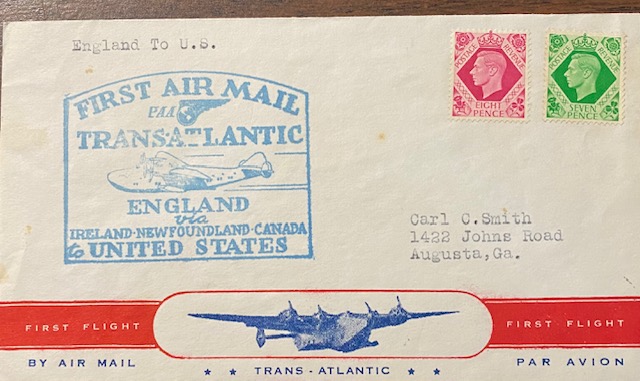
The illustrated cover likely never left British soil, not, as an actual airmail cover flown by Pan Am. At that time, stamps were almost always cancelled, and receivers were commonly applied. I've seen many covers which someone hoped to mail, but never did.
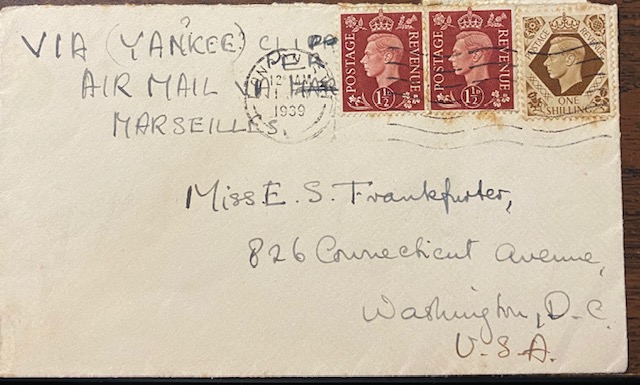
The second cover was almost certainly flown to the U.S. on 31 May, which was the first day of official airmail from England to the U.S., flown on the southern Atlantic route — Marseilles, Lisbon, Azores, New York. If I'm wrong, I hope someone will correct me. This is relatively new postal history to me.
Bob |
|
Send note to Staff
|
|
|
Pillar Of The Community
750 Posts |
|
|
No new information, or mystery to solve, but these two do show a trip in both directions. Thanks to all for the information in the above posts. pat   |
|
Send note to Staff
|
|
|
Replies: 25 / Views: 7,319 |
|




 Posted 07/10/2017 11:26 am