| Author |
 Replies: 30 / Views: 4,527 Replies: 30 / Views: 4,527 |
|
|
|
Pillar Of The Community
United States
2555 Posts |
|
|
Anytime you see a stamp that is cut like this, a trimmed stamp should be suspected. There was no reason to cut imperf stamps from the sheet in this manner. Perforated stamps that have had there perforations trimmed, on the other hand, look exactly like this stamp. It is pretty common to find 1c Plate 4 stamps that have been trimmed as well. Also, take a look at some revenues if you want practice spotting trimmed stamps. |
Send note to Staff 
|
|
|
Pillar Of The Community
United States
1036 Posts |
|
|
Sorry if I am confused here.... Winston Sinclair posted pic of a stamp above that he believes is a trimmed Scott 31.
(Looks like a Scott 13 to me)
jmt406 sold this exact stamp as a Scott 13 (pos 99R1), which he believes is scott 13 and not trimmed.
Now I'm really interested? (Assuming I'm following this thread correctly?)
|
|
Send note to Staff
|
|
|
Pillar Of The Community
United States
2555 Posts |
|
|
It isn't my stamp, it is just a stamp that was on my watch list once upon a time. |
|
Send note to Staff
|
|
|
Pillar Of The Community
United States
1036 Posts |
|
|
Pillar Of The Community
United States
3224 Posts |
|
|
Laurie 02 wrote: Quote:
pardon my ignorance but as a newbie you speak of guide dots?
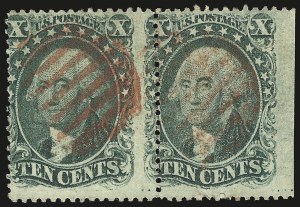
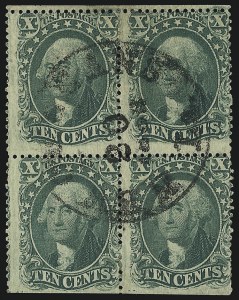
Where are they on a stamp? They are in the margins around the corners of the stamp designs, sometimes intruding on the design. They are not at every corner of each stamp design and are not found next to every stamp design in the sheet. Nor do they always print clearly. Note rgstamp's pair and block above; see the bottom margins of each. For the US issues in this time period, point marks were made on the printing plate to aid in layout when transferring designs. Left in place, the result is a printed dot. |
|
Send note to Staff
|
|
|
Pillar Of The Community
United States
1036 Posts |
|
|
The scans above that I posted are from Siegel. Most plate blocks and multiples of scott 31 clearly have significant perf shifts/misperfs. It's shocking to see how poorly centered these perforated stamps were produced back in the day. Perfs clearly went thru adjacent stamps. I'm not sure much of a money advantage of turning a 31 into a 13, but if one side was a SE or damage to perfs, perhaps a horribly centered imperf 13 would be worth more than a horribly centered perf 31 |
|
Send note to Staff
|
|
|
Pillar Of The Community
Australia
967 Posts |
|
|
Pillar Of The Community
United States
3515 Posts |
|
|
Sinclair - I'm happy you posted this stamp. This is a very useful exercise. About the one thing that I can think of which might be helpful here, is to compare the paper. Starting late second-half of 1857, they started using the high rag content paper, which is less white, and of poorer quality.
Plate 2 (Ty V's) didn't come into play until 1859, so many Ty I 10c stamps from plate 1 were printed on the high rag content paper. Perforations came into play on the 10c stamp plate 1, in July 1857. So, if it can be established that this was the high rag content paper, then it is likely a #31. The dry printing, and overall poor impression of this stamp certainly doesn't absolutely mean that it was on the poorer paper, but it may tip the scales highly in that direction. |
|
Send note to Staff
|
|
|
Pillar Of The Community
United States
3515 Posts |
|
|
One final thought - I wonder what the odds are, that, if sent in for expertization, that this would get certed as a #13? |
|
Send note to Staff
|
|
|
Pillar Of The Community
United States
1036 Posts |
|
|
As said before, not all stamps can be scott identified. Thus, in my opinion, PF or PSE should decline to identify Scott number on this stamp (unless we are missing something), but could definitely certify as a type 1.
I would guess that they would certify as 13! But I agree with Sinclair that it is more likely a 31. |
|
Send note to Staff
|
|
|
Valued Member
324 Posts |
|
|
Good conversation.
Laurie 02: Guide dots can be in different positions on a stamp based on the issue (e.g. top row stamps from 1850s typically have a guide dot above or at the top margin of the stamp). For the Type I 10c stamp from the 1850s, the guide dots are below the bottom edge of the stamp.
Txstamp: "Starting late second-half of 1857, they started using the high rag content paper". I didn't know that about the timing of the rag content. Do we know if this was simply an economic decision to save money or if some other circumstance drove the change? |
|
Send note to Staff
|
|
|
Pillar Of The Community
United States
3224 Posts |
|
|
Going to a rag content paper may have meant the older quality paper they wanted was no longer available. Rag content would probably have been better than the purely wood pulp papers of the time -- consider typical covers of the time that were not of writing paper quality vs. the (blue) watermarked writing paper. Jump over to the American Bank notes and that paper was lower quality than the rag content paper used for these, I think. Quote:
if one side was a SE or damage to perfs, perhaps a horribly centered imperf 13 would be worth more than a horribly centered perf 31 Or a 31 with perf damage or a tiny tear. Otherwise, it's surprising the number of perfed stamps that only get reperfed on the short side. That was also probably done to remove readily visible damage. |
|
Send note to Staff
|
| Edited by hy-brasil - 08/09/2017 5:58 pm |
|
|
Pillar Of The Community
United States
2555 Posts |
|
|
I do think the paper of the 1851-61 stamps can often yield valuable clues as to the approximate date of printing of the stamp. However, you don't need to look very long to see that perhaps many different grades and supplies of paper were used in a given period, with the years 1857-59 being no exception. |
|
Send note to Staff
|
|
|
Pillar Of The Community
Australia
967 Posts |
|
|
Pillar Of The Community
United States
3515 Posts |
|
|
lukusw - When I was doing this back in the 1990s, it was well understood that the paper became significantly less white starting in late 1857. I agree with sinclair, that that is not a 100% all-inclusive statement, but it is quite noticeable.
At the time, noone that I know was aware of any detailed paper study of that era. I believe since then that there has been at least one paper published on this subject, maybe more. I have a faint recollection of finally seeing one, but its been awhile. If I stumble across it I'll post it. |
|
Send note to Staff
|
|
|
Replies: 30 / Views: 4,527 |
|



 Posted 08/08/2017 8:40 pm