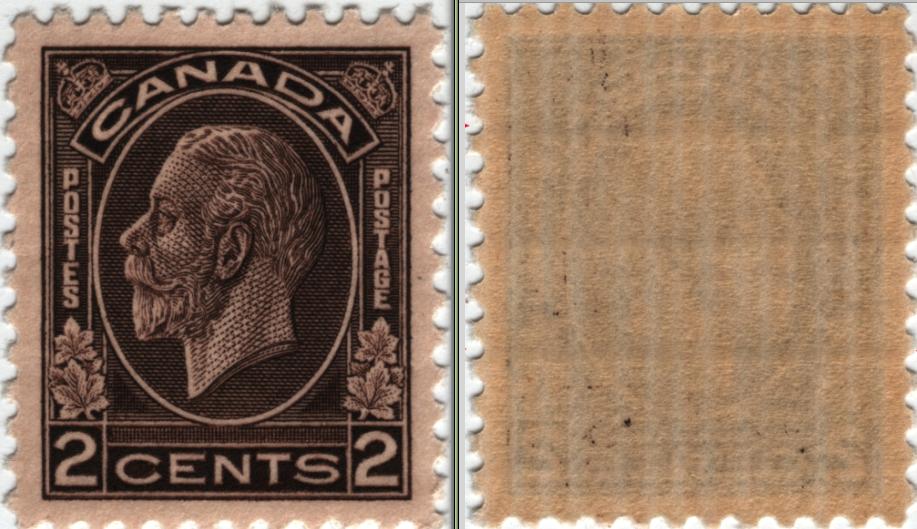
Let's hope that these imperforate stamp multiples (pairs, strips, blocks, etc.) do not get broken down by some who are searching for a perfectly centered stamp out of them. So far, this has happened mostly to U.S. stamps, but it could happen to Canadian stamps too. It is a philatelic practice to at least have imperforate stamps collected in pairs.
Any new developments on the aforementioned information?
There is much confusion between Canada BABN rotary press wet printed stamps and rotary press dry printed stamps along with flat plate dry printed stamps.
Canada BABN Arch/Leaf Stamp Issue (1930-1931): The 1 to 3 cents sheet stamps were rotary press wet printed. The 1 and 3 cents booklet stamps were flat plate dry printed. The 2 cents booklet stamps were rotary press wet printed and flat plate dry printed. The 1 to 3 cents coil stamps were rotary press wet printed. The 4 cents sheet stamp was flat plate dry printed. The 5 cents violet sheet stamps were rotary press wet printed and flat plate dry printed. The 5 cents blue sheet stamp was flat plate dry printed. The 8 cents to 1 dollar sheet stamps were flat plate dry printed.
Canada BABN Medallion Stamp Issue (1932-1933): The 1 to 3 cents sheet stamps were rotary press wet printed and rotary press dry printed. The 1 to 3 cents booklet stamps were flat plate dry printed. The 1 to 3 cents coil stamps were rotary press wet printed. The 4 to 13 cents sheet stamps were flat plate dry printed.
Disclaimer: While a tremendous amount of effort goes into ensuring the accuracy of the information contained in this site, Stamp Community assumes no liability for errors. Copyright 2005 - 2026 Stamp Community Family - All rights reserved worldwide. Use of any images or content on this website without prior written permission of Stamp Community or the original lender is strictly prohibited. Privacy Policy / Terms of UseAdvertise Here





 Posted 04/21/2018 07:25 am