| Author |
 Replies: 18 / Views: 3,651 Replies: 18 / Views: 3,651 |
|
Valued Member
157 Posts |
|
|
|
|
Pillar Of The Community
1151 Posts |
|
|
Valued Member
United States
197 Posts |
|
|
Pillar Of The Community
United States
939 Posts |
|
|
Okay, I'm perplexed! And I'm going to show off my philately ignorance. How on earth do you determine what position in a plate a 150 year old stamp was printed? Is there a plating number or indicator of some sort on the stamp? jmt406, awesome project! Please continue to update.  |
Send note to Staff 
|
|
|
Pillar Of The Community

United States
1951 Posts |
|
|
Jim406.
That looks like an expensive project. I'd be happy if I had just one of those babies.
Jack Kelley |
|
Send note to Staff
|
| Edited by jkelley01938 - 09/04/2017 06:47 am |
|
|
Pillar Of The Community
United States
1043 Posts |
|
|
Pillar Of The Community
United States
1043 Posts |
|
|
Jmt,
Don't you have that perforated unused 10R4? that some of us drooled over when you posted pic few months ago.... Put it in the slot.
Rg |
|
Send note to Staff
|
|
|
Pillar Of The Community
United States
8956 Posts |
|
|
Moyok13, no ignorance involved, just a great question. On these older stamps it is generally possible to "plate" them. Most if not almost all of these stamps have small characteristics that are recognizable to a philatelist. Small plate cracks, scratches, double transfers, unintended dots and intended dots, guide lines and you name it. Even some modern stamps have varieties that can be used to plate them.
Peter |
|
Send note to Staff
|
|
|
Pillar Of The Community
United States
939 Posts |
|
|
Peter, thank you. I read that some stamps have numbers or symbols related to the plating. Interesting to know.
ken |
|
Send note to Staff
|
|
|
Pillar Of The Community
United States
1566 Posts |
|
|
I can't even imagine the work needed to do this. The thrill of completing a project like this has to be immense. I too really didn't fully understand how you can position each and every stamp. I could figure out how you can plate the edges but how do you pllate the middle. What a project and I would like to hear more about the process. |
|
Send note to Staff
|
|
|
Pillar Of The Community
United States
1821 Posts |
|
|
Pillar Of The Community
United States
3534 Posts |
|
|
Pillar Of The Community
United States
3534 Posts |
|
|
I see that you have a 3L4. Just in case you don't already know, 3L is usually, if not always a Ty IIIA - broken at bottom. I don't think Neinken mentioned that, but it is/was clearly the case. I had a perf and imperf 3L4, and both were definitely IIIA's. |
|
Send note to Staff
|
|
|
Pillar Of The Community
United States
1360 Posts |
|
|
Moyok13, no ignorance involved, just a great question. On these older stamps it is generally possible to "plate" them."
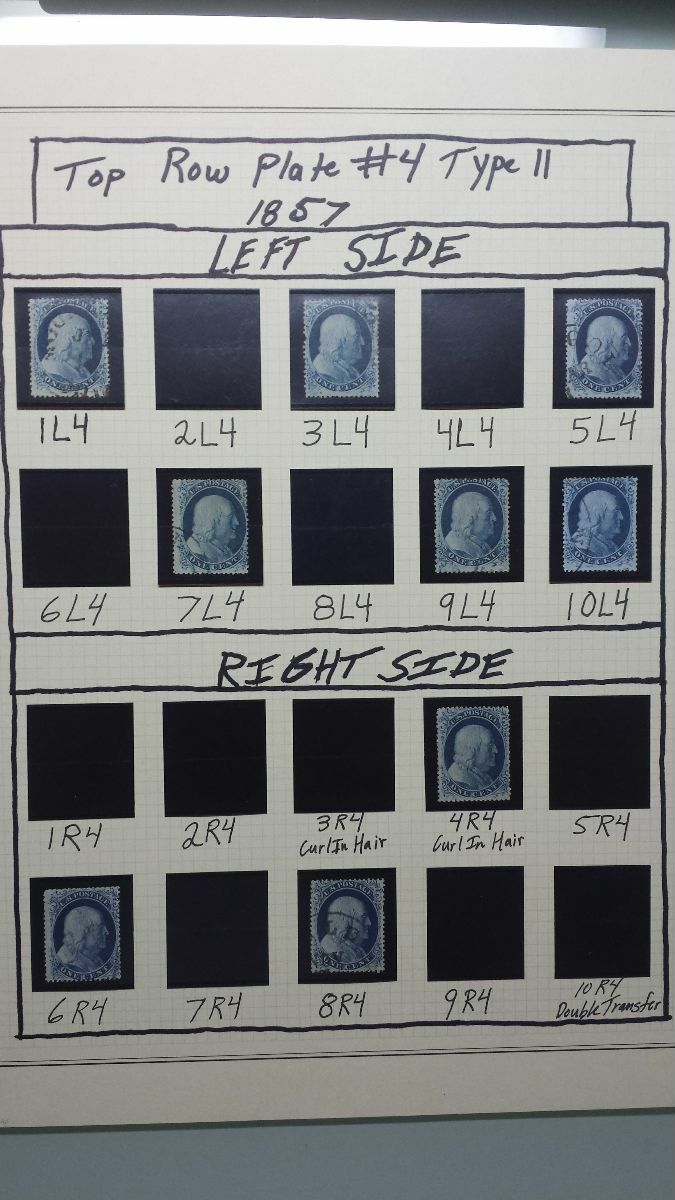
To add to Peter's response, the fact that jmt is collecting the top row of Plate 4 is also significant in the fact that these are the only Type II (Scott #20) positions on the plate, making each one of them very desirable, more valuable than usual, and very scarce....
Question to the other platers...since I've concentrated on the Type V and Va plates, are there any physical characteristics that one can use to know a Plate 4 vs a Plate 2 top row Type II, (guide dots different, etc.)?
Thanks, Ray
|
|
Send note to Staff
|
|
|
Valued Member
157 Posts |
|
|
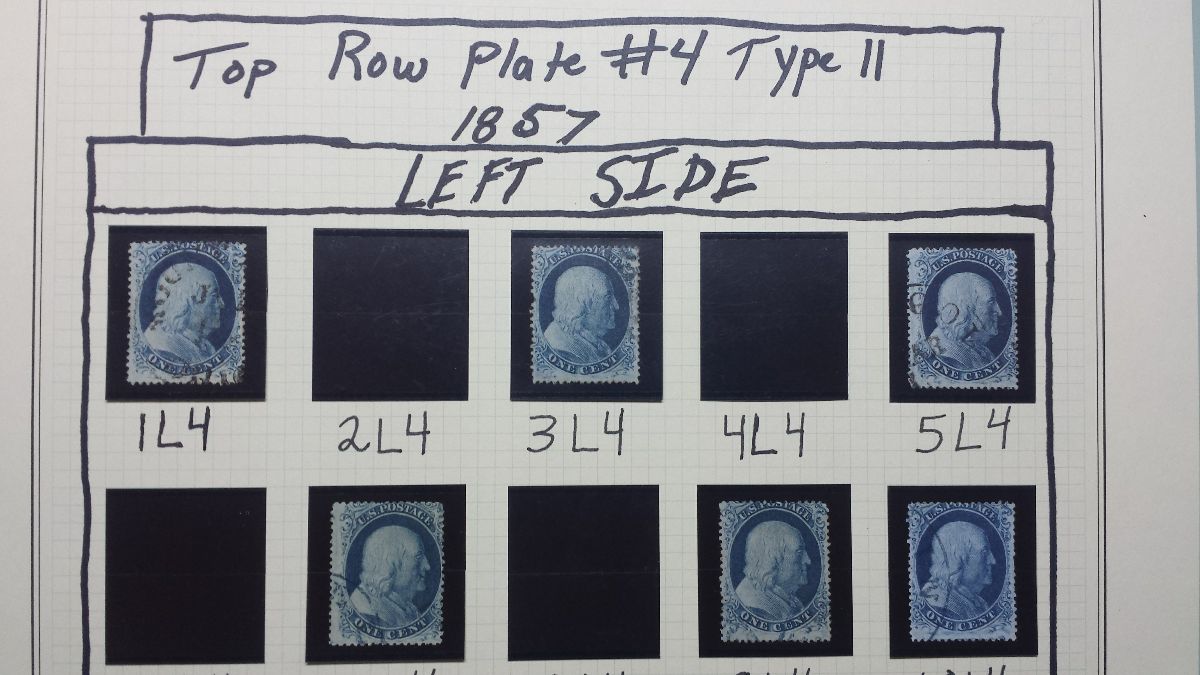
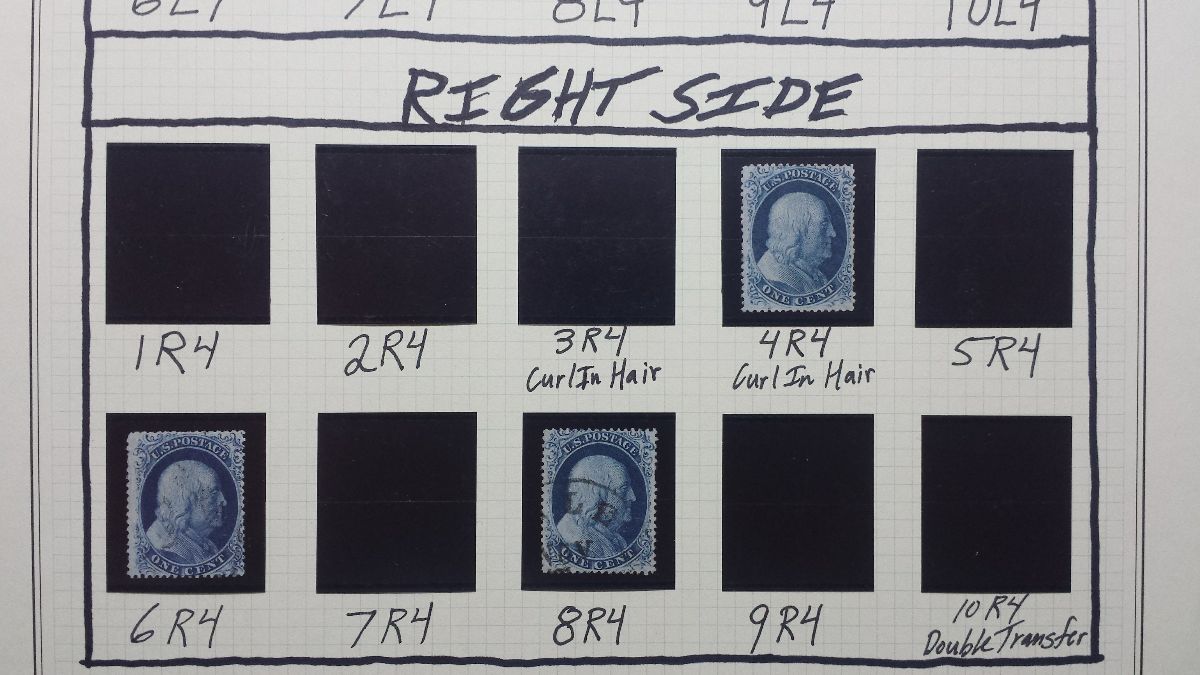
Thank you all for your interest & responses. I definitely have 5R4 & 10R4, but they are being plated(along with 17 other items). Looks like they're expected to arrive tomorrow (Tues). I sent out at least one other I believe is a Plate 4 Type II; hope it's one I need.  I did send in a cover that I was able to Plate to Position 9R4. I'll pass it on to another collector & search for one off cover; I wouldn't want to ruin such an old item.  When I first started collecting these stamps I often thought I had a Type IIIa or III, because the bottom shows breaks on some positions. I still don't understand why some weren't/aren't classified as Type IIIa. Scott Cat. did add the following after #7 TII listing: "Please note: Regardless of the strength or weakness of the design at bottom, all stamps originating from the top row of plate 4 are classified as Type II." As you can see from my examples, the perfs cut into the top of the design. I found this to be fairly common. They seem to be centered really well, or shifted up. I don't mind because I think the bottom of the design is more interesting for this Type & Plate anyway! There are some really neat blurs & scratches found on some of these positions! I will update, when I receive stamps back from Plating! |
|
Send note to Staff
|
|
|
New Member
2 Posts |
|
|
Replies: 18 / Views: 3,651 |
|



 Posted 09/03/2017 10:50 pm


 I'm a little over 1/2 way there now (a couple are currently away for Plating & aren't present here).
  Please try to ignore my terrible penmanship.