| Author |
 Replies: 164 / Views: 25,352 Replies: 164 / Views: 25,352 |
|
|
|
Pillar Of The Community
United States
6469 Posts |
|
|
Yeah, the centering uber alles focus of stamp grading is IMO wrong. Seeing a 95 or 98 graded stamp with blunted corners, short perfs, or faded color is just, well, annoying.
I'll take a post-office fresh example with vibrant color and full clean perfs but only F/VF centering over some of the supposedly higher graded examples out there. |
Send note to Staff 
|
|
| Edited by revenuecollector - 09/14/2017 12:01 pm |
|
|
Pillar Of The Community
United States
1043 Posts |
|
|
A perfect example of this problem is rslny stamp 1861 3c posted in other thread. Assuming no faults it is centered "85" ish to me but the impression, color and full perfs for sure make this an XF (90) or even XF-S stamp to me. But grading standards would not allow it to go above 85 due to centering? which is absolutely absurd! Perhaps others disagree on the centering of 85, but it my brain this stamp is no doubt XF or better regardless of the centering grade |
|
Send note to Staff
|
|
|
Moderator

United States
12330 Posts |
|
|
The engineer in me wants to see a standard, quantified, weighted specification which everyone would use. If the evils of grading are to remain, then it would be good if there at least was some consistency. The development of a standard specification would, of course, require coordination and buy in by the leading firms and other grading-interested groups. I am still amazed at the number of listings which call our a grade but do not ID where the grade came from, I currently just ignore any mention of the grade as marketing fluff.
Don
|
|
Send note to Staff
|
|
|
Pillar Of The Community
United States
3528 Posts |
|
|
I'm a software engineer as well, and fully appreciate the desire for a mathematical specification for things.
But, how do you mathematically define: "really pretty" ?
|
|
Send note to Staff
|
| Edited by txstamp - 09/14/2017 2:57 pm |
|
|
Moderator
United States
12330 Posts |
|
|
I was thinking of a weighted scale system...
Centering xx%
Color xx%
Condition xx%
etc.
Then each section would be further defined on a scale of 1-10 or something. A method which supports subjective opinion but keeps it restrained within a quantified system.
The final grade is then calculated.
Don
|
|
Send note to Staff
|
|
|
Bedrock Of The Community
12747 Posts |
|
|
Bill Crowe wrote an excellent reply post on this very subject not long ago about the subjective vs objective components of grading. Darned if I can find it though. |
|
Send note to Staff
|
|
|
Pillar Of The Community
United States
6469 Posts |
|
|
At the end of the day, you can come up with the most complicated, attribute-filled, numeric grading system in the world, but as txstamp correctly states, there is a subjective, aesthetic component to grading that a numeric system just can't quantify.
Additionally, the larger the number of factors in such a calculation, the less comprehensible it becomes and the muddier distinctions get. Weighing certain factors against others also becomes a subjective determination. Some might say that whiteness/brightness of paper should be a highly weighted factor, whereas someone else might think that texture and originality of gum should be higher than that, etc.
Bottom line: there is more to grading than numeric perfection. The cure is worse than the disease.
This was tried by several companies in numismatics over the decades: grading systems with multiple factors and they all flopped. |
|
Send note to Staff
|
|
|
|
Moderator
United States
12330 Posts |
|
|
Hi Dan, So your opinion is that it is impossible to come up with a subjective system that is constrained within a quantified classification? Or is it that you just do not like the approach and/or grading? Or all three?  Don |
|
Send note to Staff
|
|
|
Pillar Of The Community
United States
3528 Posts |
|
|
No matter what mathematical engine is built for grading stamps, there will always be individual people, who view a given stamp as over or under-graded. This is true, even if the stamp is graded correctly within the rules.
In keeping with this, I say keep grading simple, and easy to at least understand the method, for all.
Further, realize that the purpose of all of this, is to create a high-end market, in order to bring a lot of money into the hobby. That's why anything of lower grade than about 95 is not significantly contributing to the stated financial goal. |
|
Send note to Staff
|
|
|
Pillar Of The Community
United States
6469 Posts |
|
|
My dislike of professional grading aside, I do not believe there is a way to construct a numerical system that captures all of the subjective aspects of grading.
Even if you could come up with a single final number that encompasses all of the individual criteria, the fact that people will disagree as to which criteria are more or less important than others in coming up with that final number means it is doomed from the start.
Trying to distill all the aspects of a stamp down to a single decimal number cannot work.
Taking a step backwards for a moment, I would posit that what PSE does is not truly a "grading" system in the universal sense of the word... it's a centering measurement system, as that one factor almost universally eclipses all others. |
|
Send note to Staff
|
|
| Edited by revenuecollector - 09/14/2017 3:50 pm |
|
|
Moderator
United States
12330 Posts |
|
|
Ah thanks for the additional input Dan and txstamp.
Grading reminds me of showing cars. The costs are approximately the same ($25-$30 on low end going much higher on the top end) and at the end of the day what you are really paying for is an opinion on what you own. It also opens similar kinds of discussions such as 'why should I pay for an opinion as long as I enjoy what I own?'.
I went to at least 200 car shows and have an attic full of mostly silly, cheap trophy's. (It would have been less expensive to simply to go buy myself some trophy's than go to all those car shows.) Car show judging also varies all across the board.
Sometimes you sit there all day and do not even see a judge come by your car. Other times a team of judges descends upon your car and crawls under and over every inch of it. At some shows you get the final judging sheet (quantified) and these were the shows I most highly prized. I liked them because they gave me the best understanding of how the opinions were formed, what those judges felt the strengths and weaknesses of the car were.
I think the same holds true for a quantified opinion for stamp grading. It gives the stamp owner the best feedback opportunity to learn and become a better philatelist. Given the often discussed 'downsides' of grading we seldom see the potential educational aspect mentioned.
Don
Note; I have never purchased a graded stamp and in general do not like them. |
|
Send note to Staff
|
|
|
Bedrock Of The Community
12747 Posts |
|
|
Grading is a contradictory creature. On the one hand assigning numerical grades to objects is a way of standardizing them for the purpose of assigning a value albeit one in a state of flux based on supply and demand. On the other hand stamps have factors such as aesthetics that do not lend themselves to assigning values. As it stands now grading is for marketing purposes. I have yet to meet a fellow philatelist that has told me about their $5 Columbian and added "and it is a 95J which added 28.2 % in the last SMQ quarterly with strong upside potential!". |
|
Send note to Staff
|
|
|
Pillar Of The Community
United States
939 Posts |
|
|
Mathematical models are not going to be of much help if you are making a big deal about a 78 or an 85. But with a market that is looking at 98 or 100 verses everything else, it should be pretty easy.
Centering xx%
Color xx%
Condition xx%
freshness of paper. xx%
everything has to be 100 or you get a lower score. Those 98's on centering with shorter perfs or aged paper just won't cut it anymore.
Basically, if you are going to grade a stamp "perfect" it ought to be perfect.
|
|
Send note to Staff
|
|
|
Pillar Of The Community
6363 Posts |
|
|
As a disclaimer, I have no graded stamps ... One thing I have noticed about the classic bi-colored stamps is grading based wholly on the centering of the frame with no regard for the print registration of the vignette. As an example, this Scott 523 (Siegel sale 1111, lot 589) is graded PSE 90. This stamp has no eye appeal to me ... as I am instantly drawn to Ben's poor centering. 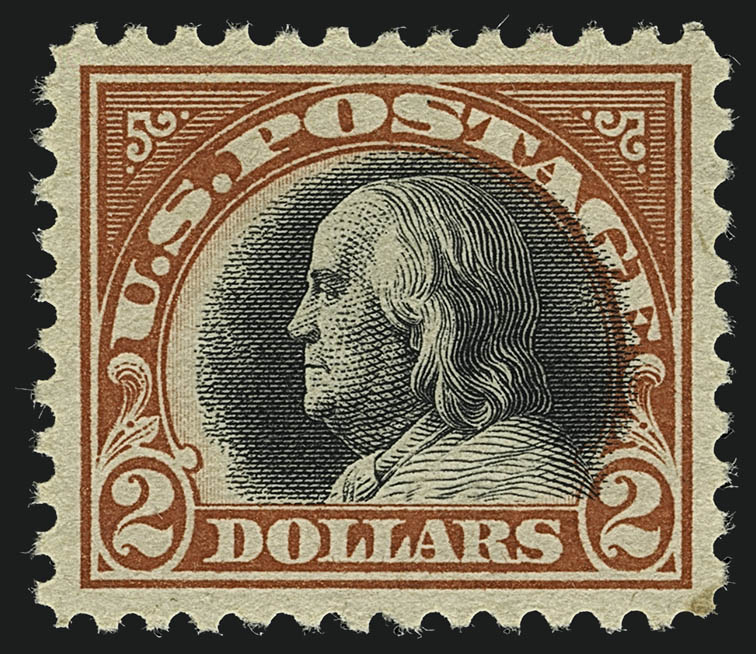 |
|
Send note to Staff
|
|
|
Pillar Of The Community
United States
3528 Posts |
|
|
That's a good observation about bi-colored stamps.
Collectors of C3, for example, would solve this issue by calling it a fast, slow or grounded plane. A skewed vignette somehow becomes a 'feature' or collectible variety, independent of grading.
I guess the example you posted would be a slow or lazy-Ben. |
|
Send note to Staff
|
|
|
Replies: 164 / Views: 25,352 |
|




 Posted 09/14/2017 12:01 pm





