Stamp Community Family of Web Sites
Thousands of stamps, consistently graded, competitively priced and hundreds of in-depth blog posts to read


Stamp Community Forum
 
Username:
Password:
Save Password
Forgot your Password?

This page may contain links that result in small commissions to keep this free site up and running.

Welcome Guest! Registering and/or logging in will remove the anchor (bottom) ads. It's Free!

The Stamps Of Epirus

Next Page    
 
To participate in the forum you must log in or register.
Author Previous TopicReplies: 26 / Views: 9,666Next Topic
Page: of 2
Valued Member
United States
143 Posts
Posted 08/15/2009   1:51 pm  Show Profile Bookmark this topic Add gvcoll to your friends list Get a Link to this Message
From Wikipedia:


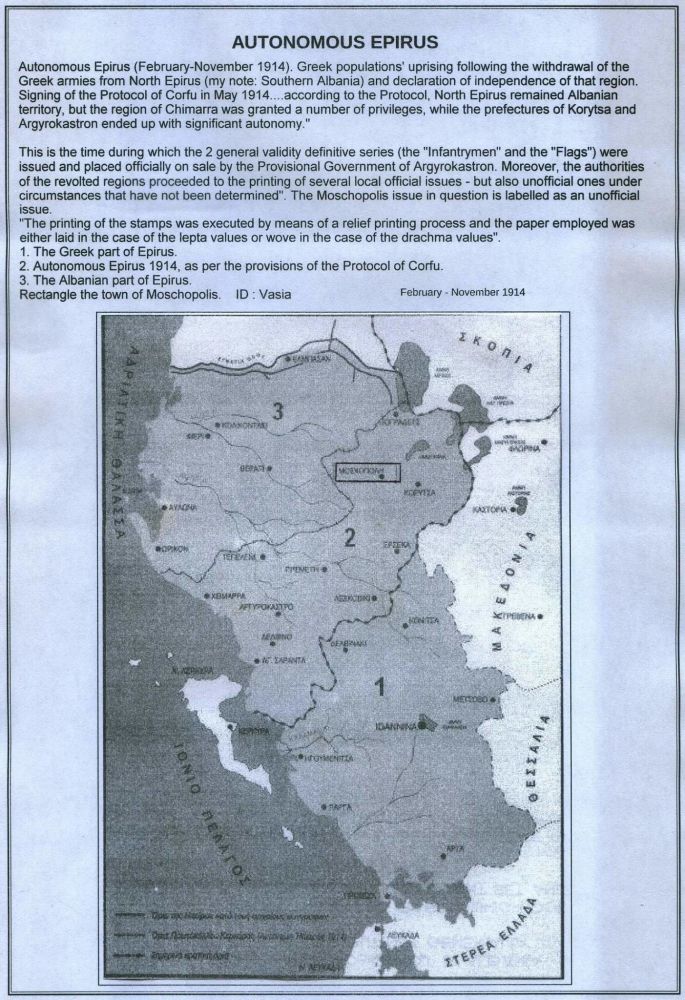
The postal history of Epirus, a region in the western Balkans divided between Greece and Albania, comprises two periods; 1912-1916 and 1940-41. Epirus was occupied by Greece during the First Balkan War, but parts of it were then awarded to newly independent Albania by the Florence Protocol of 1913. During this period, Greek stamps were used. Greece withdrew from the region in early 1914. The people of Epirus were unwilling to be part of Albania, though, and launched a revolution. Under a provisional government, the independent Autonomous Republic of Northern Epirus was formed in February 1914; it eventually managed to win some autonomy under Albanian rule. Epirus operated its own postal service and issued postage stamps, both official and unofficial, during that year.

Greek armies returned to occupy Epirus in November 1914, after the outbreak of World War I, but were driven out by Italian forces in 1916. During this time Greek stamps overprinted N. EPIRUS were used. After the war, the region was confirmed as part of Albania.

Epirus briefly came under Greek control again in 1940, after Italy launched an invasion of Greece from Albania. A successful Greek counter-attack occupied much of southern Albania, including Epirus. This lasted until 1941, when Germany invaded and conquered Greece. As earlier, overprinted Greek stamps were used in Epirus during the period of Greek control.

The first stamps used in Epirus, following its occupation by Greece in 1912, were Greek stamps overprinted HELLENIC ADMINISTRATION; these were succeeded in 1913 by newly issued Greek stamps, the so-called "Campaign issue". Both were meant only for use in the newly occupied areas, or "New Territories".

Following Greece's 1914 withdrawal and the founding of the Autonomous Republic of Northern Epirus, a number of stamps were released in the region. They included official definitive stamps, stamps for local use and unofficial issues.

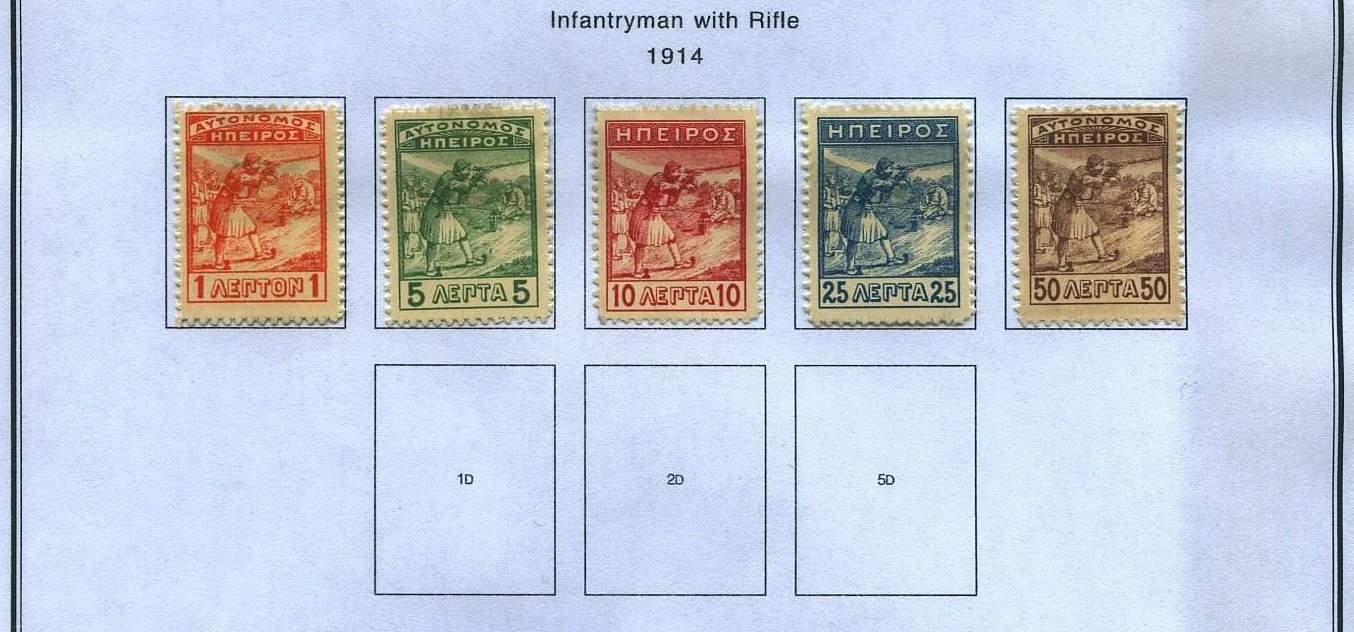
The provisional government's first definitive stamps came out in February, March and April 1914. The set of eight stamps, with denominations of 1 lepton, 5, 10, 25 and 50 lepta, 1 drachma and 2 and 5 drachmae, depicted an infantryman aiming a rifle while others look on; the 10 lepta and 25 lepta values were inscribed only EPIRUS (these were released in February), while the others read AUTONOMOUS EPIRUS (these were released in March with the exception of the 5 drachma, which came out in April). The set was printed by the firm Gerasimos Aspiotis Bros. of Corfu, which was also responsible for printing many Greek stamps. Instead of regular perforation a serrate roulette was used. Serrate roulettes superficially resemble perforation, but are distinguished by angled cuts rather than round holes.

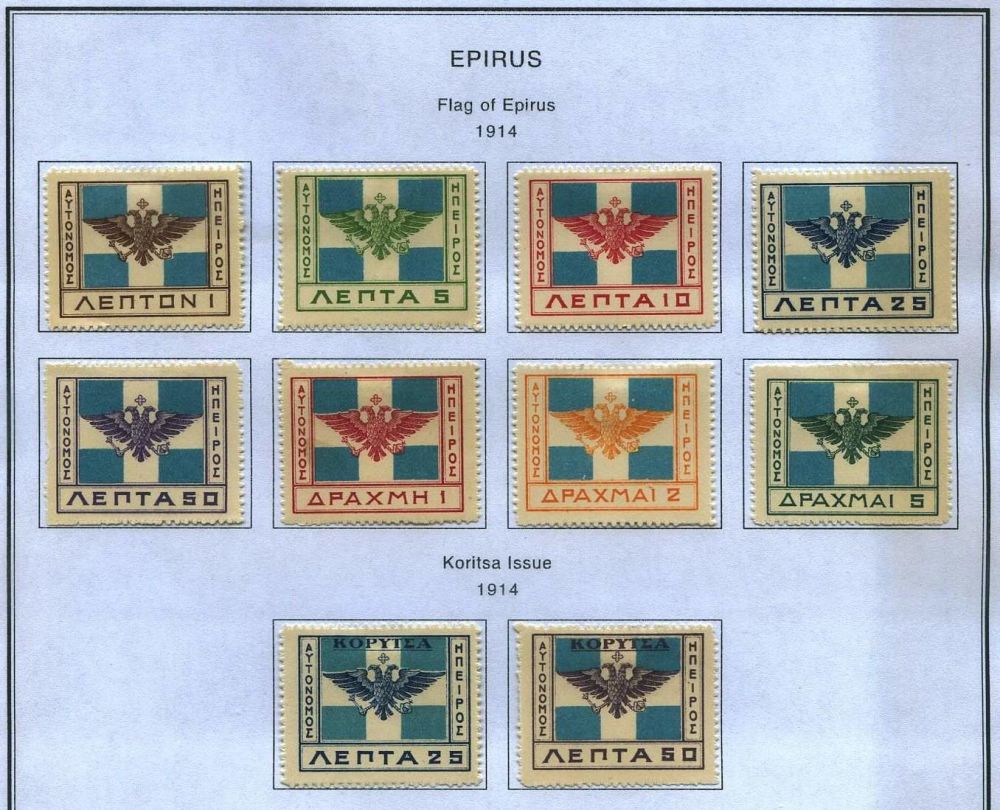
On August 28, the government issued a new set of eight, with the same denominations as previously, depicting the flag of Epirus and a double-headed eagle in a two-color design. Like the previous set, it was printed by Aspiotis Bros. The 25 and 50 lepta values from this set were modified at Koritsa to include the overprint KORITSA in dark blue.

A third definitive set came out on October 10, 1914. Produced by the "Papachrysanthou" printing house of Athens, it was issued at Chimarra and depicted King Constantine I of Greece with the inscription GREEK CHIMARRA. It consisted of ten denominations; the same eight as the previous sets, with the addition of 2 and 20 lepta stamps. Some sheets from this set bore the watermark PARCHEMINE JOHANNOT de Montgolfier, Luquet & Cie., Angoulème at the top or bottom; stamps with part of this watermark are priced much higher than stamps without it.

The first stamps of independent Epirus were issued in Chimarra in February 1914. The set of four (1 lepton and 5, 10, and 25 lepta) was imperforate, featuring a double-headed eagle along with a skull and crossbones, and inscribed GREEK AUTONOMOUS EPIRUS - FREEDOM OR DEATH - DEFEND OUR COUNTRY. Produced manually with a handstamp, they also bore a control mark in the lower right corner consisting of a blue oval with the letters "SP" inside, after Spyros Spyromilios, the commander at Chimarra. Though this set was intended for local use, specimens are known with cancellations for Delvinon and Agioi Saranta. Some experts argue that it does not qualify as an official stamp issue.

Stamps for local use were also issued in Argyrokastro, by overprinting Turkish stamps with AUTONOMOUS EPIRUS and new values in Greek currency. The overprints were applied vertically in black or red, reading either up or down. This issue was withdrawn from sale on March 6, 1914.

On August 28, in Chimarra, stocks of Greek stamps from 1911 and 1913 were overprinted GREEK CHIMARRA 1914. This set exists both with and without the letters "SS" (for S. Spyromilios) in manuscript. Counterfeits of both this and the first Chimarra set from February are plentiful.

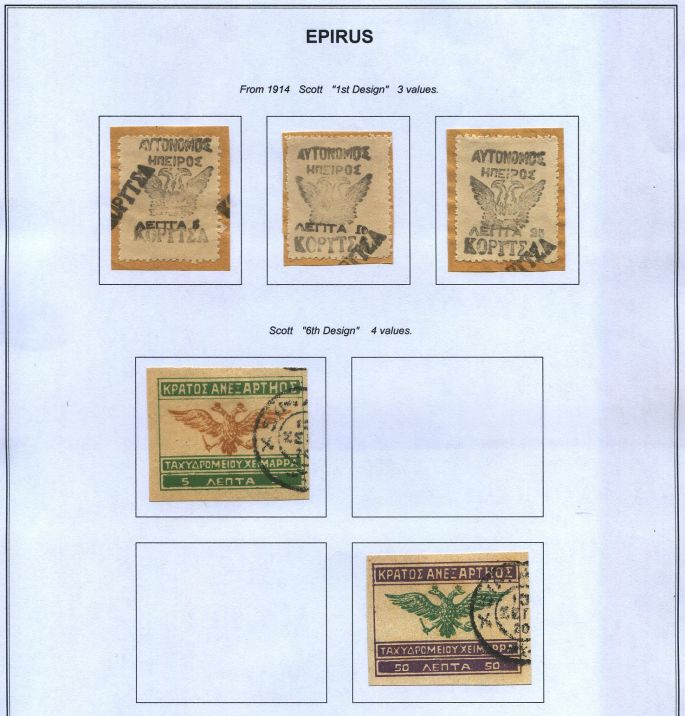
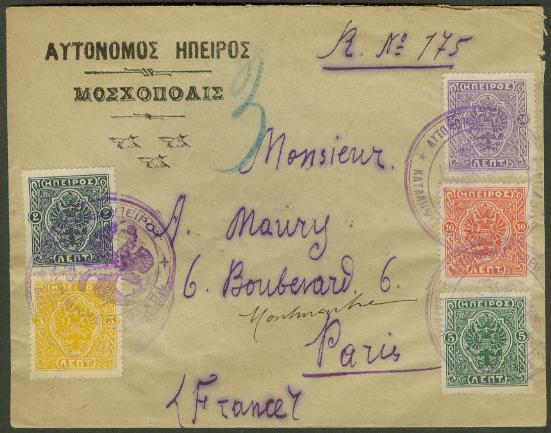
Four unofficial issues were also produced in 1914; one consisting of overprinted Albanian stamps (six values), the other three bearing new designs of varied quality. These three were produced for Erseka (seven values), Koritsa (three values) and Moschopolis (fifteen values). They were likely issued for publicity and propaganda purposes; their regular postal use is questionable, though cancelled specimens of the Erseka and Moschopolis issues and examples of these stamps on covers exist. An additional design dates from 1920, long after Epirus' postal system had ceased to exist.

Greece resumed control over Epirus in November 1914; on the 30th, to meet the area's postal needs, stamps from its "Campaign issue" were issued with the overprint N. EPIRUS horizontally in black; red overprints were also made, but not issued. (Some cancelled copies are known to exist.) These replaced Epirus' definitive issues. In 1916 the same overprint was applied vertically, reading either up or down, to Greek stamps from 1911 and 1913. All of these have been counterfeited.

Greek forces were driven out of Epirus by Italy in 1916; at the same time, Koritsa came under French occupation. Under French administration, a short-lived Republic of Koritsa was formed there and stamps were issued in December 1916. They were produced by further overprints of a double-headed eagle and new values in centimes on Greek stamps with the N. EPIRUS overprint.

In October 1940, Italy launched an invasion of Greece from Albania. A Greek counter-attack succeeded in occupying much of southern Albania, including Epirus. During this period of Greek control, which lasted until the German invasion of April 1941, the overprint HELLENIC ADMINISTRATION in black or carmine was applied to Greek definitive issues, airmail stamps, postage due stamps and charity stamps. The overprinted issues were withdrawn from sale in June 1941.
Send note to Staff
Edited by gvcoll - 08/16/2009 12:43 am

Pillar Of The Community
USA
867 Posts
Posted 08/15/2009   8:22 pm  Show Profile Bookmark this reply Add sfgoda to your friends list  Get a Link to this Reply
thanks for all of the great information. I really enjoyed it.


Butch
Send note to Staff  Go to Top of Page
Pillar Of The Community
Philippines
505 Posts
Posted 08/16/2009   03:12 am  Show Profile Bookmark this reply Add nic to your friends list  Get a Link to this Reply
Epirus citizens sure had it rough, last mention of it was June 1941, is it still existing or now annexed to some other country?
That's some great story reading about Epirus

nic
Send note to Staff  Go to Top of Page
Pillar Of The Community
Learn More...
Canada
3963 Posts
Posted 08/16/2009   07:37 am  Show Profile Bookmark this reply Add Dianne Earl to your friends list  Get a Link to this Reply
Great History lesson gvcoll.

Thanks for sharing it with us.

Dianne
Send note to Staff  Go to Top of Page
Don't grumble that the roses have thorns, be thankful that the thorns have roses
Pillar Of The Community
Australia
1658 Posts
Posted 08/16/2009   5:41 pm  Show Profile Bookmark this reply Add nuggethill to your friends list  Get a Link to this Reply
this is great information ,
thanks for sharing.

Send note to Staff  Go to Top of Page
Valued Member
United States
143 Posts
Posted 08/16/2009   10:15 pm  Show Profile Bookmark this reply Add gvcoll to your friends list  Get a Link to this Reply
Thanks, everyone. To answer nic's question, northern Epirus has been part of the country of Albania since the 1920s, except for the time when Greece controlled it in the 40s.
Send note to Staff  Go to Top of Page
Pillar Of The Community
Philippines
505 Posts
Posted 08/17/2009   03:46 am  Show Profile Bookmark this reply Add nic to your friends list  Get a Link to this Reply
Copy that gvcoll! Thanks!
Looking forward to your next story post, you know, it's really interesting to know the rough times, allows me to appreciate the peaceful times...
Send note to Staff  Go to Top of Page
Bedrock Of The Community
Australia
38679 Posts
Posted 12/17/2016   03:52 am  Show Profile Bookmark this reply Add rod222 to your friends list  Get a Link to this Reply

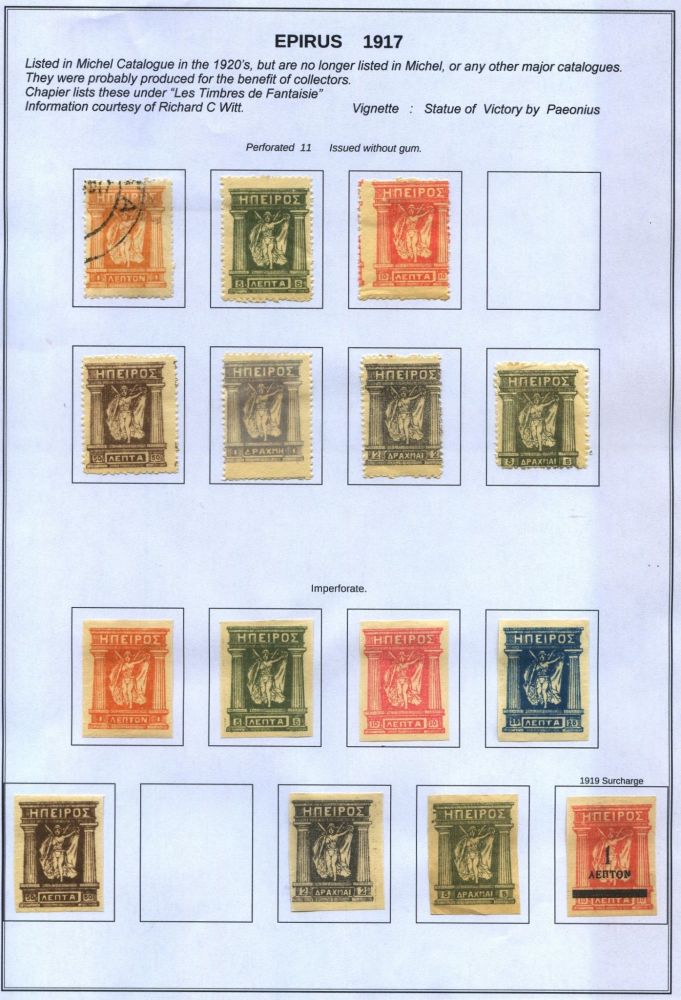
"Les Timbres de Fantaisie"

Statue of Victory by Paeonius.


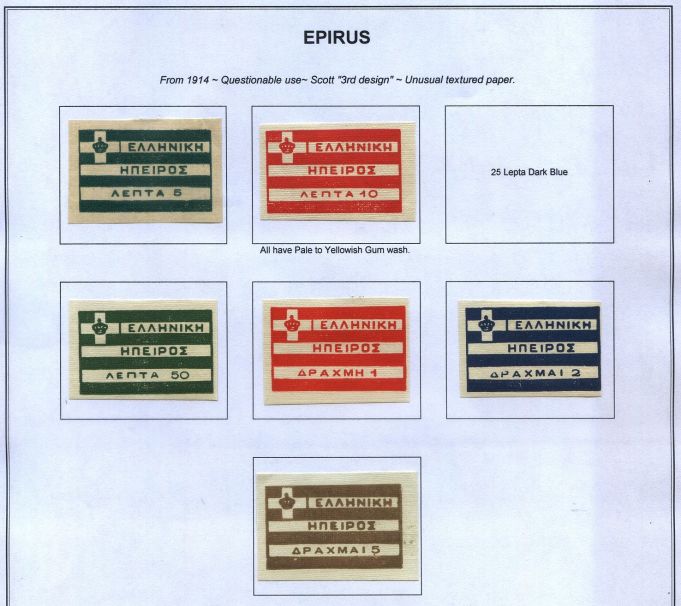
From 1914
Scott 3rd Design. Questionable Use.

Send note to Staff  Go to Top of Page
Pillar Of The Community
United States
8397 Posts
Posted 12/17/2016   1:47 pm  Show Profile Bookmark this reply Add floortrader to your friends list  Get a Link to this Reply
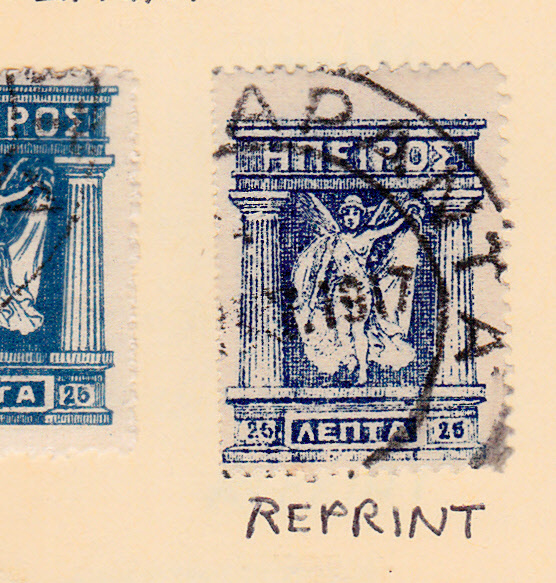
ROD222-----The Statue of Victory set comes two ways , as the bogus set plus their is a reprint in blurry print [that second set is in a different shade of color ] .
Send note to Staff  Go to Top of Page
Edited by floortrader - 12/17/2016 1:48 pm
Pillar Of The Community
Norway
1661 Posts
Posted 12/17/2016   2:06 pm  Show Profile Bookmark this reply Add Blaamand to your friends list  Get a Link to this Reply
Rod - that's a beautiful display of stamps, thanks for sharing

And thanks for bumping this old thread - that's a marvelous OP by gvcoll
Send note to Staff  Go to Top of Page
Pillar Of The Community
United States
8397 Posts
Posted 12/17/2016   3:21 pm  Show Profile Bookmark this reply Add floortrader to your friends list  Get a Link to this Reply
ROD222 - Looks like that flag set you have above comes in that rough textured paper {that you show} and on smooth white paper . The high value of the flag set { 5 apaxmai }comes in both a olive brown color like your copy and also comes in a metallic gold ink .
Send note to Staff  Go to Top of Page
Bedrock Of The Community
Australia
38679 Posts
Posted 12/17/2016   5:20 pm  Show Profile Bookmark this reply Add rod222 to your friends list  Get a Link to this Reply

Thank you boys, for your nice words, and advice.
So a forged set of the bogus. Interesting.

I agree, Blaamand, a nice post by the original Author.
Makes a good Album Page.

I also Use information by SCF Author Vasia......


The integrity of the following, is questionable.

Send note to Staff  Go to Top of Page
Bedrock Of The Community
Australia
38679 Posts
Posted 12/17/2016   5:33 pm  Show Profile Bookmark this reply Add rod222 to your friends list  Get a Link to this Reply

Moschopolis Issue Used on Cover To French Stamp Dealer Maury.
(Not Mine)


Epirus 1914
Steiner Page 4

Flag


1914
Steiner Page 2 Infantryman.


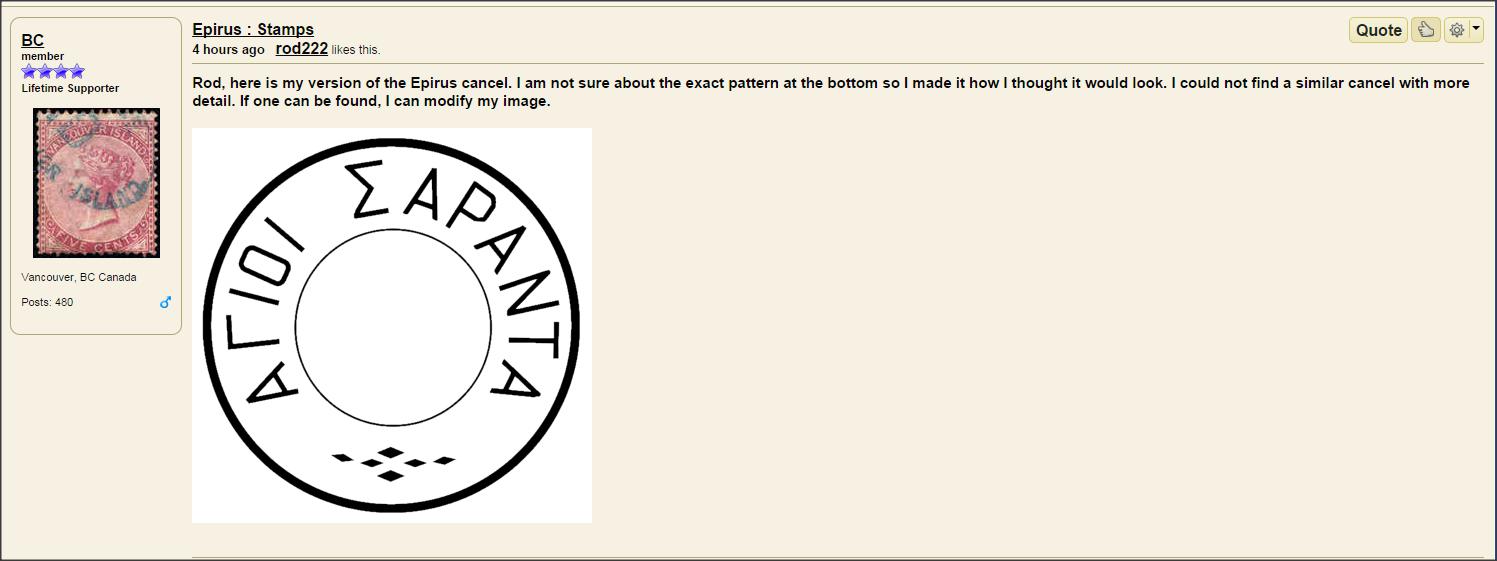
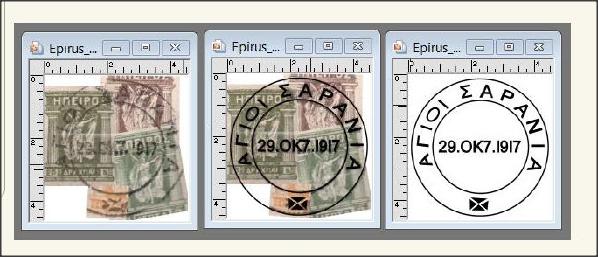
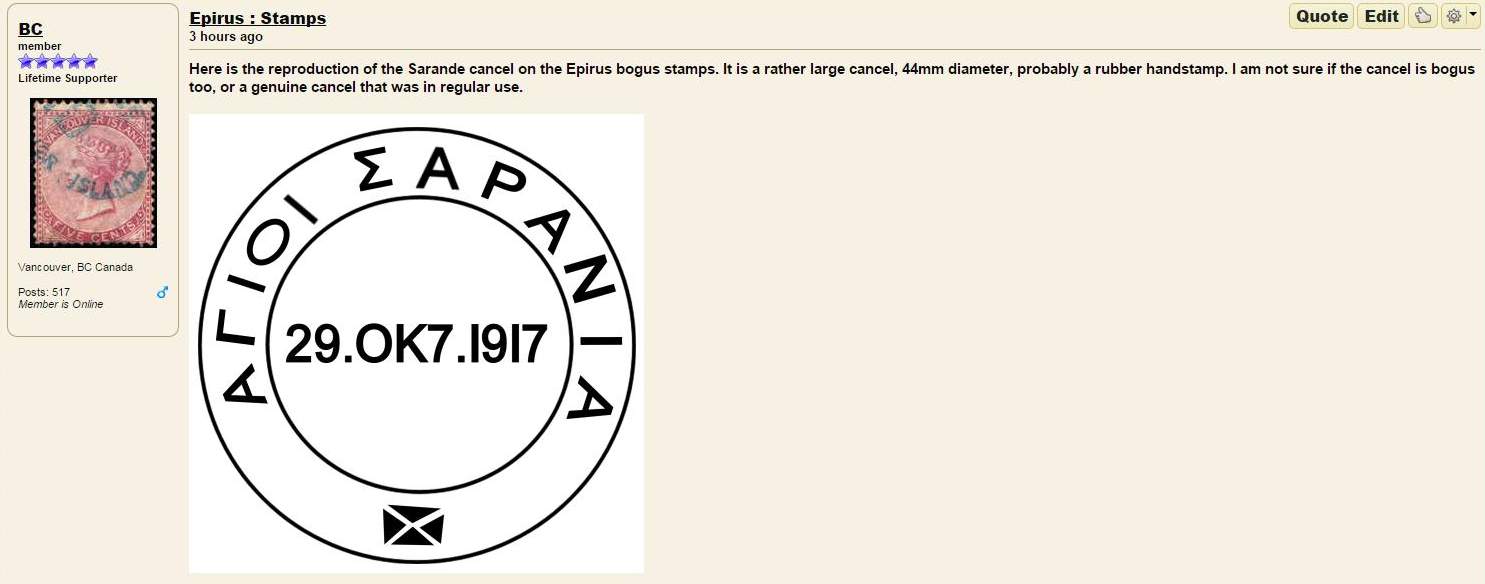
Brian's CAD drawing of Postmarks on Bogus Issues (Great Work)

Send note to Staff  Go to Top of Page
Pillar Of The Community
United Kingdom
3210 Posts
Posted 12/17/2016   6:10 pm  Show Profile Bookmark this reply Add nigelc to your friends list  Get a Link to this Reply
Sorry if this seems picky but the second last letter of the big Agioi Saranta postmark on my copies is a "T" rather than an "I".

Mine also all appear to be dated "29 OKT 1917" where I can see parts of the date.
Send note to Staff  Go to Top of Page
Nigel
Edited by nigelc - 12/17/2016 6:17 pm
Bedrock Of The Community
Australia
38679 Posts
Posted 12/17/2016   6:16 pm  Show Profile Bookmark this reply Add rod222 to your friends list  Get a Link to this Reply

Quote:
Sorry if this seems picky but the second last letter of the big Agioi Saranta postmark on my copies is a "T" rather than an "I".


Please be picky Nigel.
We are here to enjoy and learn.
Your observations and knowledge are valuable .

I'll see if I can find the bogus stamps with the Postmarks.

Update:
Nigel, perhaps there were two differing hammers? (although you did mention the larger ring type)


Solved:

Brian (at the time) did not have enough material to discern the "I" was in fact a "T"
as you have brought to our attention.

The "T' was just off the stamp, only the downstroke visible.


Send note to Staff  Go to Top of Page
Edited by rod222 - 12/17/2016 6:34 pm
Pillar Of The Community
United States
8397 Posts
Posted 12/17/2016   8:49 pm  Show Profile Bookmark this reply Add floortrader to your friends list  Get a Link to this Reply
Here is a clear view of the "T" in the cancel .

Send note to Staff  Go to Top of Page
Page: of 2 Previous TopicReplies: 26 / Views: 9,666Next Topic  
Next Page
 
To participate in the forum you must log in or register.

Go to Top of Page

Disclaimer: While a tremendous amount of effort goes into ensuring the accuracy of the information contained in this site, Stamp Community assumes no liability for errors. Copyright 2005 - 2026 Stamp Community Family - All rights reserved worldwide. Use of any images or content on this website without prior written permission of Stamp Community or the original lender is strictly prohibited.
Privacy Policy / Terms of Use    Advertise Here
Stamp Community Forum © 2007 - 2026 Stamp Community Forums
It took 0.23 seconds to lick this stamp. Powered By: Snitz Forums 2000 Version 3.4.05