|
This page may contain links that result in small commissions to keep this free site up and running.

Welcome Guest! Registering and/or logging in will remove the anchor (bottom) ads. It's Free!
To participate in the forum you must log in or register.
| Author |
 Replies: 117 / Views: 27,235 Replies: 117 / Views: 27,235 |
|
|
|
Valued Member
146 Posts |
|
|
Quote:
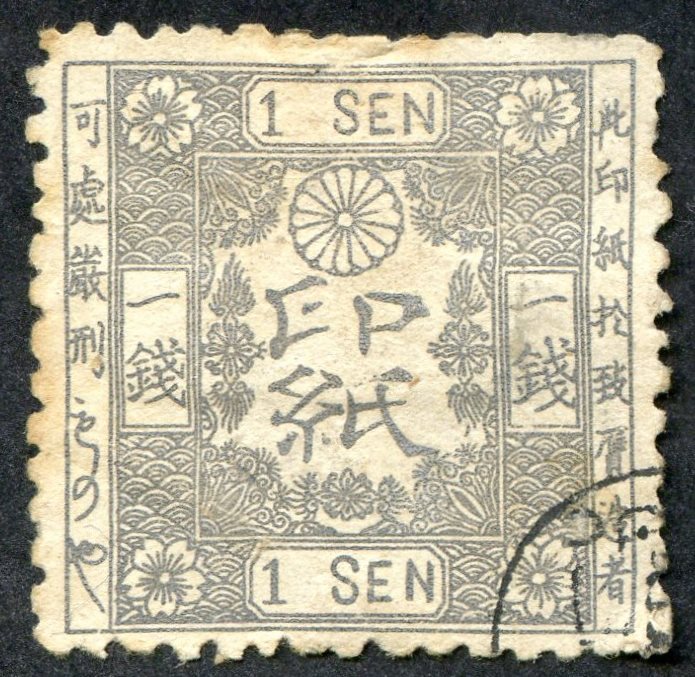
I am pretty sure that you've already spotted that the lower left stamp, lacking the small scroll pattern in right, is identical to error I-26 in Hasegawa, p.149. Congratulations for the nice variation ! Thanks Hironobu, Just looking through some of my 1 sen stamps, I noticed that the stamp below has roulettes on the left side and the other three sides with perforations? I don't think its listed in 'Hasegawa', maybe in another catalogue? I wonder if this combination of roulette & perfs is already known?  This 1 sen block of eight is from the 5th printing if I have identified the stamps correctly? The vertical margin measures 3.25mm and the horizontal margins are 3.5mm. I have noticed that the left and right edge of the block have been cut in a straight line giving an appearance of imperf before being used on the document, any ideas why? 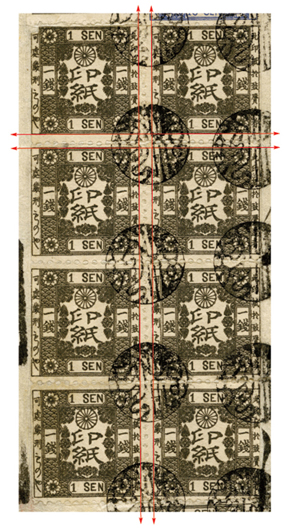 Next is a vertical pair of 5 sen stamps not sure which issue, could be the 1st issue? I have highlighted two interesting features that I found on the top stamp: 1. Large ball to the tip of the numeral '5' along the base 2. Missing piece of floral scroll 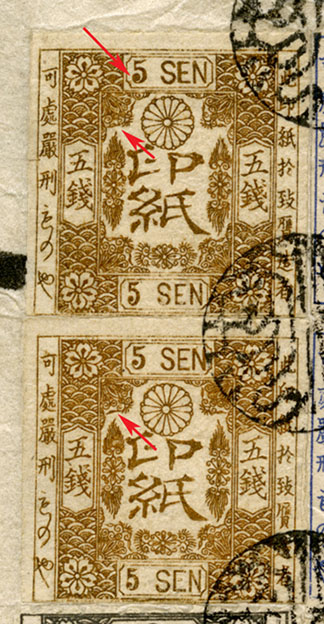 Look forward to your comments Andrew |
Send note to Staff 
|
| Edited by agb - 11/24/2017 01:47 am |
|
|
Valued Member
Japan
350 Posts |
|
|
Andrew, let me try go thru one by one; Quote:
Just looking through some of my 1 sen stamps, I noticed that the stamp below has roulettes on the left side and the other three sides with perforations? I don't think its
listed in 'Hasegawa', maybe in another catalogue?
I wonder if this combination of roulette & perfs is already known? The stamp is very likely to be 5th issue, electroplated with wide gap (3mm) on porous paper, first appearance in Meiji 12. As the perforations were already applied from the 3rd series, I believe there will be very little chance that roulette machines existed at the same time with the perforation machines in the printing factory. But it looks indeed like a roulette... maybe due to blind perforation ? I haven't met such example yet. - Hironobu |
|
Send note to Staff
|
|
|
Valued Member
Japan
350 Posts |
|
|
Quote:
This 1 sen block of eight is from the 5th printing if I have identified the stamps correctly?
The vertical margin measures 3.25mm and the horizontal margins are 3.5mm. I have noticed that the left and right edge of the block have been cut in a straight line giving an appearance of imperf before being used on the document, any ideas why? Yes, they seem to be the 5th printing. The both edge seem to be simply cut by scissors by someone lazy to save time  Quote:
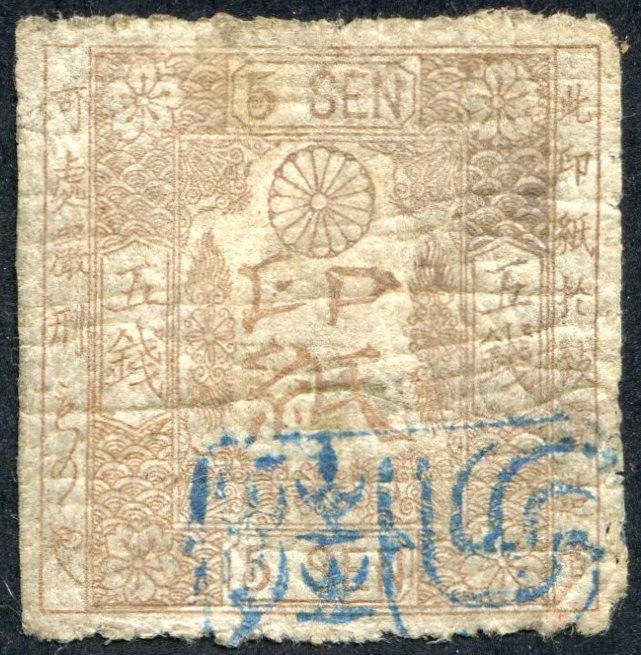
Next is a vertical pair of 5 sen stamps not sure which issue, could be the 1st issue? I have highlighted two interesting features that I found on the top stamp:
1. Large ball to the tip of the numeral '5' along the base
2. Missing piece of floral scroll The coluor looks a bit brownish for 1st series but bit too dark for 2nd series. I do have similarly coloured ones on documents, which I temporarily categorize as "1st series" with a big "?". The "Large ball" of "5" could appear in several plates, although I don't have enough knowledge to allocate this characteristics to a particular plate. I have scanned several (random) examples of "5" from my 1st 5sen album; you can see the wide variety in the font itself, some of them having large ball, some of them having scrolls etc. 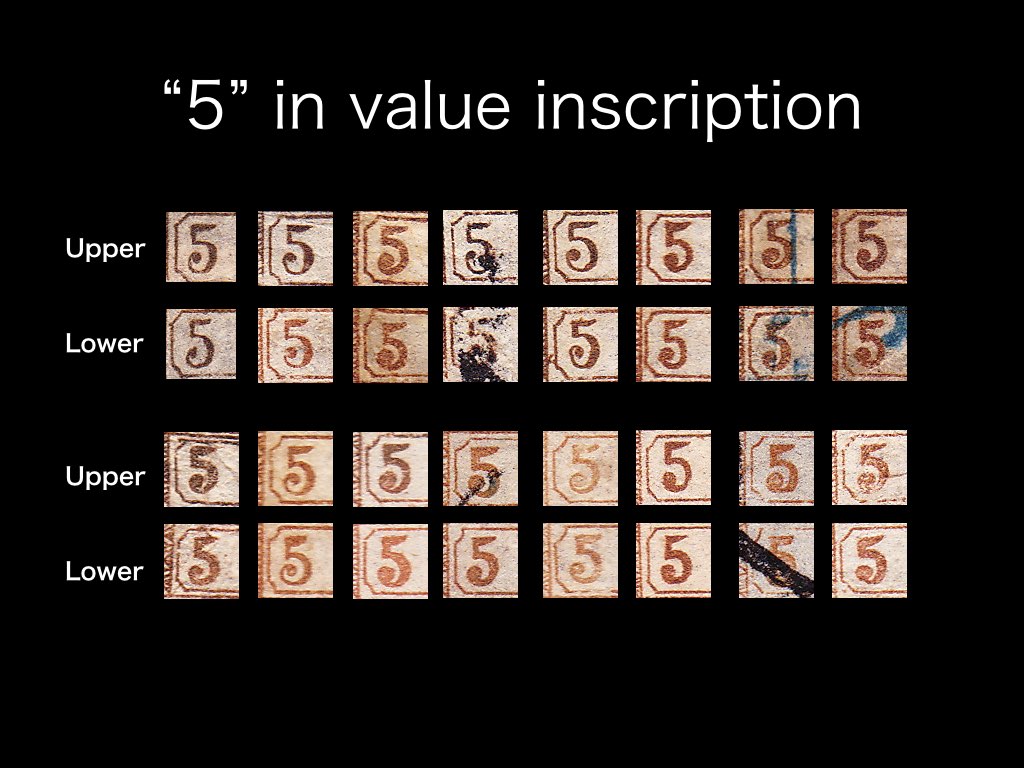 I believe that, for the engravers at that time, roman numerals and alphabets were something they haven't seen before and thus was like a mere "design" for them. This is why the individual engraver has such apparent characteristics of their own. And this should be a big clue for at least grouping the stamps into plates; I bet anyone can notice the strong similarity between some of the examples, which should belong to the same family. And the "missing piece of floral scroll" is definitely an engraving error. Congratulations ! -Hironobu |
|
Send note to Staff
|
|
|
Valued Member
146 Posts |
|
|
Hironobu, Thank you for clarifying the points I made above, it been a great help. I am impressed with your detailed work on the 5 sen numerals. Quote:
The stamp is very likely to be 5th issue, electroplated with wide gap (3mm) on porous paper, first appearance in Meiji 12. As the perforations were already applied from the 3rd series, I believe there will be very little chance that roulette machines existed at the same time with the perforation machines in the printing factory. But it looks indeed like a roulette... maybe due to blind perforation ? I haven't met such example yet. I will have to do a little more research into stamp perforating etc, it sure does look like it has rouletting on the left side. Lets hope further examples will surface as a result of collectors reading this topic. Andrew |
|
Send note to Staff
|
| Edited by agb - 11/24/2017 11:31 am |
|
|
Bedrock Of The Community
Australia
38679 Posts |
|
|
Valued Member
146 Posts |
|
|
rod222, Thanks for joining in and showing some of your 1 & 5 sen hand engraved revenues. I do like your 5 sen stamps, maybe 'Hironobu' could confirm that they may be varieties? I have annotated the areas of interest with arrows. 1. Break where the two lines meet? 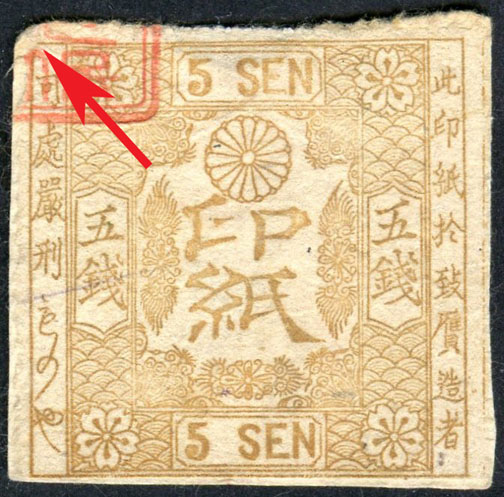 2. Break in top line 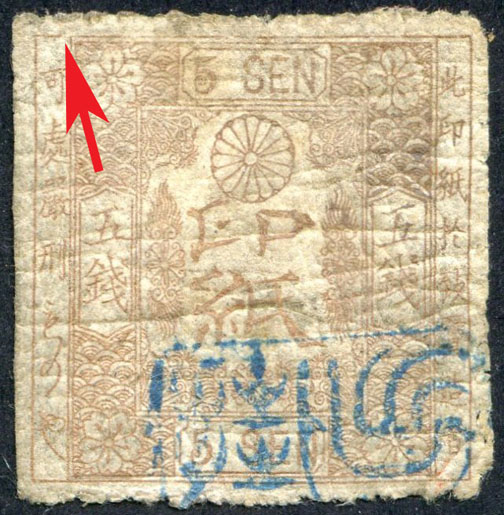 These breaks may be constant or as a result of wear to the printing plate?  I am hopeful that someone will show a 1 sen stamp which has roulettes on the left side of stamp and perfs on the three other sides as the one shown above which Hironobu has kindly commented on. I am still contemplating how this may have occurred, any printers out there? Andrew |
|
Send note to Staff
|
| Edited by agb - 11/24/2017 3:51 pm |
|
|
Bedrock Of The Community
Australia
38679 Posts |
|
|
Andrew.
Please correct me if I am wrong, but with hand engraved issues, are "varieties" per se, a misnomer?
Every stamp is going to be different, hence the differences are just a means to plate the issues.
I note the 1 sen examples, some of the florals left of the Chrysanthemum, are vastly different.
Re the dual separation method, dashed if I can recall from whence they originated, but I have seen stamps with both roulette and perforate edges.
Maybe sheets were rouletted between panes, then perforated.
I do not know what quantity of these revenues were printed per sheet.
|
|
Send note to Staff
|
|
|
Valued Member
146 Posts |
|
|
rodd222 thank you for your comments Quote:
Please correct me if I am wrong, but with hand engraved issues, are "varieties" per se, a misnomer?
I agree with you, it is probably a misnomer. Quote:
Every stamp is going to be different, hence the differences are just a means to plate the issues.
I note the 1 sen examples, some of the florals left of the Chrysanthemum, are vastly different.
In an article which I mention earlier it was stated that there were '130+ printing plates made'. The 'Hasegawa' catalogue mentions the stamps were in sheets/panes of 50 stamps. Not sure if that means printed in sheets of 50 images or in panes of 50 stamps with several panes on a sheet? As all the images having minor differences, I wonder if there had been any major works by collectors in trying to plate these stamps from sheets, part sheets, or blocks etc. Maybe Hironobu could help with this information? Quote:
Re the dual separation method, dashed if I can recall from whence they originated, but I have seen stamps with both roulette and perforate edges.
Maybe sheets were rouletted between panes, then perforated.
You may be right, but more information is needed Quote:
do not know what quantity of these revenues were printed per sheet.
I read that most of these issues were printed in sheet/panes of 50, (10 x 5), or maybe in panes of 50 on a large sheet, say 6 panes to view, then the rouletting could be applicable to one side? Andrew |
|
Send note to Staff
|
| Edited by agb - 11/24/2017 6:11 pm |
|
|
Bedrock Of The Community
Australia
38679 Posts |
|
|
For the record. Mixed Perforate and Roulette. The South African "Bantams" 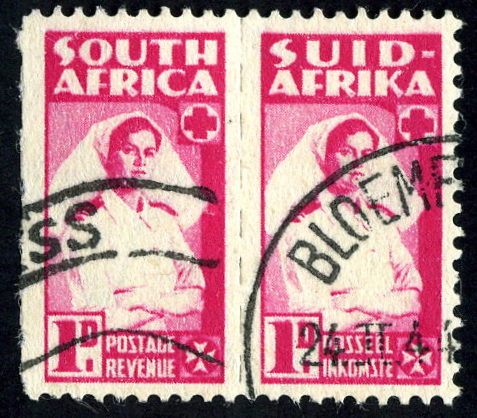 |
|
Send note to Staff
|
|
|
Valued Member
146 Posts |
|
|
Valued Member
Japan
350 Posts |
|
|
Hi Andrew and all, Re the roulette-perforation combined 1 Sen stamp, I have made several measurements using ImageJ app on Mac OS X based on the posted image. i) I assumed the width of the printed area to be 24.5mm (from my experience for 5th issue 1 sen stamps) and normalized the measuring scale for ImageJ; ii) checked the bottom and right perforations using clearly distinguishable perforations and by measuring the separation distances, which resulted to be p10, a common perforation for this issue thus confirming the normalization of the scale in i); iii) measured the distance between clearly distinguishable roulettes on the left edge, which resulted to have about 9.6 roulettes per 20mm (=p9.6). (It would be nice if Andrew can confirm this measurement on the original stamp) Now, the roulettes used for earlier issues (1st and 2nd) are either 14.5 or 18 (Hasegawa also lists 16 as a part of combination roulette 14.5x16 in his catalogue), but they are not coarse enough to fit the observed "9.6" pitch. 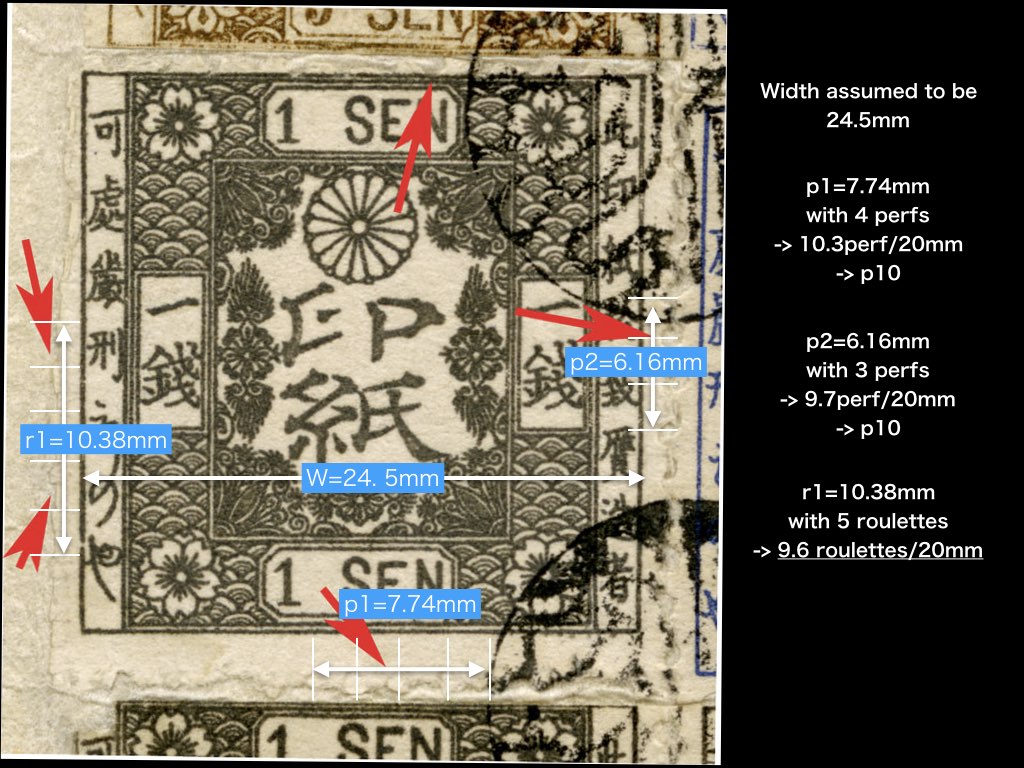 So as for the discussion, there will be two possibilities for this Andrew's interesting example; 1) not a roulette, but an accidentally "roulette-like" looking perforation due to blind perforations and/or scissor cut or whatever, 2) indeed is a roulette, but with more coarse pitch (similar to rod222's example) used for other purposes. If so, the scenario could be like this; [Scenario 1] - one column of perforation was missing, and has been found during final product inspection and returned to perforation process, - the then used perforation machines were totally occupied so the roulette machine (for other purposes) available was used, resulting to this combination. [Scenario 2] - one column of perforation was missing, has passed thru the product inspection and distributed to local vending offices, - the vending office found this and applied their own roulette for ease to sell, resulting to this combination. May sound like a fantasy, but we can imagine and dream whatever we want  I now have to look very carefully into my stock albums of 1 Sen black. Thanks for the interesting example. -Hironobu |
|
Send note to Staff
|
| Edited by unechan - 11/24/2017 9:53 pm |
|
|
Valued Member
Japan
350 Posts |
|
|
Re "variations", I am not quite sure what wording should be the most appropriate for the hand engraved (etched) revenues and stamps. As rod222 has mentioned, every stamp on a plate (sheet of 5 rows x 10 column) are different, and the engraver of the plates may be different, resulting to 50 x (number of plates) stamps having unique characteristics, or variations in general. As for the case with obvious mistake in engraving, such as missing a part of design, mistakingly drawn lines, and light engraving, would it be fair to call them as "Errors", or to stay within "varieties" ? Furuya, on his example of written album page, uses the term "Error of Engraving"; 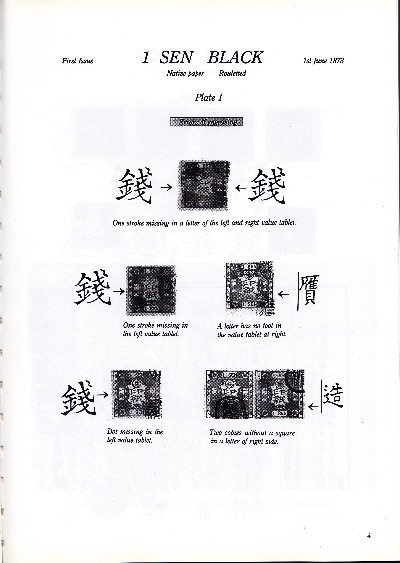 Hasegawa, in his catalogue, uses the term "Etching Variety"; 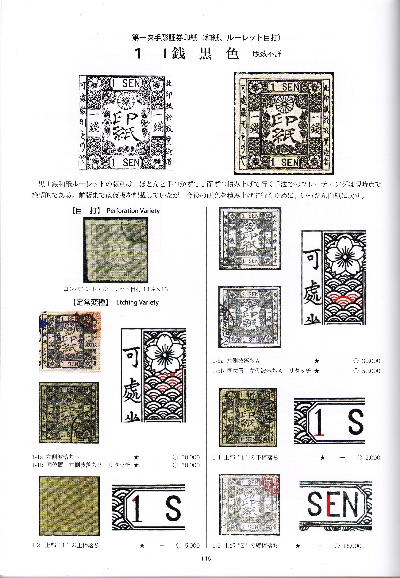 The Japanese Stamp Specialized Catalogue uses "Varieties" for hand engraved stamps (Dragon and Cherry Blossom stamps); 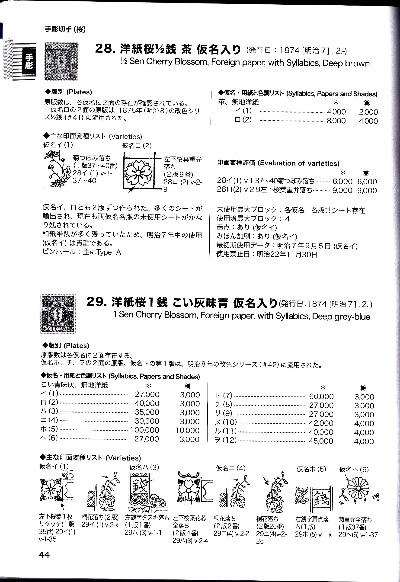 I believe that there are common practices for describing this issue for classical stamps in general, so any suggestions or comments, especially from native english speakers are welcome. -Hironobu |
|
Send note to Staff
|
| Edited by unechan - 11/24/2017 8:38 pm |
|
|
Valued Member
Japan
350 Posts |
|
|
Quote:
In an article which I mention earlier it was stated that there were '130+ printing plates made'. The 'Hasegawa' catalogue mentions the stamps were in sheets/panes of 50 stamps. Not sure if that means printed in sheets of 50 images or in panes of 50 stamps with several panes on a sheet? As all the images having minor differences, I wonder if there had been any major works by collectors in trying to plate these stamps from sheets, part sheets, or blocks etc. Maybe Hironobu could help with this information? It is pretty sure that the hand engraved revenue stamps were engraved on a single plate of 50 stamps, and each plate individually printed (printing in multiple panes were only introduced at the late printing of UPU Koban stamps). For the 5th series, the original (hand engraved plate of 50 stamps) were reproduced by electroplating to match the increased demand, but still being printed per plate. An example of plate reconstruction could be found in "Hand Engraved Revenues" by Furuya, issued 2003 from Narumi publishing. It should be theoretically possible to reconstruct a plate by accumulating large blocks, strips and pairs; the problem is accumulating the material may be easier for the lower face value stamps but they have so many plates, and for the higher face value stamps the number of plates are limited but obtaining the appropriate materials are extremely difficult. I am now gathering blocks and multiples of 1 sen black, but still far away from the goal... 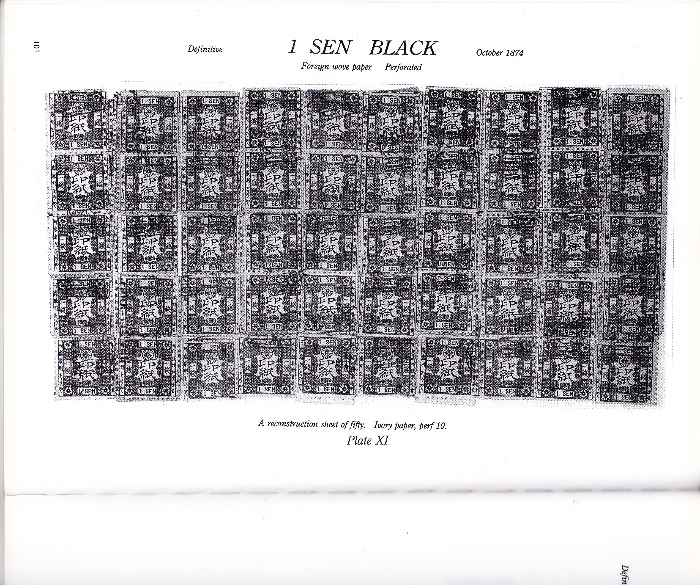 -Hironobu |
|
Send note to Staff
|
| Edited by unechan - 11/24/2017 9:01 pm |
|
|
Valued Member
Japan
350 Posts |
|
|
Dear rod222, thanks for posting your nice examples.
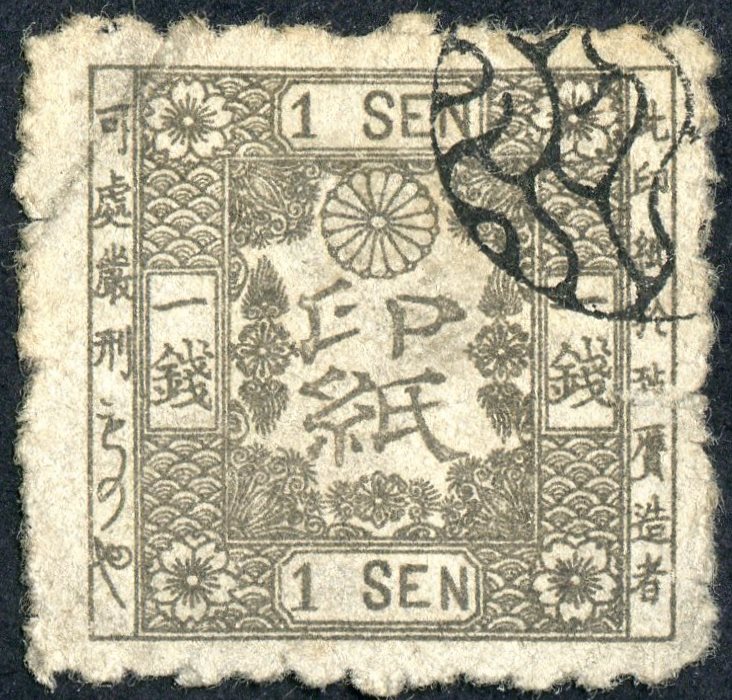
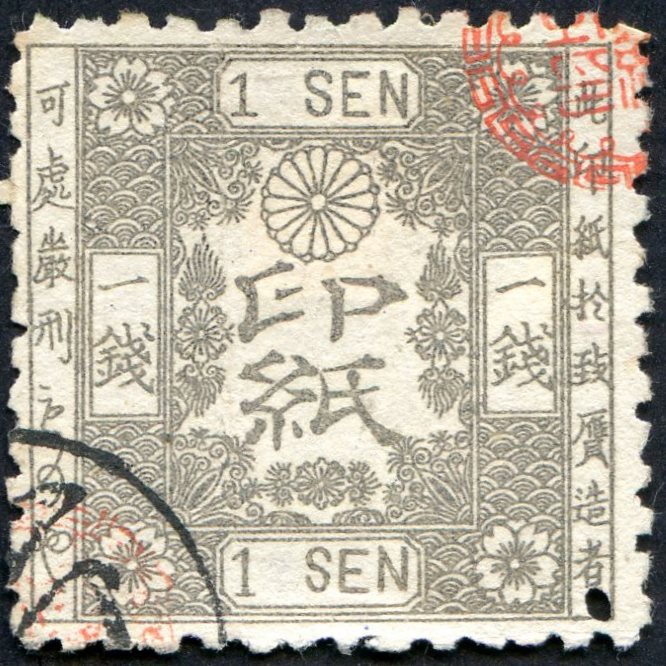
1st stamp: 4th issue 1 Sen on foreign paper. perf 10 or 11 (note the randomness of the teeth...)
2nd stamp : 5th issue 1 Sen on foreign paper, very likely on porous paper, perf 9 (often close to 8 1/2)
3rd stamp: 4th issue 1 Sen on foreign paper. perf 10. Should belong to different plate from the 1st stamp (the kanji characters have different characteristics on strokes)
4th stamp: 2nd issue 5 Sen on native paper, rouletted.
5th stamp: 1st issue 5 Sen on native paper, rouletted. Early printing, judging from the color and impression and also the guide line for rouletting (on the right side).
The interesting thing about these hand engraved revenues are all stamps are different so there's very little chance of having any duplicates, thus any example shown is invaluable for collectors !
-Hironobu |
|
Send note to Staff
|
| Edited by unechan - 11/24/2017 11:24 pm |
|
|
Bedrock Of The Community
Australia
38679 Posts |
|
|
Hironobu. Andrew. Interesting discussion on verbiage : errors / variations /varieties. I can come to no firm conclusion, happy to accept whatever the interested parties use. I drew a parallel with my own countries stamps (The Australian (New South Wales) "Sydney Views") These were all hand engraved on copper sheets, and printed on a crude hand press. Every stamp was different (each engraved individually) From what I have read, I could not see "error / variety /variation" entertained, Philatelists refer to each stamp as a "position" Thereby assuming all the stamps are "plated" This may be difficult with stamps / positions unidentified, as the Japanese revenues. "Variation" would, to me to appear to be the most suitable. This thread is becoming rather fascinating. 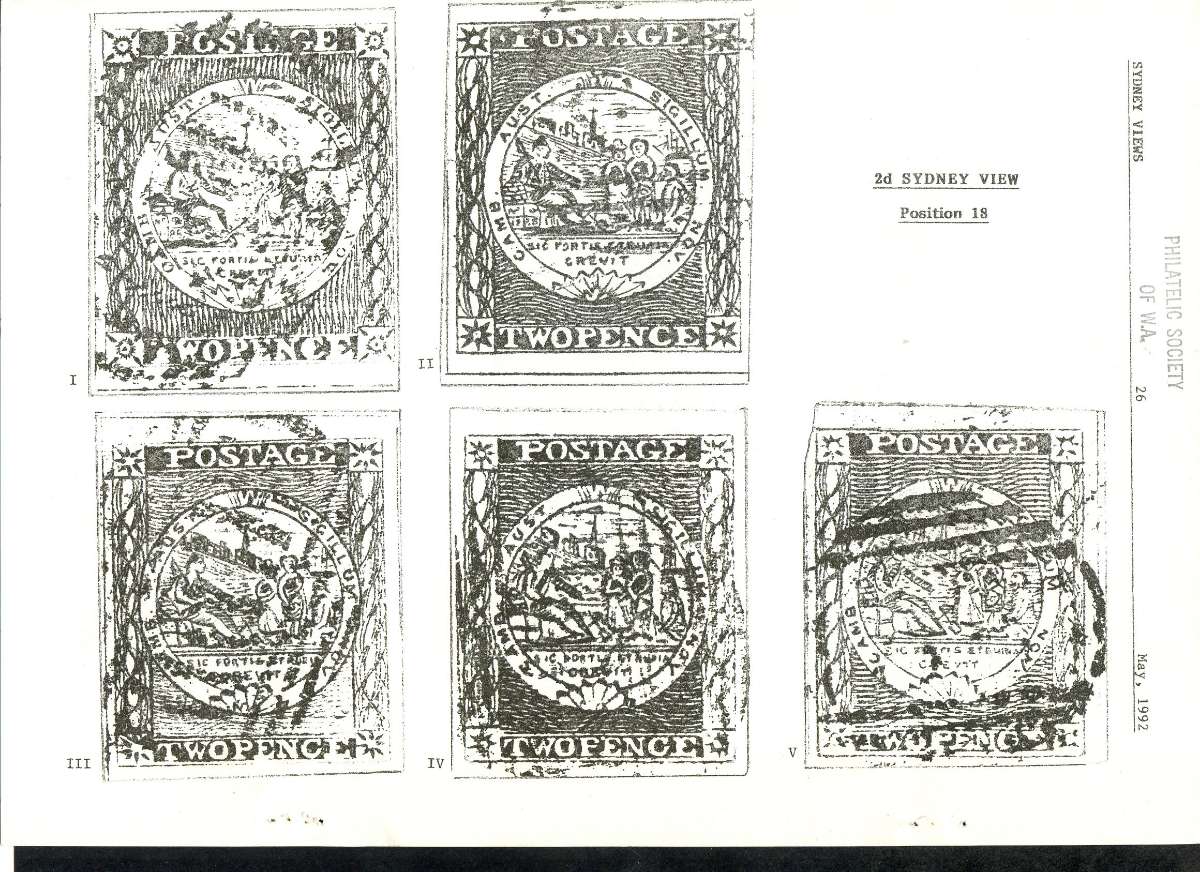 |
|
Send note to Staff
|
| Edited by rod222 - 11/25/2017 12:46 am |
|
|
Replies: 117 / Views: 27,235 |
|
|
To participate in the forum you must log in or register. | |
Disclaimer: While a tremendous amount of effort goes into ensuring the accuracy of the information contained in this site, Stamp Community assumes no liability for errors. Copyright 2005 - 2026 Stamp Community Family - All rights reserved worldwide. Use of any images or content on this website without prior written permission of Stamp Community or the original lender is strictly prohibited.
Privacy Policy / Terms of Use Advertise Here |
| Stamp Community Forum |
© 2007 - 2026 Stamp Community Forums |
| It took 0.22 seconds to lick this stamp. |
 |
|
|
|


 Posted 11/23/2017 12:43 pm