| Author |
 Replies: 117 / Views: 27,236 Replies: 117 / Views: 27,236 |
|
|
|
Bedrock Of The Community
Australia
38679 Posts |
|
|
Quote:
thus any example shown is invaluable for collectors ! Finally, dug out my Japan Album, here are two more stamps, for the record. (In my ignorance, I have always referred to these as my "EP's"....what does the central script translate to, please?) 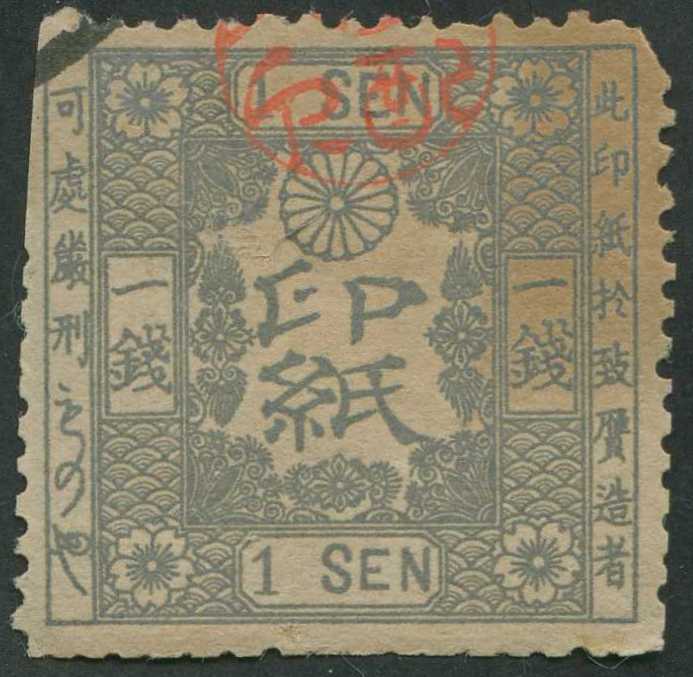 Example on piece.. 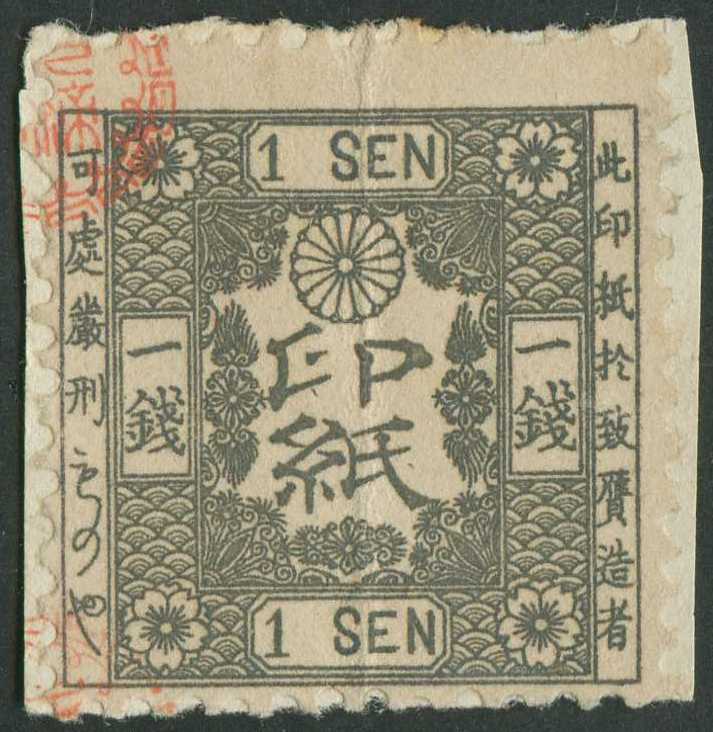 Back 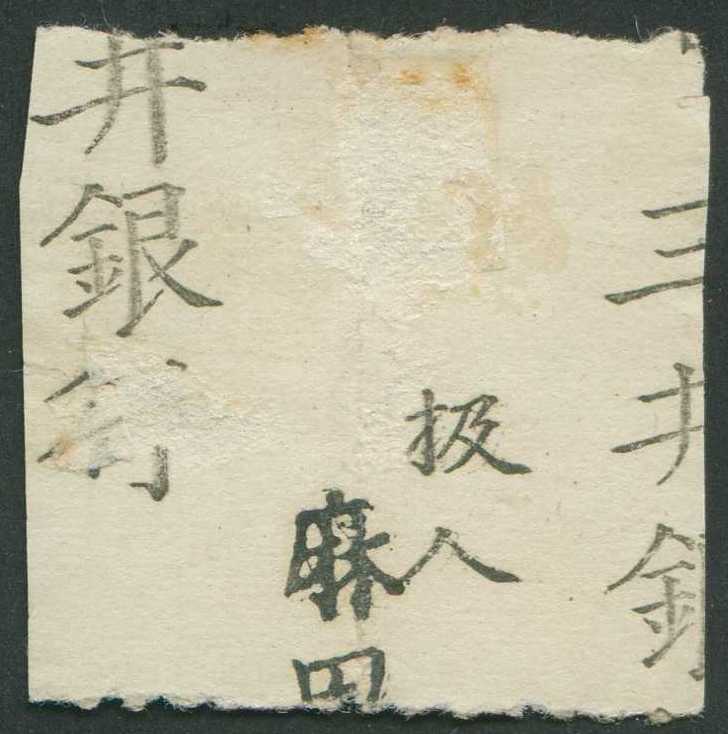 |
Send note to Staff 
|
| Edited by rod222 - 11/25/2017 01:05 am |
|
|
Bedrock Of The Community
Australia
38679 Posts |
|
|
Valued Member
146 Posts |
|
|
Hi Hironobu & rod222
Thank you both for your input to this exciting thread. I will need the weekend to try and absorb the information this thread is producing.
Andrew |
|
Send note to Staff
|
|
|
Valued Member
Japan
350 Posts |
|
|
Dear rod222,
Thanks for the in-depth argument on the verbiage. I was thinking about the three words and am now understanding that;
- variation is some "change" from the norm , thus something akin to deviation,
- variety is a "group" or "kind" of things with some common nature, so something akin to diversity,
- error is an obvious deviation from the norm which could not be considered as normal.
In this sense, "variation" would include "error", and the ensemble of the variations could be referred to "variety". Thus I also think that "variation" would be the most appropriate.
So, maybe I can say that
"Japanese hand engraved revenues have wide (or large) variety with lots of variations".
- Hironobu |
|
Send note to Staff
|
|
|
Valued Member
Japan
350 Posts |
|
|
Dear rod222, Quote:
(In my ignorance, I have always referred to these as my "EP's"....what does the central script translate to, please?) Well it indeed looks like "EP"...  That is the Kanji character for "In" in "In-shi" = revenue stamp. "In" itself means "mark" or "chop". The second character, "Shi" means "paper". So literally "In-Shi" means "paper with mark" = "a piece of paper to show the payment of the tax ", or "a piece of paper bearing evidence of the payment of the tax", thus "revenue stamp". - Hironobu |
|
Send note to Staff
|
| Edited by unechan - 11/25/2017 09:09 am |
|
|
Bedrock Of The Community
Australia
38679 Posts |
|
|
An erudite response, as usual Hironobu.
To be frank, I only meddle around the borders of Japanese stamps, my main focus is elsewhere, however, I am well aware, your in depth knowledge here, is well appreciated, it is not often (due to language barriers I suspect) we get the advantage of new and exciting insights on early Japanese Philately.
I can see Andrew is enjoying this immensely.
Thank you Hironobu.
|
|
Send note to Staff
|
|
|
Valued Member
146 Posts |
|
|
Hi Hironobu Thank you for your detailed analysis of the roulette/perf. 1 sen stamp. Quote:
Re the roulette-perforation combined 1 Sen stamp, I have made several measurements using ImageJ app on Mac OS X based on the posted image.
i) I assumed the width of the printed area to be 24.5mm (from my experience for 5th issue 1 sen stamps) and normalized the measuring scale for ImageJ;
ii) checked the bottom and right perforations using clearly distinguishable perforations and by measuring the separation distances, which resulted to be p10, a common perforation for this issue thus confirming the normalization of the scale in i);
iii) measured the distance between clearly distinguishable roulettes on the left edge, which resulted to have about 9.6 roulettes per 20mm (=p9.6).
(It would be nice if Andrew can confirm this measurement on the original stamp)
Now, the roulettes used for earlier issues (1st and 2nd) are either 14.5 or 18 (Hasegawa also lists 16 as a part of combination roulette 14.5x16 in his catalogue), but they are not coarse enough to fit the observed "9.6" pitch.
So as for the discussion, there will be two possibilities for this Andrew's interesting example;
1) not a roulette, but an accidentally "roulette-like" looking perforation due to blind perforations and/or scissor cut or whatever,
2) indeed is a roulette, but with more coarse pitch (similar to rod222's example) used for other purposes. If so, the scenario could be like this;
[Scenario 1]
- one column of perforation was missing, and has been found during final product inspection and returned to perforation process,
- the then used perforation machines were totally occupied so the roulette machine (for other purposes) available was used, resulting to this combination.
[Scenario 2]
- one column of perforation was missing, has passed thru the product inspection and distributed to local vending offices,
- the vending office found this and applied their own roulette for ease to sell, resulting to this combination.
I have carefully looked as this stamp again and checked the image width of the stamp which I make out to be 24.4mm, so its not too far from your measurement. The roulette measurement is as yours 10.38mm within the measured area. I seem to favour that it is a roulette and senario 2, but would the 'vending office' have its own facilities/equipment to roulette or even apply perfs? We really need to see or find other examples of a 'roulette-perforation combined' . Hope that more will turn up on this thread in due course? Andrew |
|
Send note to Staff
|
|
|
Valued Member
Japan
350 Posts |
|
|
Andrew, Quote:
I seem to favour that it is a roulette and senario 2, but would the 'vending office' have its own facilities/equipment to roulette or even apply perfs? This is totally a mere guess, relying on the fact that privately perforated stamps do exist for the Earthquake Emergency issue, 1923-1924, originally issued as imperforate but being perforated or rouletted by post offices or privately. I believe roulette could be much more easily done using wheel roulette gears (if available) such as shown below; actually I have used my mother's tool to make a hand made stamps in my childhood  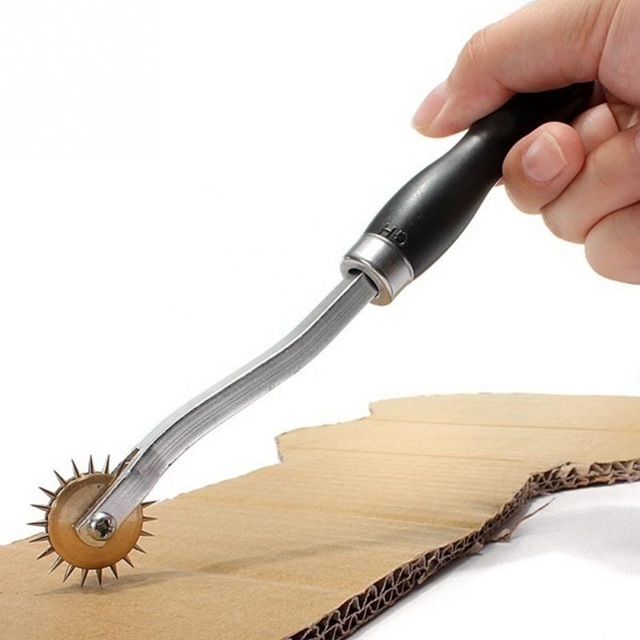 I'd like to stress again that this is a mere guess, and as you have mentioned, I am also awaiting for the discovery of another roulette-perforated combination stamp. - Hironobu |
|
Send note to Staff
|
|
|
Valued Member
Japan
350 Posts |
|
|
Rod, Thanks for posting your nice examples. Both seems to be 5th issue on foreign (normal) paper, the first one with much more scarce perf 13 or 12 1/2. As for the perforation variation on these issues, Hasegawa lists 10, 11, 13, 12.5 and compound 13x10, whereas Furuya (the editor of the former catalogue) lists 10, 11, 13 and compound 13x10. My personal opinion is that this classification are somewhat inconsistent with the perforations used for Cherry Blossom, Old and UPU Koban postage stamps issued at the same period (that is, 9s, 11s, 11, 12, 12.5, 10 and more later, 11L and 8.5) . I have several examples which should be considered as 8.5 (apparently coarser than 10) , and some with apparent 11L (large hole). Also distinguishing 13 and 12.5 might be pretty tricky. To explain this, I need to refer to the individual perforation and their date (year) of appearance, which I would like to spend some time next weekend. I would just like to show some examples which I categorize as 8.5, 10, 11L and 12.5. Note that, for Koban stamps, perf. "8.5" may vary from 8 to 10, perf "10" from 10 to 11, perf "12.5" from 12 1/4 to 12 3/4. 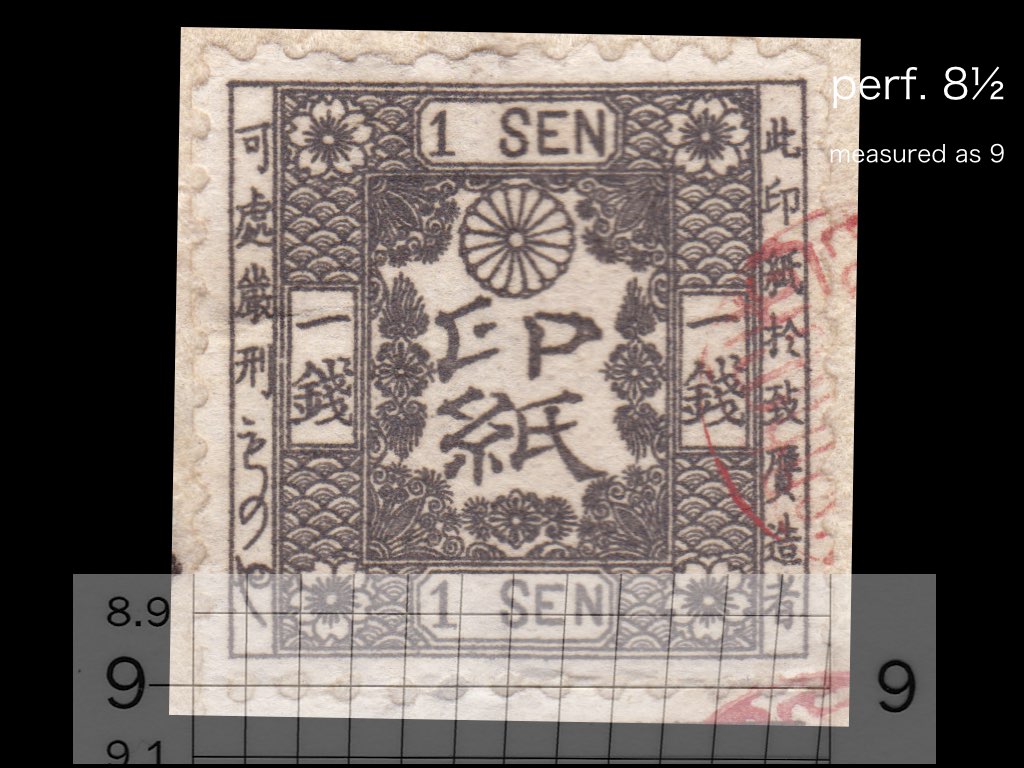 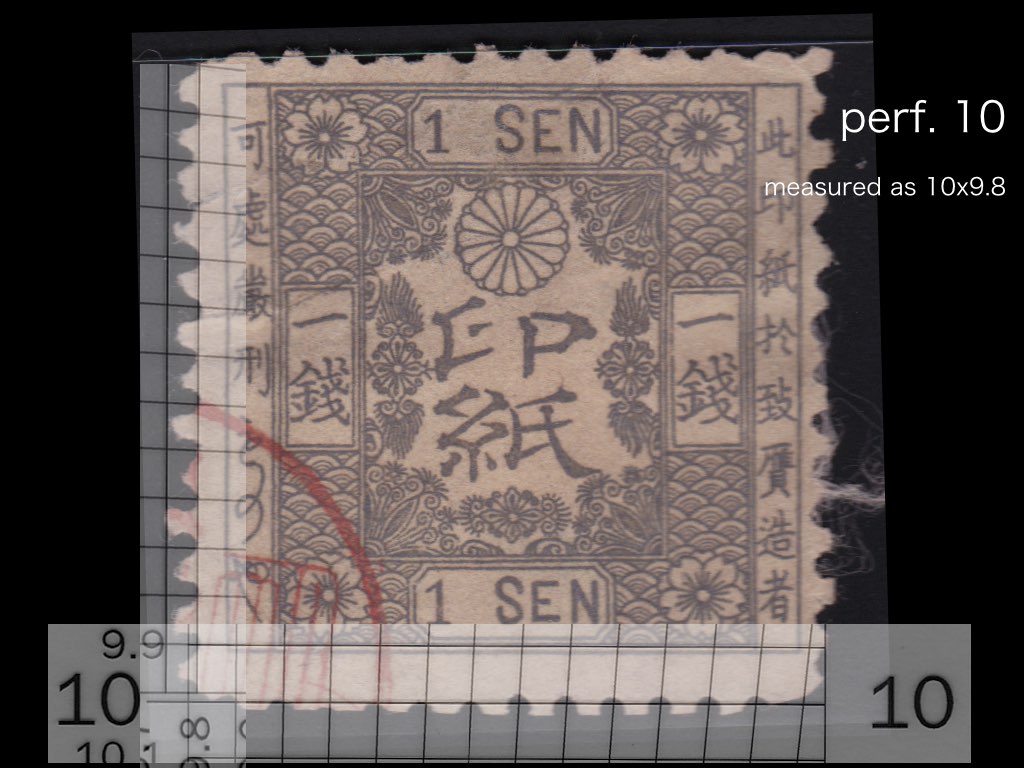 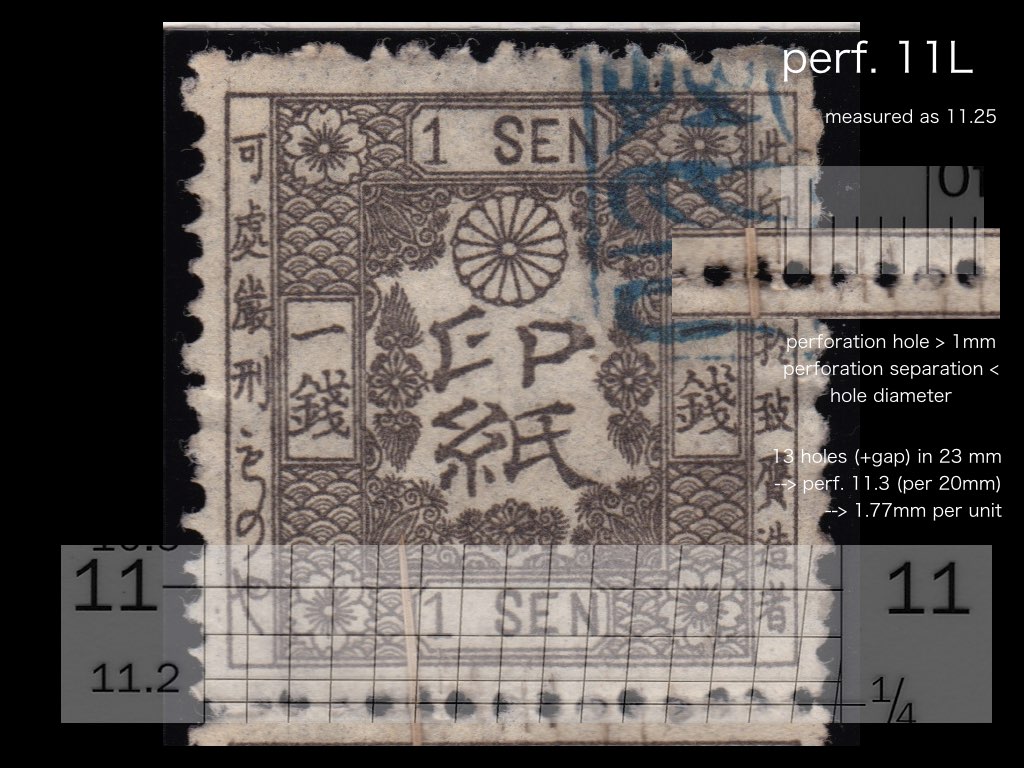 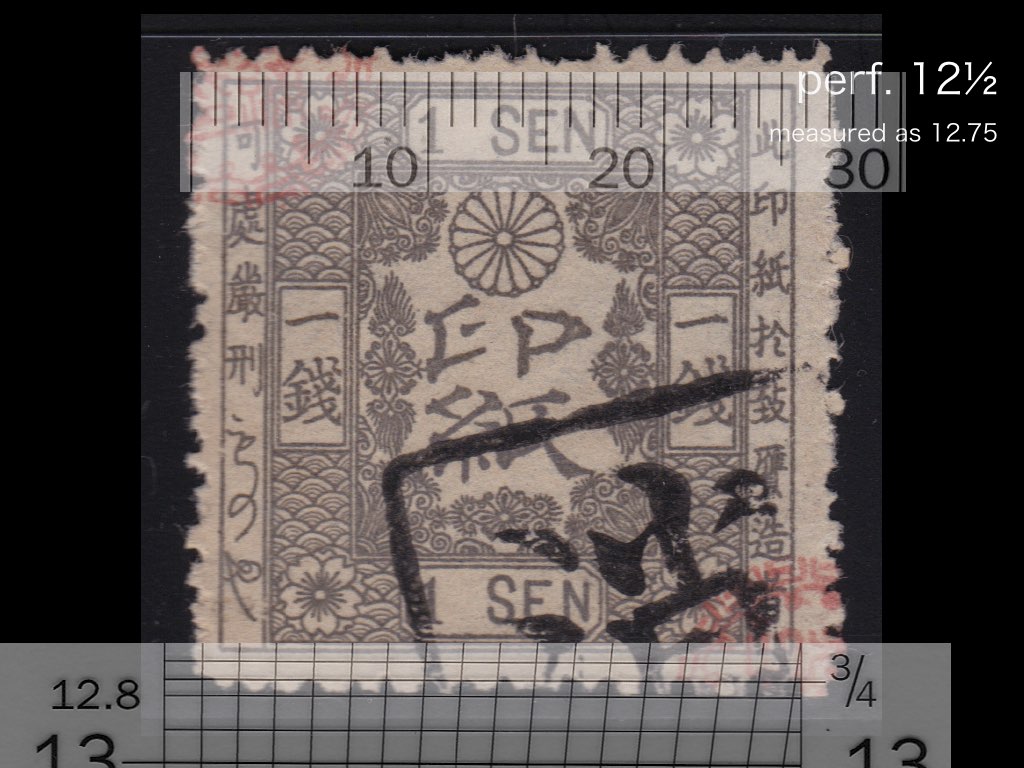 And one example of (possibly) 11s (small hole) on 4th issue 5 sen ( I haven't met a 1 Sen with this perforation); 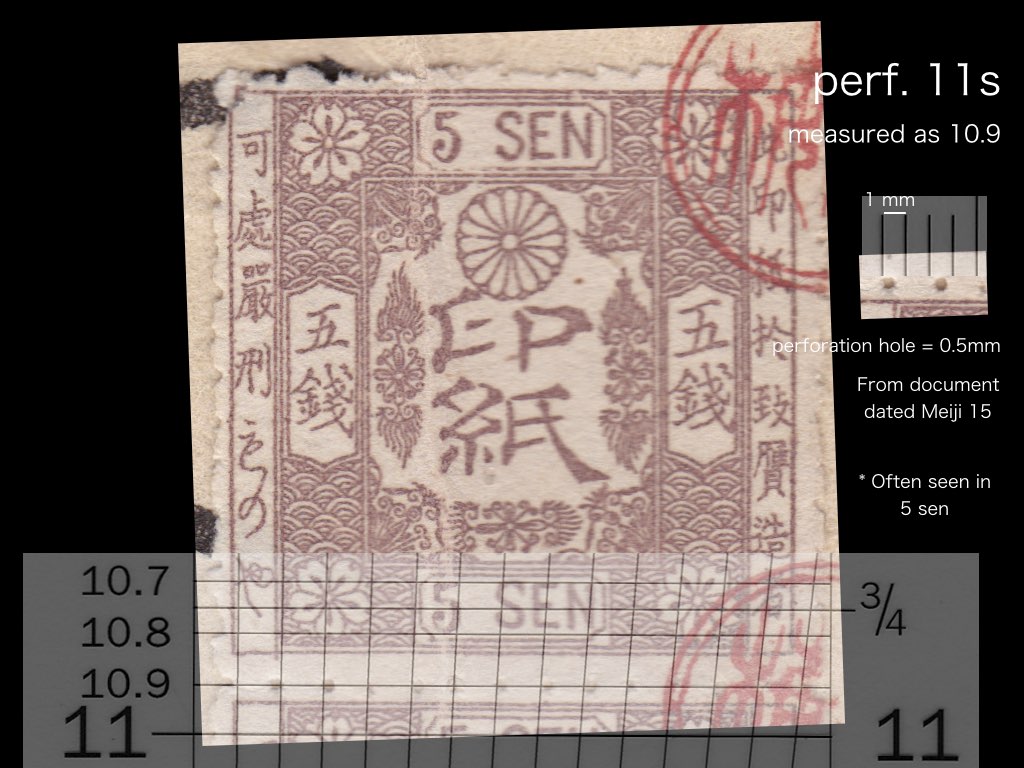 Definitely more in-depth arguments should be made for this classification, and I would like you all to have some investigation on the perforations of the stamps in your collection. It is indeed an topic to be analyzed in detail, and this is where the relation between revenue stamp and the date of the document attached becomes really important (thus our suggestions NOT to remove any stamps from the document). - Hironobu |
|
Send note to Staff
|
|
|
Valued Member
146 Posts |
|
|
I will need to check all my 1 sen revenue stamps on and off documents for perf. variations etc.
The plastic perforation gauge which I have been using for years will have to go....Any suggestions which would be a suitable perforation gauge for the Mac which I could download from the web?
Thanks
Andrew |
|
Send note to Staff
|
| Edited by agb - 11/29/2017 5:11 pm |
|
|
Valued Member
Japan
350 Posts |
|
|
A long and winding week is over, so back to business again  Quote:
The plastic perforation gauge which I have been using for years will have to go....Any suggestions which would be a suitable perforation gauge for the Mac which I could download from the web?
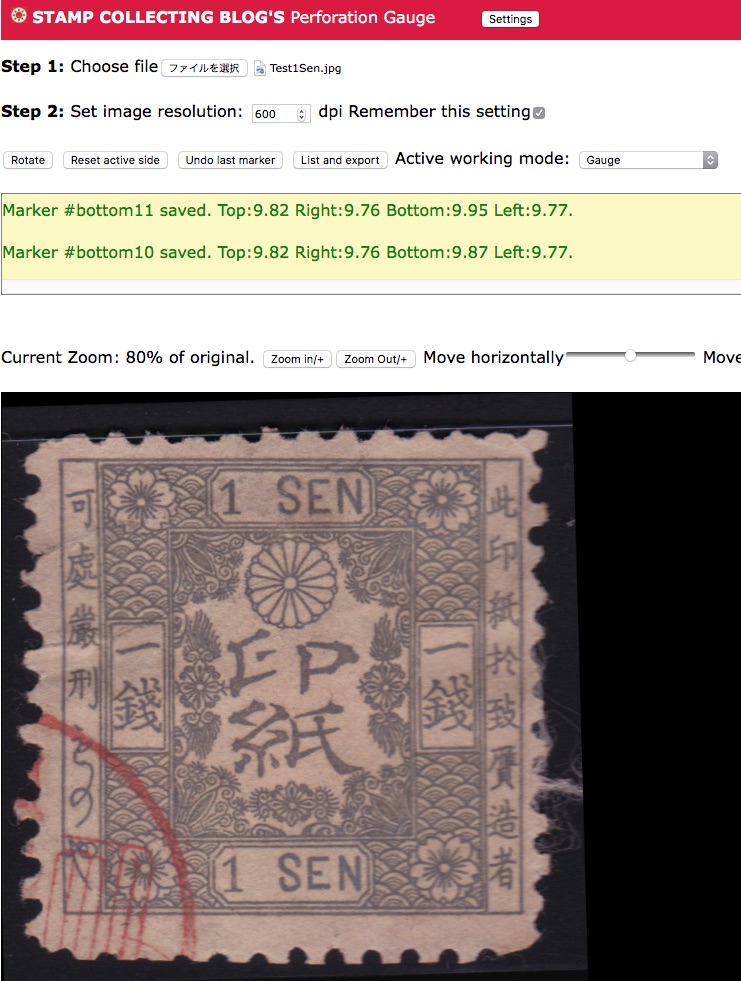
I simply use my own scanned JPG image of Scott/Linn's multi perf gauge. I make scans of revenues and the gauge in 600 DPI and use Keynote to manage and analize the revenues. For each page (slide) I just paste the revenue image (cut & paste using Preview if necessary), adjust the rotation, overlap the perf gauge image and adjust its transparency, play around with the gauge to find the matching perfs and then simply trim the unnecessary portion of the gauge image. There are several arguments on the precision of scanned images (distortions on the edges etc), but for the perforations of hand engraved revenues the accuracy is pretty sufficient compared to the precision of the perforations at that time. - Hironobu |
|
Send note to Staff
|
|
|
Valued Member
146 Posts |
|
|
Valued Member
Japan
350 Posts |
|
|
Valued Member
Japan
350 Posts |
|
|
As for the perforations of hand engraved revenues, I use a simple trick to sort out the perfs, and go to more detailed measurement (as shown in my former post) if necessary. It's so simple; just count the number of perforations within the printed area (i.e. each frame) and divide it by 1.2. This is based on the fact that length of each frame is around 24mm to 24.5mm, and assuming 24mm for simplicity. Dividing the number of perforations within 24mm with 1.2 gives the "number of perforations within 20mm"= perforation pitch, so all you need is a calculator. For example, the stamp I used for measuring with the Web perf gauge has 12 perforations within the top side frame, thus 12/1.2 = perf. 10, which agrees with the more precise results. Here's some more examples. Please note that, due to the accuracy of the perforation machines at that time, you do not have to be very precise nor sensitive on counting the perforations; simply counting the number of holes or teeth, and if there's some extra just adding 1/2 seems to be pretty enough and works. 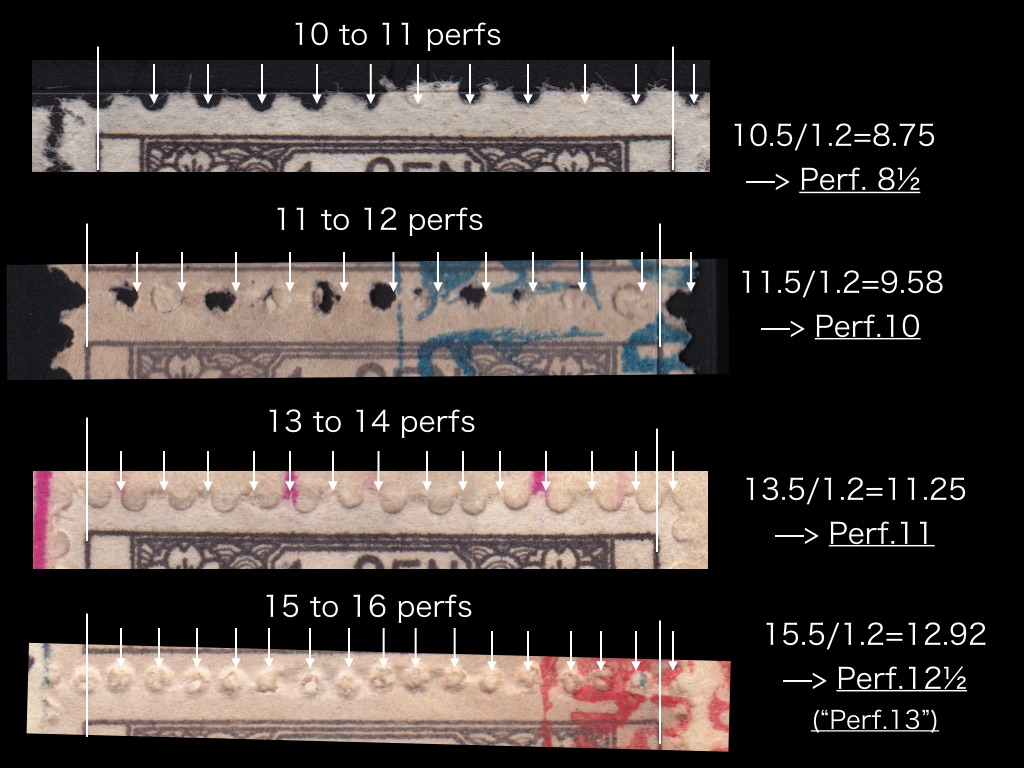 - Hironobu [Edited for typo] |
|
Send note to Staff
|
| Edited by unechan - 12/03/2017 02:00 am |
|
|
Valued Member
146 Posts |
|
|
Hi Hironobu,
I tried your method for calculating the number of perfs across a measured area, so easy...
Thanks you for sharing.
Andrew
|
|
Send note to Staff
|
|
|
Replies: 117 / Views: 27,236 |
|




 Posted 11/25/2017 01:02 am