| Author |
 Replies: 117 / Views: 27,237 Replies: 117 / Views: 27,237 |
|
|
|
Valued Member
Japan
350 Posts |
|
|
Andrew, Just noticed that I've totally forgotten to answer our initial questions  I'm pretty sure you are now able to identify the revenue stamps with the aid of Hasegawa catalogue, so I've listed only the type of the document, amount and year. Please note that I'm ignorant in the formal (official) names of these agreement documents so the titles are sort of direct translation. 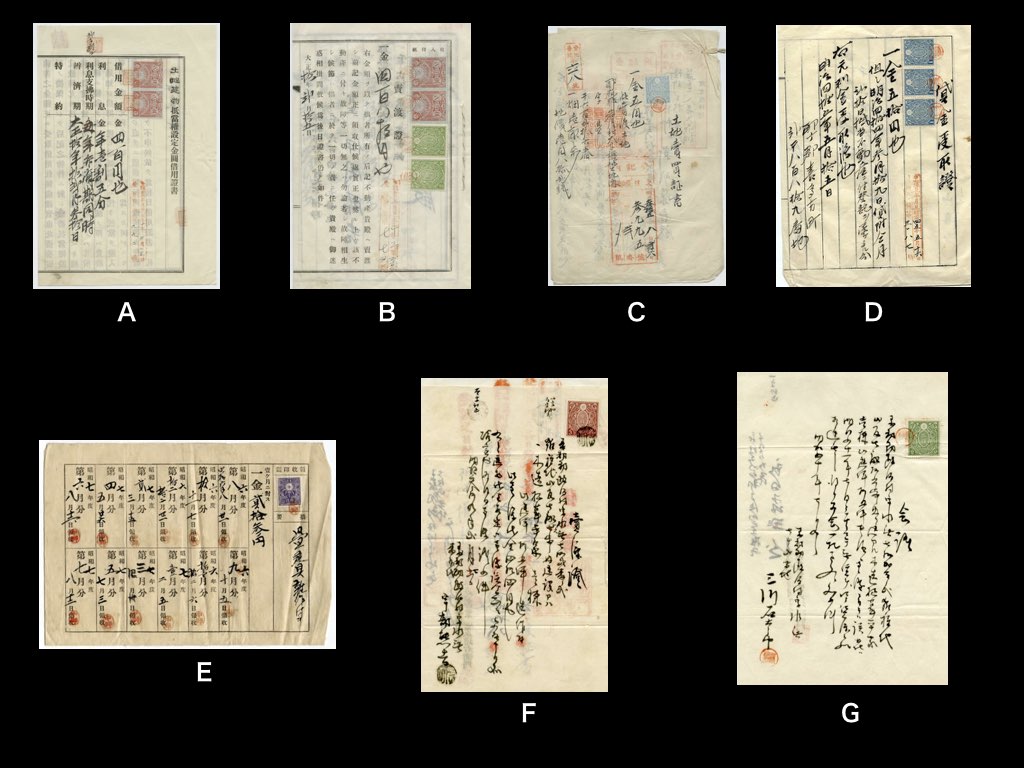 Document A: Bond of debt for mortgage, 400 Yen Taisho 10 (1921) Document B: Sale Certificate (land trade), 480 Yen Taisho 10 (1921) Document C: Certificate of land trade, 5 Yen Meiji 35 (1902) Document D: Receipt of debt payment, 50 Yen Meiji 45 (1912) Document E: Receipt of monthly payment, 13 Yen per month, from August, Showa 6 (1931) to July, Showa 7 (1932) Document F: Sale Certificate, 44 Yen Meiji 39 (1906) Document G: Certificate of payment (amount unreadable) Meiji 40 (1907) - Hironobu |
Send note to Staff 
|
|
|
Valued Member
146 Posts |
|
|
Hironobu, Thank you for remembering the documents which I posted in an earlier post and your detailed analysis of them. The other similar documents which I have, I can now more or less be able to classify into their respective types, I hope! I completely forgot the posting as I was immersed in sorting out the perforations on my 1 sen stamps. The task has been made easier for me by following your method of calculating the perforations along a given line. Its much more enjoyable and less eye straining than using a plastic perforation gauge, thank you. Quote:
three 50 Sen green revenue posted by Andrew is a loan document for 1500 Yen, thus requiring 1500 / 10 = 150 Sen franking in total, which matches the revenue stamps attached. Just returning to the above 'loan document' which you identified as such, I have posted a further scan showing the front page and hopefully the date can be identified and any other relevant information is may contain? 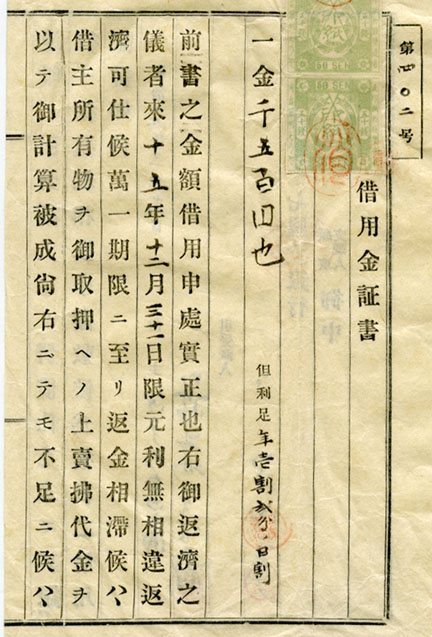 Andrew |
|
Send note to Staff
|
| Edited by agb - 12/03/2017 10:54 am |
|
|
Valued Member
Japan
350 Posts |
|
|
Andrew, Quote:
Just returning to the above 'loan document' which you identified as such, I have posted a further scan showing the front page and hopefully the date can be identified and any other relevant information is may contain? The title of the document literally says "certificate of borrowed money", that is certificate of dept, or I.O.U. The date is generally written at the very end of the document together with the name and chop of the person in charge. The content says something like "... the debt should be paid by Dec 31 of the year 15..." so it should be around Meiji 14 or 15. Are there some continuing pages for this one ? - Hironobu |
|
Send note to Staff
|
|
|
Valued Member
146 Posts |
|
|
Hironobu Its a single page document folded in the centre 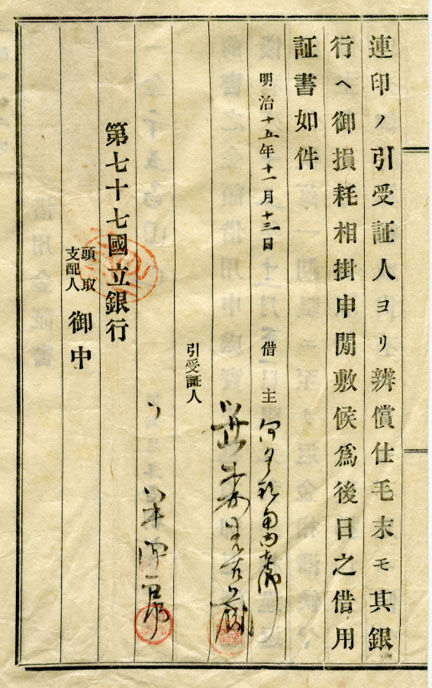 Andrew |
|
Send note to Staff
|
| Edited by agb - 12/03/2017 11:12 pm |
|
|
Valued Member
Japan
350 Posts |
|
|
Andrew,
Nov. 14th 13th, Meiji 15. It's written on the fifth column from right (including the centre margin column).
- Hironobu
- 2017/12/5 corrected for typo: "13th" is correct. |
|
Send note to Staff
|
| Edited by unechan - 12/05/2017 04:57 am |
|
|
Valued Member
146 Posts |
|
|
Valued Member
Japan
350 Posts |
|
|
Andrew and all, Just niticed the mistake ; the date should be 13th, and the original post corrected. My eyes are getting unift to iPhone screen... - Hironobu |
|
Send note to Staff
|
|
|
Valued Member
146 Posts |
|
|
Valued Member
146 Posts |
|
|
Valued Member
146 Posts |
|
|
Not sure if this is a revenue/cinderella stamp or a label size 65mm x 55mm used for sealing packets or a label for advertising the company? The label shows silk moths in gold and white caterpillars on mulberry leaves? Interested to learn if this item is listed in catalogues or other reference works? 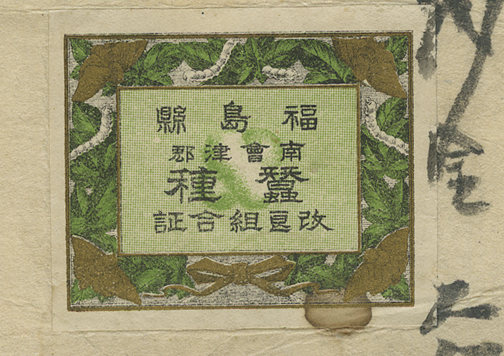 Just added the following: I've noticed that the above label was on the inside of a custom made wrapper holding two note books together. It looks very much like an advertising label? Any ideas as to its usage and issue date and any relevant details? 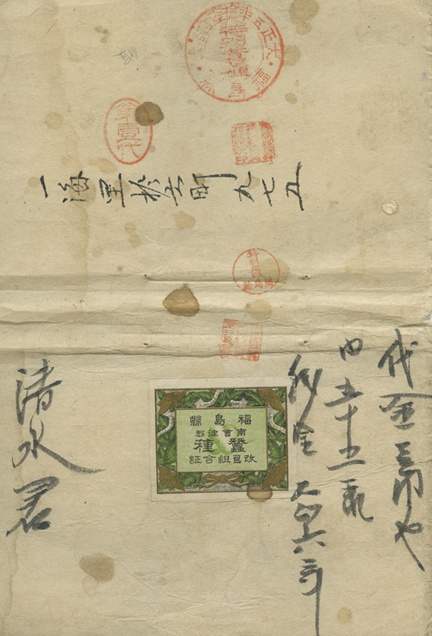 Andrew |
|
Send note to Staff
|
| Edited by agb - 12/11/2017 12:42 am |
|
|
Valued Member
Japan
350 Posts |
|
|
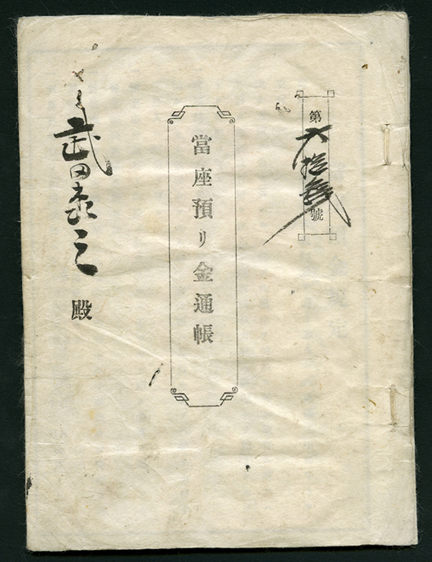
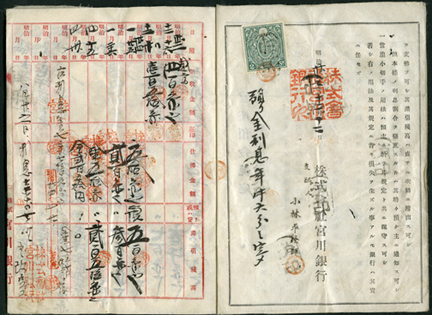
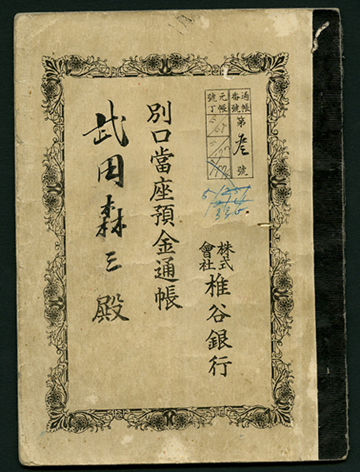
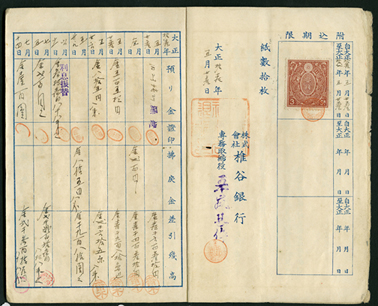
Andrew, another interesting series. Quote:
Just looking through my pending file for more almanacs, I came across these three booklets with revenue stamps and though they would make interesting written up display pages.
I am not sure as what they are, am guessing either a type of saving deposit book or a rent payment account book or some other?
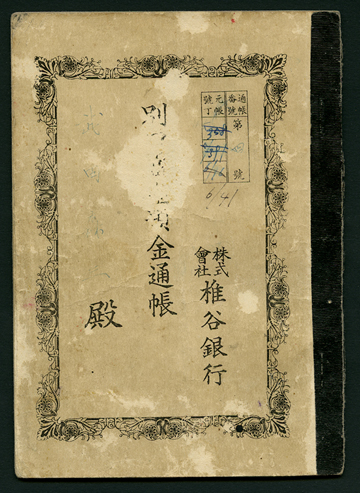
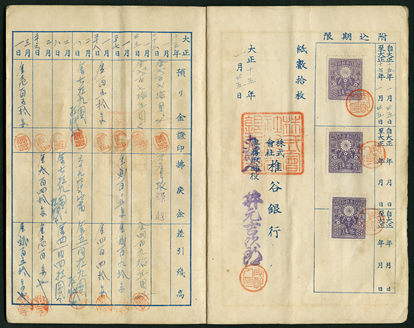
Looking for help as to the type of booklet, date and a brief outline of its contents. The revenue stamps I have been able to identify by using the Hasegawa revenue catalogue which is mentioned in an earlier posting. The three booklets seem to be, as you have guessed, sort of saving deposit books. The titles say "credit account deposit book". The holder is the same person (Mr. Takeda) as the almanac books you mentioned in another thread. The first book is for the holder's account on Miyagawa bank, which (according to Web search result) exited from Meiji 29 to Taisho 13 in Niigata city. The deposit is starting on December, Meiji 33. The second and third books are for the holder's account on Shii-tani bank, which (according again to Web search result) exited from Meiji 42 to Showa 6 in Niigata city. The starting date for the second book is not readable (possibly Taisho 13). The third book starts from January, Taisho 15. I need to look into archives of tax regulation to understand the different franking; I suspect the franking is depending on the total amount of the deposit at the end of the book period, but have to confirm whether this is correct or not. - Hironobu |
|
Send note to Staff
|
|
|
Valued Member
Japan
350 Posts |
|
|
And for the silk worm label and wrappers, which is again a surprise indeed; Quote:
Not sure if this is a revenue/cinderella stamp or a label size 65mm x 55mm used for sealing packets or a label for advertising the company? The label could be read as "Fukushima Prefecture / Minami-Aizu-gun / Silkworm egg / improvement Association member certificate". Quote:
I've noticed that the above label was on the inside of a custom made wrapper holding two note books together.
It looks very much like an advertising label? Any ideas as to its usage and issue date and any relevant details? The big red circle cachet says "Inspection Certificate, Taisho 5" and "Fukushima prefecture" as well as "Special silkworm egg" in the middle. The oval cachet on the lower left of the big cachet says "first generation". The handwritings on the lower half right says "Price ** yen / of which 55 (?) sen / price Taisho 6", and left says "Mr. Shimizu". So I suspect this wrapper contained the silkworm egg paper bred at the aforementioned association, and the label was used as a sort of product certificate. This label is not listed in my 1981 Shimomura catalogue, and I couldn't find any additional information on the Web as well. One queer thing about this wrapper is the hand script on the top part; it says "1 Kai-Ri 16 Cho 975". I thought it was some address but couldn't sort it out. Indeed, "Kai-Ri" literally means "nautical mile", which does not make any sense for silkworm egg... More investigation required. - Hironobu |
|
Send note to Staff
|
|
|
Valued Member
146 Posts |
|
|
Thanks you once again Hironobu for your detailed replies. You didn't have to go to such trouble, brief details would have been okay for me to be able to write up these pages. I feel I am taking up too much of your time with my constant queries. Quote:
I need to look into archives of tax regulation to understand the different franking; I suspect the franking is depending on the total amount of the deposit at the end of the book period, but have to confirm whether this is correct or not. You don't have to go to all this research on my behalf. Andrew |
|
Send note to Staff
|
|
|
Valued Member
146 Posts |
|
|
The silk worm label information is interesting, lets hope as a result of this others may turn up? Quote:
One queer thing about this wrapper is the hand script on the top part; it says "1 Kai-Ri 16 Cho 975". I thought it was some address but couldn't sort it out. Indeed, "Kai-Ri" literally means "nautical mile", which does not make any sense for silkworm egg... More investigation required. You mention the hand script on the top part of the wrapper, is that the pencil annotation? If so, just an after thought, maybe this has nothing to do with the wrapper and was merely written inside the wrapper by the owner of the two exercise/note books? I have taken the opportunity to scan a page from the note book, just in case any reference has been made to nautical matters I may be wrong of course? 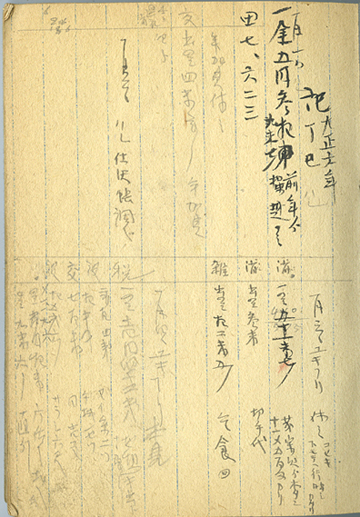 Front of the wrapper, it may help? 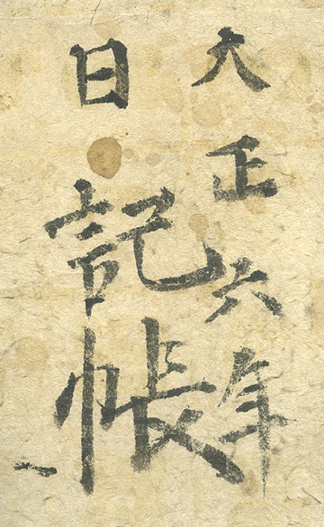 Andrew |
|
Send note to Staff
|
| Edited by agb - 12/11/2017 1:27 pm |
|
|
Valued Member
Japan
350 Posts |
|
|
Andrew, No worries. I'm pretty much enjoying solving the fantastic puzzles, and I am surely improving and upgrading my knowledge on the very niche portion of Japanese philately (and its surroundings). There's very limited information on these topics even in Japanese, not many collectors in this field... it's so entertaining to find out something new  . Philately is a wonderful hobby, so why not spend time on it ?  (and posting replies also is an excellent opportunity to improve my english  ) - Hironobu |
|
Send note to Staff
|
|
|
Replies: 117 / Views: 27,237 |
|




 Posted 12/03/2017 09:32 am