|
This page may contain links that result in small commissions to keep this free site up and running.

Welcome Guest! Registering and/or logging in will remove the anchor (bottom) ads. It's Free!
To participate in the forum you must log in or register.
| Author |
 Replies: 615 / Views: 74,615 Replies: 615 / Views: 74,615 |
|
|
|
Pillar Of The Community
United States
3520 Posts |
|
|
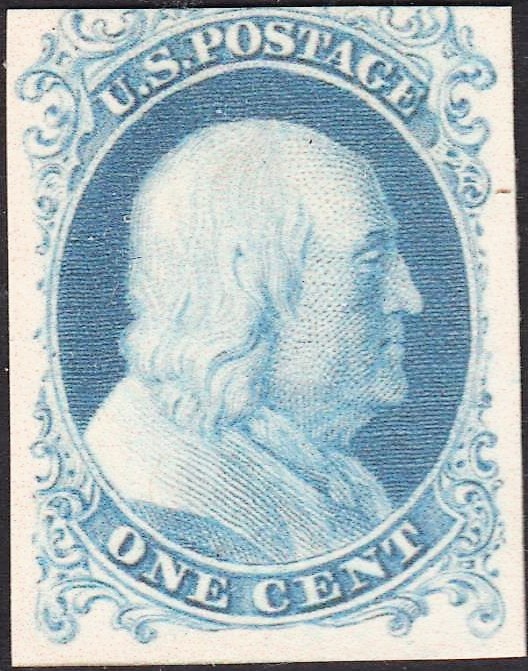
On the 35L1L candidate - a number of comments.
- I definitely agree that jaxom's stamp is an earlier impression than dudley's. No doubt.
- given the above, I am bothered that an otherwise consistent plating mark would be present on a later impression, and not on an earlier impression. That is counter-intuitive -- it should be the other way around. Of course, exceptions exist, like the inverted transfers which show up better in late impressions, etc etc. But just on average this bothers me somewhat. In looking at jaxom's stamp, it looks like there may be abrasions or imperfections in the surface which might have affected this spot. I suggest a good look at where this dot should be for absence of paper, or some sort of alteration from normal that would explain the absence of it. This is not a 'dry'-type of printing, where ink did not get imparted on the paper. That is more frequent towards the edges of the sheet (this position would be middle) and this stamp is well printed. Anomalies can happen, though, of course, and maybe this just is one.
- dudley's stamp shows the white area in the top line between the T and A of POSTAGE well. This is on the plating mat. It is understandable that an earlier impression might show this filled in better, as jaxom's stamp does.
- overall shape of the ornaments compares relatively favorably, allowing for some wear on dudley's vs jaxom's.
I haven't done enough elimination of other possible candidates to say for sure that this is 35L, but it could be.
Plating A reliefs from transfer roll #1, when you don't have a nice guide dot (from a neighboring B relief above) to work off of, or some other obvious plating mark, can be a rough ride. For stamps like these, I used to spend much of the night (and day) staring at one, and comparing to all possible positions for elimination. It takes a lot of effort to get these right - my last suggestion is once you are sure you have it, go back and check all the A relief positions again very critically. I find that once I've spent the time it takes to get all of the subtle details in my head to identify a stamp like this, that that is actually the time that its appropriate to go back and re-eliminate everything again. Think about the process - you go through scans and plating mats eliminating positions that don't appear to match. Initially you are using criteria that is most obvious to you at the outset. Once you've spent 6-8 hours staring at one stamp, your criteria has expanded significantly. That's why its always a mistake when you're not 100% sure to "not" go back and redo your elimination chart. |
Send note to Staff 
|
|
|
Pillar Of The Community
United States
3520 Posts |
|
|
Regarding the 17R1L candidate posted by jaxom on the prior page ...
Its not 17R1L. Take a good look at the bottom recut line comparison chart between the candidate stamp and the sheet 17R1L which was posted. They don't match. On the real 17R1L, from the sheet, the recut is considerably farther away from the bottom label in between E and C. On jaxom's stamp it is much closer to the bottom label.
Another mismatch is the lower right plume. jaxom's stamp has a good plating characteristic to note, which is a LR plume that is pretty much gone. That can be useful for plating when its this extreme. The Neinken/Ashbrook drawings for Plate 1L, very regrettably, don't show ornament completeness. They were so focused on other things, they omitted that, which is very unfortunate, especially for these difficult A reliefs, where you need all the help you can get.
Note that you also have a LR plume for the stamp to the left of this one to also compare completeness against. 16-17R are not a good match here.
jaxom's stamp is 57R1L. |
|
Send note to Staff
|
|
|
Pillar Of The Community
United States
1334 Posts |
|
|
Txstamp, thank you for your insightful input. Here is a close-up of the missing "dot". This image was scanned at 12800 dpi, not just blown up. I do not see any surface paper damage. There is a dark spot where the dot should be but no dot. 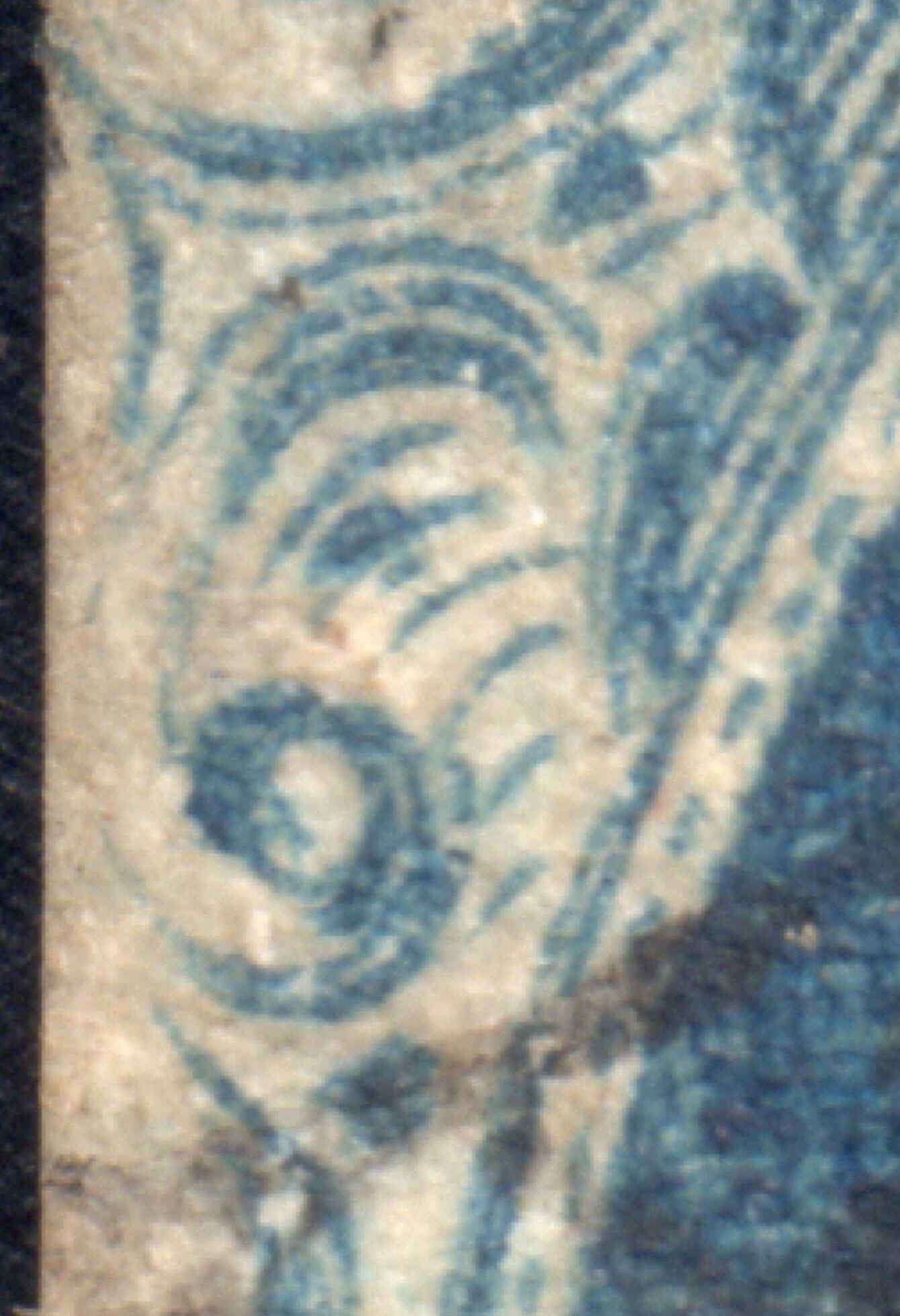 Also, thanks for your help and correcting the plating of the 17R1L to 57R1L. I guess that the image that I made showing he alignment to the stamp to the left would not plate the position but did place the column. 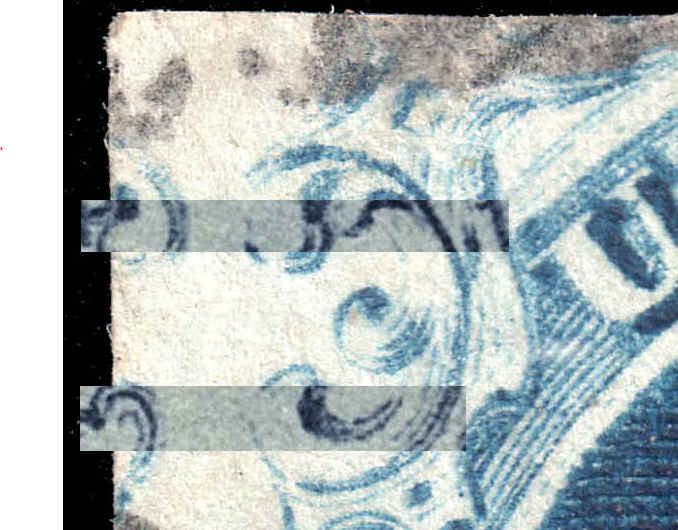 |
|
Send note to Staff
|
| Edited by jaxom100 - 01/08/2019 04:47 am |
|
|
Pillar Of The Community
United States
3520 Posts |
|
|
Horizontal spacing and vertical alignment, particularly on PL 1, where it is well-understood, is a very useful plating tool. I like your pictures, as they illustrate things such as that, well.
We are fortunate, that the columns tend to share the same horizontal distance and vertical alignment properties. It is not surprising, if you think about why, actually. Roll #1 is a 3-relief transfer roll, so that implies fixed vertical distance for several entries. The only trick is getting each setting of the roll just right. That is where guide reliefing comes into play. This is where the bottom of the T relief, for example, is guided into the bottom of the last B relief entered, to help align the next roll setting just right. On the 9th row, they used the A relief to guide, and we get dingles as a result.
So guide reliefing helped to keep things vertically straight across roll settings. We have long debated whether the over-rocking of the guide relief over the bottom of the last entered position, was intentional or accidental. It seems to me as though it must have been intentional, for this exact reason - to vertically align the column and ensure consistency in the entries. |
|
Send note to Staff
|
| Edited by txstamp - 01/08/2019 10:53 am |
|
|
Pillar Of The Community
United States
1334 Posts |
|
|
Here is an interesting example of using the row alignment to determine the column of a strip of 3. If I did it right, this group is column 7-9 of the right pane. The question is plate 1 late or early? I had assumed plate 1 early, but the more that I look at it, I do not see any recuts on the tops of the 3 stamps. If it is columns 7-9, then the plate positions are 17R-19R, 37R-39R, 57R-59R, 77R-79R. It should be easy to plate, but it is not. 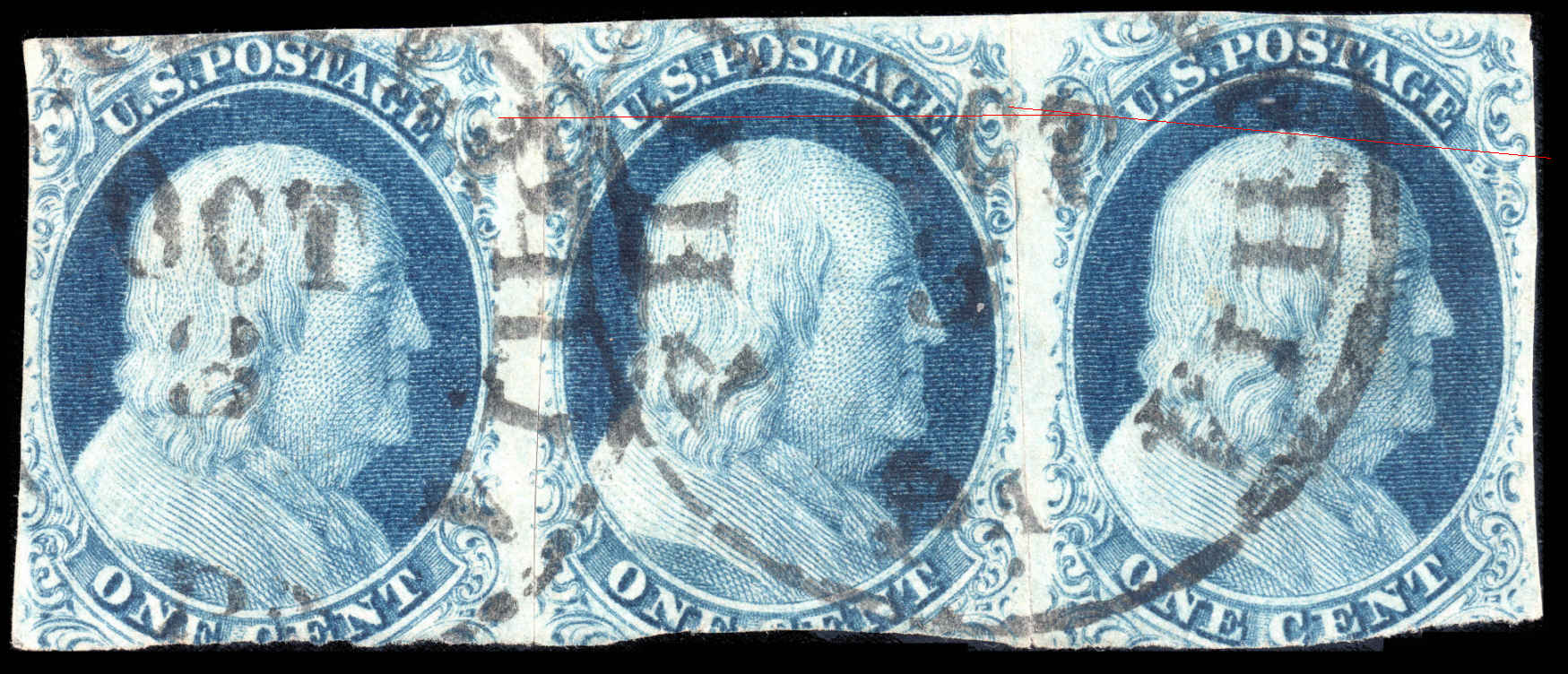 |
|
Send note to Staff
|
|
|
Pillar Of The Community
United States
3520 Posts |
|
|
That is definitely a plate 1-Early strip. The top of the middle stamp is not recut, and the overall impression/appearance is that of 1E. Using spacing and alignment is a good way to narrow this down quickly. Good. The drawings in Neinken do show ornament completeness or lack thereof for plate 1E. I usually start with the left side ornaments and study them, then proceed to top+bottom, finally right. That, for me, tends to be the order of most interesting to least when I'm looking at ornament shortness, etc. Plate 2 and 3 have, on average, shorter left side ornaments than 1E. This is not true for all positions, and there are many exceptions, but another tell here is that the left side ornaments are pretty full. Study the completeness of the ornaments carefully, and compare to Neinken, and to scans available. Of course if you note any giant plating marks, those are always useful.  |
|
Send note to Staff
|
|
|
Pillar Of The Community
United States
1334 Posts |
|
|
The only good plating mark is the scratch between the second and third stamp, about in the middle. |
|
Send note to Staff
|
|
|
Pillar Of The Community
United States
3520 Posts |
|
|
Unfortunately, that vertical scratch does occur on quite a few positions, including some not noted in Neinken. It is still useful, but a bit more help may be needed.
Safety tip: plating closely cut A reliefs can make you old very quickly. |
|
Send note to Staff
|
|
|
Pillar Of The Community
United States
1334 Posts |
|
|
You are right, trying to plate these A reliefs is making my hair greyer.
I rechecked the column lineup to match the left pane. I came up with columns 4-6 are a good possibility. So, searching that criteria, I came up with what appears to be a match at 54-56L1E (II, IIIa, II).
|
|
Send note to Staff
|
|
|
Pillar Of The Community
United States
1334 Posts |
|
|
Pillar Of The Community
United States
3520 Posts |
|
|
35L1L - Well, it pays to go back and look at your stuff. I have a cover with 35L1L on it - a very early, well printed impression. Circa Sep 1852. jaxom's is second-half 1853 I suspect (still early but not this early). Its exactly what I was hoping to find, but couldn't, online. So look in your/my album silly!  I tried to make several scans, but my scanner doesn't like this stamp (or many others). Sometimes I get good scans sometimes I just can't get a high detail scan. So be it. Anyway, there is a lot of detail on the copy I have. All markings show very well, including a good dot in Ornament C - the so-called 'consistent plating mark'. Its there on mine. The scratches at TL are there, quite a few of them in fact. The recut is a clear match with Dudley's stamp. No question the stamp I have matches Dudley's. The recuts are identical. I think your stamp is the same, jaxom, the recuts were a bit hard to see on yours - more than anything that was slowing me down -- exactly where the recuts start and end. On Dudleys, a late impression, the recuts show very well. On mine, a very early impression, they also show well. |
|
Send note to Staff
|
|
|
Valued Member
28 Posts |
|
|
Pillar Of The Community
United States
2555 Posts |
|
|
It's a Type 1. Presents as a 40P4 but could be a trimmed #40 or even just a crude copy. The impression seems extremely grainy... |
|
Send note to Staff
|
|
|
Pillar Of The Community
United States
6664 Posts |
|
|
I won 3 lots of 1¢ Franklin's in a local stamp firm auction. Not the greatest pair but I love multiples. I believe these are positions 83 and 841L. The better stamp showing the double transfer.  |
|
Send note to Staff
|
|
|
Pillar Of The Community
United States
3520 Posts |
|
|
83L is kind of interesting in how significant a double transfer it really is, but how understated it comes off. Particularly on your example, which is a very late impression. |
|
Send note to Staff
|
|
|
Replies: 615 / Views: 74,615 |
|
|
To participate in the forum you must log in or register. | |
 New South Wales Numeral Cancels Value Question: Full Sheet, Austria Scott # 840A-H, Issued 5'24'1969. Who Was The Upper Keswick, N.b. Postmaster In 1941 Big Blue Album - How Far Along Is Everyone? Pushing 330,000 All Different Worldwide Stamps In One Collection . History And Usage Of Usir "silver Tax" Stamps What Did You Do Philatelically: Today Or Recently? Indypex 2026, September 18, 19, And 20, 2026 Cover Calendar For Month And Day -Pics Show Me Your Sports Stamps! Fruits Anyone? Food On Stamps! Chile Casa De Moneda De Chile Philatelic Souvenir Cards Of The 50's And 60's Postmarks.day By Day Minkus Supreme Global Albums (The Big Red Thread) Wanted: On-Cover Solo Uses Of United States 14¢ American Indian Stamp Extinction Of Non-Spray Cancels, Minneapolis Lacks The Year Germany Michel #110 Color Computers, Electronic Devices, Software, Information Technology, And Internet On Stamps Portuguese 1910 Overprinted "republica" Forgeries Show Your US 1851-57 Imperforate Stamps Coffee, Tea, And Other Hot Brews! The Stamps Of Indo-China. 1851-57 12c Washington Thematic Group On Freemasonry New South Wales Numeral Cancels Value Question: Full Sheet, Austria Scott # 840A-H, Issued 5'24'1969. Who Was The Upper Keswick, N.b. Postmaster In 1941 Big Blue Album - How Far Along Is Everyone? Pushing 330,000 All Different Worldwide Stamps In One Collection . History And Usage Of Usir "silver Tax" Stamps What Did You Do Philatelically: Today Or Recently? Indypex 2026, September 18, 19, And 20, 2026 Cover Calendar For Month And Day -Pics Show Me Your Sports Stamps! Fruits Anyone? Food On Stamps! Chile Casa De Moneda De Chile Philatelic Souvenir Cards Of The 50's And 60's Postmarks.day By Day Minkus Supreme Global Albums (The Big Red Thread) Wanted: On-Cover Solo Uses Of United States 14¢ American Indian Stamp Extinction Of Non-Spray Cancels, Minneapolis Lacks The Year Germany Michel #110 Color Computers, Electronic Devices, Software, Information Technology, And Internet On Stamps Portuguese 1910 Overprinted "republica" Forgeries Show Your US 1851-57 Imperforate Stamps Coffee, Tea, And Other Hot Brews! The Stamps Of Indo-China. 1851-57 12c Washington Thematic Group On Freemasonry
Disclaimer: While a tremendous amount of effort goes into ensuring the accuracy of the information contained in this site, Stamp Community assumes no liability for errors. Copyright 2005 - 2026 Stamp Community Family - All rights reserved worldwide. Use of any images or content on this website without prior written permission of Stamp Community or the original lender is strictly prohibited.
Privacy Policy / Terms of Use Advertise Here |
| Stamp Community Forum |
© 2007 - 2026 Stamp Community Forums |
| It took 0.25 seconds to lick this stamp. |
 |
|
|
|


 Posted 01/07/2019 12:38 pm