| Author |
 Replies: 615 / Views: 74,588 Replies: 615 / Views: 74,588 |
|
|
|
Bedrock Of The Community
12700 Posts |
|
|
Pillar Of The Community
United States
2230 Posts |
|
|
jaxom100, Thanks for posting the very useful guide dot charts. I'm working on a similar project for the 3-cent imperforates, but some positions are proving to be elusive. |
Send note to Staff 
|
|
|
Pillar Of The Community
United States
1334 Posts |
|
|
Thanks CC. No one responded when I reposted them so I thought no one was interested. I would like to see Doporto post them on his website. He said he wanted to put them on the intro page for that plate.
I am currently working on the guide dot charts for plate 1 early.
Some of those positions are difficult to find as well.
I found a strip of 45-47R1E that I had to identify from Neinken's charts since the Franklin Archive did not have 45 or 47. I found a photo of Ashbrook's original reconstruction of plate 1. It is only about 300dpi but I was ecstatic about finding it. I also saw the 8-10R1E strip being sold separately from the plated position sheet, so it may have been dismantled now. Another piece of philatelic history destroyed. I hope they at least keep the left pane together.
|
|
Send note to Staff
|
|
|
Pillar Of The Community
United States
1036 Posts |
|
|
Jaxom
Your guide dot chart is fantastic... I used it to plate stampman's Scott 9 last night.
It increased my speed of plating it dramatically!!
It is a worthwhile endeavor
Rg
|
|
Send note to Staff
|
|
|
Pillar Of The Community
United States
3520 Posts |
|
|
I don't think that the 1E plating has been destroyed.
I'm fairly sure I know where it is.
A couple of the top row right pane positions were probably removed since they obviously carry a lot of value and are easily plated, so no real need to keep them together.
Your guide dot quick-ref is very nice. Thanks for that.
Guide dots for Plate 1E and 1L are similar, to the same, being from the same plate. Still, a 1E chart like your 1L chart would be nice, as I'm sure there are some subtle differences, in appearance, if nothing else. |
|
Send note to Staff
|
|
|
Pillar Of The Community
United States
1334 Posts |
|
|
Yes, I know the charts will be real similar. But it the those subtleties that the pictures show that help as well. Then I will make one for plate 2. I do not think there is the information out there to do a plate 3 or plate 4.
What got me about those reconstructed plates was that the right pane and the top strip of three was sold in the same auction. There was no note of the strip being removed from the sheet sale. It was Siegel #994 Lot 607 and the strip was Siegel #994 Lot 623.
|
|
Send note to Staff
|
|
|
Pillar Of The Community
United States
3520 Posts |
|
|
jaxom - I see your point, which is interesting.
All I will say to that is that I'm sure the buyer was well aware of this.
ps I had already stashed away the Siegel scans of these panes for future reference. I've done that with a number of large multiple images from plate 2 as well. The Siegel site is a treasure trove for plating, since they handle good material, and produce way better than average scans. |
|
Send note to Staff
|
|
|
Pillar Of The Community
United States
1334 Posts |
|
|
Siegel is a great source. I am grateful that I asked and received permission to use their photos as long as I give them credit. So I have been taking photos, tagging them with type and position on top and Siegel's credit on bottom with auction and lot numbers. And I am building a database for plate 1 early as I collect the plate dots. I have a 2TB hard drive so I should be OK there. I am working on the sold Wagshal collection for starters. What a beautiful collection he amassed.
|
|
Send note to Staff
|
| Edited by jaxom100 - 12/24/2017 12:23 pm |
|
|
Pillar Of The Community
United States
3520 Posts |
|
|
Jerry Wagshal bought much of Mort Neinken's 1c collection privately, after Neinken passed away.
As such, Wagshal's sale through Siegel was the first time much of that material had been offered for sale since the mid 1900's. |
|
Send note to Staff
|
|
|
Valued Member
United States
103 Posts |
|
|
Jaxon 100, Bravo on your guide dot chart and your commitment to adding other plates. I am putting together a data sorting program to ease plating by eliminating those positions that are not a possibility. It incorporates the architecture developed by Mark Friedman in his "cheat sheets." I am a long way to finalizing the A relief of plate 2. It primarily asks for a value for the completeness of the side ornaments. Entering several of these values usually results in leaving you with a small number of possibilities. If we can convert your dot locations to values then we have another data point. For example on the chart below we could identify the general vertical and horizontal position with two data points. For horizontal 0 would be no dot, 1 would be to the right of the vertical line, 2 about on the line, 3 to the left and 4 for multiple dots. Even if you are in doubt, you can use not or < snd > functions to filter. It would be similar for the vertical. When I am a bit further along I will post the results on the thread tex opened for this project. Remember this does not find the position, it eliminates the positions it could not be. 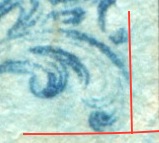 |
|
Send note to Staff
|
|
|
Pillar Of The Community
United States
1334 Posts |
|
|
Njs, that is exactly what I was planing to do as well. More of a questionaire about ornament completeness, relief, etc, and just eliminate choices. The main problem that I see with the guide dot locations is the rotation of the stamp. The stamp itself does not have any horizontal lines to zero it out. As you look at the guide dot chart, notice the rotation of orn R vs the stamp you are looking at. And I do agree that it will not give an exact match but will eliminate a lot real fast. I do like your idea of pinpointing the dot like a chart. Let me think on that one.
|
|
Send note to Staff
|
|
|
Pillar Of The Community
United States
3520 Posts |
|
|
jaxom - on your left pane GD chart, 21L1L can't be correct, with a centerline to the left. Maybe its 21R.
Its easy to transpose panes, although I haven't checked this one.
I currently have a cover, with an Ashbrook-plated stamp -- a well-known cover that has been in many collections --, and Ashbrook wrote the pane down wrong. The stamp on the cover has been mis-represented in sale after sale for probably 50 years, as a result. |
|
Send note to Staff
|
|
|
Valued Member
United States
103 Posts |
|
|
Pillar Of The Community
United States
3520 Posts |
|
|
Pillar Of The Community
United States
1334 Posts |
|
|
Yes, you are correct. The stamp I used for 21L was 21R and marked as such. Was my error. I replaced the two images with the correct photo. Let me know if you find any other mistakes. I should have known better by the cut line to left of 21L. 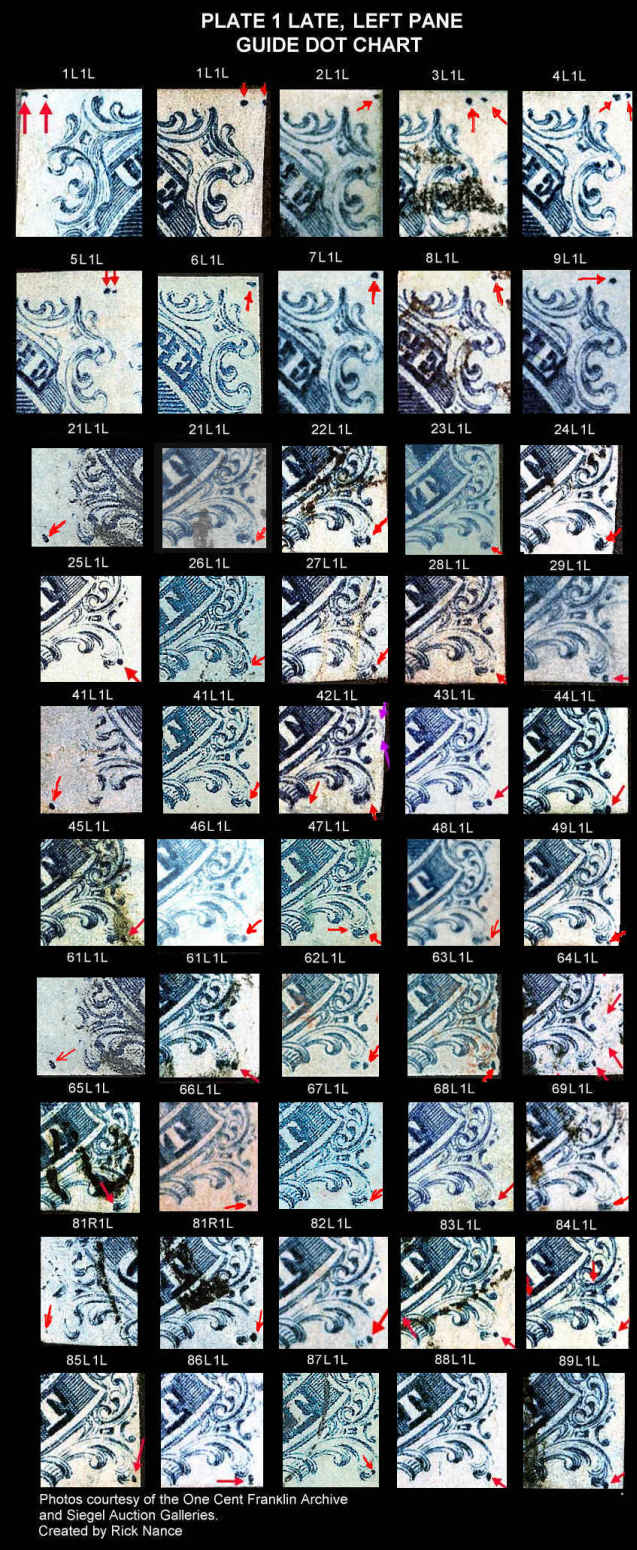 Ps: I am only missing 3 positions to complete my guide dot chart for right pane plate 1 early. I am missing 24R1E, 66R1E and 68R1E. Left pane is a bit over half done. |
|
Send note to Staff
|
| Edited by jaxom100 - 01/01/2018 08:18 am |
|
|
Replies: 615 / Views: 74,588 |
|




 Posted 12/23/2017 12:23 am


