Stamp Community Family of Web Sites
Thousands of stamps, consistently graded, competitively priced and hundreds of in-depth blog posts to read


Stamp Community Forum
 
Username:
Password:
Save Password
Forgot your Password?

This page may contain links that result in small commissions to keep this free site up and running.

Welcome Guest! Registering and/or logging in will remove the anchor (bottom) ads. It's Free!

Canada Flat Plate Or Rotary Press Printing?

 
To participate in the forum you must log in or register.
Author Previous TopicReplies: 12 / Views: 2,829Next Topic  
Pillar Of The Community
3859 Posts
Posted 12/28/2017   06:06 am  Show Profile Bookmark this topic Add jogil to your friends list Get a Link to this Message
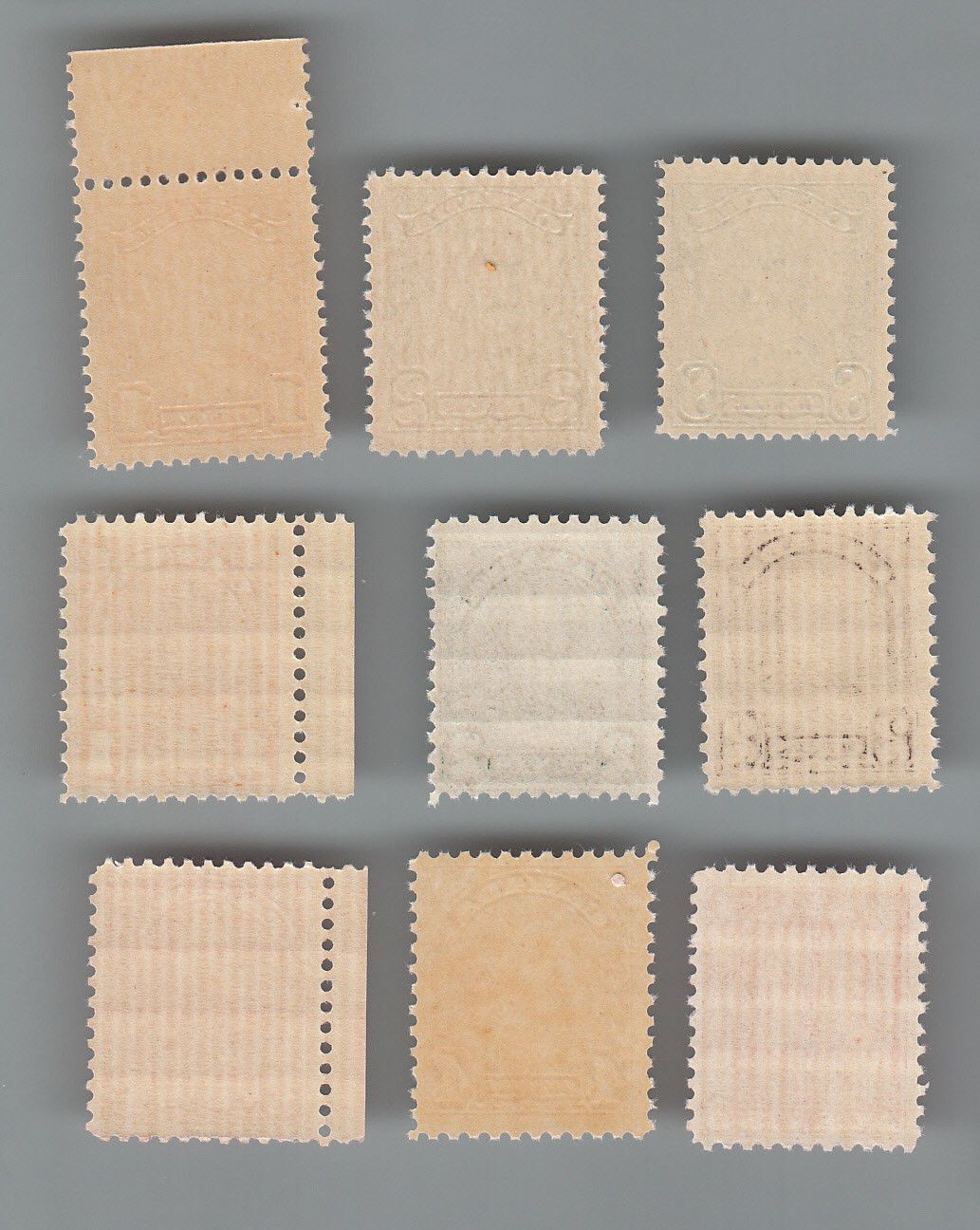
Which of the following Canada stamps are flat press printed and which of the following Canada stamps are rotary press printed? Why?

Send note to Staff
Edited by jogil - 12/28/2017 06:09 am

Pillar Of The Community
United States
725 Posts
Posted 12/28/2017   07:24 am  Show Profile Bookmark this reply Add watermark to your friends list  Get a Link to this Reply
The horizontal breakers showing on the gum maybe an indicator of a rotary press stamp. of course a used stamp will not show these. In the US postage I measure the face of the stamp design on stamps that were printed by flat and rotary presses. The rotary press stamps are taller and narrower while flat plate stamps are shorter and wider. I believe this also occurs on Canadian stamps. Measuring maybe the best way to be sure of what you have.
Send note to Staff  Go to Top of Page
Edited by watermark - 12/28/2017 07:25 am
Valued Member
Canada
265 Posts
Posted 12/28/2017   10:52 pm  Show Profile Bookmark this reply Add Trodent to your friends list  Get a Link to this Reply
if you were to label stamps 1-9 from top left to bottom right

1,2,3,8 are flat press, dry printing
4,5,6,7,9 are rotary press, because of the horizontal gum bends every 10-12mm apart.


Trodent
Send note to Staff  Go to Top of Page
Pillar Of The Community
3859 Posts
Posted 12/29/2017   8:34 pm  Show Profile Bookmark this reply Add jogil to your friends list  Get a Link to this Reply
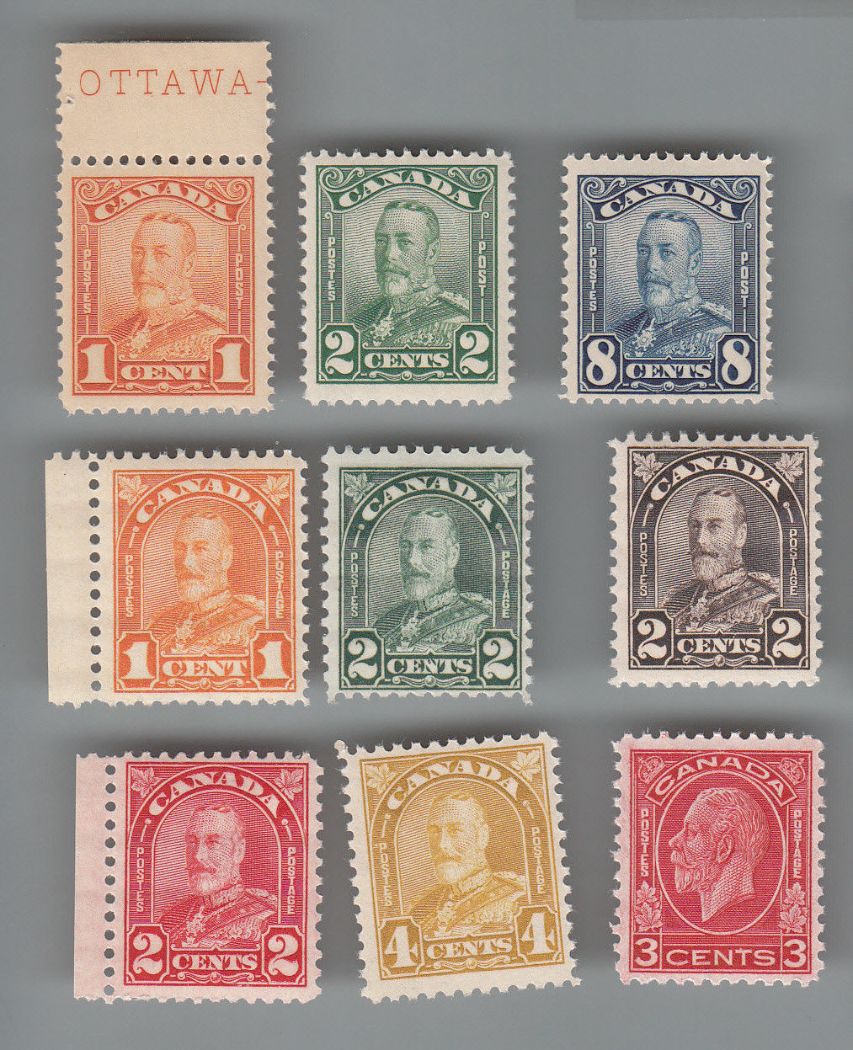
Thank you for your answers to the above questions. Does showing the front of the stamps below change your answers?

Send note to Staff  Go to Top of Page
Edited by jogil - 12/29/2017 8:38 pm
Valued Member
Canada
265 Posts
Posted 12/29/2017   11:49 pm  Show Profile Bookmark this reply Add Trodent to your friends list  Get a Link to this Reply
Nope not at all, I think the only way to distinguish between the rotary or flat press is by the image size. Rotary is slightly taller I believe.

Trodent
Send note to Staff  Go to Top of Page
Pillar Of The Community
3859 Posts
Posted 12/30/2017   02:56 am  Show Profile Bookmark this reply Add jogil to your friends list  Get a Link to this Reply
As you have both said, Stickney rotary press stamps do have horizontal gum breakers and they measure slightly more vertically and slightly less horizontally than flat plate stamps.

The above first three stamps were printed by the Canadian Bank Note Company (CBNC) and the above six stamps after them were printed by the British American Bank Note Company (BABNC).

The first three stamps are Scott/Unitrade 149, 150, 154 and they were all sheet-fed rotary press dry printed and perforated 12 x 12 gauge.

The other six stamps are Scott/Unitrade 162, 164, 165, 166, 168, 197 and they were all web-fed rotary press wet printed and perforated 11.25 x 11 gauge, except for Scott/Unitrade 168 which was sheet-fed flat plate dry printed and perforated 11 x 11 gauge.

Thus, the first three stamps (149, 150, 154) were printed differently than the eighth stamp (168), but they all have embossed looking gum since they were all dry printed.
Send note to Staff  Go to Top of Page
Edited by jogil - 12/30/2017 10:14 am
Pillar Of The Community
3859 Posts
Posted 12/31/2017   2:31 pm  Show Profile Bookmark this reply Add jogil to your friends list  Get a Link to this Reply
For British American Bank Note Company (BABNC) 1930-1934 issued stamps, perforation gauge does help to determine the printing of these stamps since one web-fed bar and wheel perforator with 11 1/4 x 11 gauge perforations was used for web-fed rotary press sheet and booklet stamps and two sheet-fed rotary wheel perforators with 11 gauge perforations each were used for sheet-fed flat plate sheet and booklet stamps. The coil stamps were perforated by one web-fed bar perforator with 8 3/4 gauge perforations was used for web-fed rotary press coil stamps.

It is too bad that such important helpful information is not mentioned in the Scott/Unitrade Canada Specialized Catalogue. Here is a summary listing with Scott/Unitrade catalogue numbers.

Web-Fed Stickney Rotary Press Wet Printed Sheet Stamps (Perf. 11 1/4 x 11): # 162, 163, 163b, 164, 165, 165a, 166, 166b, 167, 169, 191, 191a, 192, 195, 196, 197, 197c

Web-Fed Stickney Rotary Press Dry Printed Sheet Stamps (Perf. 11 1/4 x 11): # 195d

Web-Fed Stickney Rotary Press Wet Printed Booklet Stamps (Perf. 11 1/4 x 11): # 164ai

Web-Fed Stickney Rotary Press Wet Printed Coil Stamps (Perf. 8 3/4 vertically): # 178-183, 205-207

Sheet-Fed Flat Plate Press Dry Printed Sheet Stamps (Perf. 11 x 11): # 168, 169a, 170, 171, 172, 173, 174, 175, 176, 177, 190, 193, 194, 198, 199, 200, 201, 202, 203, 204, 208, 209, 210, C2, C4, E4, E5, J6-J10, J11-J14

Sheet-Fed Flat Plate Press Dry Printed Booklet Stamps (Perf. 11 x 11): 163a, 163c, 164a, 165b, 166a, 166c, 167a, 195a, 195b, 196a, 196b, 197d
Send note to Staff  Go to Top of Page
Edited by jogil - 01/01/2018 09:55 am
Pillar Of The Community
Canada
1415 Posts
Posted 01/01/2018   09:17 am  Show Profile Bookmark this reply Add Gilles le timbre to your friends list  Get a Link to this Reply
Jogil,
one suggestion to consider to supplement this kind of information to Unitrade catalog could be the addition of an electronic link called "supplemental information" for Unitrade catalogue owners (similar to the "errata" additions that come from time to time. This would not add more pages to the catalogue but would be useful for specialized collectors who want to explore complex issues in more details.
Send note to Staff  Go to Top of Page
Pillar Of The Community
3859 Posts
Posted 01/01/2018   10:03 am  Show Profile Bookmark this reply Add jogil to your friends list  Get a Link to this Reply
Gilles le timbre: Thank you for your suggestion on getting a website link up for supplementary Canada philatelic information. I have submitted such a paper for consideration to BNAPS BNA Topics some time ago on BABN perforations and I did suggest that the Unitrade Catalogue make a distinction such as Perf. 11 1/4 x 11 for BABN Stickney rotary press stamps and Perf. 11 x 11 for BABN flat plate stamps hopefully somewhere as a small information box.
Send note to Staff  Go to Top of Page
Edited by jogil - 01/01/2018 10:04 am
Pillar Of The Community
France, Metropolitan
3745 Posts
Posted 01/01/2018   10:22 am  Show Profile Bookmark this reply Add perf12 to your friends list  Get a Link to this Reply
Send note to Staff  Go to Top of Page
Edited by perf12 - 01/01/2018 10:24 am
Pillar Of The Community
Canada
1415 Posts
Posted 01/01/2018   11:08 am  Show Profile Bookmark this reply Add Gilles le timbre to your friends list  Get a Link to this Reply
Perf12, the Kenmore link is an excellent idea. An inexpensive tool to quickly differentiate wet and dry printings. I'll try to make one for my admirals, as a start. One othe way to assist, if working with JPG files, is to open as "paint" items and the draw a line to measure the number of pixels of the frame. This works quite well too.
Send note to Staff  Go to Top of Page
Valued Member
Canada
29 Posts
Posted 01/02/2018   11:07 pm  Show Profile Bookmark this reply Add DeEll to your friends list  Get a Link to this Reply
I thought that #'s 149, 150 and 154 were sheet fed flat plate printings and the very first rotary press printing was actually #164? Also, I find your explanation of #168 a bit confusing.
Send note to Staff  Go to Top of Page
Pillar Of The Community
3859 Posts
Posted 01/03/2018   1:58 pm  Show Profile Bookmark this reply Add jogil to your friends list  Get a Link to this Reply
Scott/Unitrade 149, 150 and 154 were printed just like the dry printed Admiral stamps by CBNC. ABNC which later became CBNC introduced a rotary type wet press starting in 1897 for Canadian stamps that were needed in larger quantities. However, it was a sheet-fed wet press and it was used in addition to the sheet-fed flat plate wet press which was used from before 1897.

ABNC stopped using flat wet press around 1913 with some of the first Admiral stamps. Around the end of 1922, CBNC (ex. ABNC) first started to change over to a sheet-fed dry press and full sheet-fed dry printing use occurred by 1928.

However, BABNC got the contract to print Canadian stamps in 1930 and went back to using a flat press but it dry printed instead of wet printed. Also, BABNC used a web-fed Stickney rotary wet press for its low denominated postage stamps that were needed in larger quantities faster. This was changed to dry printing for 195d.

This is a bit more complicated than for U.S. stamps. Most U.S. stamps were first BEP Hoe flat plate wet printed (1894-1939) and later BEP Stickney rotary press wet printed (1914-1962).
Send note to Staff  Go to Top of Page
Edited by jogil - 01/03/2018 2:55 pm
  Previous TopicReplies: 12 / Views: 2,829Next Topic  
 
To participate in the forum you must log in or register.

Go to Top of Page

Disclaimer: While a tremendous amount of effort goes into ensuring the accuracy of the information contained in this site, Stamp Community assumes no liability for errors. Copyright 2005 - 2026 Stamp Community Family - All rights reserved worldwide. Use of any images or content on this website without prior written permission of Stamp Community or the original lender is strictly prohibited.
Privacy Policy / Terms of Use    Advertise Here
Stamp Community Forum © 2007 - 2026 Stamp Community Forums
It took 0.19 seconds to lick this stamp. Powered By: Snitz Forums 2000 Version 3.4.05