|
This page may contain links that result in small commissions to keep this free site up and running.

Welcome Guest! Registering and/or logging in will remove the anchor (bottom) ads. It's Free!
To participate in the forum you must log in or register.
| Author |
 Replies: 58 / Views: 9,715 Replies: 58 / Views: 9,715 |
|
|
|
Pillar Of The Community
United States
1946 Posts |
|
|
Quote:
Does anybody have info on the steam press used for the 205c Special Printing? Steam press wasn't used for this. Clearance to use a steam press for stamp production did not come along until 1885 due to efforts to block by the plate printers union. |
Send note to Staff 
|
|
|
Bedrock Of The Community
12784 Posts |
|
|
Does anyone have any info (links) concerning the steam press and its usage? |
|
Send note to Staff
|
|
|
Pillar Of The Community
1375 Posts |
|
|
I had a look at the archives of Siegel and PF. There is no sale and no certificate for any American Bank Note special printing as used stamp (1880, 1882, 1883-85). I expected this, and in the past I always thought that there are no used examples because of the lack of gum. But indeed there are accepted used special printings, but only Continental, and only two of them, the 3c and the 24c. For both used special printing stamps there are PF certificates, the 3c certificate being quite old. But it seems possibe to distinguish the CBN special printing from the regular issue (paper, color, impression).
For me the reason why there are no ABN used special printings can only be that it's not possible to make a certification to it as the paper, ink and impression is just too similar (= the same) between the normal issue and the special printing. Sometimes Siegel writes "proof-like impression" to ABN special printings, but when I look at the scan, it's just a normal stamp to me with no fine lines. My guess now would even be that the PF perhaps only certifies unused special printings when they can analyze exactly that there never has been any gum and no trace of cancellation which would be a good indicator for a special printing.
What would interest me still: why is the impression of the CBN special printing (and as some may say of the ABN special printing and as in Micarelli is written also for the 205C and 211D) so good, "proof-like" or with a "clarity of impression", what is the reason for this? Have there been special plates, or just better ink or more time to produce them?
|
|
Send note to Staff
|
|
|
Valued Member
United Kingdom
299 Posts |
|
|
There is an interesting study of the 3c stamps papers used during the banknote period: https://repository.si.edu/bitstream...eb_FINAL.pdfHowever, nothing shows the 'specials' being constantly produced with different paper types than the 'regulars'. So, at this point, unless some particular information is discovered I believe that it will be impossible to prove a circulated 5c Garfield stamp is a 'special print' unless on a complete cover and canceled within the few months (February to April) before the regular issue. Next week I hope to be able to measure with an ultrasound gauge the thickness of paper of the 5c in my possession in order to compare it with the measurements mentioned by the above article. But even so, knowing how printing houses work, I would assume that American did use the same type of paper for a wide range of stamps. According to the above article, starting 1881 American was using paper with thickness starting from 0,0026 up to 0,0042 inch. Perhaps, if one could measure all the certified 205c stamps and would find that all of them are on paper with same thickness (ie. 0,0032 in) then one would be able to say with a greater certainty that a 5c Garfield is more likely to be a 205c if printed on that thickness ... Another aspect is the bleaching and sizing of the paper: after 1879 I believe American moved to starch sizing based paper. So, a spectroscopic analysis might also help. |
|
Send note to Staff
|
|
|
Valued Member
United Kingdom
299 Posts |
|
|
Stamperix, I found your post from December mentioning the same article :) |
|
Send note to Staff
|
|
|
Pillar Of The Community
United States
1414 Posts |
|
|
Quote:
Another aspect is the bleaching and sizing of the paper: after 1879 I believe American moved to starch sizing based paper. Try long wave ultraviolet light. National and Continental Bank Note hard papers will appear brighter while Continental and American soft paper will be dead looking in comparison. Unfortunately, intermediate paper exists, perhaps correlating with the alum paper type mentioned by Barwis. Finally, it is not clear that the transition from gelatin sizing occurred at exactly the time of the February 4, 1879 consolidation. Based on dated covers and other evidence, the change from hard to soft paper took place before the consolidation. Soft paper on covers with dates from the Continental period are considered by specialists to be Continental printings. The Scott Catalog correlation of paper type with printing vendor is not useful to beginning stamp collectors. Finally, American Bank Note Company some stamps on hard paper, purchased initially for a special or experimental printing that was destroyed. See the recent article by Ron Burns about American Hard Paper in the Classics Society "Chronicle". |
|
Send note to Staff
|
|
|
Rest in Peace
United States
205 Posts |
|
|
stamperix, to an extent the quality impression of the Special Printings is owed to good plate wiping. Special Printings do not display the plate wash of the regular issues. Now, it may also be that in order to not interrupt normal production of postage stamps the banknote companies utilized a proofing press to print the 50 sheets of 200 of each denomination (I believe that was the number ordered; point is it was a small printing). Intaglio presses of the time (anyone, please feel free to correct me) had multiple plates printing in a specific order (Inking, wiping, placing paper and pulling the print). Just easier to lock a single plate into a proofing press than disrupt production of regular postage stamps. The manner of wiping would be a bit different if done by personnel used to printing proofs, who would wipe the plate thoroughly but in a manner that kept from removing ink from the engraving - perhaps even polishing the plate before printing. This would create the proof-like impression, which is really a sharp print accompanied by a strong contrast between the print and the white paper surface.
Keep in mind that aside from #205C (first impressions) and #211B (steam press essays) the Special Printings were printed from business plates that often had some degree of wear. #172, the 10-Cent Continental, has an especially-worn impression. Speculating further, if the Banknote SP's were printed by proofing press, not simply drawn from printed stock, then I suspect either fresh plates OR used plates awaiting destruction were utilized, because I doubt a press run would have been interrupted to transport one of the plates to the proofing room for production of Special Printings. |
|
Send note to Staff
|
|
|
Pillar Of The Community
United States
1946 Posts |
|
|
Quote:
Next week I hope to be able to measure with an ultrasound gauge the thickness of paper of the 5c in my possession in order to compare it with the measurements mentioned by the above article. Let me urge caution with this. That study was done by John Barwis. To get the same results John got, you need to use his technique and verify that your instrumentation and his are adjusted to the same settings and tolerances. Case in point, I asked him about how he did his measurements. I use a Mitutoyo dial thickness guage for my paper measurements, and he used a Mitutoyo micrometer. Mine is spring loaded with a broad-based plunger, his is manually cranked with a much smaller plunger. I mentioned that variance in the amount of cranking can introduce variant readings (per the manufacturer's instructions) but he preferred the smaller plunger to confine his readings to the unprinted edges of the stamps only. (Intaglio printing deforms the paper wherever the ink is deposited.) Confining to the edges is harder to do with a dial thickness gauge, but unless that is done the variation in paper measurement is significant. How all of that compares with an ultrasound gauge I do not know, but I suspect some adjustment will need to be made. Quote:
Intaglio presses of the time (anyone, please feel free to correct me) had multiple plates printing in a specific order Quite correct. "Four-plank" hand presses were the norm until the advent of steam. Thereafter, American used a proprietary five-plank steamer press designed by one of their own (who came to them along with Continental). Nonetheless, a clean wipe on a well inked new plate could produce a very sharp impression on stamp paper, depending upon the speed of operation for which the press was set. However, I don't think the claim that an impression is "prooflike" was meant to imply that it was produced by the tools and methods used for producing proofs. I have a number of imperforate proofs on stamp paper with strong clean impressions; i.e. prooflike, but none of these is as sharp as what can be seen on plate proofs on India or card. I have seen Spyder press demonstrations on wove papers, always with a backing board, but do not know how their images would compare to normal production papers under the contract of 1877. |
|
Send note to Staff
|
|
|
Valued Member
United Kingdom
299 Posts |
|
|
Calibration wise, the ultrasound gauge comes with calibrated test blocks.
In theory, I will be able to measure the paper thickness and the ink layer thickness.
Until then, I am struggling to find the type of ink used on 205s by American. Hopefully, they will answer to my inquiry and allow me access to operational records of the period if they still have them :) |
|
Send note to Staff
|
|
|
Pillar Of The Community
United States
1946 Posts |
|
|
Quote:
Calibration wise, the ultrasound gauge comes with calibrated test blocks. By this your calibration is standardized to the test blocks. Blocks that Barwis did not use. Do not expect the readings to be the same. Quote:
In theory, I will be able to measure the paper thickness and the ink layer thickness. If that is done point to point and the paper thickness remains the same everywhere, then that should work for the paper thickness. The gauges we were using would be off because of the graphic relief of the design elements if we measured a spot where there was printing. Quote:
Hopefully, they will answer to my inquiry and allow me access to operational records of the period if they still have them The present American Bank Note Co. should not be expected to have those records, inasmuch as the old ABNCo was bought out in the early 1990s and its archives were dispersed. As for their inks, those were their own proprietary formulations that varied according to formula and mixture from batch to batch. |
|
Send note to Staff
|
|
|
Rest in Peace
United States
205 Posts |
|
|
"If we could magically assemble all the existing #205C special printing stamps, would we see very consistent colors across all the stamps today (100+ years later while these stamps were all stored under different environmental conditions)?"
I had an opportunity to view two #205C, each certified as such, side by side. One had a warm gray brown shade and the other had a gray to brownish gray color with a weaker impression. So, no, there would not be such a consistency. However, I believe a couple of blocks have been broken into singles over the years, so these would obviously show a consistency of shade and impression. |
|
Send note to Staff
|
| Edited by Tipzi - 02/10/2018 5:49 pm |
|
|
Valued Member
United Kingdom
299 Posts |
|
|
... ultrasound doesn't work well on paper: too much empty space between paper fibers ...
Back to the drawing board :)
Crphoto, I will try the long wave UV over the next few days once I get my hands on some stamps from each of the banknote companies, for comparison. |
|
Send note to Staff
|
|
|
Rest in Peace
United States
205 Posts |
|
|
I just bought an interesting item from a recent Siegel auction that circles back to this topic. As previously discussed, Mooz wrote an article in 1992 that attempted to explain the scarcity of #205C when the official records (bill books) recorded over 2000 of these stamps being sold through the Third Assistant Postmaster General's office as stamp specimens, commonly referred to today as Special Printings. His concluded his research by proposing that the stamps considered by the Scott catalog as the real #205C were from the few hundred sold between February 4 and March 9 of 1882, and the remainder of the stamp orders were filled after April 10 with regular issues having gum. I do not think this is correct, for two reasons. The first reason is John Luft's observation of a reddish tint to a stamp he was shown that was accompanied by a letter from the 3rd Assistant Postmaster General stating the stamp came from the first sheet printed. This would be the only stamp demonstrably issued prior to the regular issue, making it the lone Special Printing. The second reason is that #205C is noted for missing most of the diagonal shading lines in the vignette. #205 is known with and without these diagonal lines, and was once considered two different types until it was understood it came about from progressive plate wear. How, then, could the first stamps issued, which Mooz suggests are the Special Printing, have come from worn plates? I don't know how this was missed, but the following links to a lot in Siegel's last US auction of an O.G. #205 that was sold from the Worthington collection in, I believe, 1917. https://siegelauctions.com/lots.php...4-15%2C+2019The 1917 lot card states that the stamp was sent to Queen Victoria at her request, while the Third Assistant Postmaster General's letter (not shown in the catalog) said this stamp came from the first sheet and was issued on February 10, 1882. This could be the stamp alluded to by Luft because it has the reddish hue and the February 10 letter. I believe the re-discovery of this stamp demonstrates the first two sheets of 200 stamps, exhausted by March 9, were in the reddish brown shade and had the full diagonal vignette shading expected of a fresh plate. If the above is correct then the stamps considered today to be #205C were issued after the regular issue became available April 10, which explains why they are so difficult to distinguish from the regular issue. I would speculate further that the order for the regular issue was printed and issued prior to the specimen stamps due to the fact that the ABNC was so far behind in issuing them, which explains why the stamps considered to be #205C are from a worn plate, being the last printed as they were the secondary priority. My plan is to submit this stamp and the accompanying documents to the PF as a variety of the #205. If the PF agrees then I will approach the Scott catalog editor to see if he would consider listing a reddish-brown sub-type of #205C. |
|
Send note to Staff
|
|
|
Pillar Of The Community
1375 Posts |
|
|
Hello Tipzi,
thank you for your post. This (your post) is a very interesting topic about which I also have been thinking a while. Also, the find of the "real special printing" of the Scott 210 would be a great discovery. But about the 205C at least a bit more information is there.
I hope for other people involved before in this thread to answer your post, as they do know more about this probably than I do. But let me just give some points which I had.
All 205C stamps I looked at in the Siegel database have those diagonal lines, and from what I read or heard the 205C have a good impression, so not coming from a worn plate. In the scans at Siegel the lines may appear weak but if you look at the right side you can often see them. I think the weakness of the lines is due to the image quality (which is high but not high enough to show such small lines well).
The 205C has a grey color (in Scott) so not reddish or yellowish. I understand your point about the reddish color of Luff's stamp and I even believe in it. I only wonder: Aren't many of the special printing stamps only certified because of their provenance, so aren't there any provenance documents of any of the known 205C? If there is information that they are really special printings (without gum), we should believe that their color is also the real color (not reddish).
About the Scott listing: From a logic point of view there can't be a variety of a special printing, either it's a special printing or not. If you submit to the PF and they say (without document of provenance) that this is the real special printing, then the other 205C should loose their status.
And of course: could you please show a scan of your stamp here in the forum so that we have an idea about the printing quality and the reddish color? That would really be nice.
All in all I like the thoughts you have and wish you can continue in this research as it is worth going that way.
|
|
Send note to Staff
|
|
|
Rest in Peace
United States
205 Posts |
|
|
Stamperix, A worn plate can give a good impression if printed carefully, though it would lack detail. In the image below, the left stamp is a warm gray brown with a fine impression. Note how little of the diagonal lines remain in the vignette, so though it is a good impression I believe it is from a worn plate. The stamp on the right is the one purportedly sold on February 10, 1882, from the first sheet printed. See how complete the diagonal lines are, as well as the reddish hue of the ink. Not only that, but the paper is bright white with no plate wash. 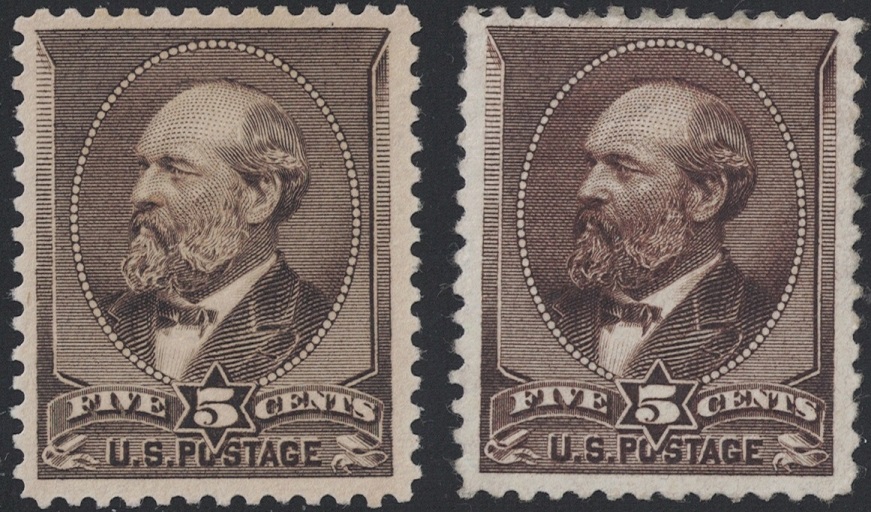 The stamp on the left is a good approximation of the Milestrup copy of #205C, which has the most visible diagonal shading of any Special Printing, IMO. Most others show significantly less. |
|
Send note to Staff
|
|
|
Replies: 58 / Views: 9,715 |
|
|
To participate in the forum you must log in or register. | |
Disclaimer: While a tremendous amount of effort goes into ensuring the accuracy of the information contained in this site, Stamp Community assumes no liability for errors. Copyright 2005 - 2026 Stamp Community Family - All rights reserved worldwide. Use of any images or content on this website without prior written permission of Stamp Community or the original lender is strictly prohibited.
Privacy Policy / Terms of Use Advertise Here |
| Stamp Community Forum |
© 2007 - 2026 Stamp Community Forums |
| It took 0.25 seconds to lick this stamp. |
 |
|
|
|


 Posted 02/09/2018 11:12 am


