[NOTE: Some of this is from memory almost 15 years ago, so if I have misstated anything, please let me know.]
I just acquired an album of 20th century tax paid revenue stamps for cheap, since I didn't have any of this material in my collection. All of it is material from the 2005-2006 deaccession auctions, which prompted me to do a little bit of research and write this up.
I was only just dabbling in U.S. revenue stamps in the early-mid 2000s, the period leading up to the two Matthew Bennet auctions of material deacessioned by the Smithsaonian Institution's National Postal Museum. Moreover, I was focused almost exclusively on 19th century material at the time, and as the deaccessioned material was exclusively 20th century revenue stamps, I didn't pay very close attention.
Back in 2004, the museum announced that it was going to destroy over 7 million revenue stamps from its vaults. There was public outcry and Eric Jackson spearheaded an Internet campaign against the destruction. If memory serves, the museum relented, first saying they would sell the stamps, but indelibly mark them. Then after further pressure, agreed to sell the stamps unaltered.
The stamps consisted of unused revenue stamps of many types, the major auction categories listed below:
Sale 1 (February 12, 2005)
http://www.bennettstamps.com/cgi-bi...e=286&lang=1Documentaries
Future Delivery
Stock Transfer
Wine
Beer
Silver Tax
Narcotics
Distilled Spirits
Tax Paids
Marihuana Tax
Sale 2 (September 30, 2006)
http://www.bennettstamps.com/cgi-bi...e=308&lang=1Documentaries
Stock Transfer
Wine
Beer
Playing Cards
Silver Tax
Potato Tax
Narcotic Tax
Boating stamps
Distilled Spirits
Firearms Transfer
Rectification Tax
Puerto Rico Rectified Spirits
Taxpaid - Alcohol
Taxpaid - Food
Taxpaid - Tobacco
These were sold as singles, multiples, and full sheets, with multiple lots of some of the scarcer stamps being the same composition, and then large balance lots at the end of each section.
While some of the stamps sold were small quantities of rare stamps that prior to the sale had never been held in private hands, and some mid-scarcity items were released in quantites of 150-200, there were other more common issues amongst the wine and tax paid stamps that suddenly flooded the market in quantities of thousands or even tens of thousands.
Even now more than a decade after the sales, I don't know that certain market segments affected by the sales have stabilized. Wine stamps, for example. The common deaccessioned material suddenly dumped into the market by the thousands has created a scenario where you can't swing a dead cat without hitting bulk lots of common mint wine stamps on
ebay, at stamp shows, and in major auctions... and they don't sell, even at cents on the dollar compared to Scott catalogue values.
While Scott catalogue values for the common deaccessioned wine stamps were lowered following the sales, they still may not be low enough. Conversely the material from the sales that was only released in small quantities is relatively stable, and some of it was completely snapped up immediately following the auctions and doesn't reappear on the market frequently, and when it does, it garners solid prices compared to Scott. One might argue that some of these stamps are actually undervalued in Scott.
(Of course the cynic in me suspects that inventories of some of the stamps are only being trickled onto the retail market in order to prop up values.)
Gauging the affect on the tax paid revenues is much tougher, as the only catalogs for that material are the Springer catalogs, which long precede the auctions. There is an 11th edition in development that is slated for publication this year, but I heard that it was "imminent" 2 years ago, so we'll see when it appears.
Even worse, from a stability standpoint, per a Linn's article from last year, there is a third deaccession sale yet to come... who knows how that will affect availability and market values. I've not seen any reference as to the composition of the holdings slated for the third sale. Will it be material not yet seen or just more of the same?
Mystic was a huge buyer at the first two auctions, as were the major revenue dealers. They still offer various bulk lots of the taxpaids. Some examples:
Eric Jackson: TAXPAIDS Cigarettes, Cigars, Small Cigars, Snuff, Tobacco & Tobacco Strips 375+ for $995, more than 10 lots available.
Mystic:
39 different taxpaids for $59
https://www.mysticstamp.com/Product.../M11194/USA/100 different taxpaids for $249
https://www.mysticstamp.com/Product.../M11195/USA/420 different taxpaids for $995
https://www.mysticstamp.com/Product.../M11196/USA/50 different 1953-55 cigar stamps for $100
https://www.mysticstamp.com/Product.../M11397/USA/100 different 1953-55 cigar stamps for $210
https://www.mysticstamp.com/Product.../M11398/USA/You get the idea; there are others.
Mystic even went so far as to have custom album pages made for these stamp lots as part of their "Heritage Collection", and you could purchase "kits" of the album pages and then the stamps in precut mounts to affix to the pages. Those lots don't appear to still be available, or at least I couldn't find them on Mystic's website. Here is an example showing how the stamps were packaged:
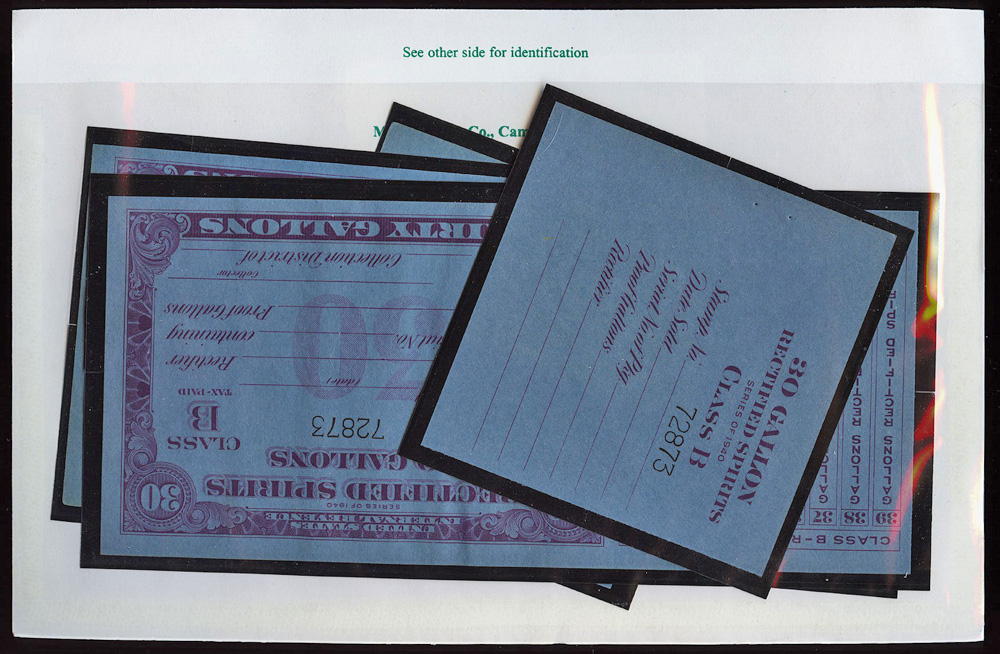
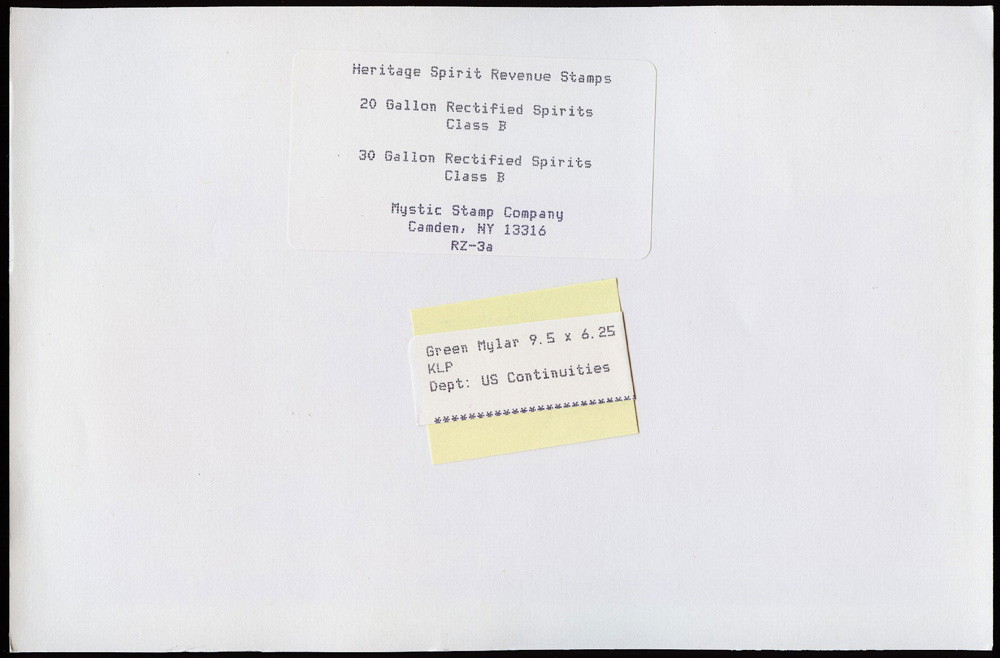
What I find reprehensible is how Mystic destroyed all of the Rectified and Distilled Spirits stamps they sold by cutting the stubs from the stamps in order for them to fit the album pages. When sold at auction, the stubs were still attached. Nominal value or not, you just don't do that.
Additionally, Mystic supplied the imperforate taxpaids only as singles, not as pairs, which would have been the appropriate thing to do, as the margins on the rouletted stamps are so large as to easily be trimmed to create imperforates. Then again, my assumption is that the retail value of these is so nominal that there isn't a different in value between roulette and imperforate. Still, it should have been the preferred presentation. Given Mystic's cost for the stamps, the difference between providing pairs vs. singles of the imperforate stamps would have been minimal.
Given the amount of material out there and the fact that there may be more of it entering the market, I certainly would not recommend purchasing at retail prices, but if you can find an accumulation on the secondary market below $1 a stamp, and you enjoy this sort of material, it's a relatively minimal investment.
I scanned the entire volume (170 pages) so you can see just what/how Mystic offered at the time. The stamp count is over 500, so it must have been a combination of Mystic lots shown above, or at some point Mystic offered an even larger taxpaid revenue stamp option.
Rather than bog the forum down with all the images, I have it on a standalone web page if you want to browse. The images have been lightened to show detail. The blue paper is actually darker than shown.
https://revenue-collector.com/mystictaxpaidAt some point I may decide to fill in the gaps. I'm not sure if I'll start working backwards into the pre-deaccession material.





 Posted 04/07/2018 10:49 am





