| Author |
 Replies: 17 / Views: 5,080 Replies: 17 / Views: 5,080 |
|
Pillar Of The Community
1375 Posts |
|
|
|
Hello,
as I know for the Washington-Franklin stamps, the sheet stamps often have another design size than the booklet stamps, as sheet stamps shrink in the horizontal direction and booklet pane stamps shrink in the vertical direction. So the booklet stamps look "more square".
I just would like to know:
For which issues is this true? Is it correct also for the booklet stamps from the beginning, before the Washington-Franklins (1c, 2c, 3c 1900-1908 and the 2c shield 1903-1908)?
|
|
Send note to Staff
|
|
|
|
|
Moderator

United States
12330 Posts |
|
|
And as a related topic...
I ran a simple test a few years ago. I took a stamp and gauged the perfs using a Precision Multi-gauge. But I did this procedure twice, once with the stamp after it was well soaked in water and once again after I had thoroughly dried the stamp in the oven in low heat. (I assume the moisture content in the wet stamp was near 100% and the dried stamp <10%.) The perfs gauged completely different; I do not recall how much other than it was significant.
I assume the paper will grow/shrink different depending upon the grain (mesh) of the paper. If so, is wetting the paper and taking careful measurements acceptable method for determining the grain (mesh) of the paper? How much does paper shrink/grow overall? How concerned should a hobbyists be about the paper moisture content when doing dimensional work?
Don |
Send note to Staff 
|
|
|
Pillar Of The Community
United States
7239 Posts |
|
|
Moistened paper expands against the grain, but not in the direction of the grain. I'm sorry, but I can't help with contraction on drying. |
|
Send note to Staff
|
|
|
Pillar Of The Community
United States
1624 Posts |
|
|
Pillar Of The Community
1375 Posts |
|
|
Yes, it's about paper grain. I mostly find out when just laying the stamp on a table and looks in which direction is curs, but this does not always help.
What I just wanted to know is, for which booklet issues the different design size is relevant and so can be a help in identifying booklet singles.
- so is the "more square" look true also for the first booklets, as above mentioned (1902 issue incl. 1903 shield)?
- does it depend also on the 180 vs 360 subject pane?
When I look at many Siegel examples for sheet and booklet stamps of the mentioned issues, I notice that most booklet stamps look more square, but not all. So this could be a definition help like "every more square stamp of the issue is a booklet stamp, but not every narrow stamp is a sheet stamp"?
|
|
Send note to Staff
|
|
|
Moderator
United States
12330 Posts |
|
|
Obviously Clark is the expert but this is what I know...
The paper can be either horizontal mesh or vertical mesh paper (mesh = grain). Flat plate booklet pane stamps were printed on the horizontal mesh because this allowed for better accuracy for cutting them into the panes. So the booklet stamps are slightly wider and typically short than the flat plate sheet stamps.
Don |
|
Send note to Staff
|
|
|
Pillar Of The Community
United States
2555 Posts |
|
|
Johl could have been more clear on the issue of watermark orientation on the 1902 issue, but it seems all of the watermarks on the booklet pane stamps run vertically and the sheet stamps ran horizontally. The booklet stamps were printed with special 180 subject plates and the sheet stamps were printed with 400 subject plates. |
|
Send note to Staff
|
|
|
Pillar Of The Community
1375 Posts |
|
|
The first booklet panes were the 2c 279Bj (horizontal wm.) and then after the change of orientation the 279Bk. There seems to be a relation also between the watermark orientation and the paper grain, as horizontal watermarks are on vertical grain paper, and vertical watermarks on horizontal grain. All later booklet panes were made on vertical watermark = horizontal grain paper.
So I think I answered partly my question, as all booklet panes - also before the Washington-Franklin stamps - were printed on the horizontal grain paper, except the first one 279Bj. Indeed those early booklet panes were printed on the 180 subject plates (again except the 279Bj). But the later ones in the W-F period were printed some both on 180 and 360 subject plates, while the watermark still is always vertical. It seems that there is no relation between the plate size and the watermark orientation then.
Of course I am looking forward to reading an expert opinion on this.
- is the "square look" a good indicator for a stamp being a booklet stamp in opposite to the narrow sheet stamp, both for Washington-Franklins stamps and - even more reliable - for the 1902 issue incl. the 1903 2c shield?
- is there a relation between the plate size and the watermark orientation and paper grain? I thought so as this is the reason for the different watermark orientation of the later 200 vs. 400 subject plates. but as mentioned the W-F booklet always have vertical watermark, but 2 different plate sizes.
|
|
Send note to Staff
|
| Edited by stamperix - 04/09/2018 03:15 am |
|
|
Pillar Of The Community
3865 Posts |
|
|
In the wet printing process, the paper is 1) wetted, 2) printed on, 3) dried, 4) gummed, 5) dried, 6) perforated.
Wet paper shrinks in the direction opposite its grain on drying so that paper with a vertical grain shrinks horizontally and paper with a horizontal grain shrinks vertically.
|
|
Send note to Staff
|
| Edited by jogil - 04/09/2018 04:44 am |
|
|
Pillar Of The Community
1375 Posts |
|
|
thank you for this small overview. I understood the concept about the paper grain and watermark orientation. That's why I wrote my own explanation above. But still I wonder if the "more square" look is something reliable for an experienced collector, and for everyone who can compare a stamp with a template stamp. I read somewhere (don't find it anymore) that for the special booklet paper stamps, you can easily compare singles with "normal" singles to find out, and it should work for booklet singles as well?
It's just logical to me, but on the other hand I heard often that you need a pair to name something a booklet stamp, or some large margins without guideline.
(also, I still ask myself why the Washington-Franklin booklets are with vertical watermark, but both 180 and 360 subject plates, shouldn't that have an influence on the watermark?) |
|
Send note to Staff
|
|
|
Pillar Of The Community
United States
1414 Posts |
|
|
Unwatermarked flat plate booklet pane singles can easily be distinguished by relative size. Horizontal grain "special paper" was intended to reduce booklet pane cutting errors. When booklet pane production was switched from flat plate to rotary press, remaining stocks of special paper was used to print regular sheet higher denomination regular issue sheet stamps still in production. It was also used to in some printings of C11, Beacon Airmail, 15 cent Special Delivery and the 1928 printings of the Special Handling stamps.
Bob Rufe has written a comprehensive article about the Special Handling issue and explains and illustrates how to distinguish the 1928 printing from later wet printings and dry printings. The dry printed stamps are the largest, without paper shrinkage. The 1928 printings on special paper are wider than the wet printings of the 1950 era, even though the paper was not as wet during printing.
Some small Bank Note stamps, First Bureau Issue, early Bureau postage due stamps and at least one special delivery stamp exist in two sizes because of different press/plate layout combinations, not fully documented in one place. A few 279 and 279B stamps were printed on horizontal grain paper. While the printing was labeled as an error, enough stamps exist to possibly refute that idea. Unless the perforating machines were reset after discovery of the error, it seems easier to believe that the printing could have been an experiment carried out at about the same time booklet panes were switched from horizontal to vertical watermarks when special paper started being used for booklets.
In an earlier post, Don raised the possibility that paper shrinkage was unstable and could be influenced by soaking. It seems clear enough that the size of the stamp would be different while wet, but it is not established that the stamp wouldn't return to its normal size once moisture content of the paper returns to normal. Washington, DC where stamps were printed can be humid in the summer without air conditioning and dry indoors in the winter. I have not been able to see significant changes in perforation spacing or hole size differences, on either used or unused stamps. It is possible that used stamps could vary in size depending on humidity, but I don't have enough patience to rigorously test Don's hypothesis. Before testing for size differences in the horizontal direction on a scanner, check the scanner to determine if horizontal and vertical measurements are consistent between the stepping motor direction and the optical direction. Placement on the scanner could also account for small changes in apparent size.
Finally, the only way to identify interior, top or bottom stamps from AEF booklets is by relative stamp size compared to sheet stamps or large top or bottom straight edge margins that don't capture the horizontal center line. Checking width is also important when examining C10a Lindbergh booklet panes. Fakes have been made by trimming right and left margins of sheet stamps and adding fake staple holes to the top selvage. |
|
Send note to Staff
|
|
|
Pillar Of The Community
1375 Posts |
|
|
Thank you for the detailed explanation and your time. If I may ask some questions about your post:
- you say "unwatermarked" flat booklet singles: does this mean the watermark is not found easily, or the issue you mean is really unwatermarked? All early booklet panes about which we talk here, have watermarks, so is the size the reliable difference to tell a booklet single from the sheet stamp for the early booklets? (from the beginning to the Washington-Franklins)
- if size is also good to check an AEF single, do the other 2CENTS2 booklet panes have another paper grain?
- why do the Washington-Franklins booklets always have a vertical watermark, but come from both 180 and 360 subject plates? is there no connection between paper grain and plate size in this case, as there is for the 200 vs. 400 subject plates? |
|
Send note to Staff
|
|
|
Moderator
United States
12330 Posts |
|
|
Quote:
...It seems clear enough that the size of the stamp would be different while wet, but it is not established that the stamp wouldn't return to its normal size once moisture content of the paper returns to normal... If it is true that a stamp would not return to its 'dried' dimension then this would be a huge philatelic story. In other words, for decades hobbyists have been unintentionally and permanently altering stamps by soaking them. It would also explain why Amos/Scott has been publishing 'rounded off' the perf gauging numbers all these years (they needed to explain a delta between mint stamp and soaked used stamps). When I ran my informal test, I was having a discussion with some of the folks in the Canadian group. So I ran the test with some Canadian and US stamps and I saw the same results. Unfortunately, I did not record the data and only scanned a Canadian stamp as shown here 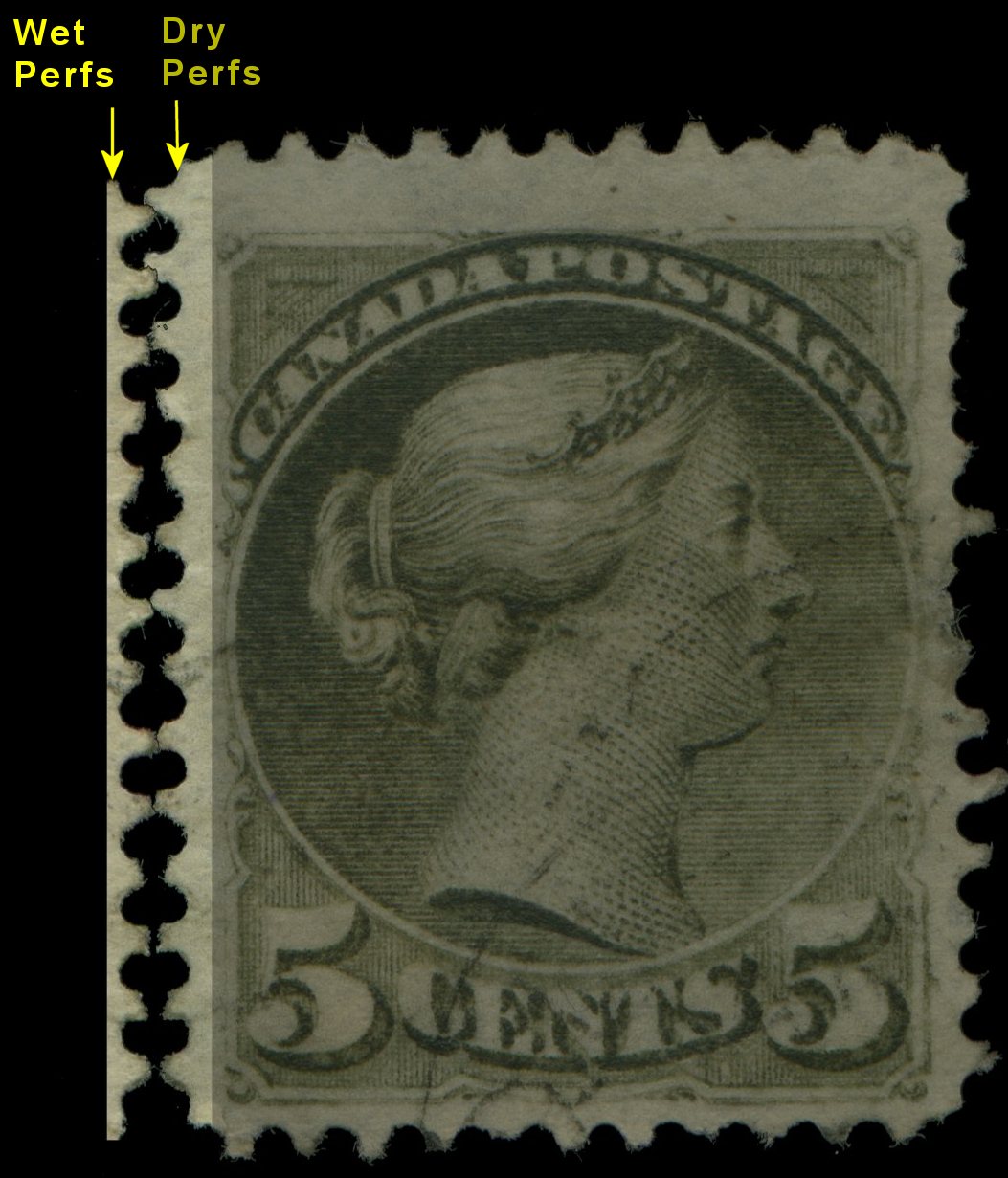 The two scans should be relative (same scanner, same direction, same locations on scanner platen). The growth between the wet and dry perfs is shown side-by-side. I first scanned the stamps wet, then dried them in an oven, then rescanned. I did this to ensure that I was working with truely dry paper moisture content. Don |
|
Send note to Staff
|
|
|
Pillar Of The Community
1375 Posts |
|
|
I just found this topic where Clark already answered a similar question to my one: size difference for watermarked booklet singles: https://goscf.com/t/41467#354152AEF booklet singles: https://goscf.com/t/41467&whichpage=2#354323So from my last 3 questions above "only" the following is left (actually I now have even more "question text"...): - as the size difference between the mentioned sheet and booklet stamps is a reliable tool, I just wonder if the shrinkage in those cases was the same overall the sheet, or if some booklet pane singles may have such a different kind of shrinkage (as they were in the middle or border of the sheet) that they don't have the "more square" look as normally for booklet singles. But I guess the difference of the paper grain of booklet vs. sheet is so large that it is more important than any shrinkage degree differences? - can I decide if a single stamp is a 499e or a 499f if it's imperforate only at the right or has no large margins? - why do the Washington-Franklins booklets always have a vertical watermark, but come from both 180 and 360 subject plates? is there no connection between paper grain and plate size in this case, as there is for the 200 vs. 400 subject plates? |
|
Send note to Staff
|
|
|
Pillar Of The Community
United States
1414 Posts |
|
|
I thought that I had made it clear that ALL flat plate booklet singles, watermarked or unwatermarked, with some First Bureau exceptions could be distinguished from sheet stamps by size. Visually, booklet pane singles will appear to be "square" in comparison to sheet stamps. The watermark provides an identification shortcut but is not necessary for identification. First and Second Bureau sheet stamps printed on 200 subject plates have horizontal grain. According to the Scott US Specialized catalog, 279Bj booklet pane stamps with horizontal watermarks were printed on 360 subject plates while 279Bk booklet panes with vertical watermarks were printed on 180 subject plates. Second Bureau booklet panes were printed on 180 subject plates. Double line watermark Washington/Franklin 331a and 332a were initially printed on 180 subject plates but production was switched to 360 subject plates using "special paper" to maintain horizontal grain and vertical watermarks. Later single line and unwatermarked flat plate booklet panes were printed on special paper. Relative size is the only way to separate sheet stamps and booklet pane singles, with some exceptions for AEF booklet singles, noted elsewhere.
Separating 279Bj or 279Bk booklet pane singles from sheet stamps is not always possible because the 279Be sheet stamp has a vertical watermark and 279Bj booklet singles have a horizontal watermark. Singles with horizontal watermarks are considered sheet stamps unless a wide margin is found without a center line. Singles with vertical watermarks are considered booklet pane singles unless the stamp is perforated on all sides or has a top straight edge or a top left or right corner.
The 50 cent Scott 422 was printed on 200 and 400 subject plates suggesting that vertical and horizontal watermarks should exist. The $1 423, 460, 478 and 518 were all printed from plate 2782 with 200 subjects. Watermarks where they exist should be vertical, but I haven't seen confirming documentation.
Finally, left over special paper was used to print flat plate sheet stamps in the late 1920s.
Information in this post is from a careful reading of the 2018 Scott United States Specialized catalog and the 2016 Durland Standard Plate Number Catalog.
Paper shrinkage in sheet stamps and booklet pane singles is dependent on the paper grain direction. Watermarks, where they exist, can serve to confirm paper grain direction, but are not required for comparison.
I hope this post is clear. Also, as Don's post makes clear, do not compare stamps not acclimated to ambient relative humidity.
|
|
Send note to Staff
|
|
|
Pillar Of The Community
1375 Posts |
|
|
thank you, as always, for your educational posts. I didn't find any information about the AEF details or the 360 plate special paper (and the square look of booklets in connection to the special booklet paper) in the Scott Specialized. I only have an old Durland, so it seems I will buy a new one. In addition, reading SCF threads is also one of the best sources of philatelic knowledge, also because of the experienced collectors like you who participate. I understood now the concept of paper grain, special paper, booklet vs. sheet design sizes and also the different plate sizes. I also will have an eye on the other special booklet paper stamps, like the special delivery or 11c - 30c stamps. Also, I looked already at some early bureau postage due, which have indeed different sizes. Rufe does not mention the postage due stamps as being on special booklet paper, but perhaps we can find new items there (I looked at some perf 12 bureau). |
|
Send note to Staff
|
|
|
Replies: 17 / Views: 5,080 |
|



 Posted 04/08/2018 10:59 am


