| Author |
 Replies: 13 / Views: 1,747 Replies: 13 / Views: 1,747 |
|
|
Pillar Of The Community
United States
670 Posts |
|
|
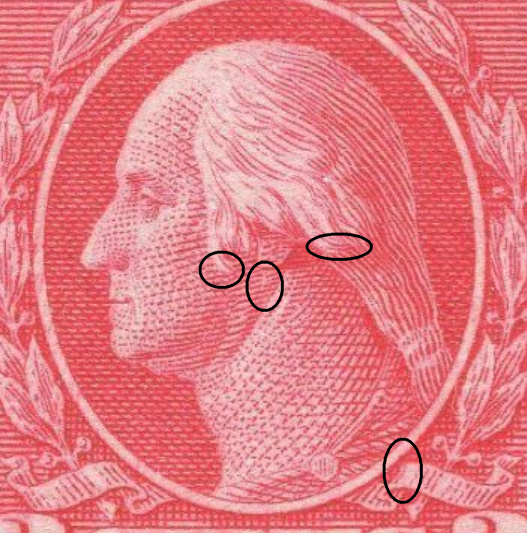
To my eyes, some differences between type I and II are very subtle. In the type I image (below) the toga rope is well defined, and the button lines are borderline. The 3 dash line in the ribbon is there, but maybe not well defined. For a positive ID, at least in some cases, the defining characteristics are then determined by the hair and ear. Possibly the mouth, but both types "smile". The line under the ear is too subtle for me to use as a defining characteristic. The line between cheek and sideburn does not look long enough, and in fact appears to be several unconnected dashes. Could be the scan. Based on that, can one say its definitely not type II? Then there is the lock of hair. Maybe someone can use arrows to show me the difference there because I don't see it. I am still not sure I am looking in the right place. This first image is not my stamp. It is a pse certed 453 (type I):  This second image is a type II I posted a few years ago. I can't find the watermark, either a 454 or 491:  |
|
Send note to Staff
|
|
|
|
|
Pillar Of The Community
1375 Posts |
|
|
Rest in Peace
United States
205 Posts |
|
|
Type II has an extended heavy hair line in the circled area. I've drawn an approximate representation of the extension on the right stamp, whereas there is a colorless void between hairs on the left stamp. |
Send note to Staff 
|
| Edited by Tipzi - 06/04/2018 7:03 pm |
|
|
Pillar Of The Community
United States
670 Posts |
|
|
Thanks Stamperix, knowing exactly where to look at the hair helps. I can see the differences now, but they sure are minute.
Tipzy, you (or maybe it was someone else) pointed that out a few years ago, but I had completely forgotten. Thanks for reminding me. |
|
Send note to Staff
|
|
|
Valued Member
United States
30 Posts |
|
|
I have found that the diagonal shading lines in the toga rope usually help me to distinguish between Type I and II. In Type I, the 2nd and usually the 6th lines from the top do not quite reach to the top line of the toga rope, as seen in Stamperix's picture (but not circled). The number of shading lines in the ends of the ribbons should be the same in both types.
Also, Type II is rotary press only, so size differences can be used to help confirm.
Tipzi, I believe you are confusing the Type I and II of the W/F series with the types of the 1922 (4th Bureau) series -- ?? It is the latter that is distinguished by the thicker hair line in Type II. |
|
Send note to Staff
|
|
|
Moderator

United States
12330 Posts |
|
|
Pillar Of The Community

United States
1273 Posts |
|
|
greenscatalog, no, Tipzi is not confusing the T-I and T-II difference on the 3rd. Bureau W/Fs with the 4th. Bureau T-I and T-II difference, see this thread below (bottom of the first page). https://goscf.com/t/42370 |
|
Send note to Staff
|
|
|
Pillar Of The Community
United States
670 Posts |
|
|
Thanks for the links Don. I should have mentioned that I refer back to 1847 on Stamp Smarter from time to time to refresh my memory.
It's usually easier to differentiate between type I and type II. This particular type I had more of a type II look in the places that easier to see, especially with online images. Greenscatalog, I will keep my eyes open for those gaps you mention. |
|
Send note to Staff
|
| Edited by raymodj - 06/05/2018 11:09 am |
|
|
Valued Member
United States
30 Posts |
|
|
Ah, I see now about the hair-line on the Type II W/Fs, thanks for the clarification, never had encountered that one in my books. -- S |
|
Send note to Staff
|
|
|
Pillar Of The Community
United States
1414 Posts |
|
|
Quote:
Ah, I see now about the hair-line on the Type II W/Fs, thanks for the clarification, never had encountered that one in my books. -- S United States Postage Stamps 1902-1935 by Max G. Johl describes the type differences clearly. All but one of the differences are in the 1847usa section of Stamp Smarter the last time I checked. |
|
Send note to Staff
|
|
|
Rest in Peace
United States
205 Posts |
|
|
Clark,
Johl does not point out the extended hair. Schmid's type illustrations are photographs, so of course do show the extended hair being discussed, but he does not make note of it. After working with this issue for 35 years and having seen how much trouble distinguishing between types I and II has been to collectors and dealers alike, I've concluded that the accepted type II characteristics are simply too subjective; too sensitive to the degree of plate wear. The extended hair line I pointed out above is the only objective difference in the dies, as the toga button and rope can be weak from a worn type II impression or strong from an early Type I impression, mimicking each other. |
|
Send note to Staff
|
|
|
Valued Member
United States
30 Posts |
|
|
Thank you, Tipzi, I will start going through my stamps to learn the hair-line feature that you point out. I did go back to my copy of Johl and thought I was going senile for a while since I couldn't find it there! -- S |
|
Send note to Staff
|
|
|
Pillar Of The Community
United States
1414 Posts |
|
|
Quote:
Johl does not point out the extended hair. Schmid's type illustrations are photographs, so of course do show the extended hair being discussed, but he does not make note of it. After working with this issue for 35 years and having seen how much trouble distinguishing between types I and II has been to collectors and dealers alike, I've concluded that the accepted type II characteristics are simply too subjective; too sensitive to the degree of plate wear. Johl does discuss the "extended hair" but in a negative fashion by describing type I as displaying white space beyond the end the hair as shaped like an arrowhead. I look at the vertical white space below the ear. The alignment of lines on each side of the gap is different for types I, II and III with a smaller gap if type II and almost non-existent gap if type III. Collectors and dealers would have fewer problem distinguishing Third Bureau die types if they also paid attention to shade, paper and printing quality. Also, part of the problem is incomplete and inconsistent descriptions in the Scott catalog. Finding essential information in one place on the web is also important. The 1847usa.com site was the best for quick ID. Finally, there is no substitute for experience. |
|
Send note to Staff
|
| Edited by cfrphoto - 06/13/2018 01:20 am |
|
|
Valued Member
United States
30 Posts |
|
|
The arrowhead described by Johl and the extended hair line Tipzi drew in higher up on the head are not the same feature. |
|
Send note to Staff
|
|
| |
Replies: 13 / Views: 1,747 |
|




 Posted 06/04/2018 12:59 pm