| Author |
 Replies: 18 / Views: 5,630 Replies: 18 / Views: 5,630 |
|
Valued Member
68 Posts |
|
|
|
I see where Scott lists cut square pricing in 'very fine' condition and shows photos with even margins all around. I also see them list XF with more surrounding paper showing.
I was curious if there was a general guideline on the overall size of a cut square that makes it fit under FVF, VF, or XF?
Say its a 1 inch square, is that generally F/VF?
2 inches square for VF? Over 2 inches for XF?
I realize the size of the imprint has something to do with the size of the resulting cut square (as well as the image centering inside whatever size the cut piece), but you have to allow for some minimum size at each centering, right?
Brent
|
|
Send note to Staff
|
|
|
|
|
Pillar Of The Community
United States
8956 Posts |
|
|
Cut squares are generally regarded as un-collectable. Nowadays with more folks understanding the value of covers as historical material the complete cover is preferred.
Peter |
Send note to Staff 
|
|
|
Moderator

United States
12330 Posts |
|
|
Quote:
...Cut squares are generally regarded as un-collectable... I disagree with this statement. Don |
|
Send note to Staff
|
|
|
Pillar Of The Community
United States
6469 Posts |
|
|
I also disagree with that statement. In the U.S. at least, cut squares are quite collectible, and in fact some squares are virtually unfindable as entires, and others impossibly expensive; for certain numbers, the only way to collect them is as cut squares. |
|
Send note to Staff
|
|
|
|
Valued Member
United States
192 Posts |
|
|
Hi Brent,
The Scott Specialized Catalogue of United States Stamps & Covers shows their standards at the beginning of the Stamped envelopes and wrappers section. (This information may also be in the Scott WW catalog)
The Scott size standards vary by the era of the issue, with some other considerations.
The introduction to this section has three pages of information that will help you identify issues and understand how these items have been collected.
As has been noted, the cut square format is unpopular, which means that if you find these issues fascinating, you may be able to find them at steep discounts.
Of course, if you want to sell, you will have to do so at the same discount.
|
|
Send note to Staff
|
|
|
Pillar Of The Community
621 Posts |
|
|
Based on my observations over the years, . . .
The primary delineation of quality for cut squares (of envelopes; cut squares
of postal cards and other non-envelope stationery products are "un-collectable"
(due to lack of collector interest)) is Full Corners v indicia cut-outs (rectangular).
Indicia cut-outs (rectangular) are evaluated similarly to stamps (even-ness of
margins, width of margins, etc). The more precisely rectangular cut square, the better.
Counter example: cut-to-shape cut squares are of extreme undesireability.
Indicia cut-outs (rectangular) are subordinate to Full Corners. Full Corners are where
the indicium is cut out of the envelope, only cutting the left and bottom sides (of
the cut square). The top flap and side flap of the envelope remain with the cut square.
The distance from the left edge of the indicium to the left edge of the cut square,
needs to be equal to, or greater than that of the opposite side (right edge of
indicium to right edge of envelope). Ditto top and bottom margins.
The interesting thing about quality evaluations of full corners is that after you get
to the point where left and bottom edges are larger than the top and right edges,
respectively, there is no change in the quality valuation. The arguement is, "you
can always cut it down to any size you want" (maintaining, of course, the aforementioned
margin size balance). Beyond a certain point, everything is supurb. All other
attributes notwithstanding (folds, wrinkles, stains, yada, yada, yada).
There is some nuance with regards the margin balance between the top and the right
edge of the envelope. However, that would change from issue to issue and would probably
depend on the overall shape of the indicicium and the "typical" placement of the indicium
on the envelope. I have not seen (in classical or online auctions) descriptions of cut squares
where that level of detail is exppressed. |
|
Send note to Staff
|
|
|
Rest in Peace
United States
1189 Posts |
|
|
I'm in the full corners category, along with entire envelopes for mint and only entire envelopes for used. Here's a few examples. I'll let the images speak for themselves. First up is U9: 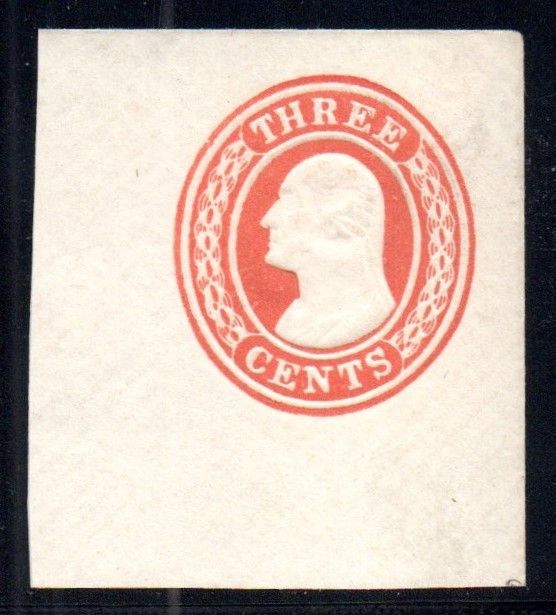 Next is U10 used with the Pacific Express Company printed indicia added to the envelope: 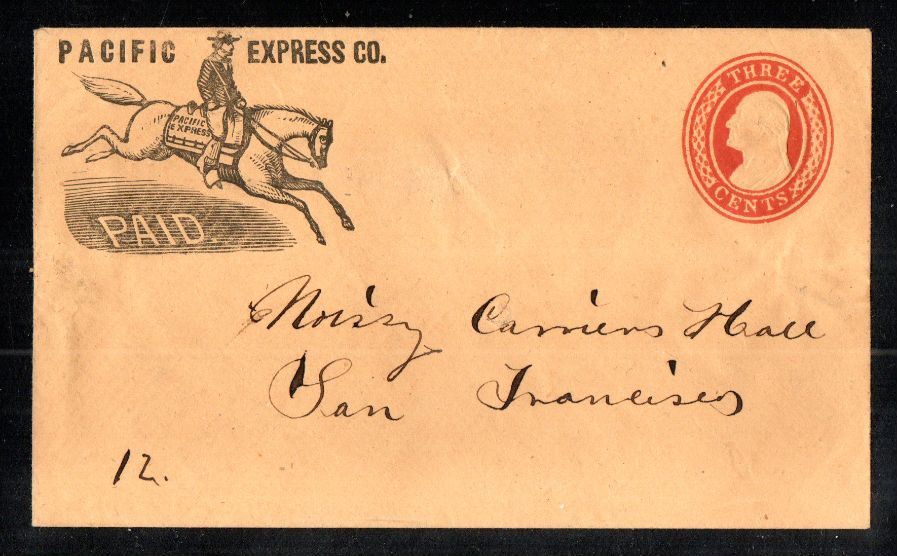 The size of the next example, a U16, basically shows the right side of the envelope: 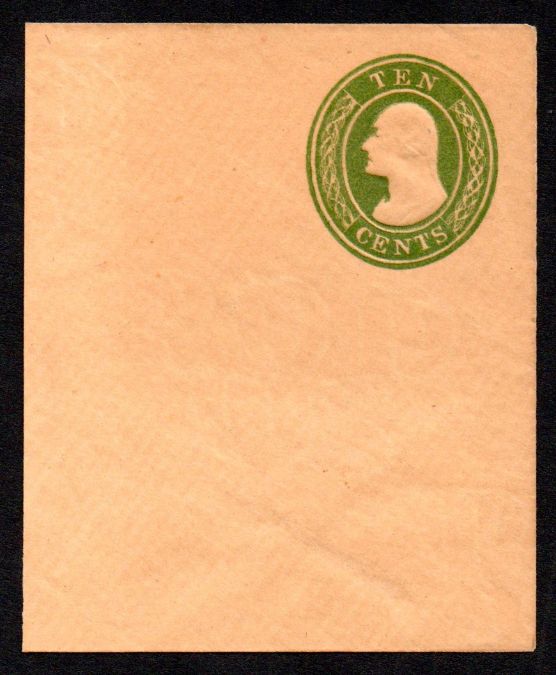 The next item is U43: 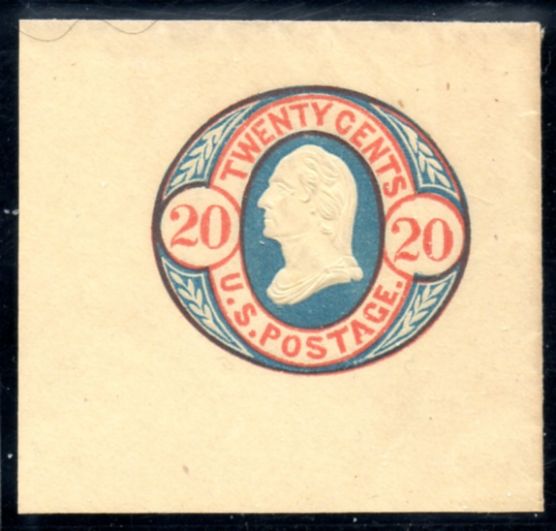 A different series, later on, gives us U72: 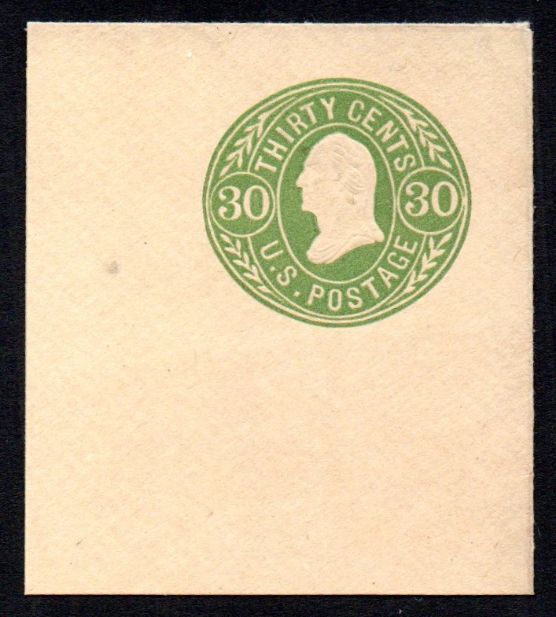 I'm going to cut it off with this last entry, as I think you have the idea about full corner cut squares. This last item is U99: 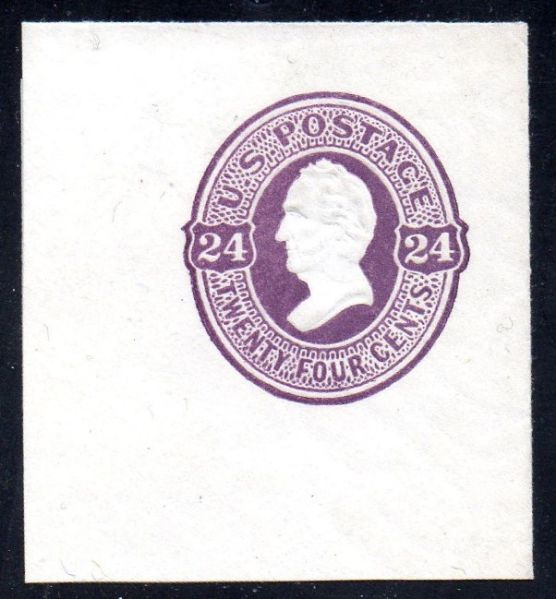 All of these would grade at the top of the grading chart. They are clear, clean and very attractive. At least I think so. Quote:
Cut squares are generally regarded as un-collectable. Peter is right, for postal stationery outside of the United States collecting community. For some reason, U.S. collectors began with cut squares and it is still very acceptable. I know I run into pretty stiff bidding on some of the material I still need, so it is definitely still a viable market here. Hope this helps. |
|
Send note to Staff
|
|
|
Pillar Of The Community
United States
1179 Posts |
|
|
I disagree with PeterT4522's statement as it applies to MINT, US Postal Stationary, without indicia or corner card. The one problem when creating a "Cut Square" is (in most cases) you lose the watermark, an important element of the printing.
The trend towards cut squares, by U.S. collectors, has been the problem of a wide variety of early issues and the difficulty mounting each variety: size, width, die cut, watermark date & type, paper color, etc., of each issue in an album and their being no album available, other than Scott's Speciality Cut Square Album.
The cut square is perfect for the average collector who does not wish to specialize. I think it's the best way to start collecting and understanding U.S. Postal Stationary. Then if you want to specialize, it is easier to progress to entire mint or used varieties.
Hal
|
|
Send note to Staff
|
|
|
Pillar Of The Community
Netherlands
800 Posts |
|
|
My opinion:
I first have to state that I do not like cut squares. And I am also European(Dutch)
If early postage albums(late 19th, early 20th century) would not have had sections to put cut squares in, we would probably not have had this problem.
But here we are.
The only use is, for collecting different dies, rare postmarks. etc.
I can understand that the US cut square collecting situation seems to be different to the European one. Cut squares are not highly regarded. A lot of it gets thrown away.
Appreciation to Scott for producing a catalogue and collecting album. But it feels like catering to an early collecting mistake from the early days of stamp collecting.
I do not want to take anything away from cut square collectors. It is their collection and I hope they enjoy their passion and all the good work they put into it.
But it does not matter how much explanation or text you throw against it, it is still an incomplete object.
As indicated in the first sentence: this is my opinion. Nothing more nothing less.
kind regards,
Johan. |
|
Send note to Staff
|
|
|
Pillar Of The Community
United States
4516 Posts |
|
|
The use of the word "uncollectible" is improper. Anything can be collected. Whether it is popular or not is a different statement. |
|
Send note to Staff
|
Al |
|
|
Pillar Of The Community
United States
607 Posts |
|
|
There is no hard and fast rule as to the proper size of a cut square. Cut-to-shape, cut into the stamp impression, and cut to the stamp impression are less desirable but were all popular at various times. 40 X 40 mm is a nice size to fit the spaces in the Scott albums. Like all other stamp collecting situations, it is the collector's choice. |
|
Send note to Staff
|
Bill Lehr
US Postal Stationery Specialist |
|
|
Pillar Of The Community
United States
8956 Posts |
|
|
Brent, everybody that jumped me on the "un-collectible" is correct, and I stand corrected. I did mean unpopular instead
Peter |
|
Send note to Staff
|
|
|
Pillar Of The Community
923 Posts |
|
|
In Canada, the Bible of postal stationery Webb's does not even list cut-squares - nor does Unitrade catalogue. |
|
Send note to Staff
|
|
|
Pillar Of The Community

United States
5471 Posts |
|
|
Valued Member
United States
333 Posts |
|
|
I can see the argument in favor of entire envelopes, rather than cut squares, but I don't agree. Where does one keep entire envelopes? Are used stamps, minus the envelope, not worth collecting?.Perhaps to big fans of postal history, yes. To most of us, no. So I will happily continue with cut squares.
Don |
|
Send note to Staff
|
|
|
Pillar Of The Community
United States
6469 Posts |
|
|
I don't think that anyone is saying (or I HOPE no one is saying) that one shouldn't collect cut squares. Just recognize that there may not currently be a ready market for them. As far as it being a U.S.-only collecting idiosyncrasy, it may be now, but actually the practice of collecting cut squares originated in Europe. I have album pages for world cut squares, published by Schaubeck ca. 1901: https://www.ebay.com/itm/253693485832 |
|
Send note to Staff
|
|
|
|
Replies: 18 / Views: 5,630 |
|



 Posted 06/16/2018 4:43 pm





