| Author |
 Replies: 17 / Views: 4,479 Replies: 17 / Views: 4,479 |
|
Pillar Of The Community
1375 Posts |
|
|
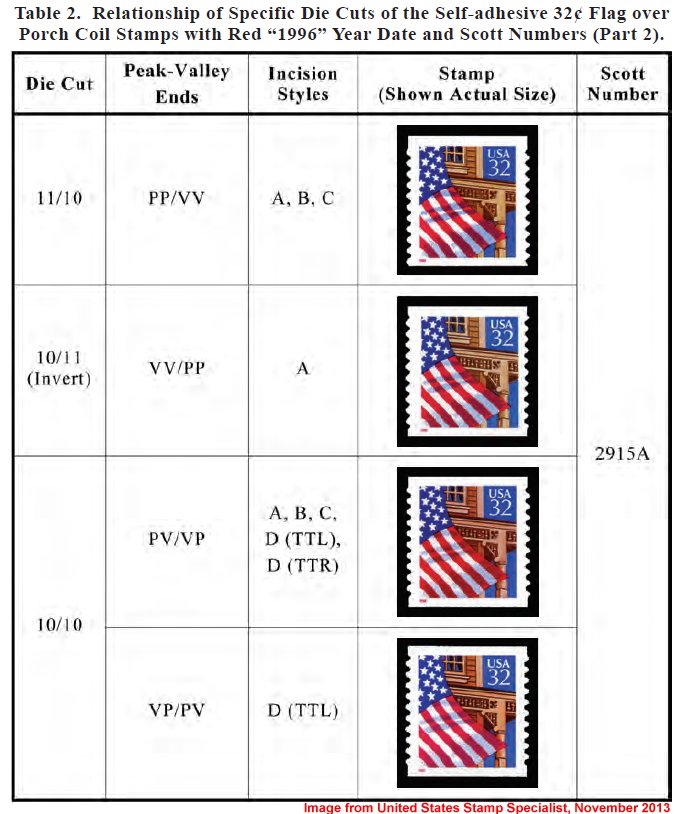
Hello, I read a bit about the die cut stamps and how to gauge their "perforation". Also, there are differences in the number of peaks and valleys. There are different approaches to name the result of the counting. Sometimes I find no information added, sometimes I find "P" only or "V" only, and sometimes I find things like "PP" and even PV/VP. It seems it's not standardized yet. But I understood what those codes are meaning, but I don't get how to count actually. That's why I chose an example here, which I found in the article "Die Cut Production Varieties of the 32¢ Flag over Porch Self-Adhesive Stamp" by R. Nazar. He writes that this stamps here is a "11/12". I would read this like there is no difference in the beginning and ending about P or V, so it's either peak or valley in both cases. Probably other people would call this "V/P" or "VP" or "VV/PP". Indeed it's left side V and right side P, but I count other numbers. I count 12 valleys at the left side and 12 peaks at the right side, which would make it a "12/12" or "12V/12P" or "12VV/12PP" :). So do we always count only the peaks? Or why is this stamp a 11/12?  |
|
Send note to Staff
|
|
|
|
|
Pillar Of The Community
1375 Posts |
|
|
I just found this site, and it seems indeed that you only count the peaks.. https://adminware.ca/fop/flag_term.htmso is this always the case? I thought at the beginning that for example "12VV/12PP" would mean that you count the V at the left side, but this seems to be wrong. |
Send note to Staff 
|
|
|
Pillar Of The Community
United States
1497 Posts |
|
|
The "11/12" refers to the number of peaks on each side. Eleven on the left; 12 on the right. One could also describe the configuration as "VV/PP"--the left side starts with a valley at the top and ends with a valley at the bottom; the right side starts with a peak at the top and ends with a peak at the bottom.
Hope this helps.
Robert |
|
Send note to Staff
|
|
|
Pillar Of The Community
United States
1497 Posts |
|
|
I agree that there doesn't seem to be consistency within the hobby with respect to die cut gauging.
Robert |
|
Send note to Staff
|
|
|
Pillar Of The Community
United States
8956 Posts |
|
|
Robert, hat you are stating above is standard procedure with the Plate Number Coil Collectors Club ( PNC3 )
Peter |
|
Send note to Staff
|
|
|
Pillar Of The Community
1375 Posts |
|
|
thank you. I was really only looking at the "V" in those codes and it was somehow clear to me to count the valleys then :). But if I think about it this was really a flag-over-porch-beginner question.
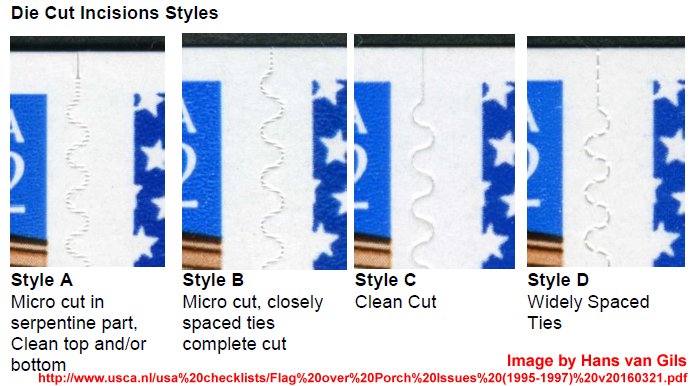
I also know the PDF checklists (or better "catalogs") by Hans v. Gils for these stamps, and I try to understand all and sort my stamps... what do you think, which parts, which defining characteristics will one day get into Scott specialized? I think the number of peaks and valleys and their exact distribution at the sides should be there (in detail). But what about the incision style and the look of the corners (divots)? Do you think about this as something that will be in Scott one day? And are there plans? |
|
Send note to Staff
|
|
|
Pillar Of The Community
United States
1497 Posts |
|
|
Quote:
standard procedure with the Plate Number Coil Collectors Club ( PNC3 ) That's good. Quote:
which defining characteristics will one day get into Scott specialized? I'm not sure how they will go about that, if ever. The die cut differences with the Flag Over Porch stamp have been known for years. The Scott Specialized catalog does note them to some extent. I actively search out die cut varieties--all ignored by Scott. For example, the 2012 Holy Family booklet stamp. The die cuts on the front of the booklet form a swastika-like arrangement; the die cuts on the rear form a mirror image of the front die cuts. 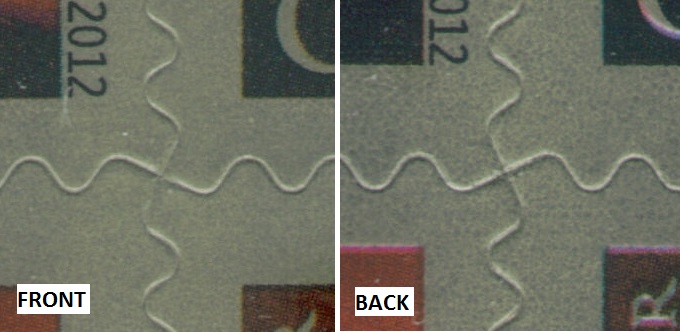 In my inventory I describe these stamps as "VP (top)" and "PV (top)", respectively. I'm not going to hold my breath waiting for Scott to recognize these varieties any time soon. Robert |
|
Send note to Staff
|
|
|
Pillar Of The Community
1375 Posts |
|
|
I have another example so that I understand the counting and naming... this stamp has "VP" at the left and "VV" and the right side, peaks are 10 each side. So would you name this "10/10 (VP/VV)" ? or do we have any peak or valley at the top left? 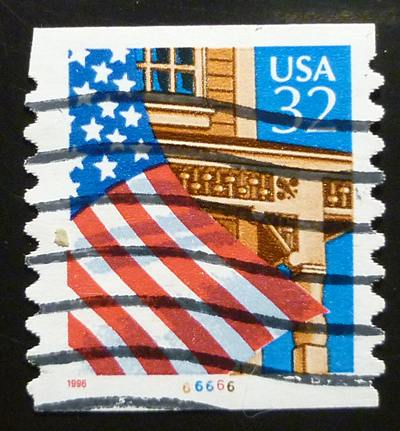 |
|
Send note to Staff
|
|
|
Pillar Of The Community
United States
1497 Posts |
|
|
Quote:
So would you name this "10/10 (VP/VV)" ? Sounds right to me, assuming the damage to the upper left didn't slice off a peak. I believe the Flag Over Porch stamps have two arrangements of "10/10" so the peak-valley reference is necessary to differentiate the two. Robert |
|
Send note to Staff
|
|
|
Pillar Of The Community
1375 Posts |
|
|
I only find the following information in Nazar's article:
10/10 (PV/VP) and 10/10 (VP/PV)
So my stamps seems to have a peak missing at the top left and was once a 11/10 (PP/VV). Gils calls this 11/10 (PP) as it seems). Are the vertical cut lines at top and bottom always exactly vertical for all flag over porch stamps (coil)? |
|
Send note to Staff
|
| Edited by stamperix - 06/18/2018 4:26 pm |
|
|
Pillar Of The Community
United States
1497 Posts |
|
|
Quote:
Are the vertical cut lines at top and bottom always exactly vertical for all flag over porch stamps (coil)? No, I don't think so, but I can't provide an example at the present time. |
|
Send note to Staff
|
|
|
Pillar Of The Community
United States
8956 Posts |
|
|
No, they are not. It depends on the printer. Also, a lot of these wind up getting mis-cut by just a little which results in all sorts of varieties, among those cobra die cut, bell die cut etc etc. Futhermore, the Flag Over Porch ( FOP ) stamp has more basic varieties than any other stamp that I can recall,
Peter |
|
Send note to Staff
|
|
|
Pillar Of The Community
United States
624 Posts |
|
|
Pillar Of The Community
United States
4168 Posts |
|
|
the numbers refer to the peak counts along the left/right sides, The 2915A comes 10/10, 11/10 or rarely 10/11 (also frequently written as 10x10, 11x10 and 10x11 - don't shoot the messenger).
For the 2915C it is 11/12, 12/12 or rarely 12/11.
The P (peak) and V (valley) letters refer to the first and last feature on a side (not counting the short vertical part). However, in most cases the letters are not necessary for identification as all but one of the left/right peak counts only come in one version. For instance the 11/10 is always a PP/VV. The only exception is the 10/10 which can come VP/PV or PV/VP/ Further more, writing the second half of this letter combo is really redundant as the right side is always opposite of the left side on these - a VP on the left is always a PV on the right (that is because the cuts separate the stamps and the left side of one stamp is the right side of the next stamp - this is not necessarily the case for the large roll coils that have spaces between the stamps which are cut cookie cutter style).
Will they one day be listed in Scott? Possibly.
Will the incision styles be listed in Scott? Highly unlikely. |
|
Send note to Staff
|
|
|
Pillar Of The Community
1375 Posts |
|
|
thank you all. I think I understood the counting and can continue looking at the stamps I have to sort them. Concerning the stamp I showed above I would say now that a peak has been cut away because this combination is not known like this. Actually I think that some extraordinary P-V combinations could be made this way by scissor so that the specialists probably only accept stamps as genuine that have clear vertical cuts at the top and bottom which are so much in the position into the design direction that it's visible if there is a peak or valley hidden (sorry, quite difficult to describe in words). So I will keep it as an oddity and continue counting... I like this stamp being not so easy like the other modern stamps.
edit: If I think a bit longer about it I would like to know though: how do you decide whether such a vertical cut (what is its correct term?) is genuine or not? I see quite often stamp with a vertical line long enough to have cut away a peak. Is there a hint like for checking the straight edges of the classic coil stamps or is it really much more difficult because some incision styles can be copied quite good with a scissor?
Or is there a distance range where you would say that the vertical cut is too long in mm? |
|
Send note to Staff
|
| Edited by stamperix - 06/19/2018 04:52 am |
|
|
Pillar Of The Community
United States
4168 Posts |
|
|
easy - the cuts separate the stamps and the left side of one stamp is the right side of the next stamp (the stamps interlock), so if you have a valley at the top right, but no peak directly opposite of it on the left, the peak has been cut off the left. |
|
Send note to Staff
|
|
|
Replies: 17 / Views: 4,479 |
|



 Posted 06/18/2018 3:07 pm