| Author |
 Replies: 28 / Views: 4,625 Replies: 28 / Views: 4,625 |
|
Valued Member
United States
139 Posts |
|
|
|
|
Moderator
1589 Posts |
|
|
It's listed, but with a dash for the value. I would take that to mean the same value as the large hole variety: $1.00. |
Send note to Staff 
|
|
|
Valued Member
United States
139 Posts |
|
|
Pillar Of The Community
1375 Posts |
|
|
I never saw one, so think it's more valuable. Is this a stamp that everybody with a big collection owns? I doubt it. So the dash does not tell you any value. |
|
Send note to Staff
|
|
|
Rest in Peace
United States
1189 Posts |
|
|
The dash in the Scott catalog indicates an item which is rarely traded or sold, so the editors are unable to assign a value to it.
That being the case, I would hazard a guess that your item might be worth more than the $1.00 listed for a normal pair. |
|
Send note to Staff
|
|
|
Pillar Of The Community
United States
4192 Posts |
|
|
"I would take that to mean the same value as the large hole variety: $1.00."
It is better than that. |
|
Send note to Staff
|
|
|
Moderator
1589 Posts |
|
|
Pillar Of The Community
United States
628 Posts |
|
|
Pillar Of The Community
1375 Posts |
|
|
Yes indeed a picture would be very nice. It also would be interesting to know who ever owned or owns such a 842. I searched a bit and indeed found one here: https://srailstamps.com/scott-842-v...il-1939.htmlI wonder why this is not getting sold for 65 USD while the value of the small holes in the liberty series is much higher? (like the Scott 1056) --- somehow some holes in this example above don't look too small to me but more large. I know this is a good seller, also member here, so I know it's genuine, but still from other "small hole stamps" I saw those had kind of more obvious small holes. Again here would a picture of DrGG be good for comparison. |
|
Send note to Staff
|
| Edited by stamperix - 06/21/2018 04:31 am |
|
|
Moderator

United States
12330 Posts |
|
|
Here is Ken's small hole stamp with normal #842 perfs overlaid for comparison. 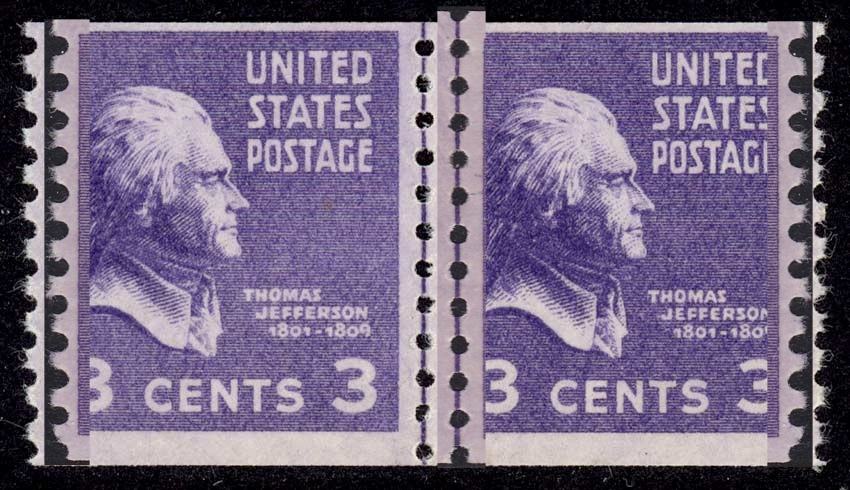 Don |
|
Send note to Staff
|
|
|
Pillar Of The Community
1375 Posts |
|
|
thank you, Don, indeed your picture shows also quite well that the holes are not equally large or small, and some of them are just as large as the large holes you show.
From other small hole stamps in the liberty issue I know that the small holes are really all small. Maybe this is a difference between the 842 and for example the 1056. Again, a picture from DrGG would be good. |
|
Send note to Staff
|
|
|
Pillar Of The Community
United States
670 Posts |
|
|
small or not, one seller has a bunch of 842s small holes listed on hipstamp. It's really hard for me to see it unless they are side by side.
I have a 2002 specialist and don't see the small hole variety. What's the story behind the slightly smaller perf pins? |
|
Send note to Staff
|
|
|
Pillar Of The Community
1375 Posts |
|
|
Hello, here is some more information: http://www.shaulisstamps.com/tips/L...mallHole.htmand here another discussion from SCF about it: https://goscf.com/t/23928Also, I show here the 1056 small holes (from Siegel) and large holes from the other SCF thread. As you can see there is a difference you can even see without measuring. As written in the first link, there seems to be differences between the stamps concerning the size of the small holes, which should be reflected by the value. If there are different differences, I wonder if the template given on the US Multigauge has any sense, of course. As long as there is no certified 842 with small holes or one sold at an auction house like Siegel, we can only guess how the small holes really look like. Or if the one at srailstamps is a genuine example, then the 842 does not show the obvious small holes as the 1056 and has much less value because of that. This would certainly an interesting area of research and exhibit for a collector to show all known large and small hole stamps of the liberty series and the 842. Then we would know more. It would be great to see some small holes examples here in this SCF topic, if any member has some to show. 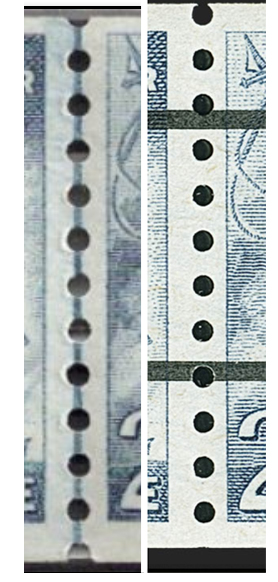 |
|
Send note to Staff
|
|
|
Pillar Of The Community
United States
1414 Posts |
|
|
At least one certified strip exists. I am not sure what criteria was used when small hole variety listings for the other Prexie coils were added to the Scott Catalog. Scott 842 was added a few years ago after an APS certificate was issued. A small hole listing for Scott 496 as 496a was also added. The criteria for those listings was like that used in to separate large and small hole Liberty series coil perforations.
However, terms "large hole" and "small hole" may not be adequate to describe Stickney Press coil holes. Initial specifications called for pins about 0.046" in diameter. "Extra-large" holes from these pins can be found in early vertical coils like Scott 449 and 450. Then the pin size must have been reduced to about 0.043", now termed "large" as noted above. This was the standard hole size until new perforators with smaller pins (small holes) associated with the Cottrell Press replaced the older perforators. But, the question of how did small hole Stickney press products occur?
The move from extra-large to large holes possibly occurred because vertical coils were too fragile. The appearance of small holes the 5¢ 496 and later Prexie and wet printing Liberty series stamps could have occurred if pins meant for sheet stamps were used in the coil perforator. After successful introduction of rotary press coils, larger presses were built to produce sheet stamps. Horizontal rows were perforated like coils with a bar perforator. Initially perf 10 was chosen and the pins would have been the same size as perf 10 coil pins. Later, horizontal row pin size was reduced to an intermediate hole size of 0.040". I haven't found sheet stamps with the small hole 0.037" hole size, but they may exist.
While small hole size should be about 0.037" on Stickney and Cottrell products, some expertizers may be accepting a hole size of 0.040" as a small hole instead of an "intermediate" hole size. At this point, I can only speculate about use of pins intended for sheet stamp production in coil perforators. Some evidence suggests that this may be the explanation for small and intermediate holes on coils from the Stickney rotary press.
|
|
Send note to Staff
|
| Edited by cfrphoto - 06/22/2018 09:48 am |
|
|
Pillar Of The Community
United States
1414 Posts |
|
|
Quote:
small or not, one seller has a bunch of 842s small holes listed on hipstamp. Clueless seller. Suggest reporting seller to HipStamp. Small hole wet printing stamps should not be sold without a certificate. |
|
Send note to Staff
|
|
|
Pillar Of The Community
1375 Posts |
|
|
Thank you for the explanation. I didn't look at the APEX archive before, and indeed there are five certificates of 842 with small holes. They look quite similar to the srailstamp pair, and they also have different hole sizes in itself. So I guess for the 842 there is less market as the "small holes" just don't look "so good" as in the liberty issue. Anyway I would like to have such a 842 in my collection and see more value than 1 USD. Two questions I would have here still: - when was Stickney and Cottrell used in the range of stamps mentioned? (496, 842, liberty) - or do we talk about "small holes" for all those stamps when it's 0.040" or smaller? - in my Scott specialized 2013 only the 842 has a "small holes entry", no other prexie coil, is there more information in recent Scott? --- I just found this topic which answers my questions quite good: https://goscf.com/t/41100only the Scott catalogue: are the small holes mentioned for all prexies now? |
|
Send note to Staff
|
| Edited by stamperix - 06/22/2018 3:08 pm |
|
|
Replies: 28 / Views: 4,625 |
|



 Posted 06/20/2018 2:36 pm


