|
This page may contain links that result in small commissions to keep this free site up and running.

Welcome Guest! Registering and/or logging in will remove the anchor (bottom) ads. It's Free!
To participate in the forum you must log in or register.
| Author |
 Replies: 42 / Views: 5,752 Replies: 42 / Views: 5,752 |
|
Pillar Of The Community
United States
568 Posts |
|
|
Regarding two covers sent by Senator/Major General Ambrose E. Burnside to my great, great grandfather Levi L. Burdon Some of you may remember that during the "Hunt thread" essayk started a conversation regarding one cover I posted being dated February 3rd, 1879. The cover that I had posted was in the mail stream on "the big day". This was the first time I had heard of Continental Paper or the contracts for printing these stamps. Apparently the contracts changed printers on that next day. essayk stated "The cover is dated to February 3, 1879, which is a day before the merger that created the American Bank Note Co to Consolidated. It bears back stamps for Feb 4, 1879 so it was in the mail stream on the big day. It is likely this stamp is on soft paper, and if so it would be a verifiable example of Continental Soft Paper". He did notice that I also had posted a second cover from the same correspondence postmarked three weeks later. February 28th, 1879. When I asked essayk if they appeared to be on the same paper this is what he posted back. "The two stamps appear to be on the same paper, and given the brief interval I would not be surprised that they came from the same sheet. However, as a technical point, the Continental Bank Note Co. ceased to exist as an independent entity as of the date of the merger. The same location, presses, paper stock, and personnel were still being used to fulfill the postage stamp contract, but now under the name of the American Bank Note Co. So the philatelic conventionsl wisdom is to follow the corporate naming of the stamp producers according to the merger date. If it could be established that both stamps are in fact from the same sheet, it would present an interesting case study." I am not a specialist, however I was persistant in my thoughts that these two stamps came from the same sheet. When I first called the PF to speak of this situation, they stated that it would be an unlikely thought to persue. I did send the two covers in to them with a full page of requests as to what I hoped to achieve. They were sent back to me several months later and certed as both being Scott # 184's. No mention of being var's ot the type of paper or printer. The second time I recieved them back, the first was ID'd as a 184var, the second just a 184, but still no metion of paper or printer. The third time I sent them back, after having several interesting phone conversations, where I was told of a number of specialists involved in the study, the following certilicates were issued. I do know that Mr. James E. Kloetzel, a previous editor of Scotts Catalog was involved in the final decision. Both stamps on covers have been ID'd as 158var's and have stated that they are both "late continental soft paper printing". I was told that this was a first and that if the later cover was not so close in proximity to the earlier cover, and not from the same correspondence, this would not have been possible.  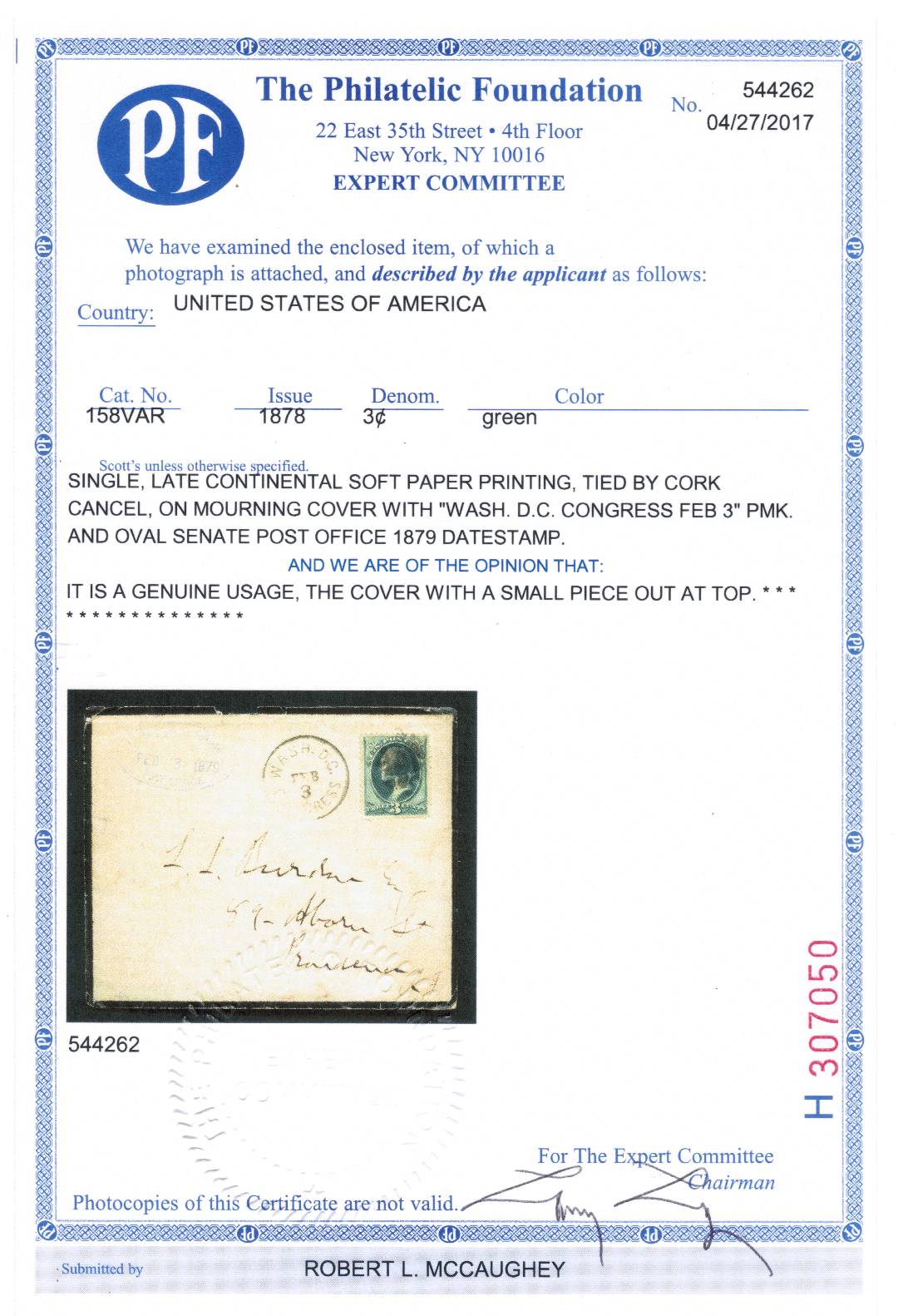 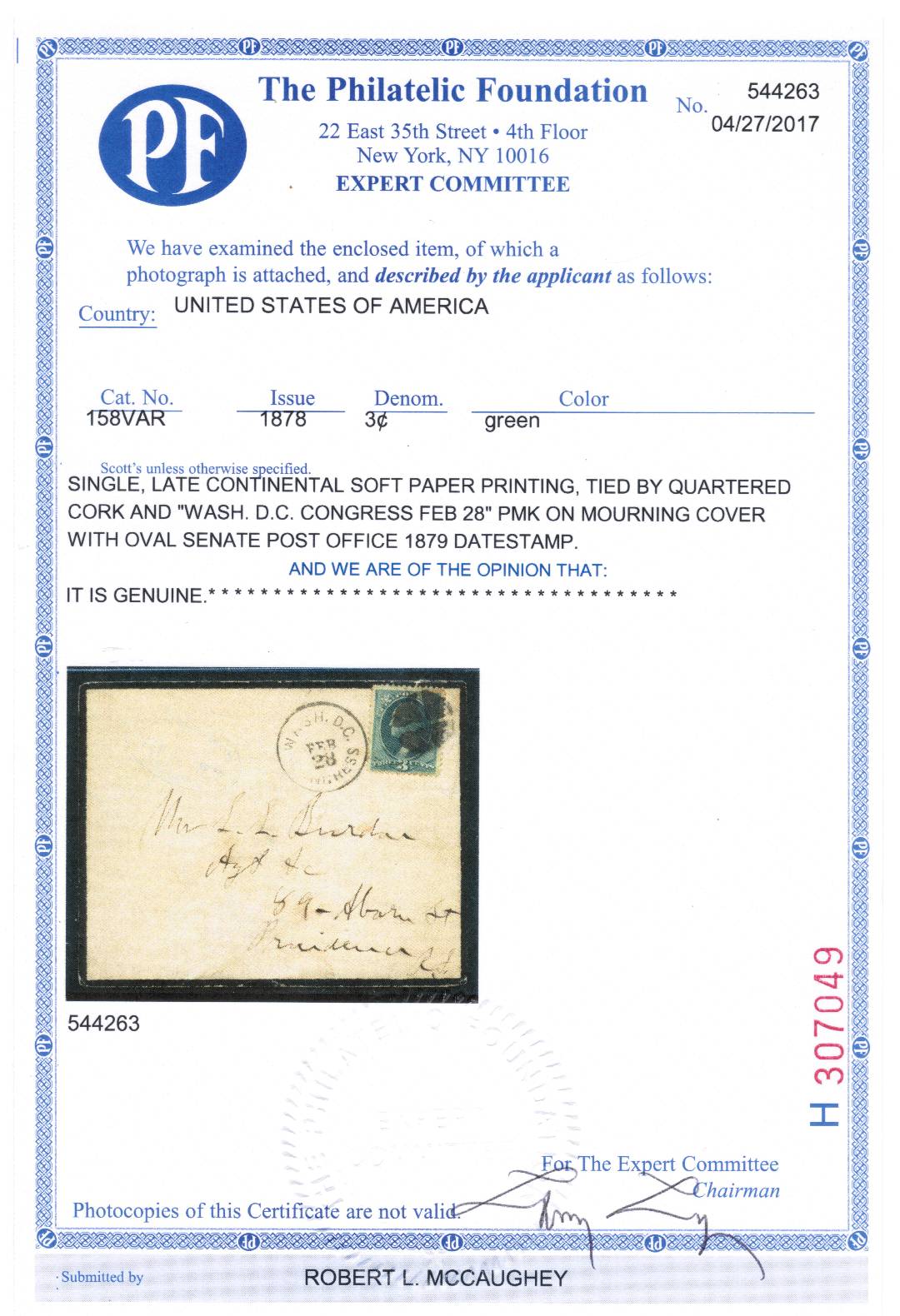 |
|
Send note to Staff
|
| Edited by rlmstamps2012 - 06/22/2018 9:35 pm |
|
|
|
|
Valued Member
United States
283 Posts |
|
|
Pillar Of The Community
United States
1946 Posts |
|
|
Glad you followed up on this, Bob. Looks like we called it, but it took your persistence to make it so. My hat is off to you!
Now you will need to keep those two covers with their certs and together for as long as possible. |
Send note to Staff 
|
|
|
Pillar Of The Community
1375 Posts |
|
|
thank you very much, Bob, for this interesting topic. It's great to see those two covers and stamps, and nice especially that it came out of your own family. I am not a specialist either, so may I ask: The usage of Continental stamps was not "forbidden" after the merger in February 1879, so normally there should be some Continental stamps on covers with late dates even after February. I guess it's just so rare that they don't usually appear, but why should it be so hard and involve so many trials and phonecalls and people involved to get a certificate then?
I know about the conventional things because of the categories of Continental and American stamps which are based on dates in Scott (and so at the PF), but if there is a cover with a date, then it should be easy.
---
sorry... I first read that both stamps were used after the merger, but now I see that the first one was before, so then I understand the issue better. After all it is interesting though that the PF changed their opinion from certificate to certificate and why. Normally from the Scott definition how I understand it, it's clear that the stamps before the merger were Continental, so that should have been an easy certificate?
essayk: is there any chance for a stamp being on cover to see if it's Continental soft or intermediate paper? If I understand Barwis correctly, then the intermediate paper should be more grayish than the yellowish soft paper and the impression better, less mottled or blurred. |
|
Send note to Staff
|
| Edited by stamperix - 06/26/2018 03:53 am |
|
|
Pillar Of The Community
United States
2555 Posts |
|
|
The Feb 3 cover should have been certed as a #158 the first time around. The second cover should have never been certed as a #158. Would love to hear the PF defense for that certificate... |
|
Send note to Staff
|
|
|
Pillar Of The Community
United States
1946 Posts |
|
|
Quote:
is there any chance for a stamp being on cover to see if it's Continental soft or intermediate paper? With present knowledge and technology, normally the only way to spot Intermediate paper is by the date of use before Feb. 4, 1879. The same machinery, printing rooms, paper stock, and even personnel that were working for Continental on February 3, 1879, were working for American by the end of the next day. There was no physical change of anything from the one day to the next. Changes did develop, but not just overnight. In this particular case, if all we had was the second cover, this determination by the PF about that stamp would not have been possible. Hence the question by Winston: Quote:
The second cover should have never been certed as a #158. Would love to hear the PF defense for that certificate... At first the PF didn't want to render this opinion. But as Robert pointed out, Quote:
I was told that this was a first and that if the later cover was not so close in proximity to the earlier cover, and not from the same correspondence, this would not have been possible. The reason the PF finally took this step was because their team of experts became convinced that the stamp on the later/second cover came from the same sheet of stamps that was the source for the stamp on the earlier/first cover. The evidence for that is as follows: 1. The time lag between the two is 25 days, on either side of Feb. 4, 1879. 2. Both covers originated in the office of the same party, a senator writing to the same constituent. They both have dated Senate Post Office markings corresponding to the dated marks of the Washington P.O. also present. 3. Both letters are in the same hand, which compares favorably with the handwriting of the senator himself. 4. They were addressed by his hand from his personal correspondence and do not seem to have been handled by staff. So the preparation of the envelopes would have been from materials in his private office stock. Conceivably the senator had a block of these stamps of unknown size for his personal use, but that is not certain. 5. The physical characteristics of the two stamps, even under close examination, are identical in every respect. None of these points alone is conclusive, but when all are taken together it becomes evidence for a situation in which a stamp from a sheet printed prior to Feb 4, 1879 was used just before that date and another was used a couple of weeks after that date. This, I believe, is as close as we will get to a verifiable usage of a Continental soft paper stamp after American had become the producer. |
|
Send note to Staff
|
|
|
Pillar Of The Community
1375 Posts |
|
|
Thank you, essayk, for this interesting information. Again something to learn.
About the intermediate paper: Sorry, I should have been more clear. The stamps on the covers of this thread are on late Continental soft paper (Barwis: 0.0030 inch, yellowish). We only can make the difference with the date, as you said. Just in an associative chain I wanted to think about the intermediate paper additionally (Barwis: 0.0028 inch, grayish). It was in use until end 1878, before the Continental soft paper was introduced. I know that the stamps above are not on intermediate paper, but as it seems impossible to define the soft paper Continental vs. American (and on cover), I wondered if it would have been possible with intermediate paper. So are the differences in paper color and impression quality something we can use to differentiate the Continental intermediate paper from the hard and especially the soft paper, was what I was thinking about. |
|
Send note to Staff
|
|
|
Moderator

United States
12330 Posts |
|
|
A fair amount of 'ifs'...
IF both covers were done by the senator, IF they were not done by a staffer, IF the preparation of the envelopes came from the same source, IF the office had purchased a large block, IF the stamps came from the same block in the drawer, etc.
Just my opinion... the covers offer supporting evidence but are not definitive enough to push this theory into fact.
Don |
|
Send note to Staff
|
|
|
Pillar Of The Community
1375 Posts |
|
|
I had a second look into Barwis' article and other information about his work I found. And I don't get this as a picture together:
- in a table I found he names the 0.028 inch paper from 1878 the "intermediate" paper
- in his 3-Cents-article he names the 0.030 inch paper from 1879 the "transitional" paper
- American used the Continental paper (sizing gelatine) until they made their own paper (sizing rosin/alum). That's why one can't distinguish the paper of late Continental and early American but by dated cover/stamp. So this should be what collectors always named "soft paper" (and Scott as well).
How I understand the intermediate paper is that at first sight it "looks" like hard paper, has a similar effect at the snap test, the perforation is more like soft paper, the UV appearance as well. So the intermediate paper should be possible to distinguish for experts from soft paper. That's why I corrected myself above with saying that the stamps on the covers are not on intermediate paper but late soft paper. But if I follow Barwis in his latest 3c article, the 1879 paper of Continental is the transitional paper though. I think in his article there should have been an explanation about what collectors always have understood as "intermediate" paper and if his "transitional" paper is the same. I think it's not.
Sorry, not easy to write in English all that :). But I think after all that if the stamps on those covers are on transitional paper (not intermediate paper) = late Continental soft paper one could at least do some examination about the sizing agent with near infrared spectroscopy. Then you would know if it's at least not the "real" American soft paper. If this examination will become standard, hopefully the contradiction in Scott aboout Continental and American soft paper and the EKU (=American EKU, but Continental by definition) will be gone. |
|
Send note to Staff
|
|
|
Pillar Of The Community
United States
2555 Posts |
|
|
"At first the PF didn't want to render this opinion. But as Robert pointed out, "I was told that this was a first and that if the later cover was not so close in proximity to the earlier cover, and not from the same correspondence, this would not have been possible."" But apparently they didn't want to certify the first cover either. The first certificate was for a #184 when it clearly had to be regarded as Continental product. Quote:
The reason the PF finally took this step was because their team of experts became convinced that the stamp on the later/second cover came from the same sheet of stamps that was the source for the stamp on the earlier/first cover. The evidence for that is as follows:
1. The time lag between the two is 25 days, on either side of Feb. 4, 1879.
2. Both covers originated in the office of the same party, a senator writing to the same constituent. They both have dated Senate Post Office markings corresponding to the dated marks of the Washington P.O. also present.
3. Both letters are in the same hand, which compares favorably with the handwriting of the senator himself.
4. They were addressed by his hand from his personal correspondence and do not seem to have been handled by staff. So the preparation of the envelopes would have been from materials in his private office stock. Conceivably the senator had a block of these stamps of unknown size for his personal use, but that is not certain.
5. The physical characteristics of the two stamps, even under close examination, are identical in every respect.
None of these points alone is conclusive, but when all are taken together it becomes evidence for a situation in which a stamp from a sheet printed prior to Feb 4, 1879 was used just before that date and another was used a couple of weeks after that date. I plate stamps and focus primarily on the 3c 1857 plates that have not been reconstructed, not even the top rows. None of your five points would ever be used to prove that two stamps came from the same sheet. I even disagree that the stamps look similar, to me they don't, and aren't even similarly off-centered as you might expect with two stamps from the same sheet. |
|
Send note to Staff
|
| Edited by sinclair2010 - 07/02/2018 7:50 pm |
|
|
Pillar Of The Community
United States
3532 Posts |
|
|
I wonder if the Senator made a mass-mailing during the 25 day period.
If so, I would think that could run through a sheet pretty quickly - with some mass form mailing at the 3c rate.
Or of course, if the one mailed on Feb 3rd happened to be one of the last remaining stamps from that sheet.... |
|
Send note to Staff
|
|
|
Pillar Of The Community
United States
568 Posts |
|
|
Both of these covers have matching content on mourning covers. Levi Lyman Burdon and the Senator were in the Civil War together. One letter is signed by the Senator "Faihfully your friend A.E. Burnside."  |
|
Send note to Staff
|
| Edited by rlmstamps2012 - 07/03/2018 08:23 am |
|
|
Bedrock Of The Community
United States
10866 Posts |
|
|
I would not "expect" that two stamps from that era from different parts of the same sheet would have the same centering. I would expect them to look different, sometimes significantly, especially the vertical perfs which tend to wander all over. |
|
Send note to Staff
|
|
|
Pillar Of The Community
United States
1946 Posts |
|
|
Quote:
None of your five points would ever be used to prove that two stamps came from the same sheet. I even disagree that the stamps look similar, to me they don't, and aren't even similarly off-centered as you might expect with two stamps from the same sheet. Apples and oranges. The criteria for how to plate the 1857's were first set down by students from nearly a century ago, in consideration of what could be done with them. But are you actually expecting that criteria for plating of 1857's should carry over to later issues to the exclusion of all other approaches? Case in point, centering within the sheet: my experience with the Banknote issues is as @revcollector has said. In a full pane the perfs tend to wander at angles and typically are not as uniform as you might expect or wish. In looking at blocks from this period some auction houses have taken to specify the grading of individual stamps within the block (to tempt the block breakers). Uniform it was not. One must be willing to consider all kinds of circumstances in questions of this sort. Quote:
I wonder if the Senator made a mass-mailing during the 25 day period. I don't think this mail was handled by the Senator's staff. Everything about it has a personal touch. If that be so, he would have used a stamp supply he had in his personal desk, would he not? That seems to be the spin the PF is putting on this situation. Quote:
...the covers offer supporting evidence but are not definitive enough to push this theory into fact. Yes, this is all very tenuous, hence my comment: "This, I believe, is as close as we will get to a verifiable usage of a Continental soft paper stamp after American had become the producer." To do more will require a situation with fewer ifs. It is a step built on probabilities not solid data. Sometimes that is all we can do. |
|
Send note to Staff
|
| Edited by essayk - 07/03/2018 11:33 am |
|
|
Pillar Of The Community
United States
3532 Posts |
|
|
These covers and stamps are quite interesting, as is the whole discussion.
Perhaps, at this point, I should point out that what the PF offers, are "opinions" and not statements of fact. We should probably keep that in mind. They obviously felt, rightly or wrongly, that there was enough preponderance of evidence here to make them opine as they did.
It is an interesting case. |
|
Send note to Staff
|
|
|
Pillar Of The Community
United States
2555 Posts |
|
|
Quote:
I would not "expect" that two stamps from that era from different parts of the same sheet would have the same centering. You are actually twisting my words. I said you "might expect". This was in response to essayk's exhibit #5: "The physical characteristics of the two stamps, even under close examination, are identical in every respect. I disagree with that and actually think they are markedly dissimilar, including the centering. It is quite reasonable to consider the centering of the stamps in this case. And in this case, the centering of the stamps offers no support for the conclusion that they came from the same pane. In fact, if they were similarly centered, you can bet that would not have gone unnoticed or unmentioned! |
|
Send note to Staff
|
|
|
Replies: 42 / Views: 5,752 |
|
|
To participate in the forum you must log in or register. | |
 Avatar Change Request 2023 Freedem Stamp. Is This Stamp Fake? Transvaal Postal History Help Earliest Stamp With In-Design Date? My First Stamps Help Newbie.help With Stamp Identification (J29) Inherited These Stamps, Are They Genuine? APS Membership Discount Metropex Stamp Show: Roseville, Minnesota October 23-24 Weird Covers, 1885,1886, And 1982 For Users Of Two-Post Blue International Albums What Is Your Experience With Binders. New Member Posting Image Of Avatar, Front And Back Of U2 Cut Square, Market Value Or References? Working On An Offline Collection George Washington 3 Cent 1861 With Print On The Back Hello From The Netherlands - New Member Then And Now, From Old Postcards New Member Wanting To Add An Avatar Sparks Auction Fees? 163 VF Nyfm Vertically Ribbed 163 XF Quartered Cork, Labeled Jumbo 136 VF Quadruple Split H Grill Nashville Philatelic Society-Your Invitation To Our Auction Night Meeting Monday, October 26, 2026 Nashville Philatelic Society-Your Invitation To Our Meeting Monday, October 19, 2026 Christmas Around The World 2026 C.e. In The Large Queen Cancel Avatar Change Request 2023 Freedem Stamp. Is This Stamp Fake? Transvaal Postal History Help Earliest Stamp With In-Design Date? My First Stamps Help Newbie.help With Stamp Identification (J29) Inherited These Stamps, Are They Genuine? APS Membership Discount Metropex Stamp Show: Roseville, Minnesota October 23-24 Weird Covers, 1885,1886, And 1982 For Users Of Two-Post Blue International Albums What Is Your Experience With Binders. New Member Posting Image Of Avatar, Front And Back Of U2 Cut Square, Market Value Or References? Working On An Offline Collection George Washington 3 Cent 1861 With Print On The Back Hello From The Netherlands - New Member Then And Now, From Old Postcards New Member Wanting To Add An Avatar Sparks Auction Fees? 163 VF Nyfm Vertically Ribbed 163 XF Quartered Cork, Labeled Jumbo 136 VF Quadruple Split H Grill Nashville Philatelic Society-Your Invitation To Our Auction Night Meeting Monday, October 26, 2026 Nashville Philatelic Society-Your Invitation To Our Meeting Monday, October 19, 2026 Christmas Around The World 2026 C.e. In The Large Queen Cancel
Disclaimer: While a tremendous amount of effort goes into ensuring the accuracy of the information contained in this site, Stamp Community assumes no liability for errors. Copyright 2005 - 2026 Stamp Community Family - All rights reserved worldwide. Use of any images or content on this website without prior written permission of Stamp Community or the original lender is strictly prohibited.
Privacy Policy / Terms of Use Advertise Here |
| Stamp Community Forum |
© 2007 - 2026 Stamp Community Forums |
| It took 0.25 seconds to lick this stamp. |
 |
|
|
|


 Posted 06/22/2018 9:09 pm


