|
This page may contain links that result in small commissions to keep this free site up and running.

Welcome Guest! Registering and/or logging in will remove the anchor (bottom) ads. It's Free!
To participate in the forum you must log in or register.
| Author |
 Replies: 42 / Views: 5,755 Replies: 42 / Views: 5,755 |
|
|
|
Pillar Of The Community
United States
1946 Posts |
|
|
Quote:
I will say it again, the two stamps are quite dissimilar. RLM should post a nice high res scan of the stamps together, side by side, to show that I am wrong. It seems he would have a strong incentive to do so. Actually, he kind of already did that with 1500 dpi scans, but not in a single image, which I agree would be better. Still... I have cropped and rearranged the pics he posted way back to facilitate the comparison, but these are his pics from when this first came up long ago. The corners showing date of use" 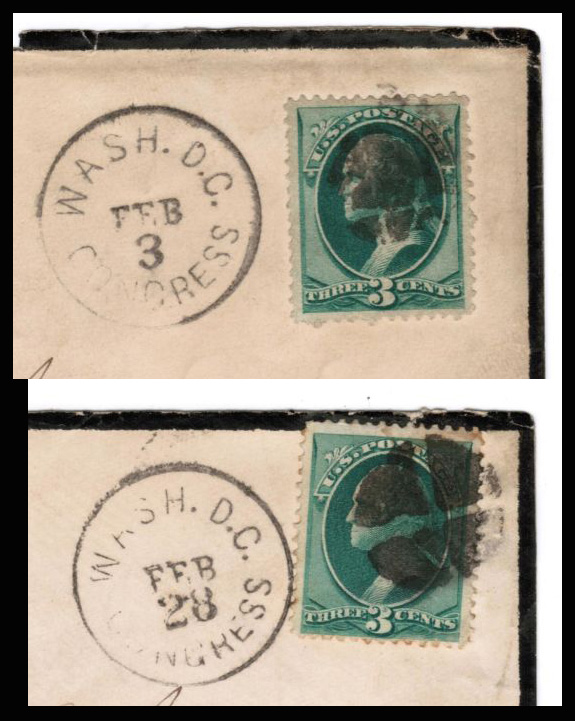 The stamps: 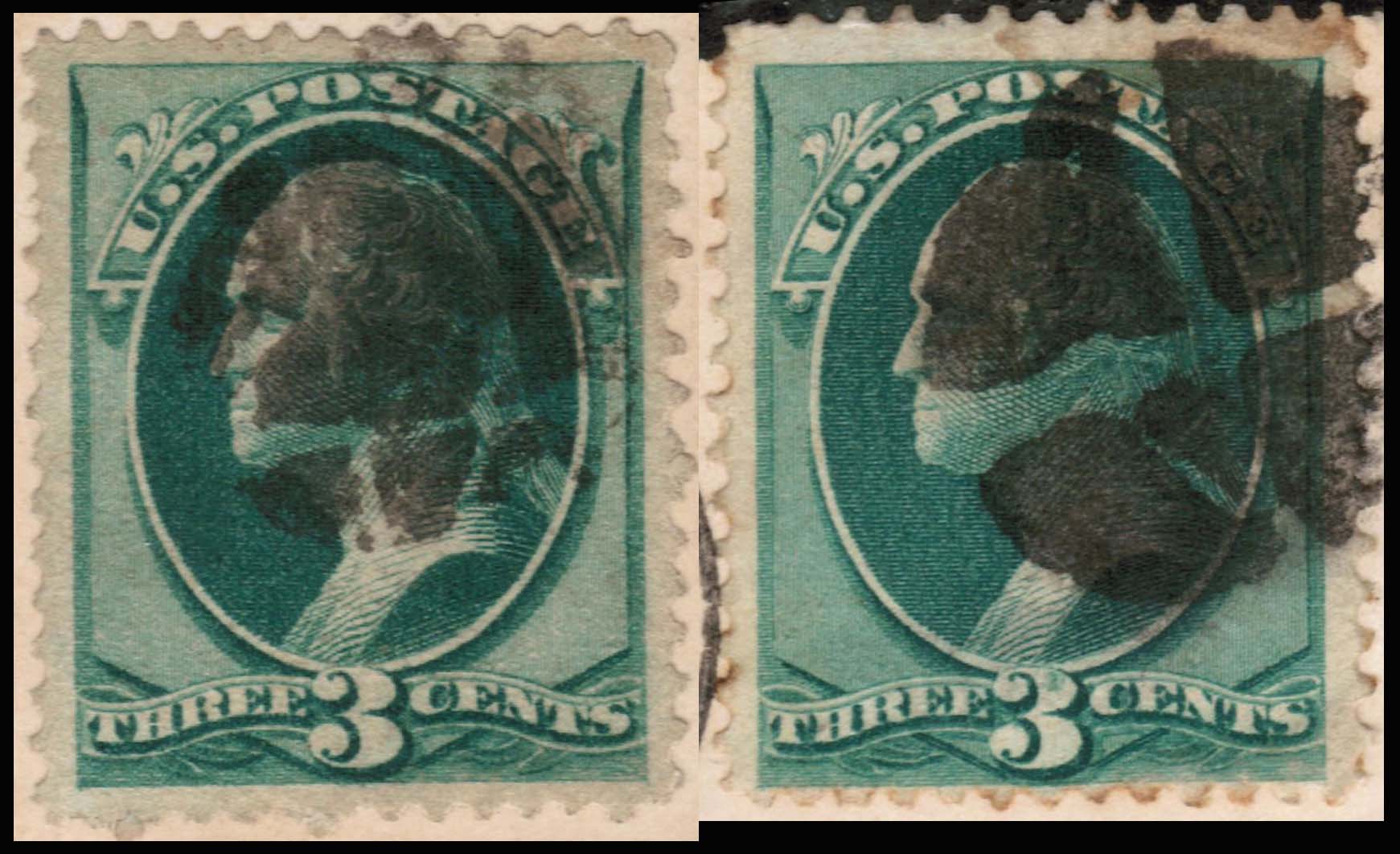 Quote:
We are left with proving that the stamp came from the same sheet. This can only be accomplished by plating or by demonstrating that the two stamps were adjacent to each other on the sheet. Plating is not currently possible and the stamps were clearly not adjacent to each other on a sheet. The problem went unsolved and the certificate should not have been issued. Some stamps and covers can't get the certificates that the owner desires. It is an unfortunate reality. If I take a pair of stamps from a sheet, separate them and apply them separately to an envelope, one on each side perhaps, is there a scientific test or method that can establish that these stamps came from the same sheet? If not, then that level of science cannot always lead us to the truth. In that case, the only proper critique is of the method, not the material. New methods of analysis available today allow us to make comparisons which heretofore were not possible. Machinery now exists which allow us to discriminate and associate paper and ink characterisitcs with enough precision to allow us to associate the elements of a disrupted multiple from a sheet. If that is so, then I think we may be at a point where it is no longer correct to apply the "only" you used in your sentence. Whether or not the PF applied such tests to these two stamps I do not know. Do you? |
Send note to Staff 
|
| Edited by essayk - 07/16/2018 6:06 pm |
|
|
Pillar Of The Community
United States
2555 Posts |
|
|
Quote:
The problem to which I referred was of proving that a soft paper stamp used after Feb. 4 1879 was a Continental soft paper. Can it be done? How? Yes. You would have to be able to positively link the stamp to a pre-merger printing. The opportunity was there with RLM's two covers but it failed for the reasons that I have already given. I strongly disagree that we now have or probably ever will have the technology to confirm that two stamps came from the same sheet by tests such as X-ray fluorescence spectroscopy. All of the technology in the world cannot overcome the following simple but obligatory question: Is it possible to have two stamps from separate printings with effectively identical ink chemistry signatures? The answer has to be yes and it might even be easy to encounter such a condition. Conversely, is it reasonable to expect that the printing inks were always so well mixed that some variation across the sheet would not be encountered? |
|
Send note to Staff
|
|
|
Pillar Of The Community
United States
2555 Posts |
|
|
Quote:
New methods of analysis available today allow us to make comparisons which heretofore were not possible. Machinery now exists which allow us to discriminate and associate paper and ink characterisitcs with enough precision to allow us to associate the elements of a disrupted multiple from a sheet. If that is so, then I think we may be at a point where it is no longer correct to apply the "only" you used in your sentence. I disagree that we have the technology to do what you are suggesting. I think for the PF to do any such advanced testing, it would have required the stamps to be lifted. I don't think that was done. We also have RLM's statement: "I was told that this was a first and that if the later cover was not so close in proximity to the earlier cover, and not from the same correspondence, this would not have been possible." Quote:
Actually, he kind of already did that with 1500 dpi scans, but not in a single image, which I agree would be better. Still... The stamp images are not of the quality of a 1500dpi scan. I am still hoping that RLM will post what I asked for. |
|
Send note to Staff
|
|
|
Pillar Of The Community
United States
4187 Posts |
|
|
"Machinery now exists which allow us to discriminate and associate paper and ink characterisitcs with enough precision to allow us to associate the elements of a disrupted multiple from a sheet:
Not true. |
|
Send note to Staff
|
|
|
Pillar Of The Community
United States
568 Posts |
|
|
Winston, the truth is that the covers are out of town at this time. They are visiting with friends. I can not offer a side by side scan at this time. I was happy and thankful to see that essayk posted my scans from long ago! Stay tuned for the rest of the story.  As always, thank you all for your interest. |
|
Send note to Staff
|
|
|
Pillar Of The Community
United States
568 Posts |
|
|
The two covers will be offered by Robert A. Siegel Auction Galleries, in their United States and CSA Postal History sale # 1191, October 25th, 2018. lot # 2333.  |
|
Send note to Staff
|
|
|
Pillar Of The Community
United States
1162 Posts |
|
|
I don't know at what dpi Seigel's scans their lots, but for all those that want an 'up close and personal' view of these covers, they can do so now. Siegel's has estimated this lot at $400-500. Curiosity: RLM, are you happy and/or surprised by this estimate? I hope you get what you want for these. That being said, I can imagine many scenarios where someone would run out of their current stamp supply, and go out and buy more of the (seemingly, at least to a non-philatelist) same stamp to replenish their supply, sometime over a 3 week period. Especially back in the day when letter writing was probably the easiest way to keep in contact. AND... especially for a person that likely had a lot of friends with which to keep in contact. Until a foolproof test can be made to prove that two stamps are from the same sheet, I would lean towards the requirement of showing that two stamps were at one time adjacent to each other by comparing perfs and tear patterns. Although not in the market to buy, I will be keeping an eye on this lot to see how it performs. |
|
Send note to Staff
|
| Edited by mootermutt987 - 10/13/2018 11:27 pm |
|
|
Valued Member
213 Posts |
|
|
Okay, devil's advocate here. This thread brings up another related question that I hope someone can clear-up for me. When the postal rates changed to 8-cents in 1971 the USPO (U.S. Post Office) issued a new regular postage stamp (SCN 1394 on right). Then, on July 1, 1971 the USPO was disbanded and incorporated into the USPS (U.S. Postal Service). My question is; If I have this 8-cent stamp on cover from July 1, 1971, can I get it certified as first day of USPS issue? Or, is the stamp still considered a USPO issue? I'm confused. How do I tell which stamp is which since the catalog only lists one such item? 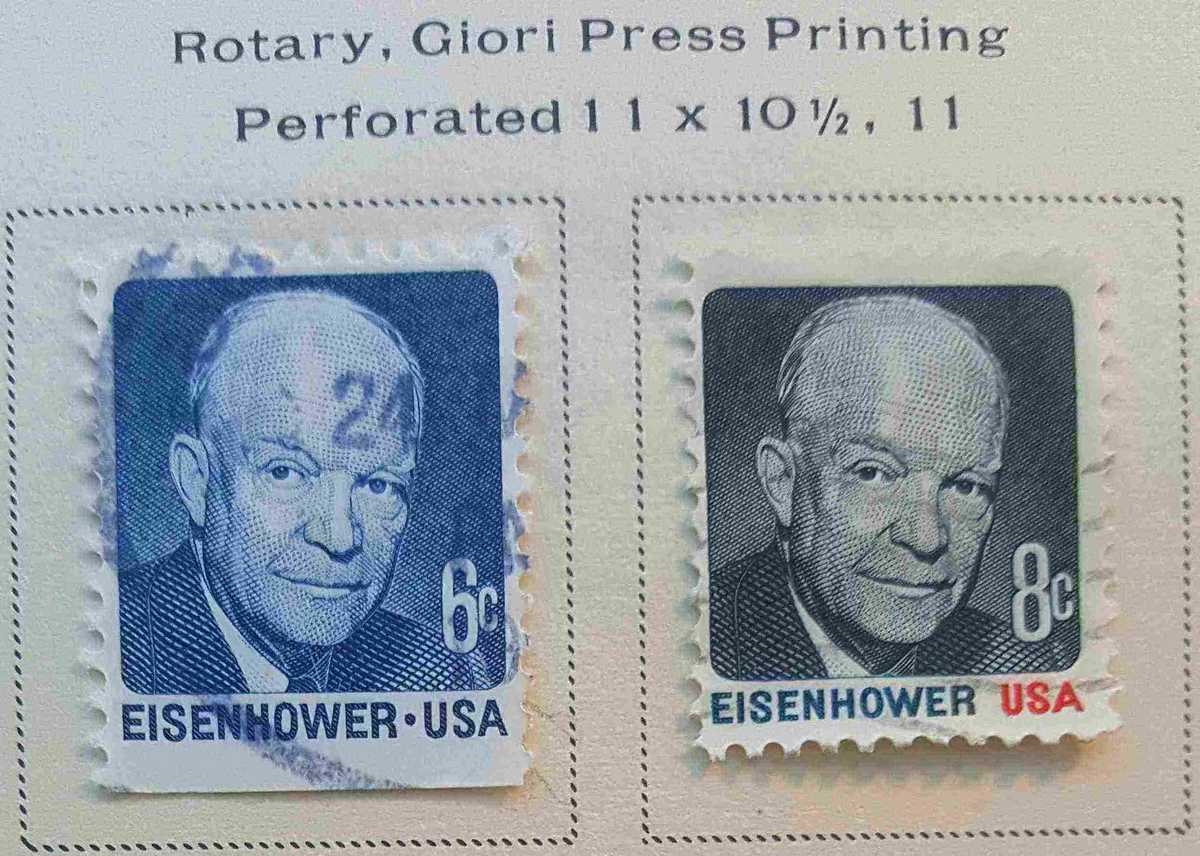 |
|
Send note to Staff
|
|
|
Pillar Of The Community
United States
1874 Posts |
|
|
Scott 1394 was issued May 10, 1971 and therefore only can be "a USPO issue". That said, the legal status of the issuing agency has been insignificant to the catalog editors and collectors. A change in the legal identity of the postal agency doesn't change the stamp. There's only one Eisenhower stamp issued May 10, 1971, and there always will be, so only one catalog listing is needed. Note that this thread on Continental Bank Note issues has focused on printers, not agencies. "First Day of the USPS" covers abound on ebay and are cheap, but feature Scott 1396, not 1394. 1396 was issued July 1, 1971 and is the only stamp that could be "the first USPS issue". I don't think any of the certifying agencies will give you that on a cert, but even if they did, it's not worth the price; Scott 1396 on cover or off is a cheap stamp and always will be because 16 million were printed. Furthermore, Scott 1394 (Eisenhower) used on cover on July 1, 1971 merely would be one of millions of stamps first canceled by USPS on that day; hundreds of other issues were valid and could have been used and canceled that day. So I don't think you have a pot of gold in a cover with 1394 on cover on July 1, 1971. |
|
Send note to Staff
|
| Edited by cjpalermo1964 - 10/14/2018 4:02 pm |
|
|
Valued Member
213 Posts |
|
|
Very good CJ. You are correct. The stamp is determined by the issuing authority at time of release. If the issuing authority later changes, as in this case, the stamp is not re-classified.
The 3-cent green of 1878 (SCN 184) was first issued around May or June of 1878. Again, the stamp is determined by the issuing authority at time of release, in this case the Continental Banknote Co. (under auspices of the USPO). Even if the issuing authority later changes, as in this case reorganization of several firms under the banner of the American Banknote Co., the stamp is not re-classified. |
|
Send note to Staff
|
|
|
Pillar Of The Community
United States
1946 Posts |
|
|
Quote: Quote:
Even if the issuing authority later changes, as in this case reorganization of several firms under the banner of the American Banknote Co., the stamp is not re-classified. No, you're still not getting it right, Alan. None of the Bank Note companies was the issuing authority for US stamps. They only did production. The POD was always the issuing authority for US postage stamps in the 19th century, under the authority of the Postmaster General. The POD was NOT the issuing authority for most (any?) revenues, but that is another subject entirely (different cabinet post too). |
|
Send note to Staff
|
| Edited by essayk - 10/23/2018 5:50 pm |
|
|
Bedrock Of The Community
United States
10866 Posts |
|
|
All revenue stamps came under the authority of the Commissioner of Internal Revenue. |
|
Send note to Staff
|
|
|
Replies: 42 / Views: 5,755 |
|
|
To participate in the forum you must log in or register. | |
 US Scott #rb11 Fake Or Facsimile? Scott #498 (1917-1919) Avatar Change Request 2023 Freedem Stamp. Is This Stamp Fake? Transvaal Postal History Help Earliest Stamp With In-Design Date? My First Stamps Help Newbie.help With Stamp Identification (J29) Inherited These Stamps, Are They Genuine? APS Membership Discount Metropex Stamp Show: Roseville, Minnesota October 23-24 Weird Covers, 1885,1886, And 1982 For Users Of Two-Post Blue International Albums What Is Your Experience With Binders. New Member Posting Image Of Avatar, Front And Back Of U2 Cut Square, Market Value Or References? Working On An Offline Collection George Washington 3 Cent 1861 With Print On The Back Hello From The Netherlands - New Member Then And Now, From Old Postcards New Member Wanting To Add An Avatar Sparks Auction Fees? 163 VF Nyfm Vertically Ribbed 163 XF Quartered Cork, Labeled Jumbo 136 VF Quadruple Split H Grill Nashville Philatelic Society-Your Invitation To Our Auction Night Meeting Monday, October 26, 2026 Nashville Philatelic Society-Your Invitation To Our Meeting Monday, October 19, 2026 US Scott #rb11 Fake Or Facsimile? Scott #498 (1917-1919) Avatar Change Request 2023 Freedem Stamp. Is This Stamp Fake? Transvaal Postal History Help Earliest Stamp With In-Design Date? My First Stamps Help Newbie.help With Stamp Identification (J29) Inherited These Stamps, Are They Genuine? APS Membership Discount Metropex Stamp Show: Roseville, Minnesota October 23-24 Weird Covers, 1885,1886, And 1982 For Users Of Two-Post Blue International Albums What Is Your Experience With Binders. New Member Posting Image Of Avatar, Front And Back Of U2 Cut Square, Market Value Or References? Working On An Offline Collection George Washington 3 Cent 1861 With Print On The Back Hello From The Netherlands - New Member Then And Now, From Old Postcards New Member Wanting To Add An Avatar Sparks Auction Fees? 163 VF Nyfm Vertically Ribbed 163 XF Quartered Cork, Labeled Jumbo 136 VF Quadruple Split H Grill Nashville Philatelic Society-Your Invitation To Our Auction Night Meeting Monday, October 26, 2026 Nashville Philatelic Society-Your Invitation To Our Meeting Monday, October 19, 2026
US Scott #rb11 Fake Or Facsimile? 2023 Freedem Stamp. Is This Stamp Fake? The End Of The Chicago Philatelic Powerhouse . Women In Our Society: Women's Rights, Empowerment, And Social Progress APS Membership Discount Scott #498 (1917-1919) Help With China Stamps Transvaal Postal History Help Pushing 330,000 All Different Worldwide Stamps In One Collection . Avatar Change Request Inherited These Stamps, Are They Genuine? George Washington 3 Cent 1861 With Print On The Back Scientists Share With US Your Table Tennis Stamps Coat Of Arms Working On An Offline Collection Frogs And Toads On Stamps, Covers And Postmarks. Springback Album..what Is That? Barcelona & Catalonia Cinderellas Stamp Comic - Laugh Of The Day Metropex Stamp Show: Roseville, Minnesota October 23-24 Show Your 1851-61 Era Cancellations And Postal Markings Let's See Your Territorial Covers! Earliest Stamp With In-Design Date? Venues For Art And Culture: Museums, Theatres, Galleries, Concert Halls, Etc.
Disclaimer: While a tremendous amount of effort goes into ensuring the accuracy of the information contained in this site, Stamp Community assumes no liability for errors. Copyright 2005 - 2026 Stamp Community Family - All rights reserved worldwide. Use of any images or content on this website without prior written permission of Stamp Community or the original lender is strictly prohibited.
Privacy Policy / Terms of Use Advertise Here |
| Stamp Community Forum |
© 2007 - 2026 Stamp Community Forums |
| It took 0.36 seconds to lick this stamp. |
 |
|
|
|


 Posted 07/16/2018 5:58 pm


