Stamp Community Family of Web Sites
Thousands of stamps, consistently graded, competitively priced and hundreds of in-depth blog posts to read


Stamp Community Forum
 
Username:
Password:
Save Password
Forgot your Password?

This page may contain links that result in small commissions to keep this free site up and running.

Welcome Guest! Registering and/or logging in will remove the anchor (bottom) ads. It's Free!

Might Sound Like A Sour Rant.

Previous Page
 
To participate in the forum you must log in or register.
Author Previous TopicReplies: 30 / Views: 2,396Next Topic
Page: of 2
Pillar Of The Community
558 Posts
Posted 07/28/2018   04:21 am  Show Profile Bookmark this reply Add Sorsh to your friends list  Get a Link to this Reply

Quote:
I like the break down the way it is ---1840's to 1940's is the classics and 1941's to 1970's as a golden age of stamp collecting . That suits me fine . Make your collection the way you want it . It is up to each collector to decide on their own .


Floortrader, yes I understood you like it how it is. but you're very headstrong when you devide the era's. is it something you feel/think, or do you actually know, and can you point me in the direction where this is so decided?
i've been searching for a definition, but haven't found it yet.

also I did ask for an explanation on "the golden age" what is that?


Quote:
I agree with 1900 (or even pre 1870) as being truly classic, but for some countries and certain stamps it goes to 1920.


thanks, in my search in found that some considder cars older than 20 years to be classic. to me that's just an older car - where as veteran cars are classic in my world.
where as for instance "a studerbaker" might be more of an iconic car since I as a danish person with hardly any interest in cars have heard of it.
i do like that word - Iconic and feel it's a good word for popular stamps outside the classic era.

and I really think that 1900 is the best cut off, since you've had 60 years of stamp production.

also taken a look at several auction houses, none of which seem to use categories but uses respective catalogues or names of stamps, like danish bi colored.


Quote:
Hi Sorsh,
Kirk, Bobby and I typically move threads to the proper forum categories within minutes once we notice them or if someone requests them to be moved. If anyone spots a more modern thread in a classic category simply 'Send Note to Staff' and it will be reviewed very quickly for possible moving.


thanks, i'll give it heads up if I see something, this "rant/debate" was maybe more an accumulated nuisance.


Quote:
As time goes on and more and more modern stamps are being issued, the definition of classic may become more flexible and inclusive up to a point given how stamps have been changing. Originally, I considered it to be pre-1900 stamps but now I consider it to be more in line with Scott's 1840-1940 timeline due to so many new issues and modern sticker like stamps.


i don't agree with this, the cretaceous period doesn't change the older the earth becomes, nor should classic.
the problem would be that the era isn't clearly defined and everyone has their own oppinion - and from what I read it's about 50/50 and oppinions are most likely swayed by personal collection area/period?


Quote:
Truth be known, if you are using market values and interest in postal history, one could possibly make an argument that material into the early 1950s has more in common with classic era than "modern" era material.

In short: It's fine as is.


classic has nothing to do with value in my world, some classic stamps are worth little to nothing, but that's not important.
a stamp is a small piece of paper (design irrellevant) proving you've payed for a service - transport from A to B.

at some point this changed - which varies in every country - to something produce not only for this purpose, but also as a collective item - and then it's no longer a classic stamp as it was first intended.

some countries won't even have classic era stamps - like Faroe Islands which basicly used danish stamps up until they wanted to make money. there are no Faroe Islands postage stamps in my book, there are stamps.

some "stamp" issueing countries don't even exist, they are fictive countries, only made to make money. these aren't even stamps far less postage stamps, they're scraps with glue I think.


Quote:
The term classic has evolved over the years. The Wikipedia stub article on 'classic stamp' quotes Williams' (1990) and Mackay's (1972) definitions, to 1875 and 1870 respectively.

Personally, I'd extend their definition a little later, to the 1880s or so, depending on the country/state. I base this on societal changes such as the introduction of compulsory education and reduced infant/child mortality.

So, some examples (only in my opinion of course):

For Great Britain, the cut-off point would be no later than Scott #110 but it could be argued that it should be Scott #87. I'd call the Seahorse issues iconic, not classic.

For New South Wales, anything prior to the 1888 issues I would call classic. I wouldn't call anything from the Australian Commonwealth classic, but the Kangaroo stamps and the Sydney Harbour Bridge 5 shillings I would call iconic.

For the USA, I'd go to Scott #191. For France, the 'Sage' type would be the last classic issue, German and Italian states are all classics by probably everyone's definition, Canada to Scott #40, Newfoundland no later than Scott #59.

Another clue might be the commencement of commemorative issues.


Quote:
ideally a stamp is made to match the needs of postal rates, local, cross country, registered, money transfer and what not. as long as these rates are the same, no new stamp is needed - right?


I broadly agree with this. The Sage type was in production for 25 years or so, the Great Britain 1d red (with a couple of minor alterations) was in use for almost 40 years.

That said, there will be cases of different firms being awarded new contracts which would involve new designs.


finally. thanks for this reasoned response, I fully agree with you. the year 1900 is a broad number to make sure the entire world is more or less covered, and an easy to remember year.
i agree with classic in most countries are earlier.

again, the word Iconic as great to point out certain stamps.
Send note to Staff  Go to Top of Page
Moderator
Learn More...
United States
12330 Posts
Posted 07/28/2018   06:46 am  Show Profile Bookmark this reply Add 51studebaker to your friends list  Get a Link to this Reply
Sorsh,
You are correct about the ephemeral use of the term 'classic' in the old car hobby. In fact in the US, this term is a buzz word which is often hotly debated, I have seen some pretty ugly exchanges at car shows over its use. There are two US old car organizations which define 'classic' differently and this greatly contributes to a palpable division in the hobby.

I posted the following in another thread the other day and I think it also applies here...

Quote:
I think this is largely a nomenclature issue.

I wonder why philately has not been able to standardize on basic nomenclature in the past 150 years. As I worked on the Stamp Smarter Glossary the number of ambivalent and often confusing terms was striking.

A written specification and standardization of the commonly used philatelic terms seems to be something that the major hobby organizations (APS, ASDA, etc.) would want to work on to demonstrate real value to the hobby. The APS has style guides for the AP, but basic terms such as 'unused' and un-cancelled' are still open for interpretation?

If a nomenclature specification were developed and published, it then could be promoted to other philatelic entities such as Amos, SG, etc. It would represent a foundation for everyone to rally around.

Perhaps this would be a worthy objective for the next 150 years.

Our community is diverse but we do not have the influence needed to impact the rest of the hobby. For whatever reason(s) the major philatelic organizations have never addressed the lack of terms standardization and prefer to allow hobbyists to flounder about for decades. In my opinion the result has been a 'nomenclature free-for-all' which has people mis-using terms (especially in listings).

Don
Send note to Staff  Go to Top of Page
Pillar Of The Community
United States
6430 Posts
Posted 07/28/2018   08:54 am  Show Profile Check revenuecollector's eBay Listings Bookmark this reply Add revenuecollector to your friends list  Get a Link to this Reply
Sorsh, different people have different standards for what "classic" means to them. That doesn't de facto make person X's opinion "right" and person Y's opinion "wrong". It's simply a matter of whether their opinion aligns with yours.

Just because you think "classic" ends in 1900 doesn't mean that if someone refers to a 1930 issue as "classic" that they're wrong. Their period that they consider classic is just different from yours.

And that is perfectly fine.
Send note to Staff  Go to Top of Page
Pillar Of The Community
558 Posts
Posted 07/28/2018   10:01 am  Show Profile Bookmark this reply Add Sorsh to your friends list  Get a Link to this Reply
@ Don, yes I think that's pretty much the gist of it all, I lack a clear definition that is widely used.

as we are now, we butt heads from time to time trying to sway others to our own definitions.


Quote:
Sorsh, different people have different standards for what "classic" means to them. That doesn't de facto make person X's opinion "right" and person Y's opinion "wrong". It's simply a matter of whether their opinion aligns with yours.

Just because you think "classic" ends in 1900 doesn't mean that if someone refers to a 1930 issue as "classic" that they're wrong. Their period that they consider classic is just different from yours.

And that is perfectly fine.


obviously!
BUT, I don't think I ever said someone was wrong, or in any way implied anyone was wrong, i've mentioned that I agree.

i did invite to a debate, and i've backed my thoughts with reason and explainations as to why I think what I think. what I don't think helps the debate is - feelings with no solid reasoning, people just stating things with no direct link to facts or where they got this information from.

what I can read from this bit so far is that about half think 1900 or earlier, and the other half feels it fine as it is.

as I started the thread I alligned classic with birds as in being a topical collective area.. birds are quite obvious and clearly defined and we all have a decent idea of what a bird is.

but clearly, classic is quite individual.

you've mentioned that you've always considdered it 1840-1940, you just forgot to tell us why?
Send note to Staff  Go to Top of Page
Pillar Of The Community
United States
6430 Posts
Posted 07/28/2018   11:03 am  Show Profile Check revenuecollector's eBay Listings Bookmark this reply Add revenuecollector to your friends list  Get a Link to this Reply
Sorsh,

The point you're missing is that it is OPINION. It doesn't need to be justified by facts and evidence and citations.

1940 is a logical breaking point *TO ME* because it's (1) the end of the 1st century of postage stamps, and (2) WW II is when many country boundaries and stamp issuing practices changed (occupational overprints, currency changes, changes in colonies and territories, etc.).

Based upon my primary collecting focus (U.S. revenue stamps) I could just as easily state that the "classic" era ends in 1872 with the issuing of the 3rd issue of documentaries.

For someone else it could be as simple as "I think the most attractive classic designs were those of the 19th century".

It's all subjective. No need for an elaborate and comprehensive treatise supporting the opinion.
Send note to Staff  Go to Top of Page
Bedrock Of The Community
12554 Posts
Posted 07/28/2018   1:26 pm  Show Profile Bookmark this reply Add rogdcam to your friends list  Get a Link to this Reply
What defined the classic period to collectors in the 1950s?
Send note to Staff  Go to Top of Page
Moderator
Learn More...
United States
12330 Posts
Posted 07/28/2018   1:43 pm  Show Profile Bookmark this reply Add 51studebaker to your friends list  Get a Link to this Reply
No one would ever call today's self adhesive stamps 'classics'. But in a hundred years from now would they then be considered 'classics'?
Don
Send note to Staff  Go to Top of Page
Pillar Of The Community
United States
669 Posts
Posted 07/28/2018   8:36 pm  Show Profile Bookmark this reply Add raymodj to your friends list  Get a Link to this Reply
In a hundred years, "modern" stamps might not be considered at all. Gone the way of video rental stores, marbles, pay phones, dialing 0 for the operator, and AOL.

I agree that 1900 is a good compromise. ebay separates U.S. Stamps at 1900, so it must be right.
Send note to Staff  Go to Top of Page
Pillar Of The Community
United States
1115 Posts
Posted 07/28/2018   11:58 pm  Show Profile Check docgfd's eBay Listings Bookmark this reply Add docgfd to your friends list  Get a Link to this Reply
When one of us posts about such and such a stamp, Scott # x, we all know what stamp that poster means (or we can easily look it up). Not that I subscribe to the thought that catalogue publishers can necessarily dictate what one collects, for lack of any convention, I'm happy enough to consider the classic era running from 1840 to 1940, just like Scott's catalogue dictates (for lack of a better word). A century's worth of stamps seems like a clean cut-off to me.
Send note to Staff  Go to Top of Page
Pillar Of The Community
558 Posts
Posted 07/29/2018   08:30 am  Show Profile Bookmark this reply Add Sorsh to your friends list  Get a Link to this Reply

Quote:
Sorsh,
The point you're missing is that it is OPINION. It doesn't need to be justified by facts and evidence and citations.


maybe it's a language thing!
but i'm used to, in a debate as that was what I encourage, read first post again, that people gives reasons, preferably grounded in some kind of fact/evidence, as to why they think the way they do.
IF a debate was just oppinions - it would die instantly.
and i'm not trying to convince anyone to think otherwise more than i'm trying to shape my own definition of what's what.

i'm just not a type of person to just change my mind because you, or anyone else feels something, or thinks something, I need a good reason, a logical reason.

for this to be a debate, people would have to give reason to why they think the way they do?


Quote:
1940 is a logical breaking point *TO ME* because it's (1) the end of the 1st century of postage stamps, and (2) WW II is when many country boundaries and stamp issuing practices changed (occupational overprints, currency changes, changes in colonies and territories, etc.).


a point, however era's typically change for a reason more than a number.
Denmark has classic era, which is including bicolored, during this debate i've thought that maybe classic is ONLY till we changed currency from Skilling to Øre - and bicolored Øre should have their own era - is was 30 years after all. OR they should just be - Iconic - starting to love that word.
BUT during bicolored another emission was made (1882) which ran along bicolored - it was made because of changes to postage rates. but these are not part of the classic era in denmark, strangely enough.
then we have an era from 1905-1933 which is called "bogtryk" Letterpres which refers to the printing method of this era - from 1933 today it's just called "Stålstik" or intaglio.

classic in skandinavia no matter which country, wouldnt be considdered much longer than 1900 I THINK!


Quote:
Based upon my primary collecting focus (U.S. revenue stamps) I could just as easily state that the "classic" era ends in 1872 with the issuing of the 3rd issue of documentaries.


had to do an internet search for those, looks like an extremely interesting area.


Quote:

For someone else it could be as simple as "I think the most attractive classic designs were those of the 19th century".


not talking about designs of stamps, but trying to define a world classic definition, maybe the easiest would be to define each stamp producing country (that started issueing before 1900) and take an average to see where that got us.


Quote:
What defined the classic period to collectors in the 1950s?


Rogdcam, that is an interesting question, didn't live then, but maybe some users here did?
would love to hear about that.


Quote:
No one would ever call today's self adhesive stamps 'classics'. But in a hundred years from now would they then be considered 'classics'?


Don - I don't understand the classic era ever change just because time passes?


Quote:
When one of us posts about such and such a stamp, Scott # x, we all know what stamp that poster means (or we can easily look it up). Not that I subscribe to the thought that catalogue publishers can necessarily dictate what one collects, for lack of any convention, I'm happy enough to consider the classic era running from 1840 to 1940, just like Scott's catalogue dictates (for lack of a better word). A century's worth of stamps seems like a clean cut-off to me.


Docgfd - NO not everyone knows which stamp it is. I don't own a scott catalogue which i'm sure alot of other people don't either.

you may not like it, but catalogue publishers DO dictate what most collect, because most collect what's in it.

a few have made aware of scott's classic catalogue.
i don't own it of course. which countries are in it?
Send note to Staff  Go to Top of Page
Pillar Of The Community
United Kingdom
8579 Posts
Posted 07/29/2018   08:40 am  Show Profile Check GeoffHa's eBay Listings Bookmark this reply Add GeoffHa to your friends list  Get a Link to this Reply
I imagine that few people in Europe own Scott catalogues unless they collect US stamps. The equivalent to the Scott 1840-1940 catalogue is Yvert's, which covers the same period. I have the latter, but, frankly, although it's a very attractive volume, I find area catalogues by Gibbons, Maury et al more useful.

I can't say I feel strongly about this, but I don't consider "classic" in stamp terms to be a date that moves ever later, just as, had I studied "Classics" at university, I shouldn't have expected to read The Sound and the Fury.
Send note to Staff  Go to Top of Page
Moderator
Learn More...
United States
12330 Posts
Posted 07/29/2018   08:58 am  Show Profile Bookmark this reply Add 51studebaker to your friends list  Get a Link to this Reply

Quote:
Don - I don't understand the classic era ever change just because time passes?

Hi Sorsh,
The term 'classic' is often used to distinguish it from a newer variety. So in many old car circles the term classic car is indeed a moving target and encompasses any car that is older than 25 years. The term and criteria is important because it defines which cars are even eligible to be entered in an old car show.

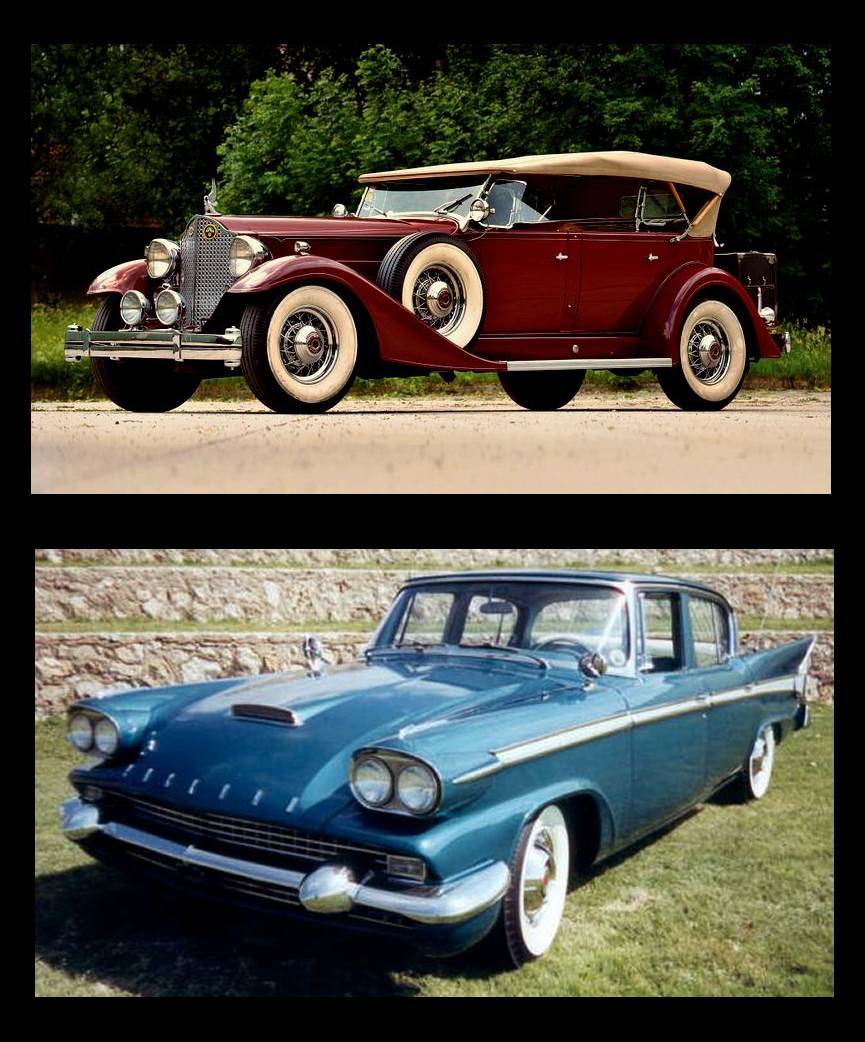
But this rubs a LOT of old car people the wrong way, those who insist that the only classic cars are those before 1940. If a person has a 1929 Packard it frosts them to be competing with a 1993 Ford Mustang for a Best-In-Show award.

The division in the old car hobby over this term is incredible. Even among the Packard specific collectors, the term causes big problems. Many only consider the early Packards (1899 – 1941) as classics and the later Packards as crappy junk which do not belong in shows and the club. If you drive a 1958 Packard (perhaps one of the ugliest and lowest quality Packard made) you are pretty much shunned by other Packard owners; image below illustrates the difference between two Packards.

Are both these cars 'classics'?
Don

Edit I think that music is another good example; what is consider a classic song? Is the Beatles 'Let It Be' a classic or is it J.S. Bach 'Suite No. 1 in G major'?
Send note to Staff  Go to Top of Page
Valued Member
Canada
94 Posts
Posted 07/29/2018   10:08 am  Show Profile Bookmark this reply Add whizard to your friends list  Get a Link to this Reply
So any country that started issuing stamps after 1900 can't have classic stamps?
Send note to Staff  Go to Top of Page
Pillar Of The Community
558 Posts
Posted 07/29/2018   2:51 pm  Show Profile Bookmark this reply Add Sorsh to your friends list  Get a Link to this Reply
Don, I don't know anything about cars at all, and all I ever heard on that subject is veteran car, or a car...

the red one looks like something I would associate with a veteran car.
the blue one looks like something from back to the future in the 50's 60's?

but clearly not as attractive as the red one.


Quote:
Edit I think that music is another good example; what is consider a classic song? Is the Beatles 'Let It Be' a classic or is it J.S. Bach 'Suite No. 1 in G major'?


that is a good example, because classic (or klassisk in denmark) is exactly mozart and all that stuff, defined by genre.
but I guess under every genre of music there would be classic/iconic banks that did something remarkable for world.

but for all I think it's usually some of the first to really bring it to new heigths, and usually some of the first.

.

Penny black, first stamp ever, an iconic stamp of the classic era.
but when would the classic era end in the UK?
what happens, and when?


Quote:
So any country that started issuing stamps after 1900 can't have classic stamps?


well, I wrote 1900 because that has been suggested by more than one, and because that kind of survey would take very long, even if you limited to countries before 1900.

if the philatellic world could agree one some global era's, then NO, some countries wouldn't have classic stamps... like Faroya Islands, Greenland to name a couple. but could still have some iconic stamps.
Send note to Staff  Go to Top of Page
Pillar Of The Community
United States
1115 Posts
Posted 07/29/2018   3:17 pm  Show Profile Check docgfd's eBay Listings Bookmark this reply Add docgfd to your friends list  Get a Link to this Reply
"you may not like it, but catalogue publishers DO dictate what most collect, because most collect what's in it.

a few have made aware of scott's classic catalogue.
i don't own it of course. which countries are in it?"

Actually, I subscribe to the fact that people can collect whatever they please and although many/most use the catalogues for their respective collecting fields, most of the collectors I know, including myself, include un-listed items in their collections.

The Scott Classic Era Catalogue includes worldwide stamps from 1840 to 1940 (and a few years beyond in some instances) and like I said, given the lack of any universal, agreed-upon convention, Scott's definition is good enough for me.
Send note to Staff  Go to Top of Page
Page: of 2 Previous TopicReplies: 30 / Views: 2,396Next Topic  
Previous Page
 
To participate in the forum you must log in or register.

Go to Top of Page

Disclaimer: While a tremendous amount of effort goes into ensuring the accuracy of the information contained in this site, Stamp Community assumes no liability for errors. Copyright 2005 - 2026 Stamp Community Family - All rights reserved worldwide. Use of any images or content on this website without prior written permission of Stamp Community or the original lender is strictly prohibited.
Privacy Policy / Terms of Use    Advertise Here
Stamp Community Forum © 2007 - 2026 Stamp Community Forums
It took 0.22 seconds to lick this stamp. Powered By: Snitz Forums 2000 Version 3.4.05