| Author |
 Replies: 14 / Views: 2,790 Replies: 14 / Views: 2,790 |
|
|
Pillar Of The Community
United States
1136 Posts |
|
|
|
My "stamping" desk has lamp on each side, currently with the "spiral" CFL bulbs in soft white tone (as used in bath & kitchens).
I'm not thrilled with them and am thinking of replacing them with LEDs. Would the "daylight" tones be a better choice, OR ?
|
|
Send note to Staff
|
|
|
|
|
Moderator

United States
4788 Posts |
|
|
Pillar Of The Community
United States
8956 Posts |
|
|
Every persons eyes are different. Having said that, I have had great results with daylight color. It is harsher to the eyes, but the colors and especially the very small plate cracks show best under this light. For my eyes, that is,
Peter |
Send note to Staff 
|
|
|
Pillar Of The Community

United States
5472 Posts |
|
|
Bedrock Of The Community
12803 Posts |
|
|
Pillar Of The Community
Australia
3299 Posts |
|
|
I've always preferred natural daylight. The colours seem more vivid and the watermarks are more easily seen. |
|
Send note to Staff
|
|
|
Pillar Of The Community
United States
1951 Posts |
|
|
When I look for phosphor bands on GB stamps, I first hold the stamp up to my window using daylight. Sometimes that works better than my UV lamp (UVtools, Inc).
Jack Kelley
|
|
Send note to Staff
|
|
|
Rest in Peace
United States
1738 Posts |
|
|
Pillar Of The Community
Canada
1648 Posts |
|
|
Before you rush out and buy all those so called daylights, do youself a favor and get a bit of education and research "kelvin light scale". Kelvin is the "temperature" color of the different lights. The scale goes from 1000k to 10,000k. And don't forget about "color rendering index" - which is the accuracy of the color you are seeing. To me this is even more important than light color when viewing stamps. A little research and testing will definately assist you in making your decision, and you will be happier for it. The K scale goes from a yellowish up towards the blue end. Actually, it appears that the higher you go it may appear brighter to the naked eye, and older persons think it is better, but it actually gives you less useable, working light.
Warm white or the yellowish, normal incandescent lamp color is in about the 2700k to 2800k range. Then there are 3000k to 3500k lamps that give you a nice quartz halogen white light. Then 4000k to 4200 so called natural white which to my eyes is starting into the bluish end of the spectrum. 4800k is considered direct sunlight acording to one scale and is definately a bluish white color. This is followed by a 5500 to 6000k which is called daylight. The 7000to 7500 range is considered to be a cool white. Be smart which brand you purchase. Manufactures have an allowable tolerance for the color, and the major ones will keep within them. Some "cheap" brands may allow a wider variance and buy rejects and rebrand.
Most house lamps are found in the 2700-2800, 3000-3500, 4100-4200, 5000 to 6500 range. Personally I like the 3000 to 3200 range as things appear most natural to me. |
|
Send note to Staff
|
|
|
Pillar Of The Community
United States
1136 Posts |
|
|
Thank you folks for the advice and information. Looks like most any bulbs towards the "daylight" type will be an improvement. I will do some testing and go from there.
Being 74, the eyesight is on that downward slope, so whatever I can do to slow it down is a big help. |
|
Send note to Staff
|
|
|
Pillar Of The Community
United States
1136 Posts |
|
|
Well, I found two "100 watt equivalent" daylight CFLs and the improvement is obvious. I'll check out Lowes later on and see if there are better choices over these.
I've been using the soft lights for umpteen years, and I should have changed them out much, much earlier. |
|
Send note to Staff
|
|
|
Pillar Of The Community
United States
4527 Posts |
|
|
More light is better than less light for identification. I prefer a lighted magnifier for any close work.
If you get daylight bulbs I recommend them for spot illumination not general. As said above, they are harsher on the eyes so have it in a shaded lamp (so not in direct line of sight) can help. |
|
Send note to Staff
|
Al |
| Edited by angore - 08/18/2018 06:20 am |
|
|
Pillar Of The Community
1370 Posts |
|
|
Though most of you find them best for close looking at stamps, I find bulbs marked "daylight" to be a bit harsh on my eyes. They're bright white so it's a little like being in an operating theater. That may very well be better for studying stamps closely, but I don't do that much. I mostly look through albums, mount stamps, and so on. For this purpose I find soft white to be more pleasant lighting and easier on my eyes. Each to their own, though.
I suppose you could have two lamps, one on each side of your desk or table, one for up-close study of a stamp, the other for more general enjoyment of looking at stamps and generalized stamp work. Or is that not good for the eyes?
As for LED's, because they don't give off the heat of the older incandescent bulbs, I find them much more pleasant to use than a hot bulb. |
|
Send note to Staff
|
| Edited by DrewM - 08/18/2018 10:13 pm |
|
|
Pillar Of The Community
Australia
1692 Posts |
|
|
I normally use a pair of philatelic tweezers (my preference is the flat nose type) and put the stamp against the daylight. I also use various magnifiers with built in lights and a UV light for phosphorous inks and papers. With thin paper stamps the watermark stands out even better if there is selvedge; even under a normal lamp the watermark can be seen. Here is a good example of a watermark seen through a thin paper stamp with selvedge. 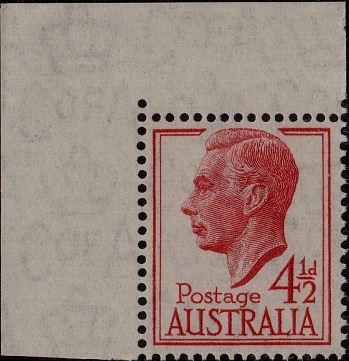 |
|
Send note to Staff
|
| Edited by Rob041256 - 08/18/2018 11:24 pm |
|
|
Valued Member
United States
75 Posts |
|
|
I use something called an Ott light for all my stamp viewing pleasure. I do not know a thing about Kelvin scales or anything like that, but the quality of the light seems demonstrably better. I got mine for r less than $20 on sale. |
|
Send note to Staff
|
|
| |
Replies: 14 / Views: 2,790 |
|




 Posted 08/16/2018 6:03 pm