| Author |
 Replies: 7 / Views: 1,907 Replies: 7 / Views: 1,907 |
|
|
Pillar Of The Community
United States
4498 Posts |
|
|
|
I am working on some GB stamps and now getting into the tagged era.
At the moment, I am in the QEII era.
I have GB Northern Ireland Scott 1 (3p), 3 (6p). and 5 (1'3). Scott states Scott 4 and 6 and subsequent are phosphor coated.
My Scott 1 and 3 show no reaction under SW and LW but the 5p is reactive. Is this just due to the paper itself?
My SG catalog states tagging is in phosphor bands but what I see is overall reaction.
I also have Scotland Scott 6 (1'6) and I do not see any bands under LW/SW but I can see a fairly wide band (more a gloss change in surface) running vertically in visible light when viewed at a shallow angle.
|
|
Send note to Staff
|
Al |
| Edited by angore - 09/29/2018 09:26 am |
|
|
|
|
Valued Member
Canada
29 Posts |
|
|
I am really curious about that too and was going to ask the same question. I am working with machins and those I am working on ( I am placing them by date) are all supposed to have phosphor bands but several don't show any under either short or long wave UV light. Sometimes I have better luck with a regular light but this make the identification really difficult. I thought it was my lamp since new. Maybe it's because those are used and with time some phosphor bands disappear? |
Send note to Staff 
|
|
|
Pillar Of The Community
United Kingdom
895 Posts |
|
|
Angore - we are talking about the 1958-1967 series (the 'Wildings')? Pre-decimal currency always has the "pence" written with a "d", so for the sake of clarity, the Northern Ireland Wildings exist as:
3d - no phosphor, or one centre band
6d - no phosphor
1/3 - no phosphor
You mention the 5p being reactive, but I presume you mean Scott 5, ie the 1/3 stamp? I don't know why you would see an overall reaction, but as there is no phosphor tagging on that stamp, I would regard it as an odd effect - maybe the paper is contaminated with something?
Scotland 1/6 should have two phosphor bands, which will be the narrow strips along the long sides. The wide band you describe sounds like the non-tagged gap between the two thin phosphor bands.
CP2018 - the Machins are more complicated, mainly due to their lifespan. There are many (decimal, this is) on phosphorised paper, and some with "all-over phosphor". Used Machins normally retain their phosphor tagging after soaking and so on, in my experience, although I've had some which are hard to see. I would add that I have never used a lamp - always just the naked eye with the stamp tilted so that the light 'bounces' off the surface. They are usually quite clear.
If you want help with them, maybe state the specific stamps and what you are seeing, and someone may be able to assist.
|
|
Send note to Staff
|
| Edited by Ringo - 09/29/2018 2:01 pm |
|
|
Pillar Of The Community
United States
4498 Posts |
|
|
Ringo,
Yes we are discussing the same stamps. I know paper can be reactive if it has brighteners.
I also have a used Scotland 1'6 as well and see nothing. I used 2 different SW lamps and a longwave. I had read that the phosphor could rinse off when soaked.
I am just viewing them under steady SW and LW and see no trace of any lines.
I also found some Canadian stamps, same period, that were in spaces marked as a phosphor and see nothing. Now, the prior owner of this album I purchased was awful at watermarks too (wrong ID) so he may have just filling holes. |
|
Send note to Staff
|
Al |
| Edited by angore - 09/29/2018 5:33 pm |
|
|
Pillar Of The Community
United Kingdom
895 Posts |
|
|
I guess the phosphor must have rinsed off the 1/6 stamp then. I have seen some which are vey hard to spot visually, so that probably does happen. As you say, you can see the after-effects as a wide band down the centre of the stamp - in other words, you are seeing the two phosphor band remnants along the edges. |
|
Send note to Staff
|
|
|
Pillar Of The Community
United States
4498 Posts |
|
|
Here is an update on my experiences with used Machins and phosphor.
On some GB stamps, despite visually seeing the bands on face of the stamp in regular light the phosphor is almost dead. Compared to US stamps, the response is weaker so I had to change my techniques.
I have 3 SW UV lamps and the most powerful appeared the least useful. Actually what was happening was the reflecting from light from paper was washing out from response to the phosphor. If I hold at shallow angle I will start to see more. Most actually look like a stain so have to look closely. Again, much different approach than US.
Some say you have to do the flick test (turn on lamp, close eyes, remove lamp, open eyes) to look for afterglow but that did not seem to yield results.
I did see some interesting results on afterglow. One sample had a delayed response that was quite obvious and another had a bright yellow flickering affect. |
|
Send note to Staff
|
Al |
| Edited by angore - 04/19/2019 07:44 am |
|
|
Pillar Of The Community
United States
1497 Posts |
|
|
Many different formulations for the taggant have been used over the years, each with their own unique characteristics. Some fluoresce (UV lamp on) to varying brightness and colors, others phosphoresce (UV light off) differently too for brightness, color and duration. It's a jungle out there.
I try to identify my Machins to Deegam level 3. Sometimes I just have to count the bands without determining the phosphor type, and declare victory.
Robert |
|
Send note to Staff
|
|
|
Pillar Of The Community
United States
4498 Posts |
|
|
Here is the one I did not fully make sense until this identification supposedly settled it. I am working with the 10p orangish ones. I have a 10p that has narrow value and no bars so has to be X940. This means the tagging (not actual X940 but same reaction under SW light) om the left has to be phosphorized paper. So example on right left to be "allover" since no bars. The left is more reactive. It is much more reactive under SW UV. Image under SW UV light. 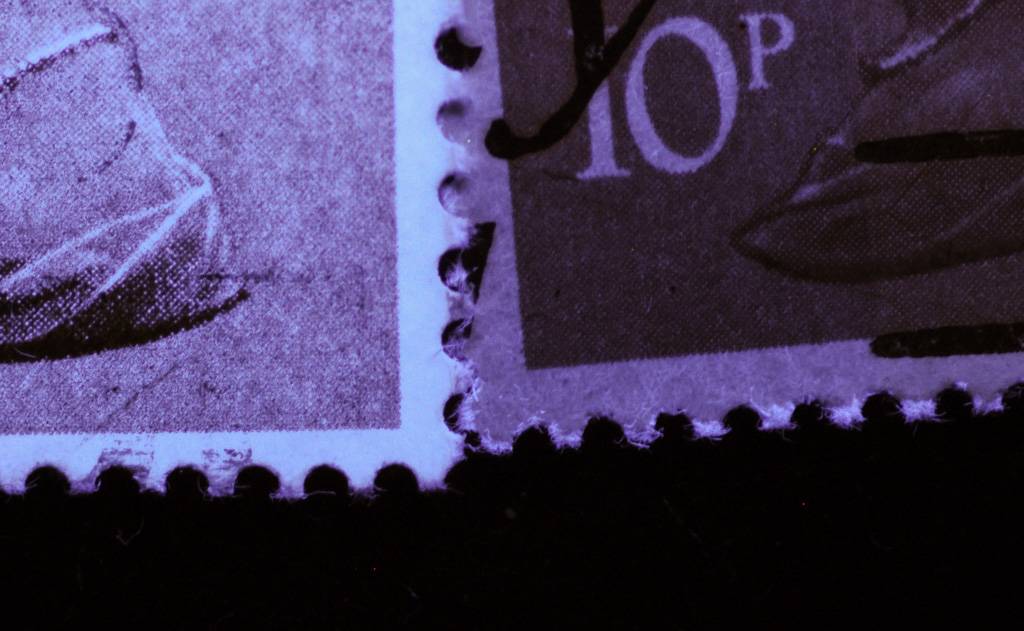 |
|
Send note to Staff
|
Al |
| Edited by angore - 04/19/2019 5:11 pm |
|
| |
Replies: 7 / Views: 1,907 |
|




 Posted 09/29/2018 08:38 am


