| Author |
 Replies: 27 / Views: 5,634 Replies: 27 / Views: 5,634 |
|
Pillar Of The Community
Singapore
750 Posts |
|
|
|
|
Pillar Of The Community
United States
7239 Posts |
|
|
They wouldn't bother me unless they moved paper fibers. If you examine the stamp at an oblique angle to a strong light source, you can see whether or not the paper has been affected/embossed. |
Send note to Staff 
|
|
|
Pillar Of The Community
United Kingdom
8623 Posts |
|
|
If an expertising mark (and genuine), the signature could add value, rather than detract. The "5" or "S" looks a little firm, however! |
|
Send note to Staff
|
|
|
Pillar Of The Community
Singapore
750 Posts |
|
|
This is a scanned back image of a used 1840 4 margin 2 pence blue from seller. I have further been told that if the expertising mark is at the top of the stamp, it is fake, if it is at the bottom, the stamp is genuine. Have guys attempted to remove these irritating pencil markings? |
|
Send note to Staff
|
| Edited by pennyblackie - 11/22/2018 6:50 pm |
|
|
Pillar Of The Community
1363 Posts |
|
|
I've never heard the "top" or "bottom" idea before anywhere, and I suspect it's someone's imaginary rule of thumb. An expertizing mark, if that's what these are, is usually some dealer's or expert's confirmation of the legitimacy of a stamp, but it can also be just an owner's mark, someone adding their initials to the back of stamps. Sometimes it's a rubber stamp impression (hopefully done very lightly) to note who owned the stamp or who evaluated it. It's unclear what these are on your stamps. Words like "faux," etc. mean "fake" and are worth looking for -- if the previous evaluator knew what they were doing. And that's always the issue, isn't it? You really don't know who added these marks or if they knew anything. |
|
Send note to Staff
|
|
|
Pillar Of The Community
Singapore
750 Posts |
|
|
DrewM, the part about expertising mark on the top and bottom came from the seller, and this is from a very reputable GB dealer with a high profile. |
|
Send note to Staff
|
|
|
Rest in Peace
United States
652 Posts |
|
|
The German and many European experts that sign the reverse of stamps did have a system whereby the location and orientation of a signature or handstamp has a meaning. A normal signature or handstamp at the lower right was good (if my memory is correct) and a vertical signature or handstamp at the lower left could indicate that the expert thought the stamp be authentic, but not sound. The Michel Catalogues used to have a page or two describing what the location meant.. |
|
Send note to Staff
|
|
|
Pillar Of The Community
Singapore
750 Posts |
|
|
Not sure if there are experts here who recognise this particular expertising mark. |
|
Send note to Staff
|
| Edited by pennyblackie - 11/22/2018 10:48 pm |
|
|
Rest in Peace
United States
652 Posts |
|
|
This site illustrates a wide variety of expertizing markings and illustrates a number of certificates. https://www.filatelia.fi/experts/index.htmlIt also has an illustration of where expertizing marks are to be located apropos of genuineness and non-genuineness of the stamp as well as brief biographical information when available. |
|
Send note to Staff
|
|
|
Pillar Of The Community
Singapore
750 Posts |
|
|
Went through the GB expertising marks in the links provided but couldn't find anything that resembles the one on this stamp. |
|
Send note to Staff
|
|
|
Pillar Of The Community
United States
2230 Posts |
|
|
In my experience (selling on ebay), expertizing marks decrease the value of stamps. Many of them bleed through to the front of the stamp, leaving an unsightly stain. |
|
Send note to Staff
|
|
|
Pillar Of The Community
559 Posts |
|
|
first off, the german BPP have a system where they stamp any stamp the issue a certificate on.(unless asked NOT to)  forged and regummed stamps would get a different mark. in the case of MNH stamps - anything, including pen marks would degrade it to MH state. however in germany in BPP mark increase the value significantly, to a state where some stamps that isn't proofed, are very hard to sell. in many other countries, including denmark experts, besides C.A.M (BPP) don't place marks, but so called owners marks to prevent theft are common - these are in general frowned upon and reduce value. i'm sure everyone has had the pleasure of washing off a stamp to find a clean, fresh stamp that looks like it just came out of the printing house. these stamps should be much more appreciated, rather than degrading stamps that has had lots of owners the last 130+ years. lastly.... NO expert marks would ever soak through the stamp, that would be vandalism by the people who were supposed to know better. these are amateurs OR simple ownermarks. |
|
Send note to Staff
|
|
|
Pillar Of The Community
United States
2230 Posts |
|
|
Sorsh, Thank you for your informative post. The marks that I've seen bleed through to the front must be owners marks, based on your information. Here's an example of one that bled through to the front of the stamp (US Scott #37).  |
|
Send note to Staff
|
|
|
Pillar Of The Community
559 Posts |
|
|
yes, perfect example of how to prevent theft - stamp is pretty much ruined :( |
|
Send note to Staff
|
|
|
Pillar Of The Community
Singapore
750 Posts |
|
|
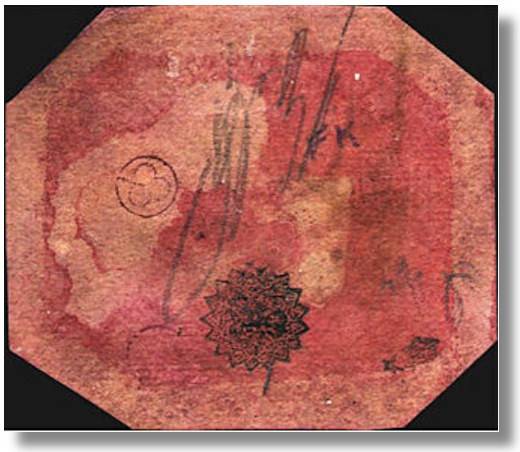
I really see no point in stamping an R at the back which can easily be forged anyway. Even the back of the one cent magenta is not spared from these horrible marks. |
|
Send note to Staff
|
|
|
Pillar Of The Community
Singapore
750 Posts |
|
|
Replies: 27 / Views: 5,634 |
|



 Posted 11/22/2018 08:34 am