| Author |
 Replies: 45 / Views: 3,007 Replies: 45 / Views: 3,007 |
|
|
|
Valued Member
131 Posts |
|
|
Pillar Of The Community
United States
1414 Posts |
|
|
Paper shrinkage across the mesh or grain was a major headache in the flat plate stamp production era. Booklet panes were printed on "special paper" with horizontal grain to improve accuracy when cutting sheets into booklet panes. Errors in horizontal direction had more impact than errors in the vertical direction. Careful comparison with known previously identified booklet pane singles and sheet stamps makes it possible to identify used AEF booklet pane singles. When flat plate booklet pane production ceased in 1927, remaining stocks of special paper was used to print Fourth Bureau high value definitives, C111, E13 and the 1928 printing of QE1-QE3 Special Handling stamps. Some collectors accumulate First and Second Bureau booklet pane singles to reassemble representative booklet panes. Unfortunately, digressions in this discussion may have obscured the fact that early booklet pane singles are collectible. Scott compounds the problem by not listing used booklet pane singles. AEF booklet pane singles are also quite collectible, especially on cover. Also, higher denomination First and Second Bureau issue stamps were mostly printed from 200 subject plates also with horizontal grain paper. A few back of the book Postage Due and Special Delivery issues exist on horizontal and vertical grain paper. Unfortunately, the Scott catalog doesn't list them as distinct varieties. This is also the case with Special Handling stamps QE1-QE3. While the Scott Catalog is silent on this subject, the Durland Plate Number Catalog discusses special paper in detail. Comparison of 319 sheet stamps and booklet pane singles:  |
Send note to Staff 
|
| Edited by cfrphoto - 12/19/2018 11:39 am |
|
|
Pillar Of The Community
1375 Posts |
|
|
thank you for this additional information. indeed Durland shows some special paper examples. why is there no mention of this paper in Durland at the special handling stamps? weren't they the "discovery copies" of this paper, so they should be mentioned as existing on special booklet paper in Durland?
and if I may ask another question: which postage due stamps are known or believed to exist on special booklet paper? |
|
Send note to Staff
|
|
|
Valued Member
United States
319 Posts |
|
|
I second the thank you for the education. Early panes are not an area I have explored, so most of this information is new to me.
As for AEF singles on cover, I can only imagine how scarce these must actually be. I see the Scott prices for 498f and 499f, so postal usage can not be too far behind. Perhaps this is an area to spec on before Scott grabs hold of an auction price or two and starts listing them in the Specialized. Just from a historical perspective, these covers are fascinating to me, having a very limited period of usage before Pershing's arrival and the advent of the free frank. |
|
Send note to Staff
|
|
|
Valued Member
131 Posts |
|
|
Bedrock Of The Community
12758 Posts |
|
|
Valued Member
131 Posts |
|
|
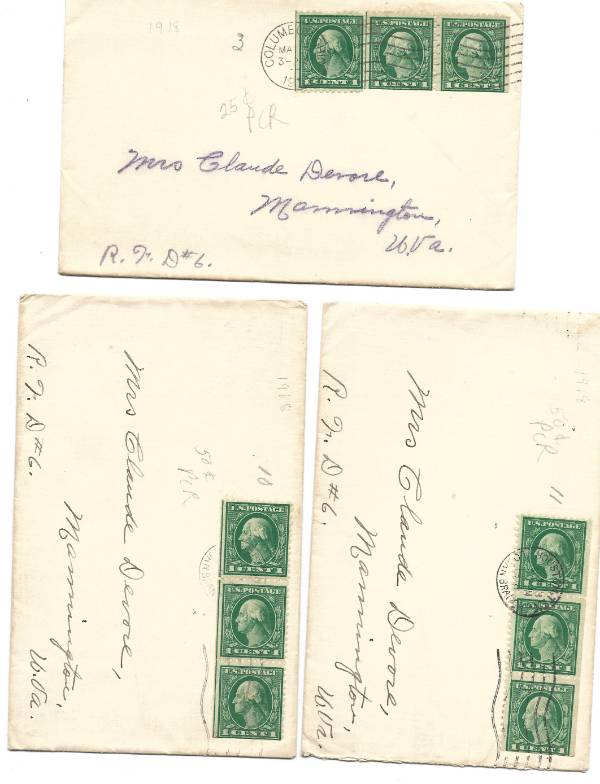
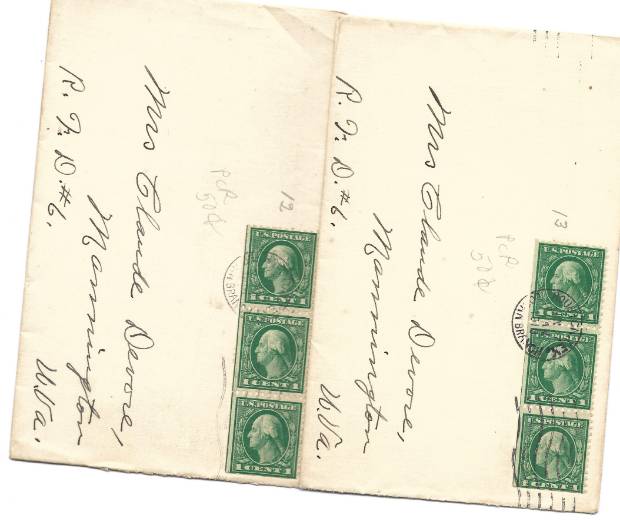
All have same name on them, and same had righting, perf 11, 1918 date, top letter has joined to gather with two strait out side edges. These are from Mr. Dietz Personal collection, I won at auction some years ago. |
|
Send note to Staff
|
| Edited by richar babcock - 12/19/2018 6:00 pm |
|
|
Valued Member
131 Posts |
|
|
Valued Member
United States
319 Posts |
|
|
Didn't we establish that guide lines on booklet panes have to be horizontal due to the 90 degree paper rotation? Furthermore, isn't it mpossible to have a guide line parallel with a straight edge on a booklet pane? Maybe I missed something; admittedly, I am still learning this area. |
|
Send note to Staff
|
| Edited by Reedededge - 12/19/2018 10:02 pm |
|
|
Pillar Of The Community
6364 Posts |
|
|
Reedededge, No. We didn't discuss vertical guidelines on sheets vs booklets in this era very thoroughly, which are always both straight edge, so little help in ID.
The horizontal guide line is SE on sheet, perfed on booklets.
Richar, A couple of helpful hints. Cropped close-up scans of the stamps and postmark area are far more helpful, numbered sequentially for easy reference by those responding. Also, this thread and others you have started have provided you with the tools to take an educated stab at the ID of stamps on your covers as to sheet vs booklet. We are trying to teach you to fish, but you keep asking to be given fish. To expand on rogdcam's post above, now using this board, your catalog and template tools, you might try asking "I believe this is a booklet pane stamp because ..." and state your observations and reasoning.
|
|
Send note to Staff
|
| Edited by John Becker - 12/19/2018 10:39 pm |
|
|
Valued Member
United States
319 Posts |
|
|
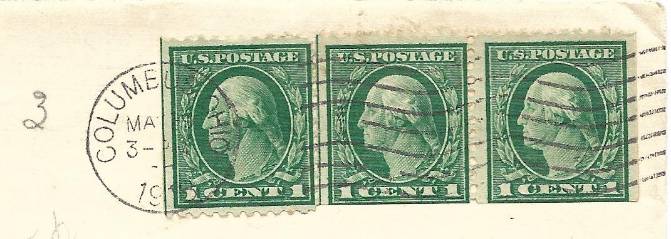
Since Richar seems to want the answer, and I would like to figure out the answer, here's what I deduced. I'm doing this quickly without fact checking what has already been disclosed, but going on the premise that these are Perf 11 stamps, and given the straight edge on bottom of covers number 2 and 3, I'm going with Scott #498e from 1917. This is consistent with the 1918 CDS and is a very common booklet pane. Furthermore, since they were from 360 subject plates, according to Scott's Specialized both left and right guidelines could exist, explaining cover #2.The first cover appears to be a combination cover of some sort, and I'm not sure about it. When I have a little more time, I will blow the image up and study it further. |
|
Send note to Staff
|
|
|
Pillar Of The Community
6364 Posts |
|
|
I agree, they do appear to be stamps from booklets, common by this time. An overlay with a known flat plate sheet stamp would quickly confirm. |
|
Send note to Staff
|
|
|
Valued Member
131 Posts |
|
|
Valued Member
United States
319 Posts |
|
|
I believe that you have a #498e booklet single combined with a #498e booklet pair, both from the right center of the plate, explaining the left guideline positions. Note the straight edges on the side and bottom of the right pair, denoting that they were from the bottom of the booklet pane, where the left stamp would have been a center or top stamp from the booklet. My guess is with the close date proximity on all 3 covers that you could match the stamps up, and there's a likelihood that they emanated from the same booklet, but this is only a guess. As John noted, until the aspect ratio is tested, this is only a hypothesis; we can not say with 100% certainty that all stamps are from booklets. Given the fact that the #3 cover shows a definite booklet pair (with straight edges on the east and west sides) combined with all stamps "appearing" to be the same height and width, I would be surprised to find out to the contrary. |
|
Send note to Staff
|
|
|
Valued Member
131 Posts |
|
|
Reedededge Thank you. I think they were used to send a stamp collection, See how all the envelopes have numbers on them, there are likely more out there that are the same as these five. Maybe a new quest for me to find them and buy all of them. |
|
Send note to Staff
|
|
|
Replies: 45 / Views: 3,007 |
|




 Posted 12/18/2018 8:19 pm