| Author |
 Replies: 21 / Views: 2,327 Replies: 21 / Views: 2,327 |
|
Valued Member
United States
198 Posts |
|
|
|
I have about 200 certificates from PSE and PF. I've noticed posts that allude to the fact that stamps with older "clean" certificates have been resubmitted and subsequently come back with faults or alterations noted. How prevalent is this? Is there a certain date/year past which one should be cautious of? Is there a specific reason for the newer certificates coming up with previously undetected faults (better equipment, more knowledgeable graders)? Has one third party grader proved to be more reliable than the other? I have certs that stretch from relatively current back to the 60's.
|
|
Send note to Staff
|
|
|
|
|
Moderator

United States
12330 Posts |
|
|
Hi,
As you mention certs have a shelf life; technology and the knowledgebase is constantly moving forward. Certs are also opinions and opinions can certainly be wrong.
I assume that folks will have opinions regarding certification accuracy and reliability but there is no evidence-based data. Without evidence-based data, consumers are left to their own devices on determining accuracy and reliability.
Don
|
Send note to Staff 
|
|
|
Pillar Of The Community
United States
1125 Posts |
|
|
For reasons that continue to escape me, some dealers adamantly refuse to accept APS certs. PF appears to be the favored third party by these folks. All services are pretty equal to one another, imo.
Another reason more recent certs may be listing previously unmentioned faults is new damage occurring in between expertizing events of the same stamp. |
|
Send note to Staff
|
|
|
Pillar Of The Community

United States
1837 Posts |
|
|
I think the reliability depends a lot on the specific stamp type. For example, knowledge about fake coil stamps has expanded a lot. So certified coils from 20 years ago certainly need to be redone. On the other hand many stamps knowledge is probably much more slow to change and a re-certification is less likely to overturn an older one. Another issue is that the agencies sometimes evolve their approach. Something that use to be "previously hinged" might come back as "slightly disturbed" because they've gotten more specific in differentiating different kinds of gum disturbances.
If I had to guess I'd guess the majority of certs from the last 20 years will be ok, but unless you run it through, it's hard to know for sure. |
|
Send note to Staff
|
|
|
Bedrock Of The Community
12757 Posts |
|
|
Pillar Of The Community
United States
752 Posts |
|
|
As docgfd states, the reasons for bias against APEX compared to PSE or the PF has never made sense to me. |
|
Send note to Staff
|
|
|
Pillar Of The Community
United States
811 Posts |
|
|
The circumstances around how you acquired the stamps and certs matters. I bought an auction lot with some ancient PF certs on some rarities. I didn't excect the certs to hold up, otherwise, the stamps would have been lotted individually with a modern cert. I'd reccomend getting new certs on anything valuable where the certs are from before 2000, especially coils and anything exceptionally expensive.
APEX certs are rare from what I've seen. I have 400 or so certs and maybe 5 are APEX. When I send stamps out, I use PSE or PF (And used to use PSAG) because that's what I know, and I trust their opinions. I don't trust Miller or Weiss certs, amd don't know whether or not to trust APEX. |
|
Send note to Staff
|
|
|
Pillar Of The Community
United States
890 Posts |
|
|
Perhaps I am being simplistic, but aren't you always going to have
this problem when the expertizing entities don't guarantee/warrantee
their work in a monetary sense? In the coin world, you have PCGS.
Of course, that brings up the dreaded slabbing issue - a tamper proof
seal which allows the expertizing entity to offer a guarantee like that.
A much harder sell in the world of philately, I know. But having a guarantee
of "a new certificate at the same state" or the guarantee kicks in is
very attractive in the confidence (and monetary) sense for the average
collector purchasing high dollar items.
John |
|
Send note to Staff
|
|
|
Pillar Of The Community
United States
1339 Posts |
|
|
I have recently purchased a stamp with a PF cert which has the incorrect type listed. It is listed as a #20 but is a #23. I am not sure how to go about getting it changed yet. If PF wants to charge me to "fix" it, then I may send it to PSE so I can show the two certs together, one right and one wrong. That will put the PF in a bad light. The cert was done on 11/30/18. |
|
Send note to Staff
|
| Edited by jaxom100 - 01/01/2019 04:54 am |
|
|
Pillar Of The Community
United States
752 Posts |
|
|
I think this issue surrounding APEX in the Stamp world is analogous to judging ANACS in the coin world. Even though both APEX and ANACS are officially excepted as one of the 3 main expertizing organizations in their respective fields. Everyone knows that the same exact coin in a PCGS or NGC holder is going to bring in general a higher price than if in an ANACS holder, which is why coins are often broken out of slabs to see if they will cross over. You don't see these coins being submitted to PCGS or NGC in their ANACS holder.
Of course, since isn't the case with stamps, which are rarely slabbed. The game here is whether to let The PF know that the Stamp has previously been certified by anyone other than itself in the past. But the perception based on market realizations is the same: the same stamp with a PF cert is usually going to bring a higher price
Than the same stamp with an APEX cert. but that is the market driving the perception and doesn't really get to the root cause of why ANACS and APEX, both older organizations than either PF or PCGS, are treated as being in the minor leagues, As we all know, mistakes and unusual opinions, being human constructs are present in all 6 organizations from both hobbies and at times seems quite arbitrary.
A perception based on market forces, as opposed to whether one believes that the opinions, stripped of their monetary impact, are substantially different in quality or correctness is a different thing. But here we may be asking too much to expect humans to make decisions on other than a basis of financial impact.
I have purposefully left out PSAG from this analysis, since I am not sure how to evaluate the relative merits of their certain in the hierarchy, even thought Randy Shoemaker , formerly of the PSE, to my knowledge is the driving force there. I have also avoided comparison of PF to PSE or PCGS to NGC even though I think we all know the preferred hierarchy there as well—again a perception in my opinion derived in good part by perception of auction realizations, although to a lesser degree than ANACS and APEX— again a distinction in my mind perhaps also unfair and based on something other than a true difference in quality. |
|
Send note to Staff
|
|
|
Pillar Of The Community
United States
796 Posts |
|
|
jaxom call or email the PF later this week. if you explain your problem they will work with you to issue a corrected cert.
a resubmission should not be required. |
|
Send note to Staff
|
|
|
Pillar Of The Community
United States
796 Posts |
|
|
on the issues raised about the reliability of certificates, one needs to keep in mind they are the collective opinions of there examining committees or specialist individuals. the change of a prior cert can and does come about. it is not done lightly. the standards and expectations have all changed. a patient today is examined just as much for condition as for identification and all submissions get the same degree of examination regardless of value. older certs can and do get "lost" at times if they don't reflect the current desired state of affairs. there is no substitute for having knowledge of your collecting field be it coins or stamps. |
|
Send note to Staff
|
|
|
Pillar Of The Community
United States
791 Posts |
|
|
m and m is right. Certificates are nothing more than OPINIONS. I believe there will (almost) always be some disagreements. |
|
Send note to Staff
|
|
|
Moderator
United States
12330 Posts |
|
|
The limited history that I am familiar with regarding getting incorrect PF removed from the database has not been good. In the 2013-2016 timeframe I am aware of at least three written requests to PF to remove/revise incorrect certs that were promised to be removed yet are still to this day in the PF database. For example, cert. #463694 was identified as fake back in 2014 and PF notified. They acknowledged it was fake, acknowledged the cert was incorrect, and said they would remove the cert from the database. Yet here is the cert screen shot from this morning… 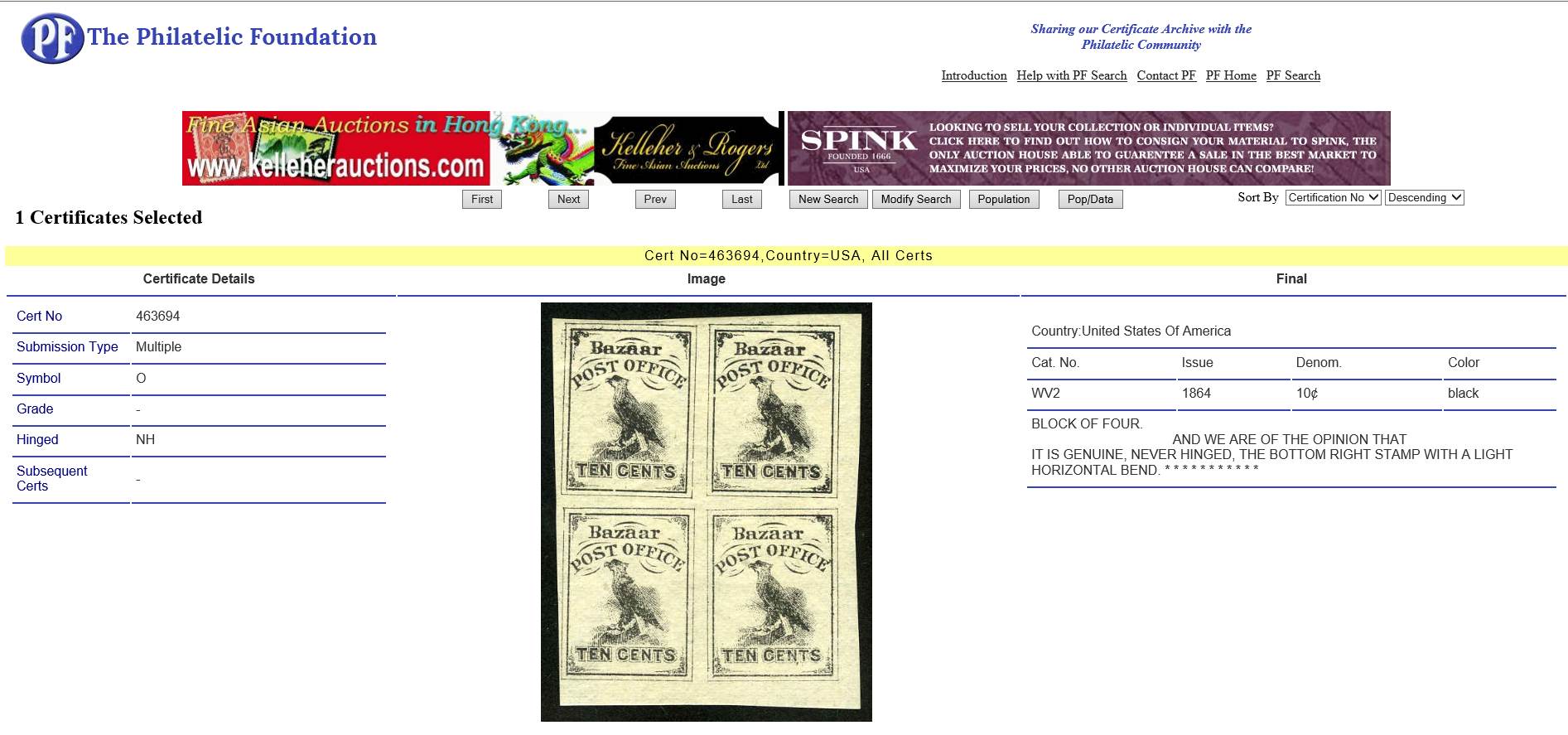 At other times PF replied by stating that while they agreed a cert to be incorrect they would not revise the cert until the item had been resubmitted to them. But I think the examples above are exceptions and not the norm. I applaud PF for publishing their cert database and my opinion is that the vast majority of certs are correct. Dealing with data quality is always a challenge and maintaining this database is a significant task. Hopefully PF will be able to purge the incorrect certs over time. I have the most confidence in PF certs and would not hesitate to use them. Don |
|
Send note to Staff
|
|
|
Bedrock Of The Community
12757 Posts |
|
|
I would add that many of the most respected auction houses specifically call out the Philatelic Foundation as being the expertizing agency that is acceptable for extension certification. |
|
Send note to Staff
|
|
|
Rest in Peace
United States
652 Posts |
|
|
The older PF certificates, especially the ones from the 60s and into the 70s, were less concerned with condition then with genuineness of the submitted item. You will find that many of the stamps sold in the Newbury sales by the Siegel firm have very small or tiny flaws. They were collected for their appearance and not for 100% soundness, though Saul Newbury would buy a sound example if it met his other criteria. With the passage of time the collectors have become more demanding and now search for perfection. The expertizing services have changed over the years in what they will describe on a stamp. The needs of collectors does vary. I once talked to a purchaser of stamps who demanded that The PF note everything on a certificate that he felt detrimental to the value of the stamp including noting that the stamp had a slightly shorter perforation. To a collector looking for a stamp that would receive a PSE grade of 100 a slightly shorter perforation would be a problem. To the vast majority of collectors it would not.
APEX does have some very good people looking at their stamps and some of their signers also look at stamps for The PF and for PSE. The auction houses prefer The PF partly for control and The PF's priority service which attempts to generate an opinion within 30 days. The auction houses may also feel that there is a certain uniformity of staff and familiarity with the people giving the opinion. One advantage to The PF over APEX is that The PF does have an extensive reference collection of genuine stamps which is especially true when it comes to the Banknote Special Printings. It is my understanding that the APEX reference collection leans more to non-genuine items donated by APS members.
jaxom100 contacted me about his problem and I suggested he contact The PF to see how they wish to handle the problem. I gave him the names of two different people to speak to. I am not sure why he is now angry. |
|
Send note to Staff
|
|
|
Replies: 21 / Views: 2,327 |
|




 Posted 12/31/2018 7:09 pm


