| Author |
 Replies: 16 / Views: 3,862 Replies: 16 / Views: 3,862 |
|
Pillar Of The Community

United States
1837 Posts |
|
|
|
I have a stamp that I believe is a Scott #124. It's unused but no gum. I assume it's a 124 and not a 113b since that is super-rare. But if I wanted to check how would I go about it? I've read that it might never get certified - even as a 124 - since there is no gum, but for the moment I'd just like to learn if there is a straight-forward way to differentiate between these two types of paper. Or - is there any other difference between the un-grilled 113 and the un-grilled 124?
(Yes, I know about pressed out grills etc. I've examined it 6 ways to Sunday, including retro-reveal, fluid, etc.)
|
|
Send note to Staff
|
|
|
|
|
Pillar Of The Community
3865 Posts |
|
|
Rest in Peace
Netherlands
963 Posts |
|
|
ALL machine-made paper is "wove" in the sense that the sieve structure [of the paper machine] is a reflection of the linen-binding [1850-now] and twill-binding [since 1938].
ALL machine-made papers have a direction - the grain, the mesh - that is either horizontal or vertical!
The question is WRONG in itself. Hard paper versus what?????
There has never been a machine-made paper that is NON-WOVE! |
Send note to Staff 
|
| Edited by Galeoptix - 01/05/2019 3:58 pm |
|
|
Pillar Of The Community
United States
1837 Posts |
|
|
The question is just based on how Scott describes the two sets of stamps. The 1869 stamps are described as "hard wove" and the 1875 stamps as "hard white". That's the only difference evident in Scott.
|
|
Send note to Staff
|
|
|
Pillar Of The Community
United States
3224 Posts |
|
|
Compare papers against your known 1869 stamps which could possibly include fresh-looking used stamps. A #124 should be on noticeably brighter whiter paper. Of course, #113s can be bleached but that usually softens the paper more than before.
Secondly, go to the PF site and compare engraving/print quality with certified #124s. The engraved lines should be very stark and distinct on a #124. You should pay particular attention to the sides of the horse, its shadow, and the hill with the tree behind it. Any merging of shading lines means it's not a #124. Now, early printings off a (new) plate could potentially look the same, so it's not a truly foolproof test by itself.
As for no gum, if there is evidence of the stamp being pressed out, probably no opinion could be rendered as weak grills can be pressed out convincingly. |
|
Send note to Staff
|
| Edited by hy-brasil - 01/05/2019 5:47 pm |
|
|
Pillar Of The Community
United States
1837 Posts |
|
|
Thank you. That is some very useful guidance. One thing that impressed me about this stamp was it's very clean, sharp appearance. But I will do these comparisons and see what will be. Thanks.
|
|
Send note to Staff
|
|
|
Pillar Of The Community
United States
1837 Posts |
|
|
Here's a comparison of the best 113 I could lay my hands on and this stamp. The optimized image loses some of the detail on the lines. The original scan the engraving difference is quite distinct. The paper is a shade whiter, but not as white as the screen image I'm seeing of some of the certified copies I see online. So, it's not definitive, but still seems like a reasonable chance. (The hopeful 124 is on the right.) 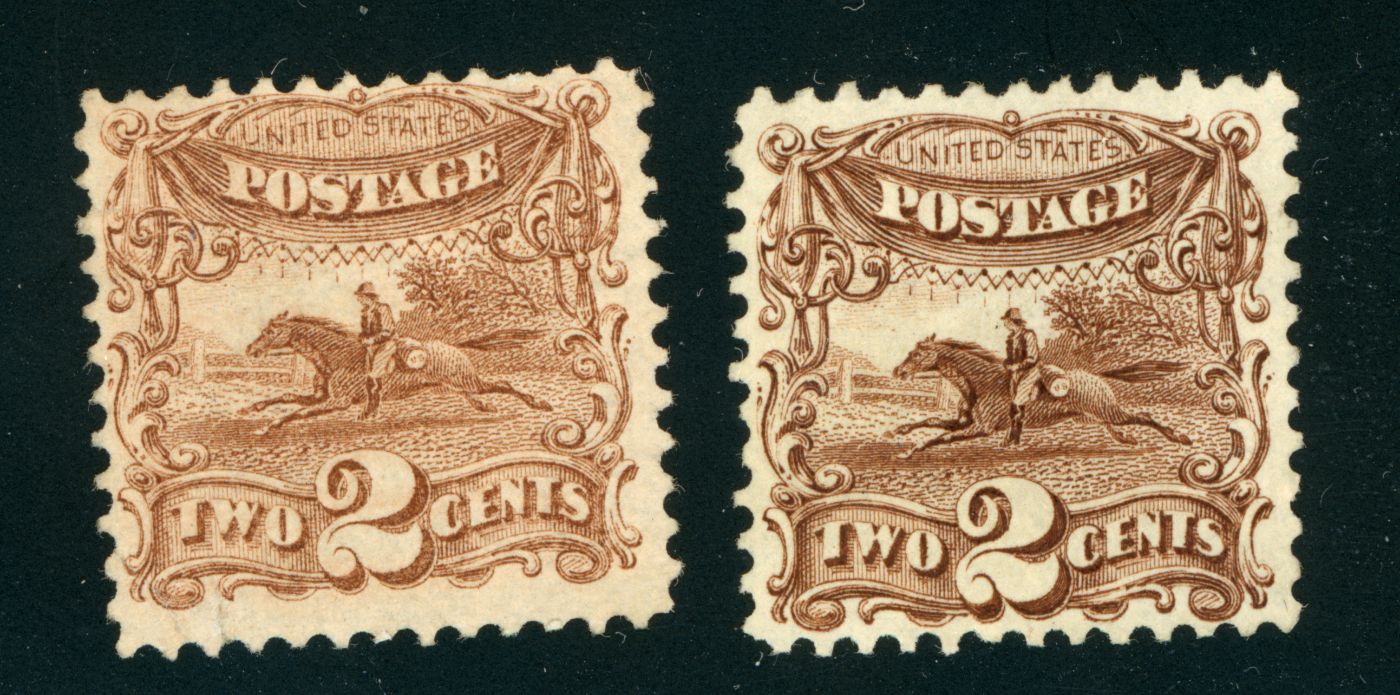 |
|
Send note to Staff
|
|
|
Pillar Of The Community
United States
1273 Posts |
|
|
Just an FYI, something I clipped from a printing of an older post regarding the special printings. You could search for 125 postings and probably find the discussion. I know the author of this info. and he is knowledgeable about classic issues. I do not know how this may or may not apply to your example, nor am I knowledgeable regarding identifying the special printings myself. Again, just an FYI. 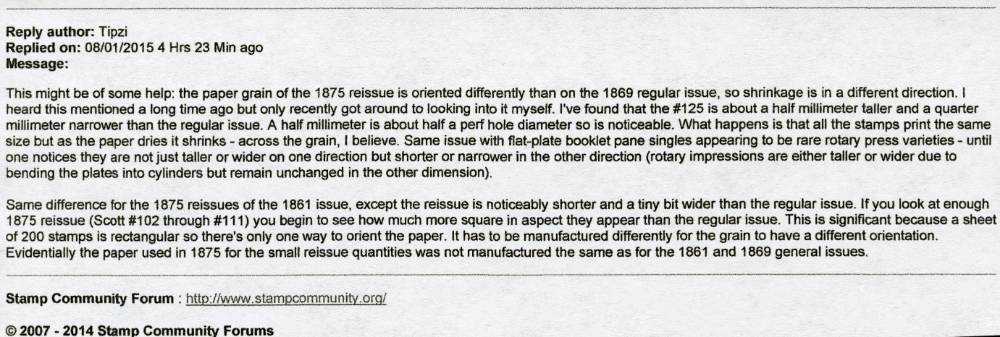 |
|
Send note to Staff
|
|
|
Pillar Of The Community
United States
1837 Posts |
|
|
Wow, that is interesting. I did the check and image on the stamp on the right is distinctly taller and narrower. More evidence in support of it being 124. You can always rely on SCF to make it interesting. |
|
Send note to Staff
|
| Edited by rlsny - 01/05/2019 9:05 pm |
|
|
Pillar Of The Community
673 Posts |
|
|
Hi Rlsny, I just ran a test on one I have. I have a PF certed 129 (different denomination, but still the same paper). I'm looking only at paper differences, and not engraving or print strikes so we're just focused on telling the difference by paper type. There are a few things I note about the differences in the Hard Wove versus Hard White paper. Interestingly the Hard White is stiffer (harder) than the Hard Wove. Looking at the paper fibers is difficult to give much of an indication, but under microscope of around 50x there appease to be more 'anomalies" in Hard Wove than in Hard White. While I can find "cleaned" examples of hard wove that seem to have similar particle contamination, against unaltered copies, I can see this difference. I've attached an image that has a 129 on the right and a 119 on the left. 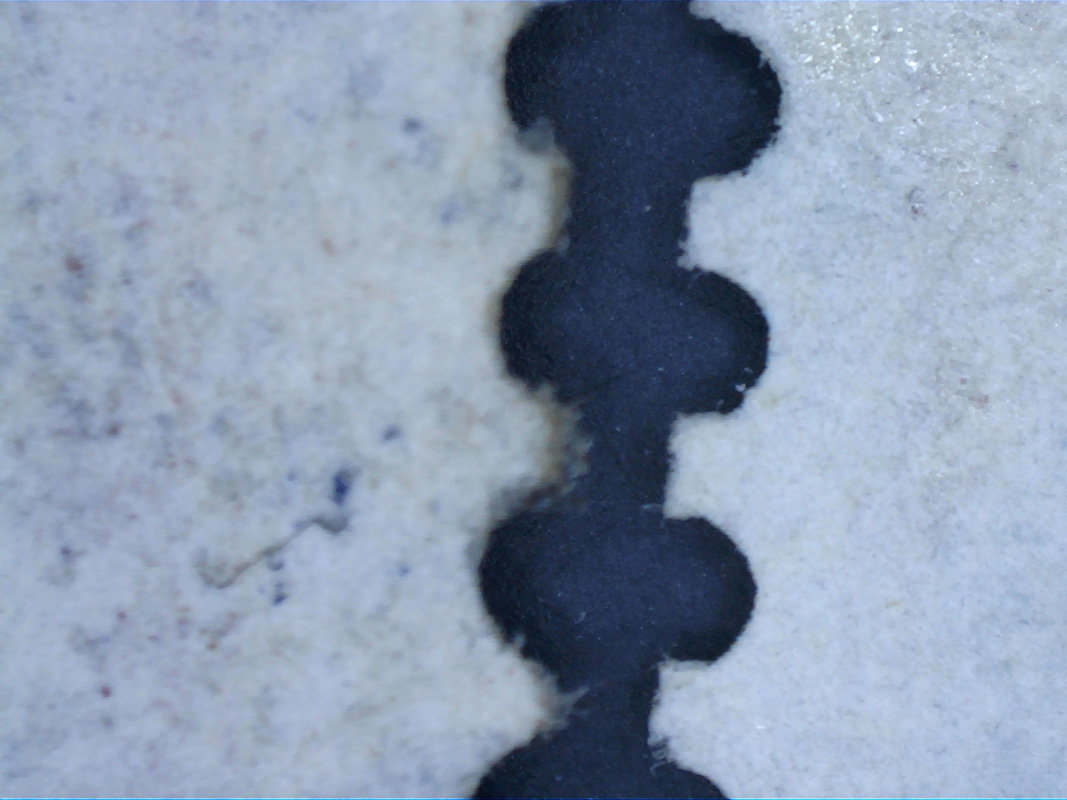 One other thing I notice, it's subtle, but it may help. To determine that one is more firm than the other, if you take an equivalent stamp, grasp it near the perf edge holding the stamp's thin edge toward you, blow lightly on the paper to make it flutter. The hard wove stamps will transfer a noticeable vibration into your fingertips. Do the same with your Hard White, and while there is movement it is less than 50% of that of the hard wove. (Similar to the "flick test" which I put no faith in, this one actually works, when you have 2 comparison items). Now, in your images there is one thing that I find striking, and that is the clarity of the image and the centering of the stamp. That sends a different alarm bell off for me. Any time we see "Amazing Color", it's a strong possibility of being a proof. The probable candidate for a proof in this case would be a 113P2 which is on white wove paper. But for that to be the case, it would also have to be artificially perfed. The stike hints of proof, but I have to say I don't see any issue with the perfs. So that leaves us with the possibility of a pressed out grill, on an ungummed stamp, but if you can determine if there is a lot of contamination in the paper, it will be a 113. In the absence of such, you have a strong candidate for a 124, which aren't so rare, it's possible. I've handled a few 123 and 124's in the past. |
|
Send note to Staff
|
|
|
Bedrock Of The Community
United States
10862 Posts |
|
|
The perfs do look good, and the impression and whiteness of the paper lean towards it being a 124. As pointed out, not all that scarce but a nice thing to find nonetheless. |
|
Send note to Staff
|
|
|
Pillar Of The Community
United States
1837 Posts |
|
|
I was going to sell it, but after going through this, I think I'm going to keep it for my own collection. I'm a big fan of the pictorial series and maybe this will start me on collecting the reprints. Next time I send some into the PF I'll include it and see what happens. |
|
Send note to Staff
|
|
|
Pillar Of The Community
United States
3224 Posts |
|
|
Quote:
The paper is a shade whiter, but not as white as the screen image I'm seeing of some of the certified copies I see online. That's fine; there's a clear difference (to me) when they are side by side. Again, the cert images can be all over the place, as can be any images online, but at least nowadays the engraving detail should be decent for comparison. I feel confident your stamp is a #124. One other point is that engravers cutting lines are clearly shown on the "shadow" of the "2", an indicator of fineness of printing detail in a reprint/reissue or an early printing from a plate. Combined with the paper color, it says reprint/reissue to me. If/when you submit it for certification, remember to use the no gum catalog value. |
|
Send note to Staff
|
| Edited by hy-brasil - 01/05/2019 10:41 pm |
|
|
Valued Member
213 Posts |
|
|
The improved impression quality is most likely due to a difference in surface treatment. Regular stamp paper was smoothed by a high speed finishing machine that does a very efficient job (read cost-effective). There are better and more costly finishing methods such as plating, which requires a plating machine in combination with a hydraulic press. Few paper mills owned these expensive machines, although they could be borrowed or loaned out by a neighboring mill.
Given that the curl, or grain of the Centennial reprints are different suggests two different manufacturers, but the Crane Brothers were a also a specialty paper-maker and could possibly have made both papers. Few papermakers could match the brightness of Crane paper except by artificial means, and the stamp papers shown here don't appear to show the tell-tale signs of bleaching which slowly fades with time.
Does anyone know if the plates used for the Centennial reprints were the same used for the regular issue(s)? This may also have some bearing on the issue. |
|
Send note to Staff
|
|
|
Pillar Of The Community
United States
1339 Posts |
|
|
Post the same size images of the reverse of those two stamps.
AJ, are you suggesting that the two different issues would curl differently? A bit of humidity and one would curl horizontal and one vertical? Hmm.
|
|
Send note to Staff
|
|
|
Valued Member
213 Posts |
|
|
Yes. The grain pattern is revealed by dampening the paper and seeing which way it curls. |
|
Send note to Staff
|
|
|
Replies: 16 / Views: 3,862 |
|




 Posted 01/05/2019 1:25 pm


