| Author |
 Replies: 21 / Views: 1,799 Replies: 21 / Views: 1,799 |
|
Valued Member
United States
42 Posts |
|
|
I've seen "Heres" handwritten on many covers, such as this letter to a German WWII POW in France. What does it mean? 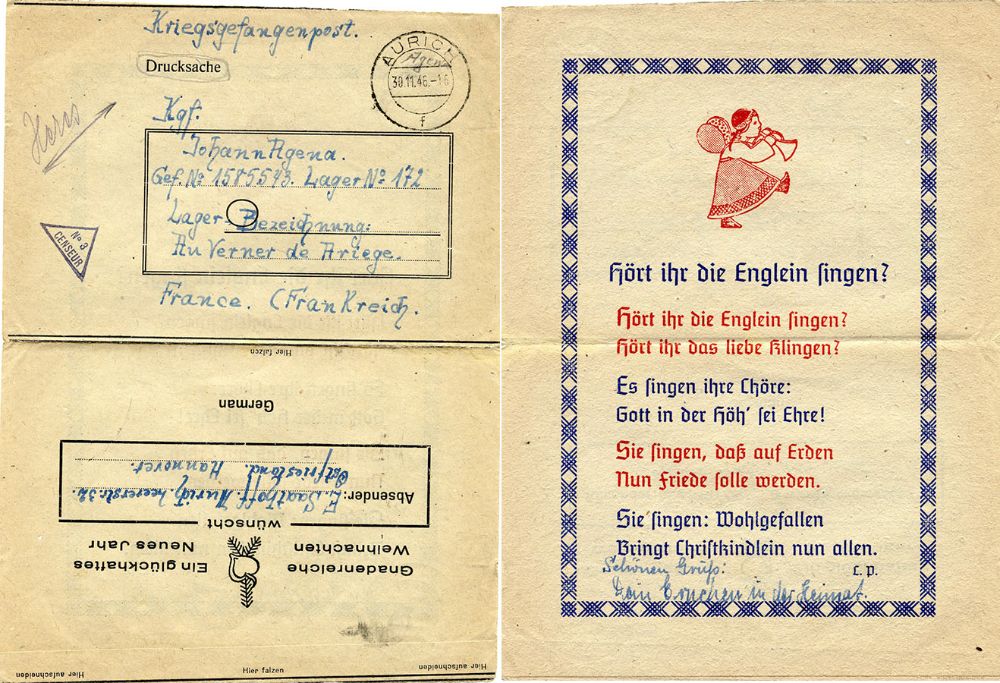 |
|
Send note to Staff
|
|
|
|
|
Pillar Of The Community

United States
890 Posts |
|
|
Very interesting. Could be the French word "Gares," which, loosely translated, means "station(s)" in English or German, with Drucksache meaning printed matter, of course. Old European script is difficult for me, but that's my best guess.
John |
Send note to Staff 
|
|
|
Pillar Of The Community
United Kingdom
3218 Posts |
|
|
Valued Member
United States
42 Posts |
|
|
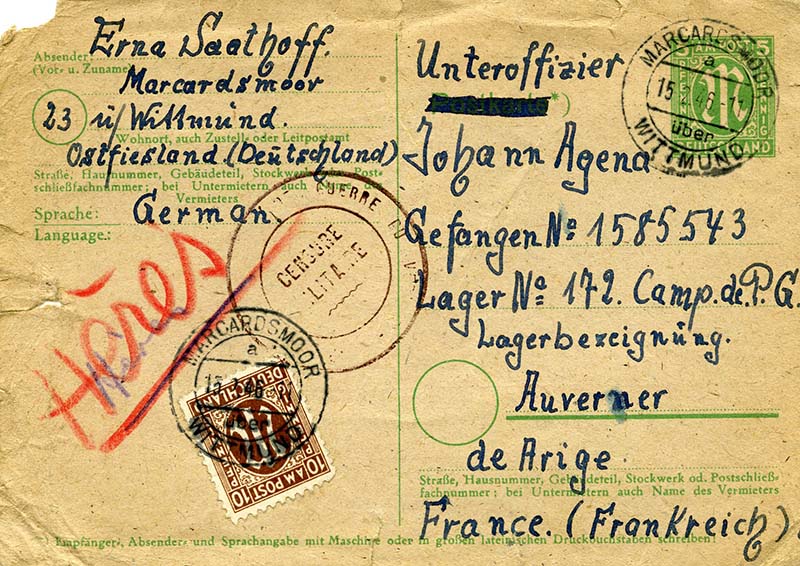
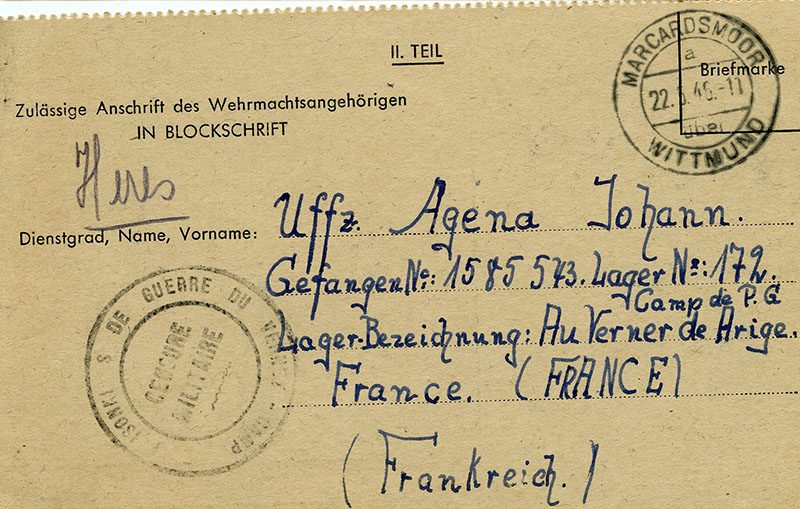
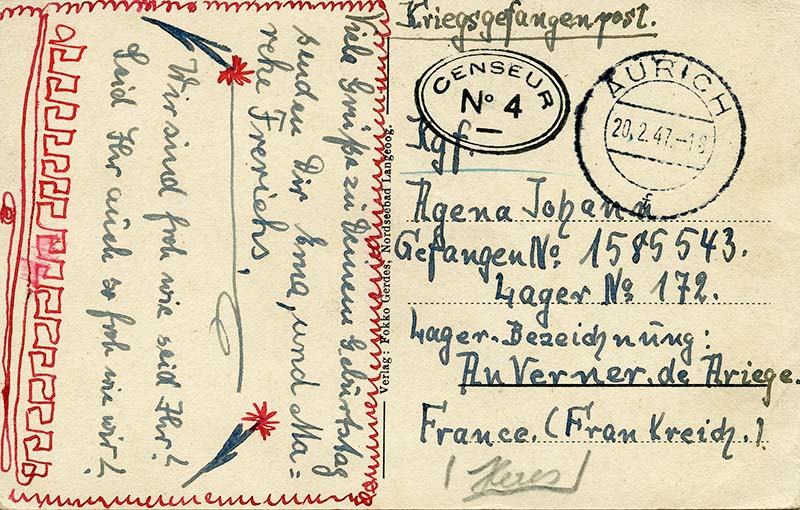
Thanks John. Just to prove I'm not crazy, I'll post a few more with "Heres" written on them. |
|
Send note to Staff
|
|
|
Valued Member
United States
42 Posts |
|
|
Valued Member
United States
42 Posts |
|
|
Valued Member
United States
42 Posts |
|
|
Pillar Of The Community
United States
8956 Posts |
|
|
The postcards were not mailed to Germany as the heading of this question says, but to France. I believe the French word "hères" means wretch, and it looks like this word was penciled in later. Lots of European folks had bad things to say about the Germans just after the war - could this just be calling this POW bad names?
Peter |
|
Send note to Staff
|
|
|
Pillar Of The Community
United States
3224 Posts |
|
|
It's French. Hères is a town in the department of Haute-Pyrénées. The cards are all addressed (in slightly different ways) to Verner in Ariege department, not that far away. So this is probably a forwarding inscription. Less likely that it is a routing; this would be a roundabout route. |
|
Send note to Staff
|
| Edited by hy-brasil - 01/09/2019 6:39 pm |
|
|
Pillar Of The Community
United States
890 Posts |
|
|
Valued Member
United States
42 Posts |
|
|
Thanks for pointing out the town of Hères, hy-brasil. One thing that has confused me for a while, though, is the spelling. I think that the actual destination is Le Vernet, and not Le Verner, even though it is consistently spelled Verner on the letters. There was a Camp Vernet, in Le Vernet, Ariege, which was a German internment camp during the occupation of France. After the German surrender, it's likely that the camp was converted to a German POW camp. |
|
Send note to Staff
|
|
|
Pillar Of The Community
United States
3224 Posts |
|
|
Sorry, it is Le Vernet; also the department is Ariège, not Ariege. The writer is obviously a primary German speaker and probably copied (or tried to) what the recipient told them. A French speaker would not use "au"/at so many times in addressing a letter.
So, we have to wonder about what the recipient was doing away from the camp. Work furlough, maybe? And camp mail is still being censored in 1947? |
|
Send note to Staff
|
|
|
Valued Member
United States
42 Posts |
|
|
Thanks again. If only I could read German, perhaps the letters could tell me the situation. |
|
Send note to Staff
|
|
|
Pillar Of The Community
United States
3224 Posts |
|
|
If you can show the backs of the ones not shown then perhaps someone can translate.
The last one sends birthday greetings; 4th line basically says 'we are glad to hear you are well'. Most of these messages to/from prisoners are pretty run-of-the-mill partly because censors often wouldn't allow much detail. |
|
Send note to Staff
|
| Edited by hy-brasil - 01/09/2019 11:40 pm |
|
|
Valued Member
Austria
283 Posts |
|
|
Sorry, but the translation of the last one is wrong. It says: Many birthday greetings, sent to you by Erna, and Mereke Frerichs. We are happy how are you? Are you as happy as we are? It's a rhyme, but for me it doesn't make any sense to write that to a person in a prison camp. But I found out how the story ended. Johann (Heien) Agena was released, came back to Germany and married Erna Saathoff. Erna died in 2001, and Johann in 2006 at the age of 91. https://gw.geneanet.org/jagena?lang...eien&n=agena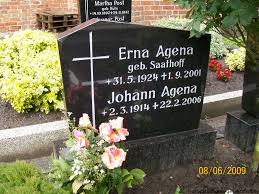 |
|
Send note to Staff
|
| Edited by tommtomm - 01/10/2019 07:30 am |
|
|
Pillar Of The Community
France, Metropolitan
3753 Posts |
|
|
Le Vernet (Ariège) No.172 https://prisonniers-de-guerre.fr/le...s-en-france/http://www.cheminsdememoire.gouv.fr...ee-du-vernet The camp changes under the Vichy regime. It becomes a repressive camp for suspicious foreigners. Forty thousand men, women and children were interned at the Vernet camp: volunteers from the International Brigades of the Spanish Civil War, Spanish Republicans, Israelites, Italians, Russians, Germans, Anti-Nazis, Romanians, Yugoslavs, and ten other nationalities. There were many types of Camps.Most people even today don't realize the extent of this. http://www.histoire-et-philatelie.f...rtation.html From this camp were deported between 1942 and 1944, six convoys to Auschwitz, Ile d'Avrigny and Dachau.___________________________________________________________________________________ |
|
Send note to Staff
|
| Edited by perf12 - 01/10/2019 09:39 am |
|
|
Replies: 21 / Views: 1,799 |
|



 Posted 01/09/2019 4:06 pm