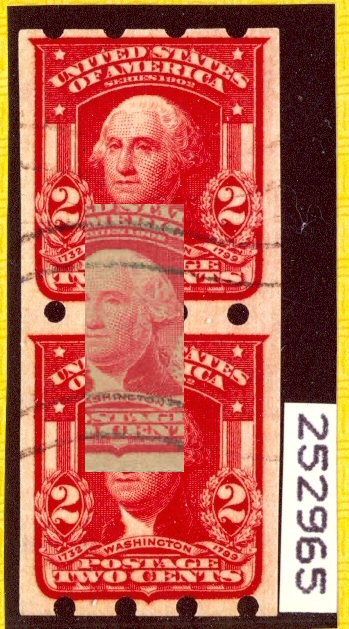
I submitted a strip of four #320Ad to the PF, knowing it had a philatelic, non-contemporaneous cancel that probably wouldn't add much to the value of the stamp compared to a contemporaneous use. To my suprise, the PF opined that the cancel is counterfeit. That leaves me feeling a bit incredulous, as I cannot find such a fake cancel on any of the early 20th Century stamps that are worth more in used condition, such as #459, #461 and #519, in the PF's web base. Further, there is a pair of #320 with Brinkerhoff perforations (PF cert #252965) that seems to have the exact mute roller cancellation, and was found to be genuine. It seems very odd to me that someone would fake a non-contemporaneous cancel, and for specifically this one item. Is this worth asking the PF for a reconsideration?
PF cert #252965 is a few decades old at this point, and was almost certainly examined by people other then those who looked at your item. Technology has improved greatly, and that pair might well get a different cert if examined today. As for faking a non-contemporaneous cancel, people use the tools available. And fakers do not always know as much as they think they do; I have seen fakes that were flat out impossible for that reason. High value documentary reds perforated on all four sides, for example. Those stamps were always issued with either one or two straight edges. So why did someone bother adding the perfs? They didn't know better.
John, the exact PF opinion is "THE CANCELLATION IS COUNTERFEIT."
Used strips of Schermack coils are almost always philatelic in nature; as you know, they were designed to be affixed by machine one at a time, hundreds per minute. All the pairs on the PF website (320d and 320Ad, same stamp), save one, are clearly used out of period as well. So, there's nothing unusual about dealers using private coil multiples on mail, and one would expect to see a roller cancel now and again.
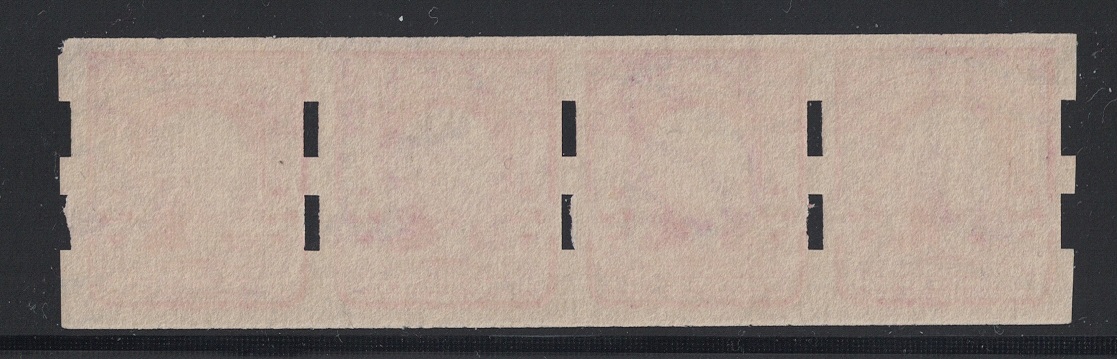
If anyone has an example of a mute roller cancel, genuine or other, I would like to see it. Sinclair, I'll post a scan of the back this afternoon.
From my observations on V&A used multiples about 1/2 are philatelic. When the Schermack/Mailometer machines were converted over to run government coils most users were left with partial coils. Often sent to the shipping department where they were torn off by hand and applied to packages. Quite often those are a bit tattered, even ratty looking.
Just to throw this out: if the roller is 1" across/in diameter (approximately so in my recollection) then a section should be repeated (every 3.14"+) on a strip of 4 which could be detectable by any damage/breaks in the lines and the repeated overall pattern of curves.
Also, this is something to put a blacklight on. If the cancel glows strongly, the ink is very modern. The stamps are still valid even today, of course, and a cert would probably read "cancel not contemporaneous" or something. But if the ink is somehow datable to later than the last usage of roller cancels, then there's a problem.
Th roller cancel on a portion of the strip of four matches the crest of the one on the genuine Brinkerhoff pair pretty closely. They are in the same family, if not actually the same cancel. Interesting coincidence anyway. Whether the Brinkerhoff cancel would be considered genuine if re-submitted is anyone's guess.
kcarmat - I have seen some single coils that appear torn off the roll as you describe. One of the certified #482A's is like that, IIRC.
I used to have close to 200 used V&A multiples. I went back and looked at some of the scans and it looks like about 50% philatelic on Schermacks/Mailometers and 75% philatelic on other vending companies.
I'm with you, I don't know how they could be so sure the cancellation was fake unless it was ink related.
Tipzi, I am afraid I am going to have to slightly disagree. Your cancel and the PF #252965 cancels are not 'pretty close'…they are identical. I resized the images so the stamps were exactly the same size, copied a section of the #252965 cancel, overlaid it on your stamp, and then made the pasted #252965 layer semitransparent. As you can see in the video below, they are a perfect match! (You can make the video full screen to see the match better.) Don
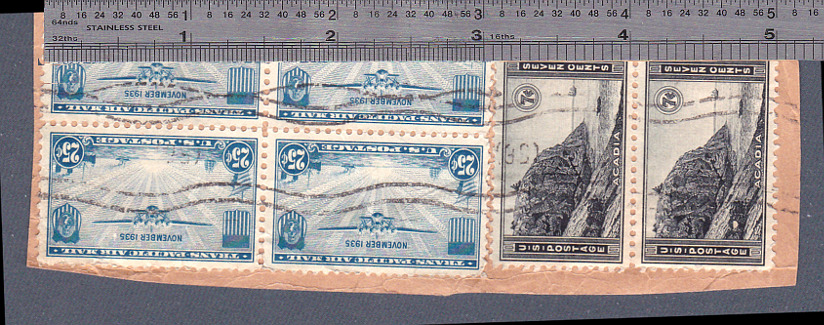
Not a mute cancel, but the curves match very well with what's on the coils: Elements like the numbers and line breaks measure right about 3-5/16" apart. Of course, all roller cancel devices need not be the same.
You might check the strip under a strong glass. If there is a fine spray of ink around the cancel, then it is a copy of a genuine cancel that was printed by computer printer.
Disclaimer: While a tremendous amount of effort goes into ensuring the accuracy of the information contained in this site, Stamp Community assumes no liability for errors. Copyright 2005 - 2026 Stamp Community Family - All rights reserved worldwide. Use of any images or content on this website without prior written permission of Stamp Community or the original lender is strictly prohibited. Privacy Policy / Terms of UseAdvertise Here





 Posted 02/17/2019 12:44 pm