Stamp Community Family of Web Sites
Thousands of stamps, consistently graded, competitively priced and hundreds of in-depth blog posts to read


Stamp Community Forum
 
Username:
Password:
Save Password
Forgot your Password?

This page may contain links that result in small commissions to keep this free site up and running.

Welcome Guest! Registering and/or logging in will remove the anchor (bottom) ads. It's Free!

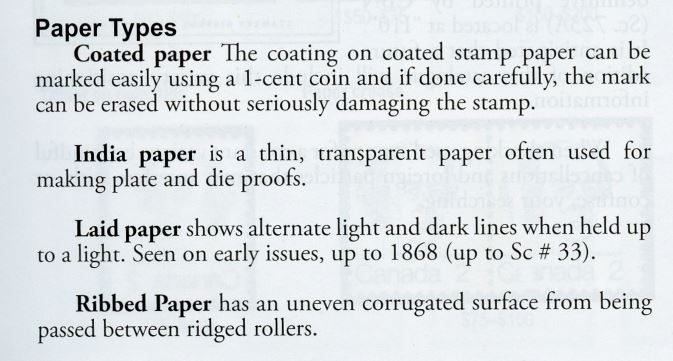
Canada Unitrade Catalogue - Paper Types - Misunderstood!

 
To participate in the forum you must log in or register.
Author Previous TopicReplies: 10 / Views: 1,210Next Topic  
Rest in Peace

Netherlands
963 Posts
Posted 03/05/2019   06:39 am  Show Profile Bookmark this topic Add Galeoptix to your friends list Get a Link to this Message


The first subdivision would be hand-made versus machine-made. Apart from maybe a few 19th century stamps, ALL stamps are printed on machine-made paper.

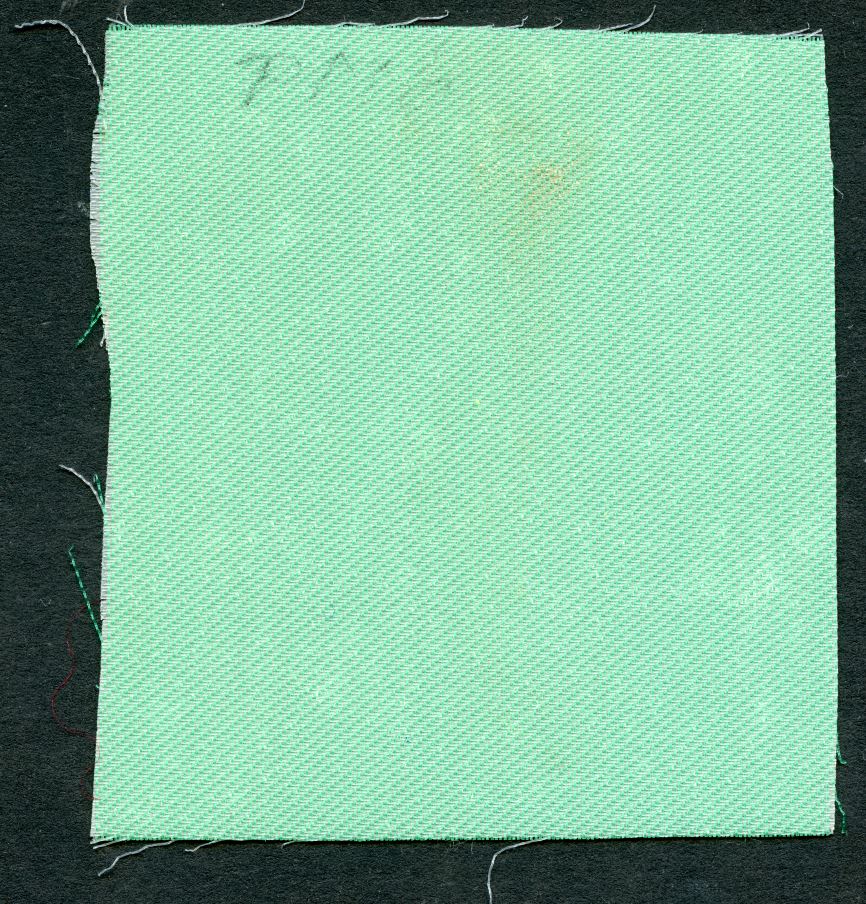
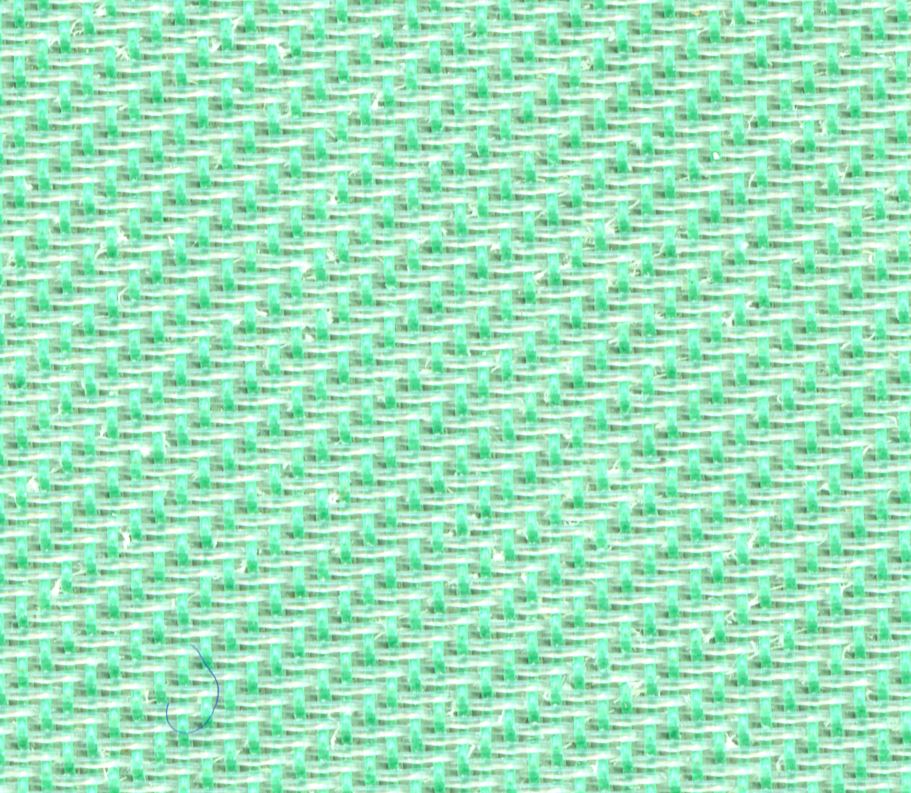
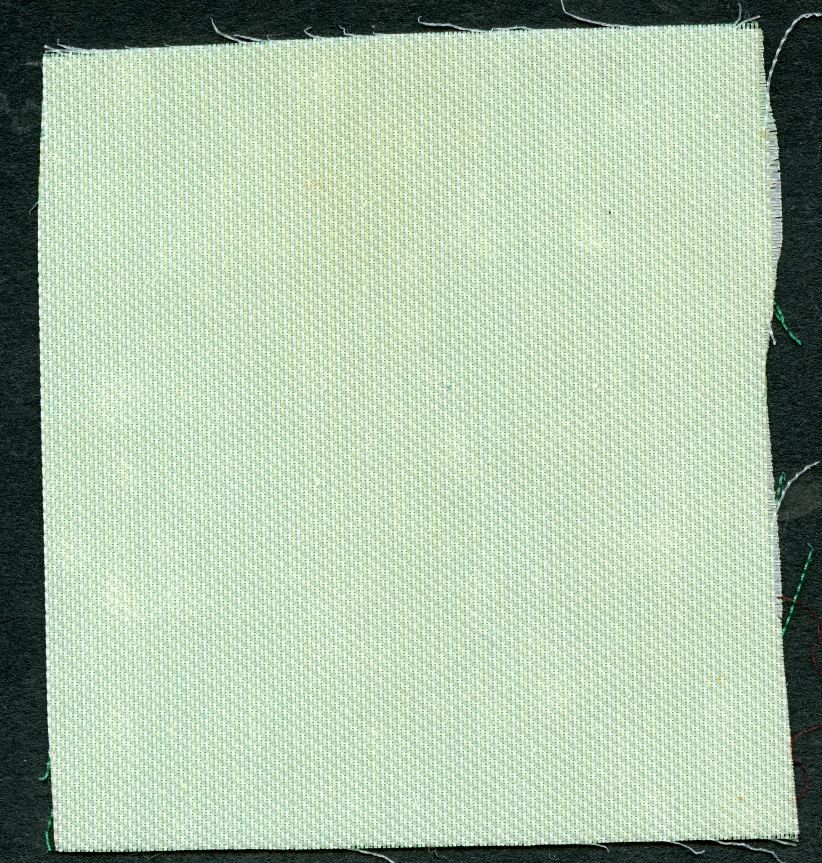
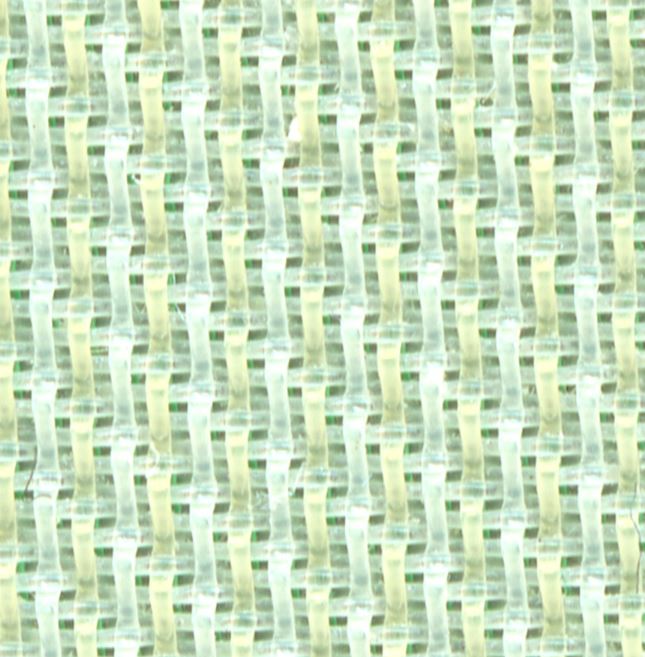
The textile-binding of the long wire/sieve gets imprinted in the paper-reel at the wire-side and hence maybe visible in our stamp papers.

This sieve-structure has (so far) 3 types of binding:

Linen-binding:
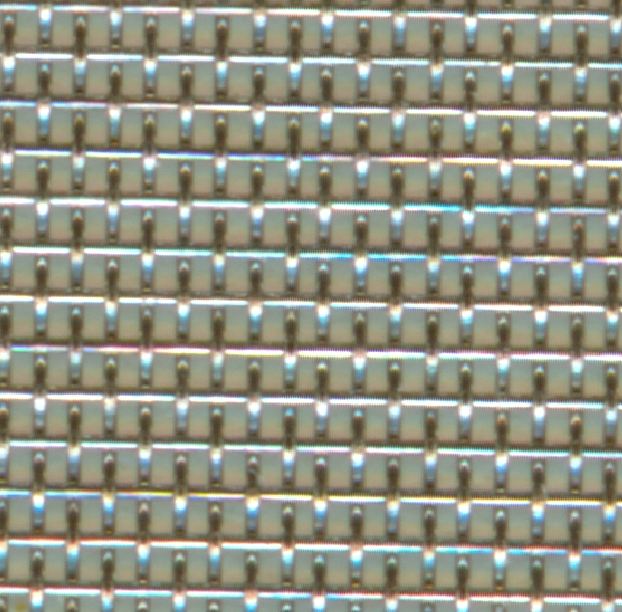


after connecting the cross-overs by a blue line:
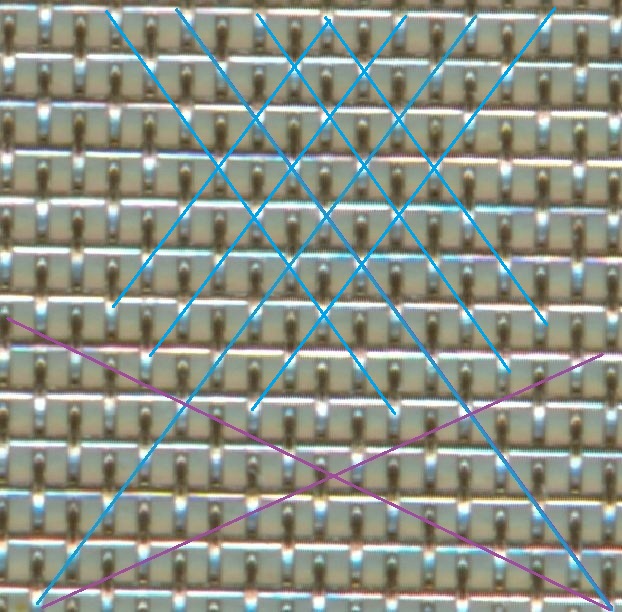


Twill-binding:
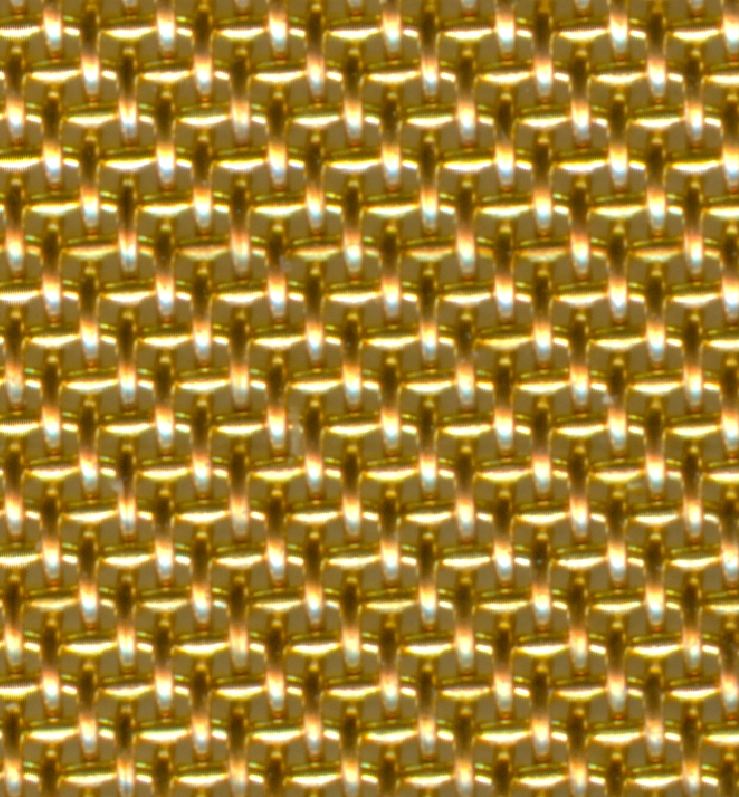


after connecting the cross-overs by a blue line:
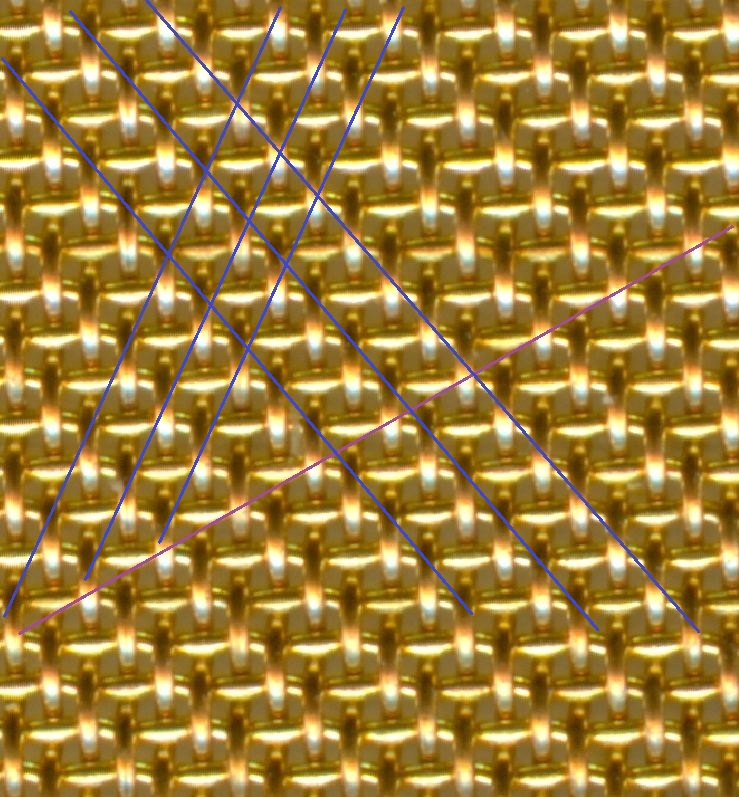


The purples lines represent diagonals our eyes are less likely to see, but still!

In the linen-binding the diagonals are symmetrical and are equidistant - the next parallel blue line is just as far way in the case of the ascending lines as of the descending lines.

In the twill-binding, however, the ascending blue lines are nearer to each other!

I hope this will make it clear why I refer to the linen-binding as symmetrical and to the twill-binding as asymmetrical. It is not just the angles of the blue lines but also the density!

The first two types of bindings can be found chronologically since the 1850-ies till 1937 with NO exception. ALL have a linen-binding.

The twill-bindings can be seen since 1937 - occurring for the first time in Canadian stamps.

Around 1971 the "simple" bindings were replaced by a multi-layered binding.

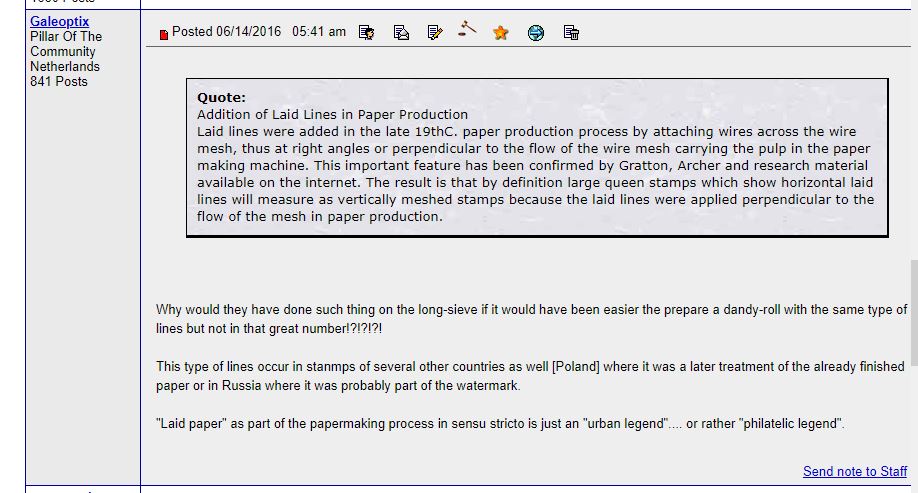
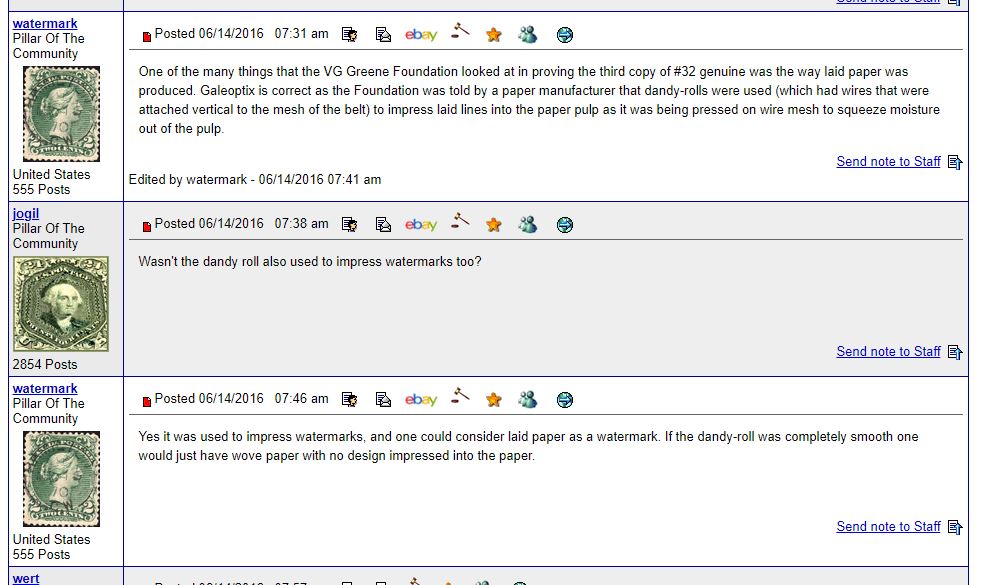
There is NO laid paper as coming from the long sieve! It is either a watermark OR a later finishing-off the paper-reel that is responsible for the so-called "laid lines".

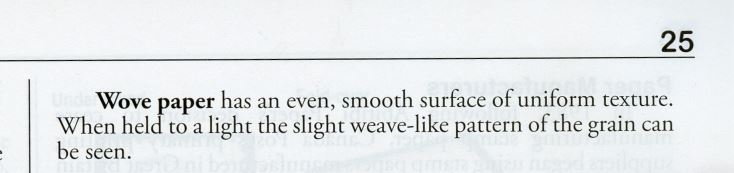
The is NO wove paper as such! ALL machine-made papers have a weave-like pattern [see my pictures above!]

Whether the sieve structure becomes visible for us depends on a variety of factors. None of which justify a separate category of paper!

The so-called "ribbing" is NO extra effect but depends on the relative thickness of the threads of the sieve.

Having established the direction of paper - i.e. where are the lengthwise threads of the sieve - and placing a stamp in our hands so the lengthwise threads run vertically, the horizontal threads are sometimes thicker. In a linen-binding this will rarely give a visible effect, in a twill-binding these thicker line give us the impression of "ribbing"!

ALL "ribbings" in Canadian stamps in the 1952-1975 period come from the twill-binding. Although it may be expected that the best side of a stamp paper - i.e.the felt side - was used for printing, this is NOT always so!

ALL 1952-1955 stamps have the wire side printed!

In the 1955-1967 period most stamps on uncoated paper have the felt side printed.

Since 1967 it gets complicated, too complicated to go into it in this thread....


Send note to Staff

Rest in Peace
Netherlands
963 Posts
Posted 03/05/2019   4:04 pm  Show Profile Bookmark this reply Add Galeoptix to your friends list  Get a Link to this Reply
An example of the multilayered binding as in use in 1986 in the Paper Mills of Maastricht, The Netherlands.


Send note to Staff  Go to Top of Page
Rest in Peace
Netherlands
963 Posts
Posted 03/06/2019   06:37 am  Show Profile Bookmark this reply Add Galeoptix to your friends list  Get a Link to this Reply
http://www.greenefoundation.ca/Repo...y152013).pdf


Quote:

Visibility of Laid Lines

It has been noted that the visibility of the laid lines can be a useful test of laid paper. On the Three Cent it is relatively easy to see the lines on the reverse since it is a thinner paper. For the One Cent usually the lines are visible on the reverse but sometimes the surface can be pressed smooth so the lines are somewhat buried within the paper visually. It is also important to see a shine of the laid lines on the front of the stamp. This can be done by holding the stamp at an angle to good light and sighting either from the side or bottom. This has been confirmed with a number of genuine items. Generally those with faked laid lines will not have the shine of visible lines on the front of the stamp.

The lines are always more visible on reverse when the stamp is placed in water or watermark fluid. The
traditional test has been simply to place the stamp in watermark fluid.


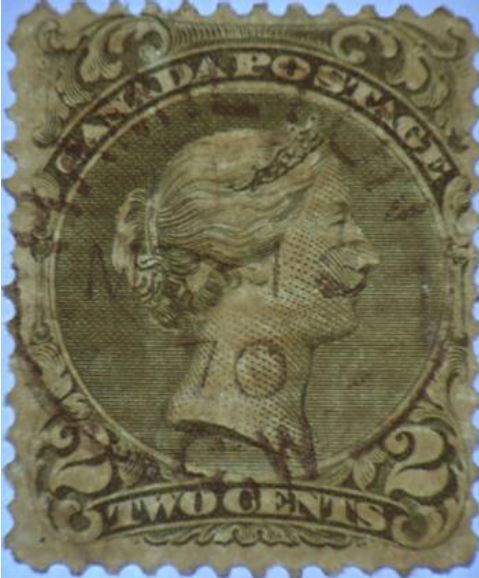
Laid lines as seen from the front
VSC6000 photographhusing 365nm transmitted ultra violet light

http://www.galeoptix.nl/fila/canada...k_2ct_02.jpg

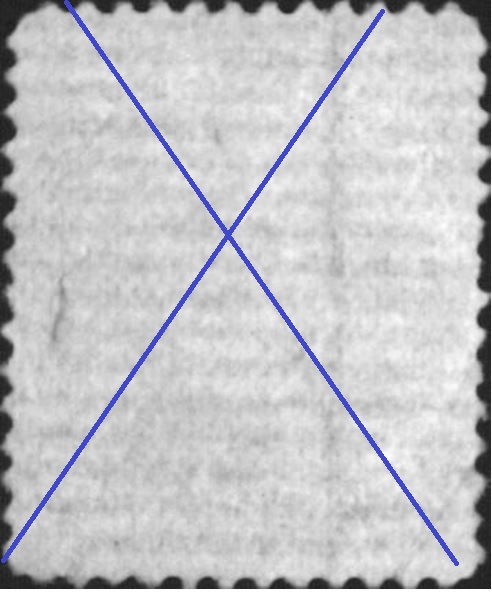
Laid lines as seen from the back
VSC6000 photograph using spot fluorescence


Normal linen-binding with probably later on applied horizontal lines in the finishing off of the paper! These lines were applied at the FRONT as can be expected with the sieve structure at the back!

NO LAID PAPER!

Whatever the „lines" are it is NOT laid paper!

This 2c Large Queen stamp may be an interesting variety, but as you can see from the picture, the „mesh" runs though the „lines" so the lines do NOT belong to the wire/sieve.
Send note to Staff  Go to Top of Page
Pillar Of The Community
3859 Posts
Posted 03/06/2019   07:57 am  Show Profile Bookmark this reply Add jogil to your friends list  Get a Link to this Reply
Since it is a variety of Canada Scott 24 that has its own individual full Scott 32 number where as other varieties have the Scott 24 number followed by a letter which makes it a sub-number and since only three used copies have been found so far, this makes it a rare and desirable stamp to many Canada stamp collectors. There are many other different paper types according to Duckworth and this is considered to be horizontal laid lines with vertical mesh paper (Duckworth paper type 5). This division of Scott numbers can be argued as having been previously applied to Canada Scott 1-3 laid paper and Canada Scott 4-10 wove paper. The aforementioned is all taken from the Scott/Unitrade catalogues. It appears that the so-called stitch watermark may have been removed from its listings.
Send note to Staff  Go to Top of Page
Edited by jogil - 03/06/2019 08:15 am
Pillar Of The Community
602 Posts
Posted 03/06/2019   11:10 am  Show Profile Bookmark this reply Add archerg to your friends list  Get a Link to this Reply
Thank you to the OP for the excellent primer on weave patterns. Your posts are deepening my understanding of the papermaking process, please continue.

The Unitrade catalogue uses the Scott numbering system by a licensing agreement. (For example, Scott calls a #24b thin paper; Unitrade must do so too even though it does not measure as a thin paper.)

The terms used to describe paper come from the visual and tactile observations of early researchers. They are often not technically accurate but the names have remained. In the interests of brevity I'll avoid listing any more.

Even the earliest laid papers (Canada #1, 2, 3) appear to be machine-made, not on the traditional wire sieve and rectangular mold.

Jogil mentions stitch watermarks, which are not really watermarks. They are better thought of as EFO's. They are remnants of repairs or surface anomalies on the sieve. They are surprisingly common on Small Queens, and vary so much in strength and appearance it is hard to justify giving them a catalogue sub-listing.
Send note to Staff  Go to Top of Page
Rest in Peace
Netherlands
963 Posts
Posted 03/06/2019   2:57 pm  Show Profile Bookmark this reply Add Galeoptix to your friends list  Get a Link to this Reply


As we discussed this here before! :)

It is just a watermark applied by a dandy-roll.
Send note to Staff  Go to Top of Page
Valued Member
Canada
97 Posts
Posted 03/20/2019   12:34 pm  Show Profile Bookmark this reply Add Brixtonchrome to your friends list  Get a Link to this Reply
Excellent! I am looking forward to incorporating this information into my discussion of the papers on the Caricature Issues when I get time to start writing again.
Send note to Staff  Go to Top of Page
Valued Member
Canada
123 Posts
Posted 04/01/2019   4:43 pm  Show Profile Bookmark this reply Add Brad905 to your friends list  Get a Link to this Reply
I guess I have a lot to understand in terms of the paper production. The pictures you have above with the metal screening - is that contemporary to the 1930's or is it relatively modern? So you are saying that the pulp was put on these types of metal screens in the Forming part of the process. At what point of the process is the binding (which you also show above) used? I believe that they use felt in the drying process.

As you seem to know a lot about paper, I was hoping perhaps you could join some of the dots so I can see the whole process.
Send note to Staff  Go to Top of Page
Rest in Peace
Netherlands
963 Posts
Posted 04/01/2019   5:18 pm  Show Profile Bookmark this reply Add Galeoptix to your friends list  Get a Link to this Reply
Brad,

The bindings are what the long-sieve is made off. So at the very beginning of the paper making process.

Linen-binding fron the very beginning of machine-made paper. Twill-binding since 1937!

Multi-layered bindings since 1974!

Rein
Send note to Staff  Go to Top of Page
Valued Member
Canada
123 Posts
Posted 04/01/2019   5:54 pm  Show Profile Bookmark this reply Add Brad905 to your friends list  Get a Link to this Reply
I am not sure that "binding" is the correct word in English. Then again, I am not in the paper industry and that is a part of philately I have ignored in the past, but would like to know more.

At any rate, I still don't really understand what part of the papermaking process this is applicable to.
Send note to Staff  Go to Top of Page
Rest in Peace
Netherlands
963 Posts
Posted 04/02/2019   12:08 pm  Show Profile Bookmark this reply Add Galeoptix to your friends list  Get a Link to this Reply
Brad,

plain weave and twill may be more proper term for it...

Rein
Send note to Staff  Go to Top of Page
  Previous TopicReplies: 10 / Views: 1,210Next Topic  
 
To participate in the forum you must log in or register.

Go to Top of Page

Disclaimer: While a tremendous amount of effort goes into ensuring the accuracy of the information contained in this site, Stamp Community assumes no liability for errors. Copyright 2005 - 2026 Stamp Community Family - All rights reserved worldwide. Use of any images or content on this website without prior written permission of Stamp Community or the original lender is strictly prohibited.
Privacy Policy / Terms of Use    Advertise Here
Stamp Community Forum © 2007 - 2026 Stamp Community Forums
It took 0.27 seconds to lick this stamp. Powered By: Snitz Forums 2000 Version 3.4.05