| Author |
 Replies: 19 / Views: 2,468 Replies: 19 / Views: 2,468 |
|
Pillar Of The Community
3860 Posts |
|
|
Just like Canada Scott/Unitrade # 90xii exists dry printed in 1905 from unhardened plates 13-16 and in 1907 from hardened plates 31-34, there may be the possibility that Canada Scott/Unitrade # 98 may also exist dry printed in 1908 from hardened printing plates 1-4.  The stamp on the left (wet?) has a narrower design width than the stamp on the right (dry?). Both are on vertical wove paper. 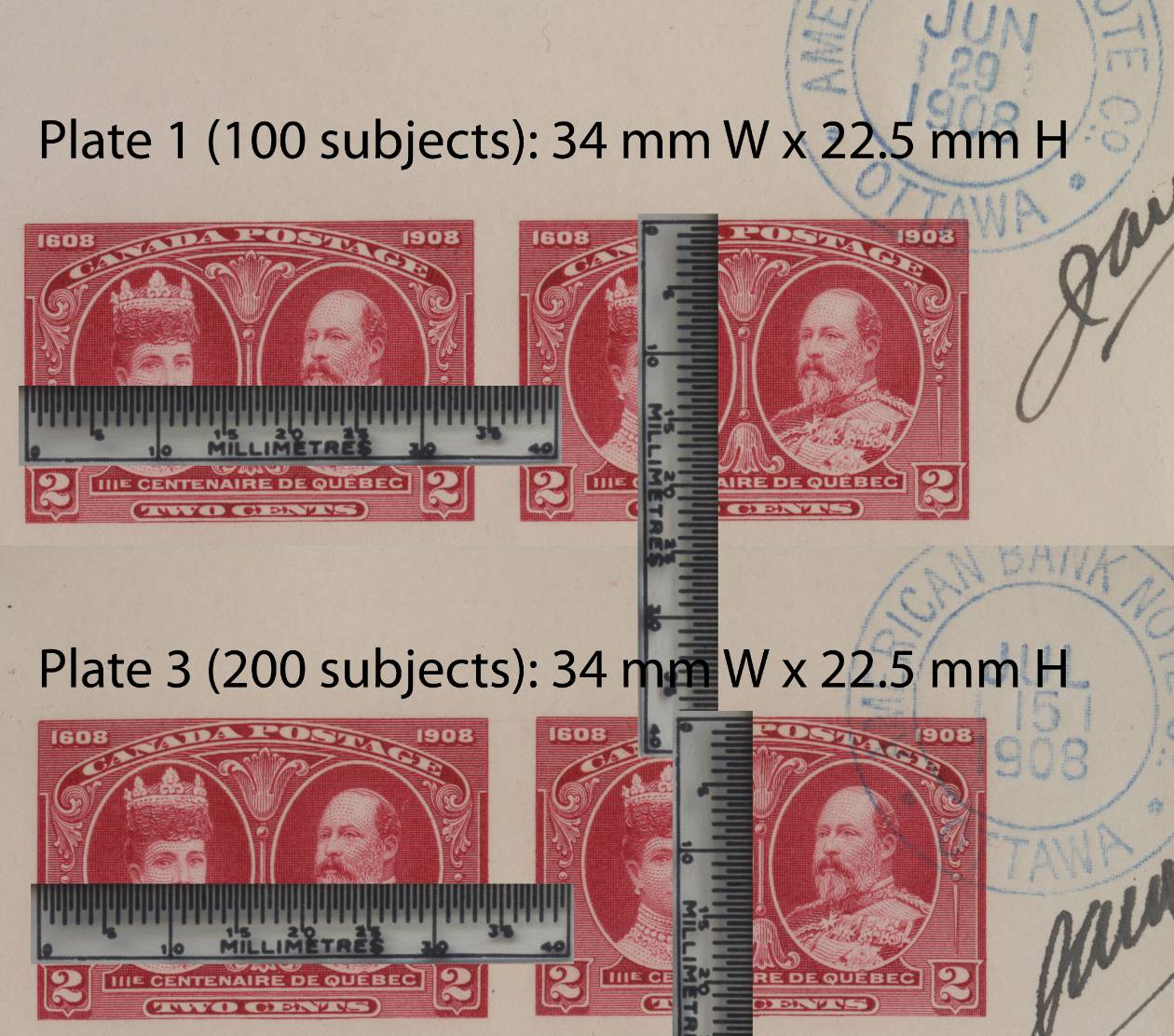 These measurements were taken from plate proofs in the stamp archives and they are the exact same dimensions as the stamp on the right above. |
|
Send note to Staff
|
| Edited by jogil - 03/28/2019 11:04 am |
|
|
|
|
Rest in Peace
7742 Posts |
|
|
jogil..Interesting
I have a few singles and only one plate..Will have to do a little measuring.
Robert
|
Send note to Staff 
|
|
|
Pillar Of The Community
606 Posts |
|
|
How does one differentiate between a "dry printing" and a printing on, say, "less dampened" paper?
With the Admiral issue the difference is obvious. The change in printing method was deliberate and the wet / dry printings are usually easy to separate, both by checking dimensions and the degree of embossing effect on back. With these pre-Admiral issues, there seems to be a wide variance in shrinkage and I respectfully question if there are intentional "dry" printings. Happy to hear your further evidence to support the theory; it's an interesting possibility.
|
|
Send note to Staff
|
|
|
Pillar Of The Community
3860 Posts |
|
|
Such variances have been found in the Queen Victoria leaf and numeral issues. However, these can be attributed to differences between vertical and horizontal wove paper with the vertical wove being narrower and longer than the horizontal wove while the horizontal wove being wider and shorter than the vertical wove. The above stamps both have vertical wove paper and the difference is in the horizontal width only. The proof size should most likely represent the exact original dimensions of the stamp. |
|
Send note to Staff
|
| Edited by jogil - 03/28/2019 4:02 pm |
|
|
Valued Member
Canada
123 Posts |
|
|
I did check my 3 mint and 15 used copies but found no difference in the width of the stamps.
I looked through Boggs, Jarrett, and Holmes and found no mention of this.
I also pulled out Ron Brigham's Auction Catalogue covering the Quebec Tercentenaries. He had numerous plate proofs. Two large ones, one hardened, the other unhardened on India Paper. Both dated in June or July of 1908. They sold for $4000 each.
Lot 82 was nine stamps with plate varieties, "on used singles all annotated as to variety including Hairlines, Guide Dots, Guidelines, Plate Dots etc." No mention of paper.
Seems if you are correct, then you are in uncharted territory!
Out of interest, where did you get the picture of the Die Proofs with the rulers on them? Is that of your manufacture?
|
|
Send note to Staff
|
|
|
Pillar Of The Community
3860 Posts |
|
|
I got the proof pictures from the Canada Postal Archive archivist who took the measurements himself and he put together the proof pictures with rulers. Did any of your copies measure 34 mm across in width? |
|
Send note to Staff
|
|
|
Pillar Of The Community
3860 Posts |
|
|
See picture below. 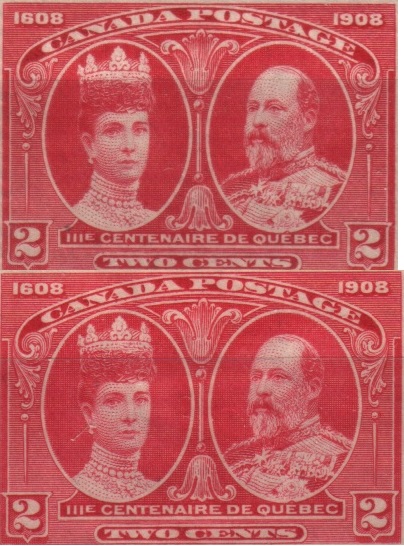 The top stamp has a design width of 33 mm and the bottom stamp has a design width of 34 mm. (A difference of 0.5 mm has been used for the Admiral stamp design widths with 17.5 mm for wet printed stamps and 18 mm for dry printed stamps.) |
|
Send note to Staff
|
| Edited by jogil - 03/29/2019 07:54 am |
|
|
Pillar Of The Community
3860 Posts |
|
|
It is interesting to note the details of the lines in the hair above the ears between both stamps. |
|
Send note to Staff
|
|
|
Pillar Of The Community
1375 Posts |
|
|
hello Jogil, I just saw your interesting topic and the first thing I made was looking in the internet. And then the first images I looked a bit closer, were these: https://deveneystamps.com/collectio...-mint-052318https://brixtonchrome.com/products/...h-vf-84-j-lhBoth have exactly the same size. But both have a different size from your stamp at the left - they are both wider, so also "dry printing"? (and both have a good printing quality) Maybe you should scan more than two stamps, and then compare in a graphics program. And if we can help you in your research - and also find stamp in 34mm width - the question is: how can we be sure it's not because of the vertical/horizontal wove, so how do we define this? (if not by design size) |
|
Send note to Staff
|
|
|
Pillar Of The Community
3860 Posts |
|
|
stamperix: Here are some five stamps that I found to be wider after examining many from different dealers stocks in comparison to the one on the left which is narrower. 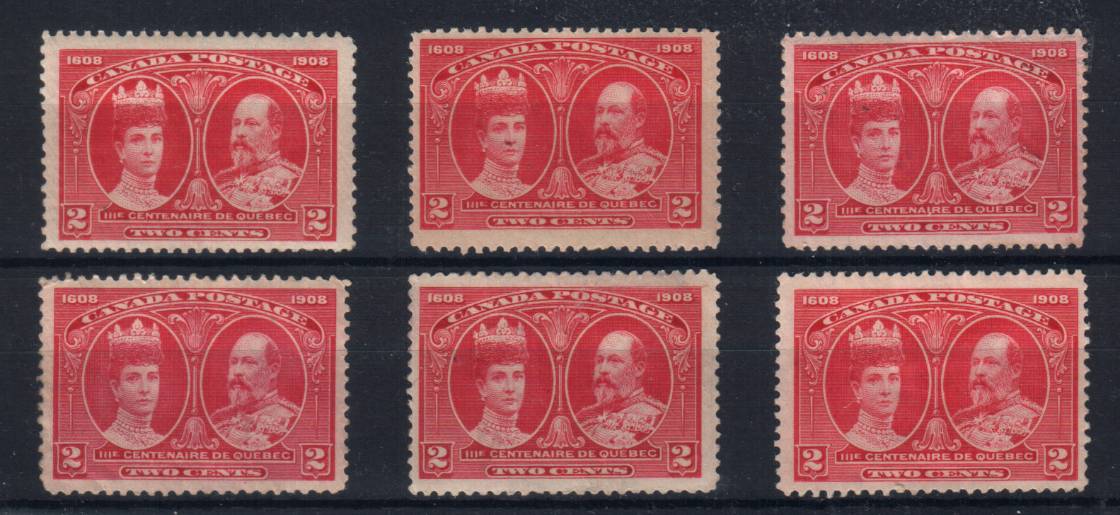 |
|
Send note to Staff
|
| Edited by jogil - 04/02/2019 10:10 am |
|
|
Pillar Of The Community
1375 Posts |
|
|
But when the size is not the defining factor alone, how can we know that it's because of the dry printing and not because of the horizontal vs. vertical paper wove?
Also, is there, like in US stamps, a difference in size between sheet and booklet stamps? |
|
Send note to Staff
|
|
|
Valued Member
Canada
123 Posts |
|
|
Jogil wrote, "I got the proof pictures from the Canada Postal Archive archivist who took the measurements himself and he put together the proof pictures with rulers. Did any of your copies measure 34 mm across in width?"
I had no idea that they would offer such a service. Did you have to go there, or did they do it for you based on a phone call or email? Is there a contact there? |
|
Send note to Staff
|
|
|
Pillar Of The Community
3860 Posts |
|
|
stamperix: All of them have vertical wove paper. If any had horizontal wove paper, then the difference would be due to this. Yes, the wide ones measure 34 mm across while the narrow one measures 33 mm across. Brad905: It was done by email by contacting them by their email but it was done some time ago by them. |
|
Send note to Staff
|
| Edited by jogil - 04/02/2019 12:59 pm |
|
|
Pillar Of The Community
1375 Posts |
|
|
Thank you again. All this is new to me as I am more collecting US stamps, but there are similar areas (Special Handling, SBP, wet and dry printing and so on). I found now interesting information about this, like at http://www.bnaps.org/ore/VanSomeren...ps-Paper.htm. I looked at some of my Canadian stamps and indeed I can see the wove before a light source. I never made this for US stamps and never read about this. So I thought it would not work that way. There was my thread about SBP here: https://goscf.com/t/66763&whichpage=1Also Galeoptix participated there and said we can see the paper grain in US stamps by looking at scans. https://goscf.com/t/66763&whichpage=2#583764So is that a lesson learned about paper grain/wove direction not only for Canadian stamps, but can we also see it always for US stamps, for example before a light source? (Yes, of course I can try it by myself...but I want to know if this is a reliable way to determine the paper grain also for experienced US collectors?) But to get back to your topic, I think you showed quite impressing examples and the difference is there. As archerg writes, the source has to be defined. What about the back and the embossing visibility? What about the printing quality, is it consistent and good over all your found examples above? In general it seems possible, especially after finding the 90xii, so what was the reason for 90xii to get listed as dry printing and not "less dampened"? |
|
Send note to Staff
|
| Edited by stamperix - 04/02/2019 4:33 pm |
|
|
Pillar Of The Community
3860 Posts |
|
|
The main sources about the dry printed stamp of the King Edward VII Scott/Unitrade # 90xii are as follows:
Marler, George C, The Edward VII Issue of Canada, National Postal Museum, Ottawa, ON, 1975, pp. 128-130.
Richardson Ed, "Canada's King Edward VII Issue 2c Experimental Printing of December 1905", The Essay-Proof Journal, Volume 14, Number 4, Whole Number 56, October 1957, The Essay-Proof Society, New York, NY, p. 216.
Selby, Alan, King Edward VII Issue 1902-1912: An Exhibit Prepared By Alan Selby, British North America Philatelic Society, Toronto, ON, 2007, pp. 66, 77-84.
Searle, Graham, "Experimental Printings Of The 2 Cent Edward VII Stamp", Maple Leaves, Volume 35, Number 4, Whole Number 346, October 2017, Canadian Philatelic Society of Great Britain, pp. 229-230.
Firby, Charles G, King Edward VII Issue: The "ASTOC" Canadian Collection, Charles G. Firby Auctions, Waterford, MI, 2007, pp. 15-23.
"New Canada Plate Numbers Come to Light After 60 Years", BNA Topics, Volume 22, Number 5, Whole Number 233, May 1965, British North America Philatelic Society, Toronto, ON, pp. 118-120. |
|
Send note to Staff
|
|
|
Pillar Of The Community
1375 Posts |
|
|
thank you Jogil, that is helpful, so I have to read some pages when I have time :).
But one point: You mention the width only, not the height. Shouldn't a dry printing be different from the wet printing as it does not shrink neither vertically nor horizontally, so that the width should be 34mm (as you said), but the height 22.5mm and so more than the stamps in wet printing and horizontal wove? So we could use both width and height as indicators to be sure (even without looking at the wove)?
|
|
Send note to Staff
|
|
|
Replies: 19 / Views: 2,468 |
|




 Posted 03/28/2019 06:28 am


