| Author |
 Replies: 11 / Views: 1,718 Replies: 11 / Views: 1,718 |
|
|
Valued Member
United States
249 Posts |
|
|
|
Amidst the heap of philatelic paraphernalia recently gifted to me was a 1936-vintage Scott Catalogue. In it, the catalogue numbers for pre-1900 U.S. stamp listings do not always coincide with contemporary numbers.
Obviously, there were one or more instances of renumbering... I welcome any additional comments.
|
|
Send note to Staff
|
|
|
|
|
Valued Member
United States
424 Posts |
|
|
A few days ago I was searching through Google Books looking to see what old stamp catalogs they had scans for, and I happened upon a 1925 version.
On page five it lists what we now call Scott #1 and 2 as 28 and 29. I wonder at what point they changed it to renumber the postmaster provisionals that were 1 - 27?
Dale
|
Send note to Staff 
|
|
|
Pillar Of The Community
673 Posts |
|
|
I wish they would undergo a new renumbering, with the focus of consistency in mind... like minor varieties meaning the same thing. For instance, <number>a, b, c would denote a color variation, <nunmber>i would denote a paper variation, <number>A would denote Inverts of a variety only, etc. The closest they come to this in the US Specialized is in the Private Die, but even then there are some inconsistencies. (I would be ok with something like a 120Aaii where it's an invert, color variant, on ribbed paper (yeah, I get that's an impossibility, but just giving an example).
It would make ID so much clearer...
But I'm sure I'll never get my wish.
|
|
Send note to Staff
|
|
|
Pillar Of The Community
United States
2941 Posts |
|
|
Quote:
I wish they would undergo a new renumbering, with the focus of consistency in mind This is the thing I love most about Michel's system -- the rigid consistency. If the catalog number suffix is a small letter from the beginning of the alphabet, it's a color variety. If it's a capital letter from the end of the alphabet, it's a watermark variety. Etc., etc., etc. |
|
Send note to Staff
|
|
|
|
Pillar Of The Community
United States
4521 Posts |
|
|
There would a crisis if Scott did anything dramatic on numbering. They can go a long way in just improving the catalog readability. |
|
Send note to Staff
|
Al |
|
|
Pillar Of The Community
United States
925 Posts |
|
|
I have a 1938 Specialized with the old numbering system. The next catalog I have is a 1948 and it has the current numbering system. |
|
Send note to Staff
|
|
|
Pillar Of The Community
6366 Posts |
|
|
A major renumbering occurred in 1940. Here is the introductory text from the 1940 Worldwide catalog: 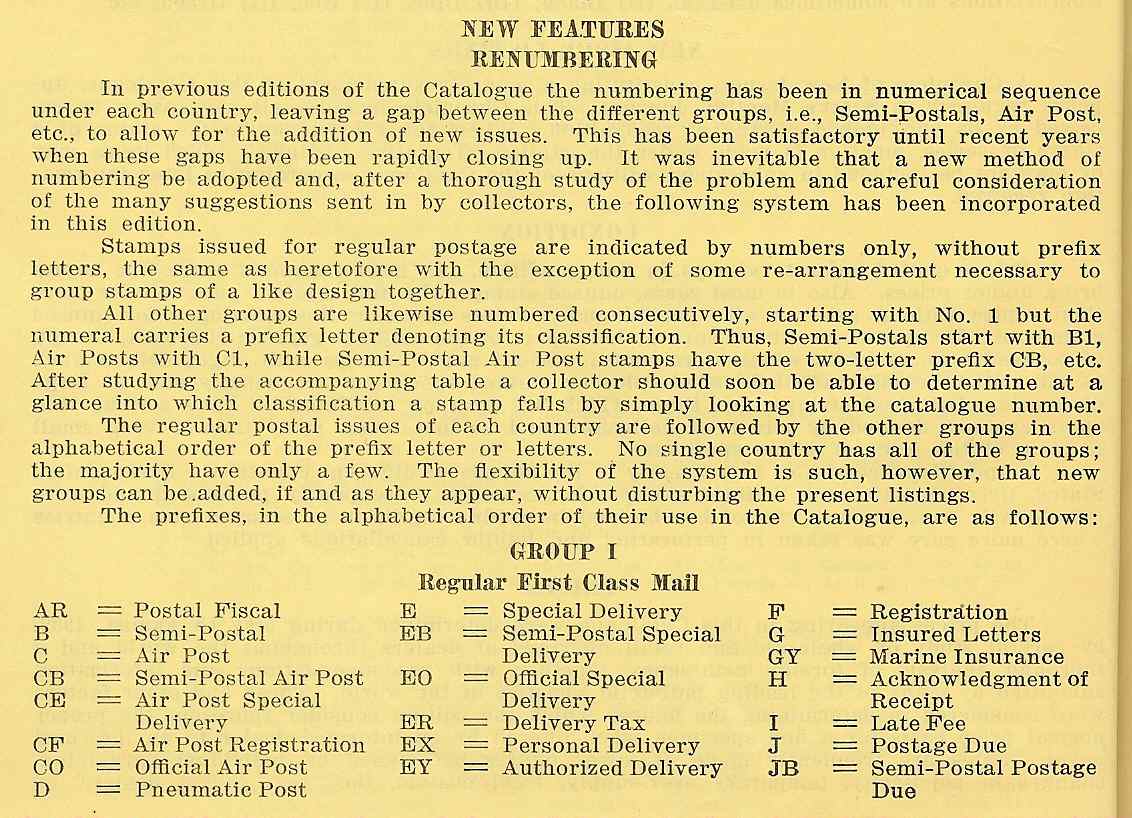 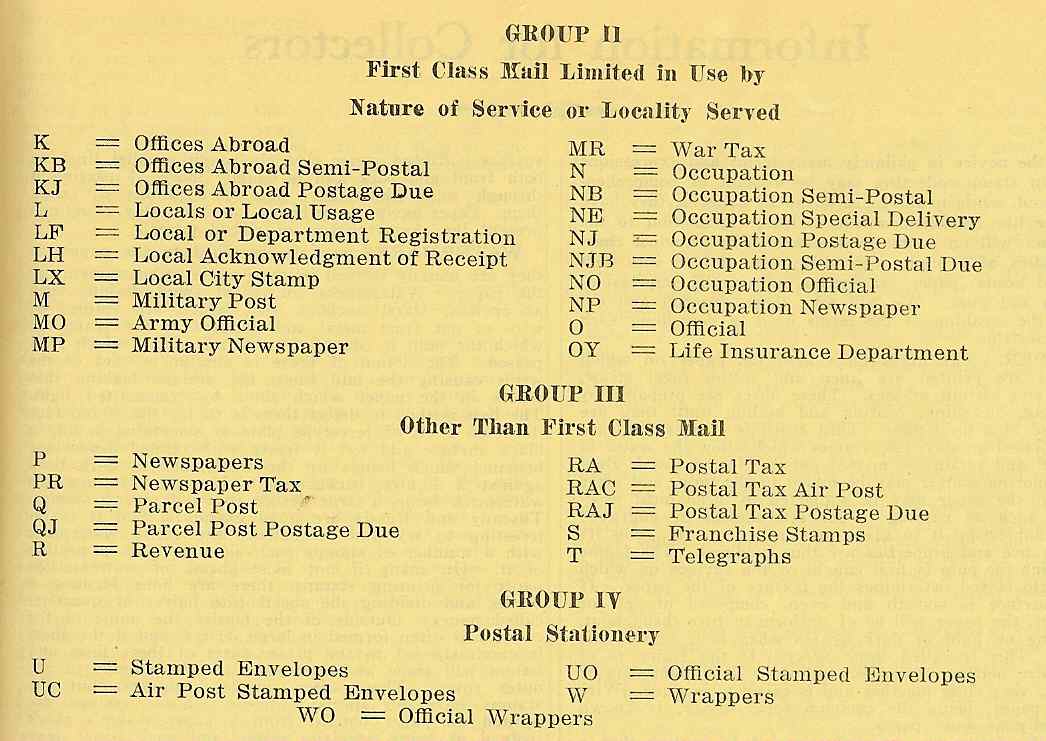 There are numerous examples of renumbering of small sections of the catalog in other years. |
|
Send note to Staff
|
| Edited by John Becker - 03/28/2019 7:33 pm |
|
|
Valued Member
United States
249 Posts |
|
|
That Scott chose 1940 to overhaul its catalog logic may not be a coincidence.
Theory: A spin-off of Roosevelt's New Deal during the 1930s was the inculcation of operational performance metrics across government. Such knowledge is portable, and it probably spread to the private sector via academia and as analysts transitioned between jobs. Scott's catalog logic may have been influenced this way. Just a guess. |
|
Send note to Staff
|
|
|
Valued Member
Canada
241 Posts |
|
|
Scott numbering system reserves catalogue numbers when they face an expanding set to use their own description of it. If a country issues less stamp than the number of stamps in that set they end up with catalogue numbers that end up unassigned.
Flip side is that if there are more stamps they come up with 545A, 545B etc because 2 values were issued between the numbers 545 and 546 for that series.
This is why we end up seeing 545a as a perf variation of 545 or 545A that would be a new value issued after the original set was issued.
Maybe the most inconsistent of the major catalogues. |
|
Send note to Staff
|
|
|
Pillar Of The Community
673 Posts |
|
|
A few random usage of "a" sub-variation in Scott:
a. <color variety>
a. diagonal half
a. printed on both sides
a. old paper
a. without grill
a. double paper
a. with grill
a. double impression
a. cap on left 2
a. vertical pair imperf
a. vertical watermark error
a. center inverted
a. booklet pain of 6
a. small holes
a. perf 10 at top or bottom
a. imperf pair
a. "Pitcher" only
Just to show a few for how inconsistent this is.
It also makes no sense t me that the 220 has a 220a and 220c (cap on left 2, cap on both 2's), but things like "Broken Hat" in the 231, or broken frame lines in the 708 don't get their own sub-variety, despite getting a mention, and their individual valuation in the catalog.
And why does 26A sub variety start at f.? That's insane.
And we wonder why the "younger generation" isn't picking up this hobby... couldn't have anything to do with the way we've managed complexity of ID...
|
|
Send note to Staff
|
|
|
Pillar Of The Community

723 Posts |
|
|
collectors should rally around an open source identification scheme, and relinquish control (in the US) from Scott. I think it's doable.
I also think that a simple alphabetical suffix is not sufficient.
Part of the problem with EFO's is classification, and it would be a fun project to assign codes to all of them, instead of just VAR. I think just adding a hyphen could work wonders. 233-ER01 conveys a lot more. With a 2 char alpha you gain a 26^2 set of combos, and 99 types of errors. The 2 chars might start off meaningful, but could be just be a map.
It also makes things parseable, so from a machine interpretation classification you gain a lot more control of online stamp listings.
It's not perfect-
an natural imperf might be 1000-IM01, but an error imperf (inadvertent die cut omitted) would still be 1000-ER01
|
|
Send note to Staff
|
| Edited by rismoney - 03/29/2019 4:43 pm |
|
|
Pillar Of The Community
United States
4521 Posts |
|
|
Quote:
And why does 26A sub variety start at f.? That's insane. It usually means that when they assigned it because a through e were taken and did not want to renumber. They have a system to make it workable but not necessarily user friendly. A simpler way is to use Scott major number and list varieties at v1, v2, v3. |
|
Send note to Staff
|
Al |
|
| |
Replies: 11 / Views: 1,718 |
|




 Posted 03/28/2019 1:01 pm


