| Author |
 Replies: 10 / Views: 2,010 Replies: 10 / Views: 2,010 |
|
|
Pillar Of The Community
United States
4490 Posts |
|
|
Disclaimer. This is not an exhaustive analysis but thought was interesting. Many sellers reference a catalog price when listing collections Many buyers often mentioning they want to buy at some percentage of catalog as a general rule. Sellers may list "$1000 CV, net $375. Most F-VF" There is usually no Scott pricing for stamps except in VF NH for issues after the 1940's so most collections would not meet the strict VF criteria. Therefore, a buyer needs to take this into account if they want to follow some benchmark of catalog value or think they are getting a deal. Catalog prices and reality of stamp pricing is often a shock to some collectors when it comes time to sell. So can one guestimate catalog values as an academic exercise? My quick look. Scott has a graded stamp report and always reports stamps in various centering. So, I took some data from latest Linn's and then did a simple check to see what the ratio of a lower and higher grade stamp was compared to the usual VF benchmark. Is there any trends. A quick analysis shows lower grades were more consistent as a percentage of the VF price than the upper 2 grades. For that seller listing the $1000 CV collection is more like a $750 collection so closer to 50% off. How does that deal sound? But there is also reality. Some collections are sold on face value and some price their material % off catalog no matter what the centering is. 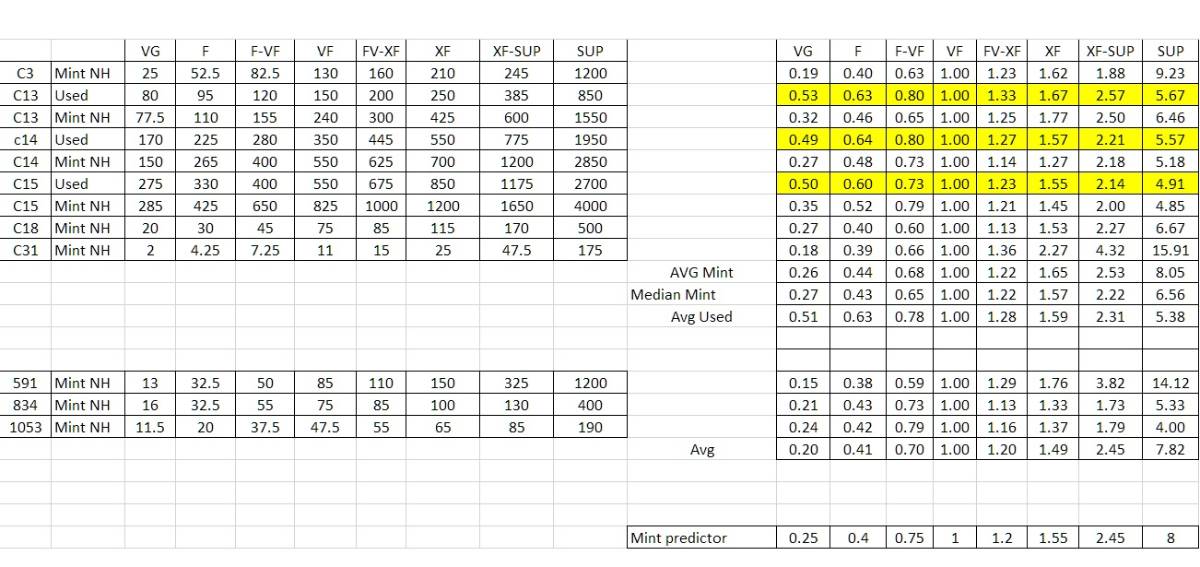 |
|
Send note to Staff
|
Al |
|
|
|
|
Pillar Of The Community
United States
1565 Posts |
|
|
Al: you raise some interesting points. Can't talk long as my day pack and a trail are calling.
First, one has to buy into the grading "craze," which I don't. I'm not willing to pay astronomical prices just because a few self-appointed gurus started the "craze" in the 1990s to jack up selling prices.
A good guide, for me, as to value, rests in the every other month price lists from Dr. Robert Friedman and Sons from suburban Chicago. Most people who have been on these boards for a while will recognize the name as perhaps the largest wholesale collections dealer in the country. His lists appear in Linn's and the American Philatelist.
In the current flyer; received on July 15; Friedman lists some US collections of stamps and plate blocks. One that I'll highlight : "Mint 1851-1940 collection with a catalogue value over $50,000. A very nice, sound, F/VF, mint collection without duplication with each stamp on a dealer sales card. The majority of the value is in stamps that catalog $100 - $800. Why pay more when you can build a classical US collection from us at ONLY $8500." That's less than 20% of Scott.
Another one from 1965 to 2002 is 98% complete never-hinged in three expensive Lighthouse hingeless albums in VF condition. Includes Bugs imperf and Legends error. Face value is $1078. Friedman price is $1,195.
I think the moral of the story is that if one does their research, one can find much better deals than somebody trying to sell at a high percentage of Scott. And I can't see any reason to pay the inflated prices of "graded" stuff.
Hopefully floortrader; the master collections buyer; will also weigh in. |
Send note to Staff 
|
| Edited by Climber Steve - 08/24/2019 5:10 pm |
|
|
Bedrock Of The Community
12704 Posts |
|
|
Valued Member
224 Posts |
|
|
Bedrock Of The Community
12704 Posts |
|
|
Interesting. I received this from SAN this AM.
StampAuctionNetwork
The StampAuctionNetwork 200 and 500
Whether you are concerned with the investment value of your collection or not, it is wise to consider the market as you build a collection. The StampAuctionNetwork 200 and 500 provide accurate historical data to demonstrate which stamps and covers are most likely to be sold as individual lots. They will also provide comparative data as to the market supply and demand for a particular stamp or cover. If you are building a collection by buying every individual stamp separately, when you go to sell it, you will find that the items with market value are offered separately while the rest will be sold as a collection. You can anticipate that situation by buying the better items singly, and picking up the rest from collection lots. This is not only a better strategy, but probably more interesting.
The SAN Top 200 and Top 500 are a measure of the stamps that are most likely to be offered as a single stamp or cover. How we came up with the Rankings. Starting from our $1.5 Billion database of 1.6 million lots going back to 2001, we took the top 2000 items by number of Lots Offered. This selection was done based on the country, catalog number and symbol (Covers, Blocks, Pairs, Mint NH, Mint, unused and used). For each stamp we then ranked them by Supply, Demand, Maximum Price, and Average Price and came up with a general ranking where we weighted each of those criteria equally to come up with a weighted ranking. We did the same for Worldwide but started with 5000 Items and ranked them down to the top 500. You can see the results below. Granted we may have to clean up the database a bit more and we are working on that, but please send me your comments and suggestions after checking out the new feature here. (Once you are take a look, there is a form to submit comments and suggestions.
|
|
Send note to Staff
|
|
|
Rest in Peace
United States
1189 Posts |
|
|
I'm wondering just how long before Amos Publishing jumps on both of these for copyright infringement. It's one thing to use Scott's catalog numbers to identify a stamp being sold, it's another thing entirely to market a database for a profit which uses those catalog numbers. It will be interesting to watch what the reactions are...  |
|
Send note to Staff
|
|
|
Pillar Of The Community
United States
1868 Posts |
|
|
How long? Until hell freezes over. Catalog numbers alone, without use of the trademark Scott, are not subject to copyright protection. There's insufficient creative authorship in the choice of a label like C3a, as opposed to any other label, for a particular stamp, to confer eligibility for copyright protection. If Amos ever litigates that issue, it will lose. |
|
Send note to Staff
|
|
|
Pillar Of The Community
United States
4490 Posts |
|
|
Quote:
If Amos ever litigates that issue, it will lose. No one so far has gone the distance to get a legal decision. They settled as in the Krause case. |
|
Send note to Staff
|
Al |
|
|
Valued Member

United States
466 Posts |
|
|
Quote:
No one so far has gone the distance to get a legal decision. Civil court cases are expensive; 90% of the time a cease and desist letter from a large company's lawyers is all that's needed to stop behavior the company doesn't like, whether they have a legal leg to stand on or not. Facts aren't copyrightable; a classification system might be, if it is deemed sufficiently creative by a judge. That's the rub, though: if it goes to court, the judge gets to make that call, and in order for the copyright to be upheld, Scott's numbering system has to be proven to involve a sufficient amount of creative input. A simple listing of stamp issues in chronological order (for example) would never qualify: that's simply a listing of facts, like a telephone directory, which is never copyrightable. Scott's numbering system is a little more than that, of course -- it often groups sets issued over periods of years together, and it splits air mail and other special-purpose stamps into their own categories. Is that enough? Maybe, but it's far from a slam dunk. Amos Press can claim anything it likes about the licensing of Scott numbers, but I suspect they don't want their numbering system to ever go before a judge, as there's a non-zero probability the judge will just throw their copyright out the window and they lose their most valuable IP overnight. |
|
Send note to Staff
|
|
|
Pillar Of The Community
United Kingdom
8624 Posts |
|
|
Bedrock Of The Community
12704 Posts |
|
| |
Replies: 10 / Views: 2,010 |
|




 Posted 08/24/2019 08:23 am


